How Many Cap Blocks Do You Need for a Wall or Fire Pit?
Count cap blocks by dividing the finished run length by the cap’s installed length, then round up. Add corner, pier, or curve pieces on their own line. If you miss the count, you end up short on a run, with odd cuts and another trip for more material. This guide covers straight walls, corners, piers, and round fire pits.
How many cap blocks do you need?
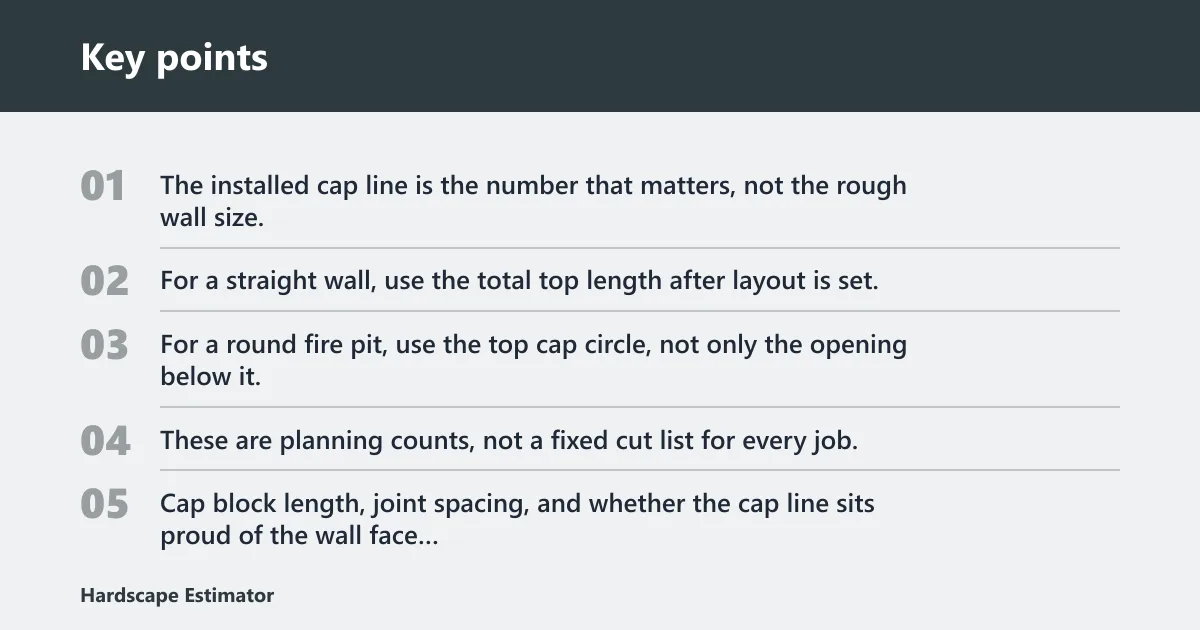
The installed cap line is the number that matters, not the rough wall size. For a straight wall, use the total top length after layout is set. For a round fire pit, use the top cap circle, not only the opening below it. Add waste after the count, not before.
| Layout example | Installed length used for count | Cap count before waste | Separate pieces | Recommended waste allowance |
|---|---|---|---|---|
| 4 ft straight wall | 48 in | 4 caps if using 12 in installed length | None | 5% |
| 8 ft straight wall | 96 in | 8 caps if using 12 in installed length | None | 5% |
| 12 ft straight wall | 144 in | 12 caps if using 12 in installed length | None | 5% |
| 10 ft wall with one outside corner | 120 in | 10 caps if using 12 in installed length | 1 corner piece | 8% |
| 16 ft wall with two corners | 192 in | 16 caps if using 12 in installed length | 2 corner pieces | 8% |
| 4 ft diameter round fire pit | 48 in top cap circle | 13 caps if using 12 in installed length | Cut pieces likely | 10% |
| 5 ft diameter round fire pit | 60 in top cap circle | 16 caps if using 12 in installed length | Cut pieces likely | 10% |
| 6 ft diameter round fire pit | 72 in top cap circle | 19 caps if using 12 in installed length | Cut pieces likely | 10% |
These are planning counts, not a fixed cut list for every job. Cap block length, joint spacing, and whether the cap line sits proud of the wall face all change the final number. If the cap maker gives a module length for your model, start with that figure.
How do I calculate how many cap blocks I need for a wall?
Measure the finished top length of the wall, divide by the cap’s installed length, and round up to the next whole piece. Then add any corners, ends, or piers that need their own cap treatment. If the wall has more than one cap course, multiply the per-course count by the number of rows.
Use the installed length, not the block face alone
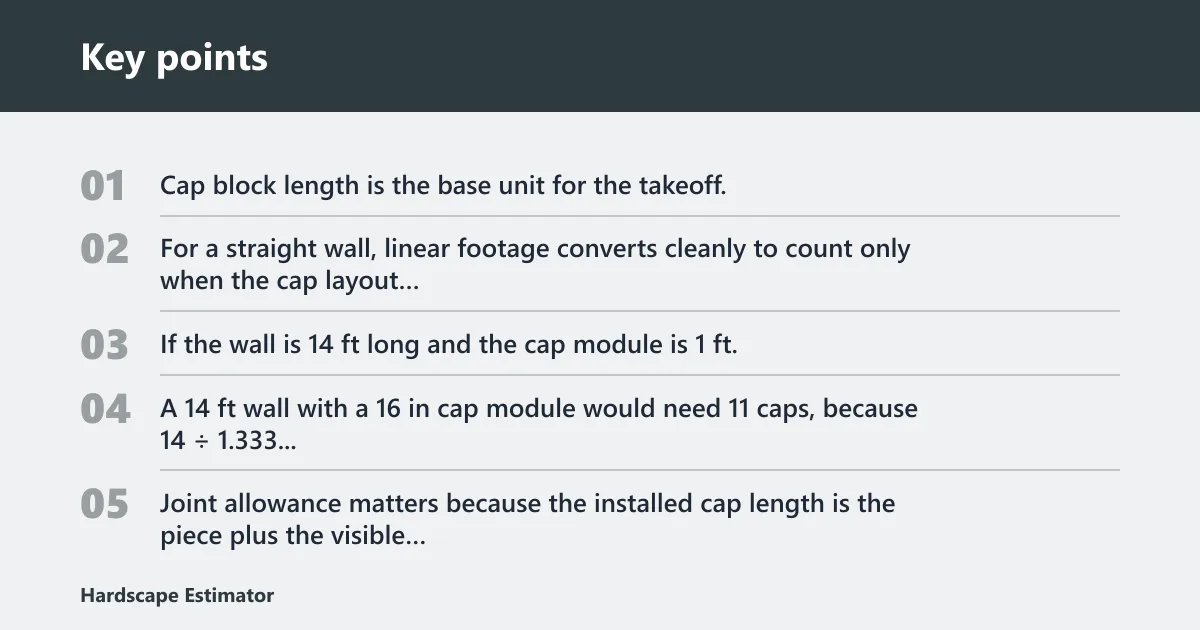
Cap block length is the base unit for the takeoff. For a straight wall, linear footage converts cleanly to count only when the cap layout matches that length. If the wall is 14 ft long and the cap module is 1 ft, the base count is about 14 caps before waste. A 14 ft wall with a 16 in cap module would need 11 caps, because 14 ÷ 1.333… = 10.5, then round up.
That same math works for any straight run. Joint allowance matters because the installed cap length is the piece plus the visible joint pattern, not only the nominal block size on the box.
Multiply by courses when the wall gets more than one cap row
One course equals one row of caps. If a wall gets two stacked cap rows, double the takeoff. A 20 ft wall with one cap row at 12 in installed length needs 20 caps before waste. The same wall with two rows would need about 40 caps before waste.
Cap width and depth do not change the count by themselves, but they do affect fit, overhang, and stability. Check the manufacturer’s listing for your model so the cap projects far enough past the wall face without leaving a weak edge.
How do I count corner caps and end caps?
Count corners and open ends as separate conditions so the same piece is not counted twice. A straight wall formula gives the main run. Corner pieces, half pieces, and end caps get added after that, based on the installed layout and the manufacturer’s corner parts.
Keep 90-degree corners separate from straight runs
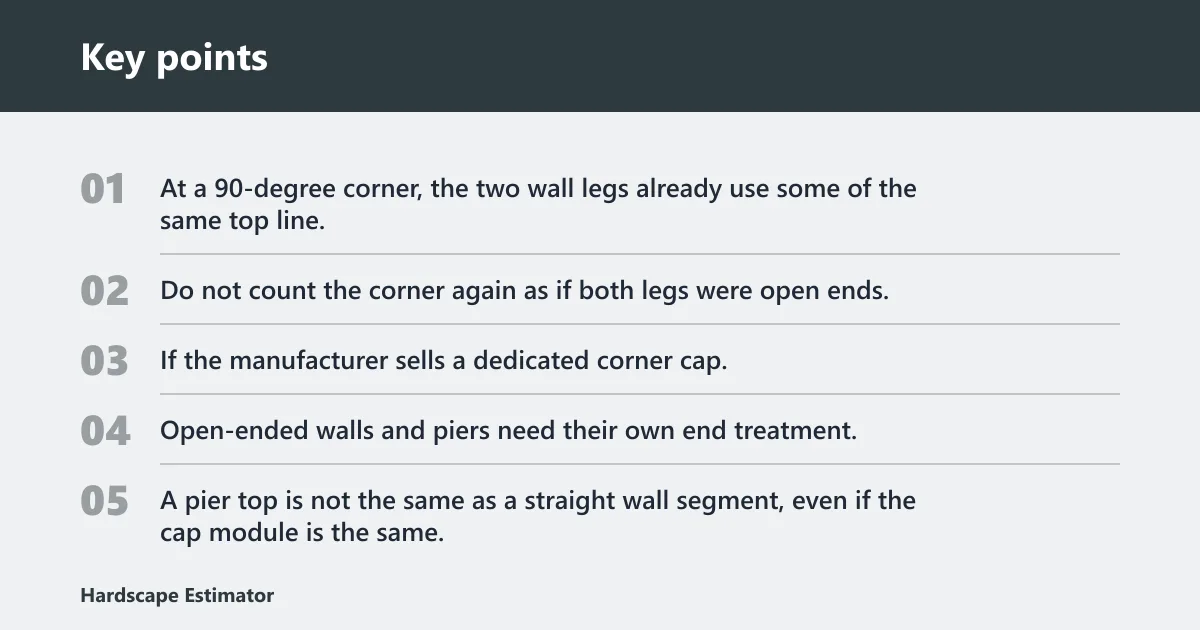
At a 90-degree corner, the two wall legs already use some of the same top line. Do not count the corner again as if both legs were open ends. If the manufacturer sells a dedicated corner cap, treat it as a separate piece and reduce the straight-run count only where the corner piece replaces normal caps.
Open-ended walls and piers need their own end treatment. A pier top is not the same as a straight wall segment, even if the cap module is the same. Handle the pier cap as a standalone item so it does not get buried inside the wall count.
Use manufacturer corner pieces when they are listed
Some systems use special corner caps, pier caps, or half caps. When those are listed for the model, use the manufacturer’s layout rules instead of forcing a full-size cap into every turn. That avoids double-counting and keeps the finished overhang consistent.
Picture a low seat wall with one open end and one return corner. The straight run may call for 12 standard caps, plus 1 corner piece and 1 end cap. If the corner piece replaces one standard cap position, count only the replacement, not both pieces.
How do you count caps for a round fire pit?
Use the top cap course perimeter, not only the inner opening. The installed cap circle is the line that drives the count. Inner diameter is a starting dimension, but if the cap course sits outside that line, the opening alone will undercount the material.
Measure the cap circle that will actually be built
For a round fire pit, calculate circumference from the finished cap circle: circumference = π × diameter. If the cap line is 48 in across, the perimeter is about 150.8 in. With a 12 in installed cap length, that comes to 12.6 caps, so round up to 13 before waste.
That is why a 4-foot diameter pit typically needs about 12-14 blocks per row in the calculator notes, depending on the cap size and layout. Small pits are sensitive to fit because a small change in diameter changes the count by a noticeable amount.
Keep cut pieces and gap management in the plan
Round layouts create shortfall at the last piece, and that is normal. Add extra material for cuts, breakage, and fit corrections. Use a higher waste allowance than a straight wall because the curve leaves more offcut loss.
Suppose the finished cap circle measures 60 in across. The circumference is about 188.5 in. With 12 in caps, the count is 15.7, so order 16 before waste. If the pit also has a fire ring insert, list that as a separate item. It changes the inside layout, but it does not replace the cap count.
What size and course details affect the count?
Cap length sets the count. Cap width and depth affect how the cap sits on the wall, how much overhang you get, and whether the piece matches the wall system. Course count matters too: one row of caps uses one set of pieces, while a taller wall with stacked cap bands uses more.
Cap length versus module length
Use the listed module length when the product data gives one. If it only gives nominal size, check the manufacturer’s listing for your model and compare that to the installed length on the plan. A nominal 12 in cap may not cover exactly 12 in once joints are set.
That is why the takeoff should start with the finished run length, not the carton label alone. The label may help with packing, but the layout controls the count.
Single course versus multiple cap rows
A single course is the simplest case. Add more rows only when the design calls for them. If a wall uses two cap rows for a wider top, count the whole top twice. The same rule applies to a broad fire pit top band if the cap course is doubled.
Do not mix cap takeoff with block-body quantity. The field blocks below the cap are a separate material count.
Do you need waste and extra ordering allowance?
Yes. Waste matters for cap blocks because cuts, chips, and layout changes are more common at the top course than on straight body runs. Use a smaller allowance on straight walls, a larger one on corners, and the largest allowance on curved layouts and fire pits.
Use higher waste on curves and corners
For planning, a 5% allowance is a reasonable starting point for straight walls, 8% for walls with corners or many end conditions, and 10% for round layouts. If the cap circle is small, lean toward the higher end because a single bad cut can remove a large share of one piece.
Round up to full units. If the count lands at 10.2 caps, order 11. If it lands at 15.7, order 16. If the supplier sells pallets only, round to the next pallet count after the piece total is set. That avoids short shipments and partial-order gaps.
Keep fire ring inserts separate from cap quantity
The fire ring insert is an optional line item in the material list. It can affect the inside diameter and the layout, but it should not be folded into the cap count. List it separately so the cap takeoff stays clean and the insert does not hide a missing cap piece.
Most layout questions come back to one rule: count the installed cap line, then add the special pieces the shape calls for. That keeps straight runs, corners, and round fire pits on separate lines of the estimate where they belong.
Frequently asked questions
How many cap blocks do I need for a round fire pit?
Use the circumference of the finished top cap circle, not only the inner opening. Divide that perimeter by the cap’s installed length and round up. Then add waste for cuts and fit loss. Small-diameter pits usually need a higher allowance than straight walls.
How many cap blocks do I need per linear foot?
It depends on the cap’s installed length. With a 12 in installed length, you need 1 cap per linear foot before waste. If the cap module is longer or shorter, the count changes. Use the product’s actual installed length, not only the nominal size on the package.
Do I need waste when ordering cap blocks?
Yes. Waste helps cover cuts, breakage, and layout changes. A straight wall may only need a small allowance, while corners and curves need more. A round fire pit usually deserves the highest allowance because the last pieces often need trimming to fit the circle cleanly.
How do I figure cap blocks for corners and curves?
Count the straight runs first, then add the corner or curve pieces separately so you do not double-count any shared length. Use manufacturer corner pieces when they are listed. Curves and tight turns usually need more waste because the fit changes at each cut.
Should I include cap stones in my fire pit material count?
Yes. Cap stones or cap blocks belong in the fire pit material count because they finish the top course. Keep them separate from the fire ring insert, which is optional and changes the inside layout rather than the cap count itself.