Sod Pallets: Cost, Coverage, Weight, and Buying Guide
A sod pallet often covers roughly 400 to 500 sq ft, weighs about 3,000 to 4,000 lb, and often lands around $200 to $650 delivered, so compare quotes by price per sq ft and confirm truck and unloading limits before ordering. Miss the coverage, weight, or delivery details and a low pallet price can turn into extra pallets, wasted turf, or a truck that cannot reach the site. This guide covers typical pallet coverage, price per square foot, how grass variety changes quoting, delivery and unloading charges, and the math to estimate the right order.
What a sod pallet really means
A sod pallet is a shipping unit, not a universal standard. One pallet of sod covers 400 to 500 square feet, and 450 square feet is the most common U.S. pallet size. That makes 450 sq ft a solid planning figure, but only until the supplier confirms the actual coverage for that grass and cut format.
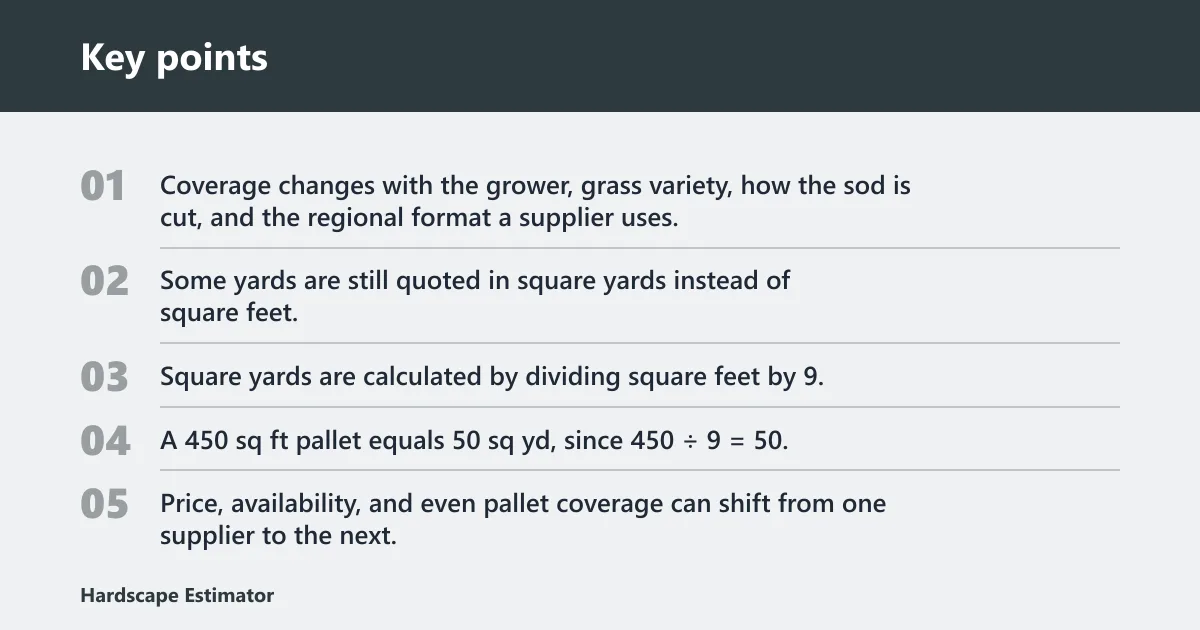
Coverage changes with the grower, grass variety, how the sod is cut, and the regional format a supplier uses. A quote for 450 sq ft per pallet is not directly comparable with a quote for 400 sq ft per pallet unless both are converted to cost per covered square foot.
Some yards are still quoted in square yards instead of square feet. Square yards are calculated by dividing square feet by 9. A 450 sq ft pallet equals 50 sq yd, since 450 ÷ 9 = 50.
Why the shipping-unit point matters
If one supplier quotes $250 for a 400 sq ft pallet and another quotes $270 for a 500 sq ft pallet, the second quote is cheaper on a coverage basis even though the pallet price is higher. That is why pallet price alone is incomplete.
The grass variety matters too. Price, availability, and even pallet coverage can shift from one supplier to the next. A dense warm-season grass may be quoted on a different pallet coverage than a cool-season blend from another yard.
How much does a pallet of sod cost?
Material-only sod typically costs $110–$450 per pallet, and observed regional supplier listings in the review ranged from $175–$390 per pallet. For buying decisions, the useful number is cost per covered square foot after delivery and other fees, because identical pallet prices can hide very different coverage and total job cost.
Convert every quote to cost per sq ft
Use this formula:
Cost per sq ft = total quote ÷ pallet coverage
Run the material-only number first, then the delivered number. If tax, pallet deposits, or unloading charges are separate, those change the real delivered rate too.
| Quote | Coverage per pallet | Material price | Delivery | Total delivered | Material-only cost per sq ft | Delivered cost per sq ft |
|---|---|---|---|---|---|---|
| Supplier A | 400 sq ft | $220 | $95 | $315 | $220 ÷ 400 = $0.55 | $315 ÷ 400 = $0.79 |
| Supplier B | 450 sq ft | $260 | $75 | $335 | $260 ÷ 450 = $0.58 | $335 ÷ 450 = $0.74 |
| Supplier C | 500 sq ft | $300 | $60 | $360 | $300 ÷ 500 = $0.60 | $360 ÷ 500 = $0.72 |
On pallet price alone, Supplier A looks cheapest. On delivered cost per sq ft, Supplier C is cheapest. For most buyers, that delivered per-square-foot number is the one that tells you which quote is actually lower.
What a complete sod quote can include
A pallet quote can include material, delivery, site prep, soil amendment, installation labor, and rolling or starter feed. Tax and deposits may also be separate. If those items are mixed together in one quote, ask for the line-item breakdown before comparing suppliers.
A common first-timer mistake is comparing a $240 pallet quote against a $320 quote without noticing that the first is material only and the second includes delivery, unloading to the driveway, starter feed, and rolling. The second quote can be cheaper once the same services are added to both totals.
How many square feet does a pallet of sod cover?
One pallet of sod covers 400 to 500 square feet, with 450 square feet as the most common planning size in the U.S. That range is normal, not an error, because growers package different grass types and cut formats differently. Always confirm the supplier’s stated pallet coverage before doing final math.
How coverage changes by supplier format
Coverage varies by grower, grass type, and roll or slab dimensions. The same yard area may take one pallet from a supplier selling 500 sq ft pallets or two pallets from a supplier using 400 sq ft pallets once waste is added and the order is rounded up.
How many pieces are on a pallet of sod?
Small rolls or slabs commonly cover about 5 to 10 sq ft each. A standard pallet can hold about 90 pieces if each piece covers 5 square feet. The same 450-square-foot pallet can hold about 45 pieces if each piece covers 10 square feet.
Piece count matters for labor, handling, and waste. More small pieces are easier to carry through a gate, but they mean more seams and more places to trim around curves.
| Pallet coverage | 5 sq ft pieces | 10 sq ft pieces | Square yards |
|---|---|---|---|
| 400 sq ft | 80 pieces | 40 pieces | 400 ÷ 9 = 44.4 sq yd |
| 450 sq ft | About 90 pieces | About 45 pieces | 450 ÷ 9 = 50 sq yd |
| 500 sq ft | 100 pieces | 50 pieces | 500 ÷ 9 = 55.6 sq yd |
Picture a 420 sq ft repair area behind a narrow side gate. Two suppliers quote the same grass. One offers 10 sq ft rolls, the other 5 sq ft slabs. The smaller pieces may be slower to lay, but they can cut down awkward trimming and make hand-carrying easier if machine access stops at the driveway.
How much does a pallet of sod weigh?
Sod pallets usually weigh between one and a half and two tons, so a full pallet is far beyond hand-moving range and often too heavy for a pickup’s payload. Weight also changes with moisture, harvest timing, and grass density, which is why unloading access matters before the order is placed.
Why weight changes
A freshly harvested pallet can weigh more if the field was irrigated. Wet sod is heavier, and recently cut sod can hold a lot of water. That helps turf condition, but it pushes transport limits fast.
For practical planning, treat every full pallet as machine-handling material. Individual pieces can be carried by hand. The whole pallet cannot.
What that means for pickup trucks and trailers
Most pickups cannot safely carry 3,000 to 4,000 lb in the bed once passengers, tools, and the pallet itself are counted. A suitable trailer may handle the load better, but that still leaves loading, tie-downs, and unloading at the site. For many homeowners, supplier delivery is the realistic option for full pallets.
Say your supplier offers a 450 sq ft pallet at a good price, but the site has a steep driveway and soft shoulder. If the delivery truck cannot place the pallet on a flat, firm area, the crew may leave it at the curb or street, which adds hand-carry time and can make freshness a bigger problem.
How do you figure out how many pallets you need?
Measure the yard in square feet, add waste, divide by the supplier’s stated pallet coverage, and round up to whole pallets. Use a 5 percent waste factor for a simple yard and a 10 percent waste factor for a complex yard with curves and tree rings.
Order math
- Measure the area. Add the lawn sections in square feet. Rectangles are length × width. Break irregular spaces into smaller rectangles and circles, then total them.
- Add waste. Multiply by 1.05 for a simple yard or 1.10 for a complex yard. The extra accounts for trimming, fit losses, and damaged edges.
- Divide by coverage. Use the supplier’s exact pallet coverage, not a generic number from another yard. Divide the waste-adjusted area by that coverage.
- Round up. Order whole pallets, or ask whether the supplier sells partial quantities or loose rolls. Rounding down is how buyers run short in the last row.
Worked examples
Simple yard, 5 percent waste: 1,200 sq ft × 1.05 = 1,260 sq ft. If the supplier’s pallet covers 450 sq ft, then 1,260 ÷ 450 = 2.8 pallets. Round up to 3 pallets.
Complex yard, 10 percent waste: 1,200 sq ft × 1.10 = 1,320 sq ft. If the supplier’s pallet covers 450 sq ft, then 1,320 ÷ 450 = 2.93 pallets. Round up to 3 pallets.
Same yard, smaller pallet format: 1,320 sq ft ÷ 400 sq ft per pallet = 3.3 pallets. Round up to 4 pallets. That single coverage change can raise the order by one pallet.
Suppose a 980 sq ft front yard has a straight sidewalk edge and little trimming. At 5 percent waste, 980 × 1.05 = 1,029 sq ft. A 500 sq ft pallet means 1,029 ÷ 500 = 2.06, so the order rounds up to 3 pallets. With a 400 sq ft pallet, it becomes 2.57, still 3 pallets, but with less leftover risk on the larger pallet format.
When should you buy a pallet instead of loose rolls?
Buy a full pallet when the area is large enough to use most of it the same day and when delivery can place the load close to the install site. For small repairs or awkward leftover amounts, loose rolls or partial quantities can reduce waste and avoid paying for unused coverage.
Where full pallets make sense
Larger areas usually favor pallets because handling and delivery are simpler on a per-square-foot basis. A single drop near the work area can be more efficient than multiple small-quantity pickups.
Where loose rolls make sense
Small jobs can be different. If a repair is 140 sq ft, a full 450 sq ft pallet leaves too much unused material unless the supplier will split quantities. Since a pallet of sod does not keep well after harvest, extra pieces can turn into wasted money fast.
Ask how partial pricing works. Some yards sell by the piece, by the square yard, or with a minimum order. Convert each option back to cost per sq ft before deciding.
Delivery, unloading, and access limits
Delivery is more than a truck charge. It is a site-access decision. A full pallet usually needs forklift or similar unloading access, plus a flat, firm drop area. Driveway or street placement may be required if soft turf, steep grades, or narrow gates block closer access.
Access checks before delivery day
Confirm where the truck can legally and safely place the pallet. Soft lawns can rut. Steep driveways can limit pallet-jack use. Narrow gates can stop access to the backyard even if the truck reaches the property.
- Ask whether the truck uses a forklift, truck-mounted Moffett, pallet jack, or tailgate method.
- Confirm the required width, turning room, and overhead clearance.
- Identify one flat, firm drop zone on gravel, pavement, or compacted ground.
- Ask whether curb or street drop adds fees or city restrictions.
- Confirm what happens if the driver arrives and site access is not workable.
Freshness, timing, and delayed installs
Sod should be installed quickly after delivery because a pallet of sod does not keep well after harvest. Stacked sod can start yellowing within about 24 hours in summer, and heat builds inside the stack. Ordering for installation day is the safest approach.
Why delays become expensive
Stacked sod holds moisture and heat. In hot weather, those conditions speed decline. Color loss can start quickly, and root health can fall before the turf ever touches soil.
What to do if timing slips
- Call the supplier early. If grading, irrigation, or soil prep is behind, ask to move delivery before the truck is dispatched. That is better than receiving fresh-cut sod with nowhere ready to lay it.
- Install the same day. Prioritize shaded or hottest exposures first if conditions are severe. The goal is to get pieces unstacked and on prepared soil as fast as practical.
- Stage pieces loosely. If the whole order cannot be laid at once, separate small groups instead of keeping the pallet tightly stacked. That reduces heat buildup while crews continue working.
- Reject bad timing assumptions. Do not plan to leave sod on the pallet overnight in summer. If delivery misses the install window, ask the supplier about the freshest replacement option rather than assuming the stack will wait well.
Sod order worksheet
Sod pallets table
| Supplier | Grass variety | Coverage per pallet | Material-only price | Material-only cost per sq ft | Delivery | Total delivered | Delivered cost per sq ft |
|---|---|---|---|---|---|---|---|
| A | Tall fescue blend | 400 sq ft | $240 | $240 ÷ 400 = $0.60 | $90 | $330 | $330 ÷ 400 = $0.83 |
| B | Tall fescue blend | 450 sq ft | $275 | $275 ÷ 450 = $0.61 | $70 | $345 | $345 ÷ 450 = $0.77 |
| C | Tall fescue blend | 500 sq ft | $320 | $320 ÷ 500 = $0.64 | $55 | $375 | $375 ÷ 500 = $0.75 |
Pallet count table
| Measured area | 5% waste | 10% waste | Pallet coverage | Pallets at 5% | Pallets at 10% |
|---|---|---|---|---|---|
| 900 sq ft | 945 sq ft | 990 sq ft | 450 sq ft | 945 ÷ 450 = 2.1 → 3 | 990 ÷ 450 = 2.2 → 3 |
| 1,200 sq ft | 1,260 sq ft | 1,320 sq ft | 450 sq ft | 1,260 ÷ 450 = 2.8 → 3 | 1,320 ÷ 450 = 2.93 → 3 |
| 1,600 sq ft | 1,680 sq ft | 1,760 sq ft | 400 sq ft | 1,680 ÷ 400 = 4.2 → 5 | 1,760 ÷ 400 = 4.4 → 5 |
Weight and access checklist
| Checkpoint | What to confirm |
|---|---|
| Pallet weight | Assume 1.5 to 2 tons per pallet and more if recently irrigated. |
| Pickup capacity | Check payload label before planning self-haul. A full pallet is often too heavy for a pickup bed. |
| Trailer plan | Confirm trailer rating, tie-down points, and how the pallet will be loaded and unloaded. |
| Drop area | Provide a flat, firm spot on pavement, gravel, or compacted ground. |
| Driveway grade | Ask whether a steep driveway affects unloading. |
| Gate width | Measure narrow side-yard gates if pieces must be hand-carried to the backyard. |
| Street placement | Ask whether curb or street drop is allowed and whether extra fees apply. |
| Install timing | Schedule delivery for the day the sod will be laid. |
Supplier quote template
| Question | Why it matters |
|---|---|
| What is the exact coverage per pallet for this grass? | Cost per sq ft depends on actual coverage, not the pallet count alone. |
| What grass variety is this, and is it in stock for my date? | Variety affects price, availability, and sometimes pallet format. |
| Are pieces about 5 sq ft or 10 sq ft? | Piece size changes handling, seams, and trimming waste. |
| What does the quoted price include? | Material, delivery, site prep, soil amendment, installation labor, rolling, and starter feed should be separated. |
| Are tax, pallet deposits, or unloading charges extra? | These items change the true delivered cost per sq ft. |
| How fresh will the sod be on delivery day? | Freshness affects install window and decline risk in hot weather. |
| What unloading method will be used? | Forklift access and drop-zone requirements vary by truck. |
| Where can the driver place the pallet? | Driveway, curb, and backyard access rules affect labor and freshness. |
| Do you sell partial quantities or loose rolls? | Small jobs may be cheaper without a full-pallet leftover. |
| What is the cancellation or reschedule policy? | Prep delays are common, and missed timing can ruin fresh sod. |
Frequently asked questions
Can I move a pallet of sod by hand or with a pickup truck?
A full pallet cannot be moved by hand, and many pickups cannot safely carry one because sod pallets usually weigh between one and a half and two tons. Individual pieces can be hand-carried, but full pallets usually need delivery, machine unloading, or a properly rated trailer and loading plan.
How long can sod sit on a pallet before it goes bad?
A pallet of sod does not keep well after harvest, especially in heat. Stacked sod can start yellowing within about 24 hours in summer, so same-day installation is the safest plan. If prep is delayed, rescheduling delivery is better than letting fresh sod sit stacked.
What affects sod pallet price besides the grass itself?
Beyond the grass variety, price changes with pallet coverage, delivery, tax, deposits, unloading limits, site prep, soil amendment, installation labor, and rolling or starter feed. That is why two pallet quotes with similar top-line prices can have very different delivered cost per covered square foot.
Should I buy a pallet of sod or loose rolls?
Buy a pallet when the area is large enough to use most of it right away and when delivery can place it close to the install area. For small patches or awkward leftover amounts, loose rolls or partial quantities can cost less overall and leave less unused sod.
What should I ask the supplier before I order sod?
Ask for exact pallet coverage, grass variety, piece size, total delivered price, what fees are extra, the unloading method, where the pallet can be placed, whether partial quantities are available, and how fresh the sod will be. Those questions force direct quote comparisons on the same coverage and service basis.