How to Unload and Move Sod by Hand Without Damage
Unload sod by hand one piece at a time. Keep the pallet shaded, and move each strip within 10 to 15 minutes so the roots stay moist and the pieces do not split. If sod sits too long or is carried badly, the edges dry out, the slabs tear, and you lose usable turf. This guide covers a safe unloading sequence, hand-carry methods, staging on the ground, and the order to lay the pieces.
What to know before you start
A sod pallet usually covers 400 to 500 square feet, and 450 square feet is the most common pallet size in the United States. A standard pallet weighs well over a ton, and some weigh between one and a half and two tons. That is why the pallet itself should stay on firm, level ground and the sod should be moved piece by piece.
Moisture changes both weight and handling speed. A standard roll of sod weighs about 30 to 50 pounds, a hand-cut slab is about 15 to 25 pounds, and a rain-soaked pallet can reach up to 4,000 pounds. Heat also builds in stacked sod, so yellowing can begin within roughly 24 hours if the material sits too long.
What you’ll need
- Work gloves with a gripping surface
- Utility knife
- Shovel or edger
- Wheelbarrow for very small sections
- Tarp or shade cover for the pallet
- Flat staging area near the work zone
- Water source for quick misting if needed
- Clear path from driveway to yard
How do you unload sod by hand?
Open the pallet on the side facing the work area. Pull only the top layer you can carry without twisting, then set each piece where it will be installed or staged. Keep the rest covered so the stack does not heat up or dry out while you work.
- Park the pallet close. Place it on flat, firm ground as close to the install area as access allows. Driveways, patios, and compacted gravel work well, and an all-terrain forklift should also set the pallet on a firm, level surface.
- Expose the top edge. Cut or peel back the wrapping only enough to reach the first roll or slab. Keep the rest covered so sun and wind do not dry the stack.
- Remove one piece. Lift the top piece straight up with two hands, or split a larger section into smaller pieces before you move it. Do not drag the full width across the stack, because that tears corners.
- Carry it flat. Keep the grass side up and the root side down. If the piece bends, fold it only enough to control the weight, then set it down soon after you move it.
- Stage it in order. Lay pieces where they will be installed, not in a tall pile. If you must stack briefly, keep the stack low and return to it within 10 to 15 minutes.
Say your pallet holds 10 sq ft rolls and the first roll feels damp and heavy. Carry one roll, set it down, then return for the next rather than taking two at once. The extra trip is slower, but it lowers the chance of tearing the edges or straining your back.
How should you carry each sod piece?
The carry method changes with size and moisture. Small hand-cut slabs fit one-person lifts, full rolls move best with two hands, and sod that has warmed in the stack should be cut smaller because it bends and splits more easily. Use the piece in front of you, not a fixed rule for every roll.
Small hand-cut slabs
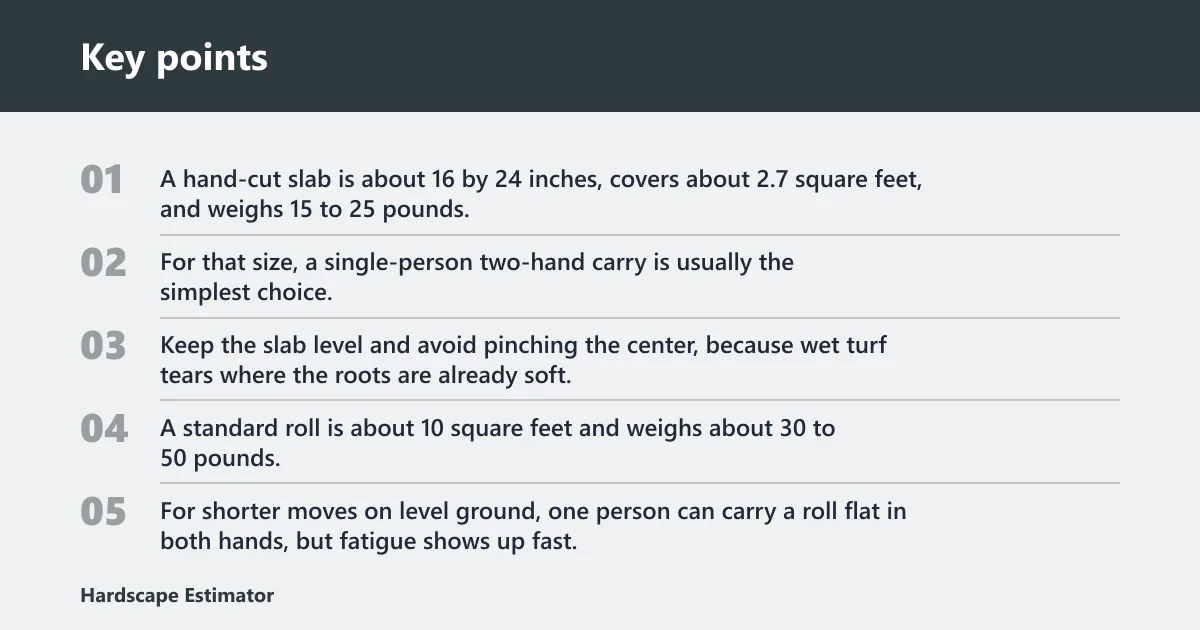
A hand-cut slab is about 16 by 24 inches, covers about 2.7 square feet, and weighs 15 to 25 pounds. For that size, a single-person two-hand carry is usually the simplest choice. Keep the slab level and avoid pinching the center, because wet turf tears where the roots are already soft.
Full rolls and partial rolls
A standard roll is about 10 square feet and weighs about 30 to 50 pounds. That is the point where a two-person lift becomes the safer option if the piece feels limp, warm, or awkward to grip. For shorter moves on level ground, one person can carry a roll flat in both hands, but fatigue shows up fast.
For partially warmed sod, fold the roll only enough to shorten the span, then carry it immediately. If the piece sags or the seam opens, split it in half with a utility knife and move the halves separately.
When to use a wheelbarrow
A wheelbarrow is useful for very small sections, short runs, or awkward scraps that would otherwise get dragged. It is not the best choice for a full roll or a large slab, because repeated loading and unloading can crush the edges. Use it as a short shuttle, not as the main carry method.
How many sod pieces can one person move safely at a time?
For most homeowners, one piece at a time is the safe answer. A single person can usually move one hand-cut slab or one standard roll before fatigue starts to affect grip and balance. Once the pieces get warm, wet, or torn, the safe cadence drops further and the pace should slow down.
A practical limit is one full roll per trip, then a short pause to reset the path and check the next piece. If the piece weighs toward the high end of the range or the path includes steps or a slope, switch to smaller cuts or a two-person lift. More pieces at once usually means more tearing.
How do you plan the route to the yard?
Plan the route before you open the first bundle. A straight path matters more than a fast one if the route includes a tight gate, a step, or a steep turn. Aim for a clear line from driveway to yard, with the staging point close enough that each piece reaches the install area quickly.
Driveway and staging setup
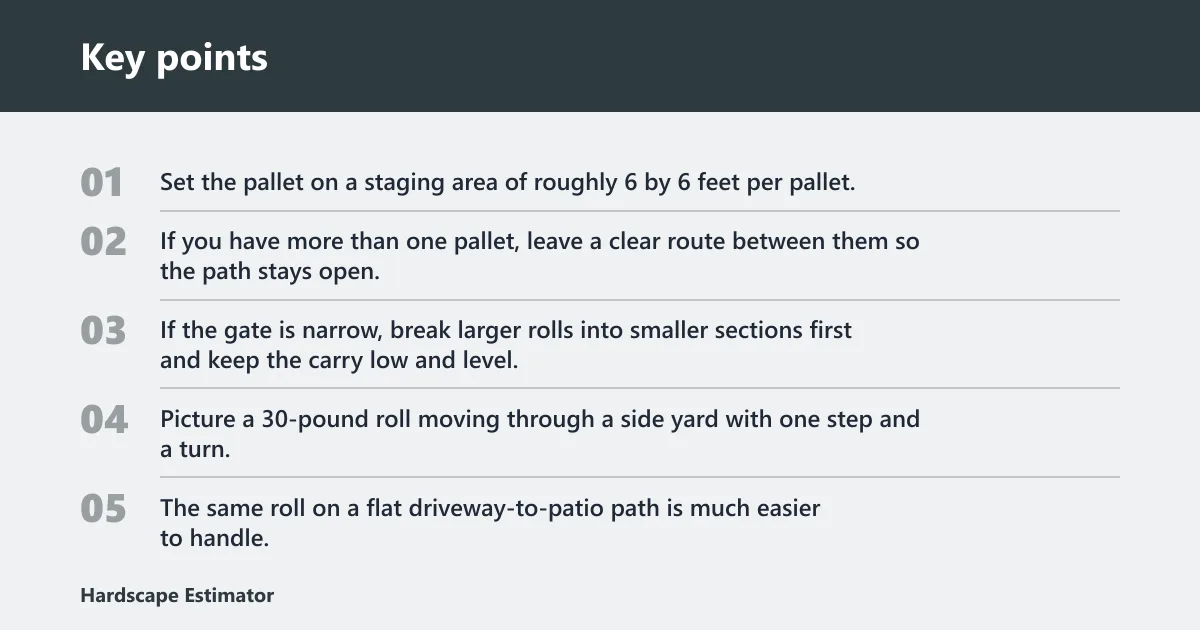
Set the pallet on a staging area of roughly 6 by 6 feet per pallet. That space should be flat, firm, and accessible, with enough room to turn and set down pieces without stepping on the grass. If you have more than one pallet, leave a clear route between them so the path stays open.
Gates, steps, and slopes
Measure any gate opening before delivery. If the gate is narrow, break larger rolls into smaller sections first and keep the carry low and level. Steps and slopes should trigger smaller loads or a second person, because a rolling foot or shifting piece can tear the sod and strain the carrier.
Picture a 30-pound roll moving through a side yard with one step and a turn. That route is manageable only if the roll is cut down or supported by two people. The same roll on a flat driveway-to-patio path is much easier to handle.
Shade and freshness timing
Keep the pallet in shade when possible, especially in hot weather. Install sod quickly after delivery because heat builds in stacked sod and yellowing can begin within about 24 hours. If the yard is hot and the path is long, move fewer pieces at once and keep the rest covered.
Sod hand-unloading checklist
| Sod piece size/weight | Recommended carry method | Max stack time |
|---|---|---|
| 10 sq ft roll, about 30 to 50 lb | One-person flat carry for short, clear paths; two-person lift if warm or awkward | 10 to 15 minutes |
| Hand-cut slab, about 2.7 sq ft and 15 to 25 lb | One-person two-hand carry | 15 minutes |
| Partially warmed sod | Cut smaller with a utility knife; carry immediately or use a two-person lift | 5 to 10 minutes |
- Check access first. Walk the driveway-to-yard route and note gates, steps, slopes, and tight turns before you touch the pallet.
- Stage the pallet. Put it on a firm, level area about 6 by 6 feet and keep it shaded if possible.
- Open one side. Remove only enough wrapping to reach the top pieces.
- Move one piece. Lift a single roll or slab, keep it flat, and carry it to the install area right away.
- Cut oversized pieces. Use a utility knife, shovel, or edger to split larger sections before the carry if the path is narrow or the piece feels too heavy.
- Recheck the stack. Return to the pallet within 10 to 15 minutes, then move the next piece.
Common mistakes
One common mistake is leaving the pallet fully exposed while the first few pieces are moved. That dries the top layer and makes the edges curl, so keep the unused section covered. Another is stacking several pieces on the ground for later; stacked sod heats up, and the lower pieces can yellow or crush.
Another failure point is trying to carry a wet 10 sq ft roll through a narrow path in one trip. If the route includes a gate or step, cut the piece smaller first. A common first-timer mistake is using a wheelbarrow for every piece, which slows the move and can bruise the turf edge.
If that did not work, reduce the piece size with a utility knife, then test the route again. If the load still feels unstable, split the trip into two-person carries instead of forcing a single-person carry.
Frequently asked questions
How do you unload sod from a pallet by hand without damaging it?
Remove one piece at a time, keep the stack shaded, and carry each piece flat. Do not drag a roll across the top layer or bend it sharply for long. The safest sequence is to open, lift, carry, and lay it down within about 10 to 15 minutes.
What is the easiest way to carry sod from the pallet to the backyard?
The easiest method is a straight, clear route from a driveway-staged pallet to the yard, with one person carrying one piece at a time. If the path is short and level, a full roll can stay flat in both hands. If the route is tight, cut the piece smaller first.
What tools do I need to move sod by hand from the pallet to the yard?
Use gloves, a utility knife, a shovel or edger, and a tarp or shade cover. A wheelbarrow helps with very small sections, but it should not be the main plan for full rolls. A flat staging area matters as much as the tools.
How heavy is a piece of sod from a pallet?
A standard roll weighs about 30 to 50 pounds. A hand-cut slab is about 15 to 25 pounds, and wet or rain-soaked sod weighs more. If the piece feels heavy enough to change your stance, cut it smaller before you carry it.
How long can sod sit before it gets too hot to handle?
Move it quickly. Heat builds in stacked sod, and yellowing can begin within about 24 hours. For unloading, a practical target is 10 to 15 minutes per piece before you return to the stack or lay the piece in place.