Pallet of Sod vs Sod Rolls: Which Should You Buy?
Buy sod rolls for small patches and palletized sod for full-yard installs. Base the choice on your square footage plus 5% to 10% waste, then compare the actual package coverage and delivery cost. The wrong package leaves you short, adds extra trips, or leaves expensive leftovers that can dry out before use. This guide compares coverage, handling, delivery, and cost so you can estimate the right amount before ordering.
| Decision factor | Pallet of sod | sod rolls | Winner |
|---|---|---|---|
| Coverage per package | Usually the better fit once the order is large enough to use most of a pallet; coverage commonly lands in the several-hundred-square-foot range and varies by grower, species, and pallet format. | Best for smaller orders where you only need a few pieces and want the order to match the area closely; a common roll may cover about 10 sq ft, though some suppliers use different sizes. | Pallet of sod for larger jobs; sod rolls for small jobs |
| Handling and unloading | Often needs equipment or help because the pallet is heavy and bulky, especially when truck access is tight or the drop point is far from the work area. | Can usually be moved by hand in smaller sections and carried through narrow paths more easily. | sod rolls |
| Waste risk on small jobs | Higher if the order is bigger than the area you can install the same day. | Lower because the order can match patch size more closely. | sod rolls |
| Likely cost efficiency | Usually better per square foot on full installs and larger lawns. | Often less efficient per square foot once small-order pricing and delivery are included. | Pallet of sod |
| Access difficulty | Best when the driveway, gate, and drop point can handle a heavy delivery and short carry distance. | Best when access is narrow, the path is awkward, or unloading equipment is limited. | sod rolls |
| Waste risk | Higher on a small or slow install because leftover sod can dry out before it is used. | Lower because the order is easier to match to the job size. | sod rolls |
What is the difference between a pallet of sod and sod rolls?
A pallet of sod is a bulk shipment stacked for larger installs, while sod rolls are smaller sections that are easier to lift, carry, and place by hand. The package size changes the job more than the grass itself. A pallet usually lowers the per-square-foot price on big areas, while rolls reduce handling trouble on small ones.
What the package usually includes
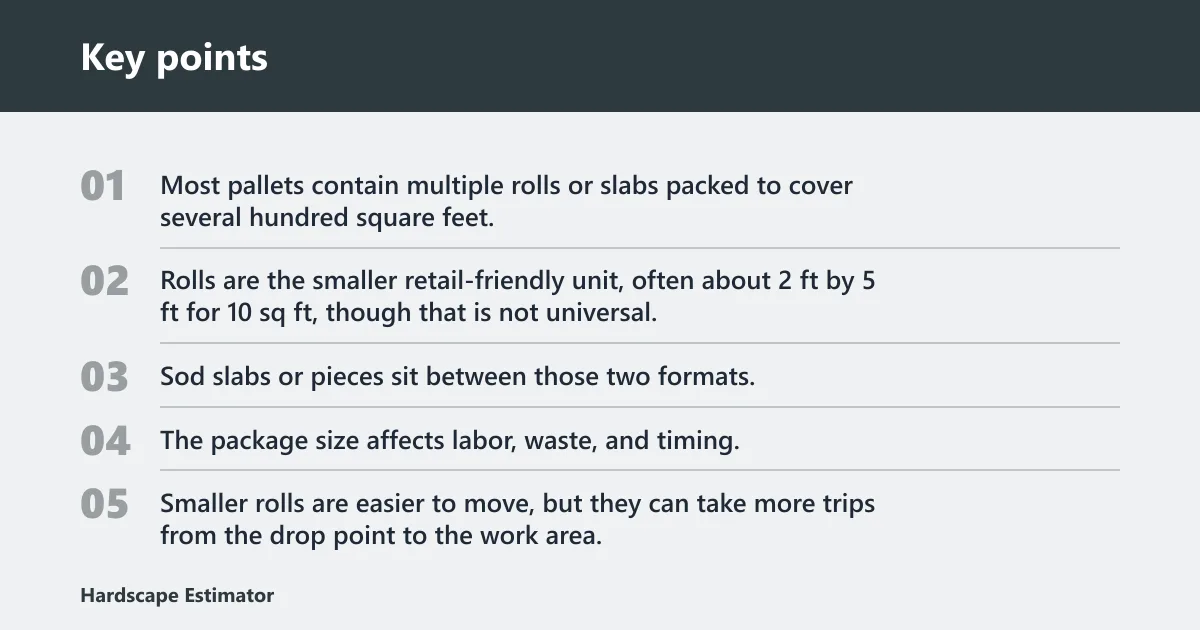
Most pallets contain multiple rolls or slabs packed to cover several hundred square feet. A pallet of sod is often sold in the roughly 400 to 500 sq ft range, though size can vary by supplier, region, and grass type. Rolls are the smaller retail-friendly unit, often about 2 ft by 5 ft for 10 sq ft, though that is not universal.
Sod slabs or pieces sit between those two formats. They are smaller cut sections that may be bundled into rolls or stacked on a pallet, which can speed placement when the yard has curves, narrow runs, or lots of trimming around beds.
Why packaging changes the job
The package size affects labor, waste, and timing. Bigger packages mean fewer joints and often better price efficiency, but they also create heavier deliveries and more pressure to install quickly before the sod dries out. Smaller rolls are easier to move, but they can take more trips from the drop point to the work area.
Is buying sod by the pallet cheaper than buying rolls?
Usually yes on larger jobs, but not always after delivery and waste are counted. A pallet often has the lower base price per square foot, while rolls can cost more per square foot once small-order packaging, extra trips, and patch-level pricing are included. The better buy is the one that matches the actual area you will lay.
Here is the simple check: if the yard needs enough sod to fill most of a pallet, the pallet often wins on price. If the job is small enough that only a few rolls are needed, rolls can avoid paying for unused square feet that may spoil.
Cost changes when waste changes
Cost per square foot is not just the label price. A common 10% waste factor on a 360 sq ft patch means ordering about 396 sq ft, which may move the order from a small roll purchase into a larger package. Once you round up to a full pallet, the cost can still be better than multiple partial orders if the project is near pallet size.
How much sod do you need?
Measure the lawn in square feet, then add 5% to 10% for trimming, slope, border cuts, and broken pieces. If the yard is square or rectangular, multiply length by width. If it has curves or inset corners, break it into sections and total the areas before adding waste.
Round up when the result lands between package sizes. Sod is sold in fixed units, so an order of 430 sq ft may still require a 500 sq ft pallet if that is the next available size from the supplier.
-
Measure each section.
Record length and width in feet for each rectangle, triangle, or curved section you can split into simple shapes. Total the square footage first, because package choice starts with the true area, not the visible lawn outline.
-
Add waste allowance.
Use 5% for simple layouts and 10% for irregular borders, slopes, or lots of cut-ins around trees, walks, and patios. More cuts mean more trim loss, and steep grades can increase breakage during handling.
-
Round to package size.
Compare the adjusted total to the supplier’s pallet or roll coverage. If the order lands between sizes, round up to the next package so the install does not stop short.
Say your front yard measures 320 sq ft. Add 10% waste for curved edging and a walkway cut: 320 × 1.10 = 352 sq ft. If the supplier’s pallet covers 400 sq ft, a pallet is the clean buy; if the supplier’s rolls are 10 sq ft each, that would take 36 rolls, which is usually more handling than a homeowner wants for a front-yard install.
Pallet vs rolls by project size
The same sod can make sense in different packaging depending on the job size. Small patches favor rolls because leftovers are minimal. Full replacements favor pallets because the package size matches the area and reduces delivery friction per square foot.
Small patch repair
For a few damaged spots near a sidewalk, mailbox, or utility trench, sod rolls are the better fit. The small unit size keeps waste low, and the lighter pieces are easier to carry to the repair without unloading a full pallet into a driveway first.
Front yard install
For a front yard that needs several hundred square feet, a pallet of sod usually makes more sense. The order size is large enough to absorb waste, and pallet delivery often cuts the number of cartons or loose pieces you would otherwise handle by hand.
Full lawn replacement
For a full replacement, palletized sod is the standard choice. The bulk format is usually more cost efficient, and it reduces the chance that a homeowner will run out halfway through a long install window.
Multi-zone or commercial job
For a property with separate zones, pallets often win if the delivery path is clear and equipment is available. If the zones are small, separated by gates, or hard to reach with a pallet jack, a mixed order can work better: one pallet for the main lawn and a few rolls for tight areas.
Delivery and handling limits
Delivery setup can decide the package before price does. A pallet needs truck access, a place to set down the load, and often a pallet jack or forklift to move it. Rolls are easier to unload by hand, which matters when the driveway is narrow, soft, or blocked.
Sod should be installed quickly after delivery. Heat, sun, and stacked weight can stress the grass, especially if the order sits on the truck or in the driveway too long. The more time-sensitive the project, the more important it is to choose a package you can unload and place the same day.
How heavy is a pallet of sod?
A pallet of sod is heavy enough that many homeowners cannot move it safely without equipment or help. The weight can vary widely with moisture, grass type, and pallet coverage, but the practical rule is to expect a load that needs planning before delivery. The safer choice depends on access, not just price.
For a simple unload, check three things first: whether the driveway can take the truck, whether the gate is wide enough for the path to the work area, and whether you have a pallet jack, forklift access, or enough helpers to move the load without dragging it across soft ground.
-
Check the access route.
Measure the driveway width, gate opening, and path to the work area before ordering. If the truck cannot get close enough to drop the pallet where you need it, the labor to move it can outweigh any price savings.
-
Confirm unloading support.
Ask whether the supplier can drop with a pallet jack, liftgate, or forklift access, and whether that service is actually available for your location. A pallet that cannot be unloaded safely is the wrong order, even if the price looks good online.
-
Plan same-day installation.
Schedule the install so the sod goes down soon after delivery, especially in warm weather. The longer it sits, the more the edges dry and the more likely the seams are to fail.
Suppose a homeowner orders a full pallet for a side yard but has only a narrow gate and no pallet jack. The pallet may need to stay at the curb, which adds carry distance for every piece and can waste time while the grass is waiting in the sun. In that case, smaller rolls can be the safer buy even if the per-square-foot price is slightly higher.
Sod roll and slab sizes
Roll and slab sizes vary by supplier, but the packaging usually follows the same idea: one smaller piece for easier handling, multiple pieces on a pallet for larger coverage. A common roll is about 2 ft by 5 ft, or about 10 sq ft, while slabs or pieces can be made narrower and shorter for tighter installations. Some growers use different formats for different species.
How slabs affect cutting speed
Smaller slabs or pieces can speed placement along curves, but they can slow total coverage if the yard is open and rectangular. On a straight-edged lawn, larger rolls mean fewer seams and less repetitive lifting. On a narrow or broken-up site, smaller units can reduce cut loss around corners.
Why species changes packaging
Bermuda, zoysia, fescue, and St. Augustine are sold according to local climate and producer format. Warm-season grasses such as Bermuda, zoysia, and St. Augustine are common in hotter regions, while fescue is often used where cooler conditions or more shade are part of the yard. Availability can change the package size more than the homeowner expects, so the local supplier’s format matters.
Installation timing also matters. Warm-season sod is usually best laid during active growing weather so it roots faster. If a species is only available in a palletized format from the local farm, that may be the deciding factor even for a smaller project.
Choose Pallet of sod if… / Choose sod rolls if…
Choose Pallet of sod if the project is large enough that waste is only a small share of the order, the delivery point can handle a heavy load, and you want the lowest practical cost per square foot for a full install. It is also the better fit when the lawn is broad, open, and ready for same-day placement.
Choose sod rolls if the area is small, broken into patches, or hard to access with equipment. They also make sense when the buyer needs to move every piece by hand, wants to avoid leftover sod, or only needs enough grass to repair a few damaged spots.
For mixed jobs, the best answer is often a mixed order: one pallet for the main lawn plus a few rolls for cuts, corners, and repairs. That keeps the bulk price where it helps and the handling burden where it stays manageable.
Which package should you buy?
The practical rule is simple: buy Pallet of sod for full-yard installs and larger front or back lawns, and buy sod rolls for patch work, small yards, or difficult access. Add 5% to 10% waste before you compare options, then round up to the next package size that your supplier actually sells.
A good order is the one that arrives in the right amount, can be unloaded safely, and gets installed before it dries out. Price matters. Fit matters more.
Frequently asked questions
How much does a pallet of sod cover compared with sod rolls?
A common pallet covers about 400 to 500 sq ft, but supplier sizes vary. A common roll may cover about 10 sq ft, though that also varies by grower and species. Always check the local package size before you compare totals, because the label is not standardized everywhere.
Those package differences are why a quick estimate can be misleading. The same yard can look like a pallet job with one supplier and a roll-heavy order with another.
Which is easier to install, pallet sod or sod rolls?
Sod rolls are easier to lift, carry, and set in place, so they are better for small or broken-up jobs. A pallet is easier in a different way: it reduces the number of packages to order and often speeds large installs. The easier choice depends on the job size and access.
If the install area is open and the drop point is close, a pallet can be the smoother option. If the path is narrow or the yard is broken into sections, rolls are easier to manage.
When should I choose sod rolls instead of a full pallet?
Choose rolls when the area is small, the access is tight, or you need to repair only a few spots. Rolls also make sense when a full pallet would leave too much unused sod, or when there is no equipment to unload heavy stacked material safely.
They are also the better choice when you need to spread the work out and carry only what you can place before the grass dries.
How much sod do I need for my yard if I buy by the pallet?
Measure the yard in square feet, then add 5% to 10% for cuts, slope, and edge waste. Compare that total with the supplier’s pallet coverage and round up if needed. If your adjusted area is near pallet size, the pallet is usually the cleanest buy.
That approach keeps the order aligned with the actual install rather than the rough shape of the lawn.
Can I buy a partial pallet or only sod rolls for a small project?
Some suppliers will sell partial pallets, but not all do, and the minimum order may still be larger than a small repair needs. For a patch job, rolls are often the safer choice because they match the area more closely and reduce the risk of leftover material drying out.
If the supplier only sells full pallets, compare the true coverage against the repair area before you commit.
How heavy is a pallet of sod and can I move it myself?
A pallet of sod is heavy enough that many homeowners cannot move it safely without equipment or help. Exact weight varies by moisture, species, and pallet size, but unloading often calls for a pallet jack, forklift, or a delivery setup that places the pallet very close to the work area.
If you have to carry the sod a long distance from the street, the safer choice is usually the lighter package, even if the unit price is higher.
Does the type of sod affect whether I should buy rolls or a pallet?
Yes. Bermuda, zoysia, fescue, and St. Augustine can be sold in different formats depending on the grower and region, and some types are easier to find only in one package size. Species also affects timing: warm-season grass is usually best installed during active growing weather, which can influence how fast you need to place the order.
That means the grass type can affect both availability and how quickly the sod should be installed after delivery.