How to Level a Small Lawn by Hand
Level a small lawn by hand with 1/4 to 1/2 in. of screened topsoil or compost on each pass, and do not bury grass deeper than 1/2 in. at once. Too much fill can smother turf, leave soft spots, and raise the repair cost later. This guide gives a hand-leveling decision tree, exact depth limits, material choices, and a quick quantity check so you do not overfill.
When hand leveling makes sense
Hand leveling fits local problems: shallow dips, a few bumps, or a small area that holds water. It is a surface repair, not a full regrade. Topdressing is the simplest fix for uneven lawns, but deeper depressions need another method.
Small dips vs. full regrade
Use hand leveling when the uneven area is small enough for a rake, shovel, and straightedge. If the yard has wide drainage issues, repeated ponding, or a long slope toward the house, that goes beyond a simple surface repair. Aim for a flatter surface. A perfectly flat yard is not the target.
When topdressing is enough
Shallow dips of about 1 inch or less can often be topdressed. Real Homes recommends a leveling mix of 40% fine sand, 40% topsoil, and 20% compost, and warns not to add more than half an inch at a time. That thin layer lets grass keep growing through the fill.
When to stop and call a pro
Stop when the low spot keeps returning after fill, when the grade sends water toward a structure, or when the area looks large enough to need major reshaping. Bigger grading issues may need a professional. Underground utilities, leaking irrigation, and root heave can all point to a repair that needs more than hand tools.
How to spot low and high spots
Use a straightedge or level to read the surface across a small lawn. Mark the low spots, high spots, and any water-collecting areas before you add material. A small lawn can hide grade changes that show up only after rain or mowing.
Use a straightedge to read the surface
Lay a straightedge across the turf and look for daylight under the board or a visible high point in the middle. Check several directions. Across a short run, the tool shows whether you have a shallow dip, a bump, or a broader hollow.
Mark water-collecting areas
After rain or watering, note where water sits longest. Those low spots are the first candidates for topdressing or lift-and-reset repair. If water pools near a patio edge, walkway, or fence line, check whether the surface still drains away from structures.
Check for slope away from structures
A lawn does not need to be flat. It still needs a drainage slope away from the house, garage, or other built edge. If you level a patch and remove that fall, you may fix the dip while creating a water problem.
Tools and materials
Hand leveling needs only a few tools. A lawn rake or leveling rake spreads mix across the turf and feathers the edges. A flat spade or lawn edger cuts and lifts small turf sections. A straightedge or level verifies grade before and after filling.
Lawn rake and leveling rake
A lawn rake works for general spreading. A lawn levelling rake is the more exact spreading tool because it helps distribute topdressing evenly and work the mix between grass blades. Use it to feather the edges so the repair blends into the surrounding lawn.
Flat spade or lawn edger
Use a flat spade or lawn edger when a low spot is too deep for surface fill alone. These tools let you cut around a small turf section, lift it, add fill, and reset the sod. That lift-and-reset method works better for deeper localized low spots.
Topdressing mix and screening basics
For small lawn repairs, screened topsoil or sand can fill low spots, and a compost blend can improve workability. Keep the mix fine enough to spread. Large clods and sticks make it harder to work material down through the grass and can leave lumpy patches.
- Topdressing mix: 40% fine sand, 40% topsoil, 20% compost.
- Sand size: use fine sand, not coarse fill sand.
- Compost role: helps the mix spread and supports turf recovery.
- Topsoil compatibility: use screened topsoil that matches the existing lawn soil as closely as practical.
Lawn leveling decision table
Use this table to choose the right hand method before you open the first bag. It matches depth to the fix and keeps each pass thin. If the spot is deeper than the topdressing limit, switch to lift-and-reset or stop and reassess the grade.
| Scenario | Low spot depth | Best method | One-pass limit | Material choice |
|---|---|---|---|---|
| Thin surface dip | Up to 1 in. | Topdress | 1/4 to 1/2 in. | 40/40/20 sand, topsoil, compost mix |
| Shallow hollow near a patio | 1 to 2 in. | Topdress in layers or lift sod if needed | 1/2 in. max per pass | Screened topsoil or leveling mix |
| Localized depression | Deeper than 1 to 2 in. | Lift sod and refill | Fill under turf in stages | Screened topsoil or sand blend |
| Bump or raised root hump | Under 1 in. | Step down or shave carefully | Small correction only | No fill needed unless a dip remains |
| Wide grade problem | Across most of the yard | Stop and review drainage | Not a hand-fix job | Professional regrading may be needed |
How do you level a small lawn by hand?
Level a small lawn by hand by mowing low, clearing debris, then deciding whether the spot is shallow enough for topdressing or deep enough for sod lifting. Spread thin fill, work it into the grass with a rake, and stop before you bury the turf. Repeat only in thin layers.
Step 1: mow low and clear debris
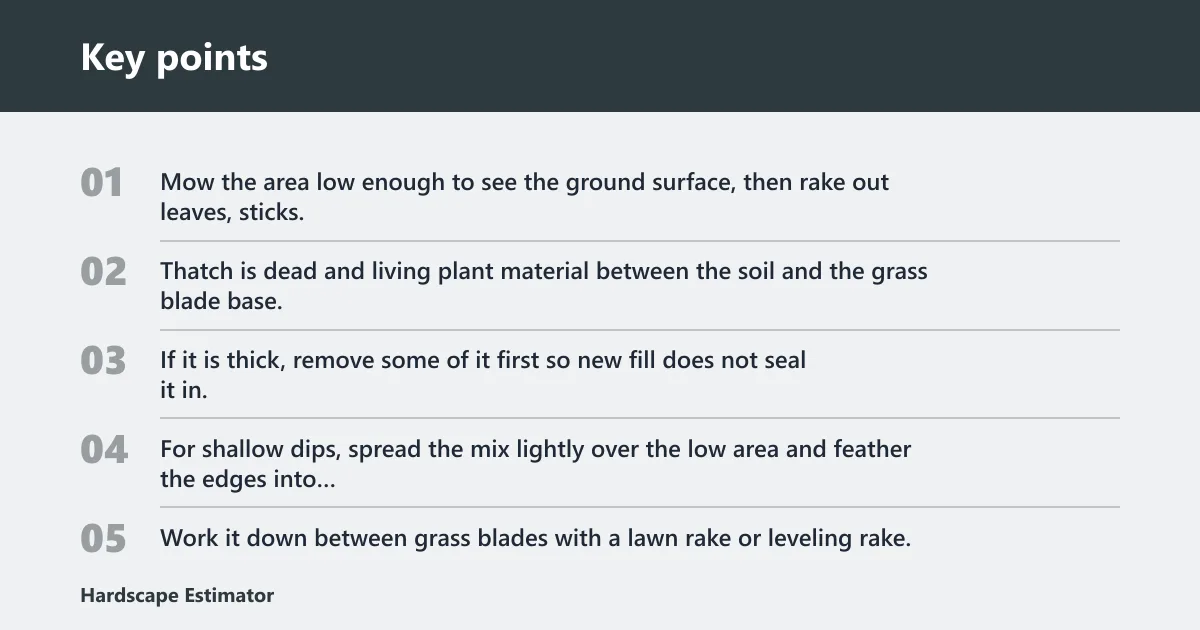
Mow the area low enough to see the ground surface, then rake out leaves, sticks, and loose thatch. Thatch is dead and living plant material between the soil and the grass blade base. If it is thick, remove some of it first so new fill does not seal it in.
Step 2: topdress shallow dips
For shallow dips, spread the mix lightly over the low area and feather the edges into the surrounding turf. Work it down between grass blades with a lawn rake or leveling rake. Real Homes warns not to add more than half an inch at a time, so keep each pass thin.
Step 3: lift sod for deeper spots
When the depression is deeper than topdressing should handle, cut a small turf section with a flat spade or lawn edger, fold it back, add fill, and reset the sod. Grassy Gator says dips deeper than 1 to 2 inches may need sod to be lifted. That keeps the surface from sealing over too fast.
Say a side yard has a 3 ft by 4 ft hollow beside a walkway, and the low area is about 1 in. deep. That is 12 sq ft. A thin topdressing pass is the right move. If the same hollow is 2 in. deep, lift the sod instead of trying to bury it in one round.
How much fill do you need?
Estimate fill with area × depth. Convert the depth to feet, then multiply by square feet to get cubic feet. That number tells you whether you need bags or a larger bulk order. Keep the first pass thin and plan to repeat only if the turf still sits low.
Area × depth math
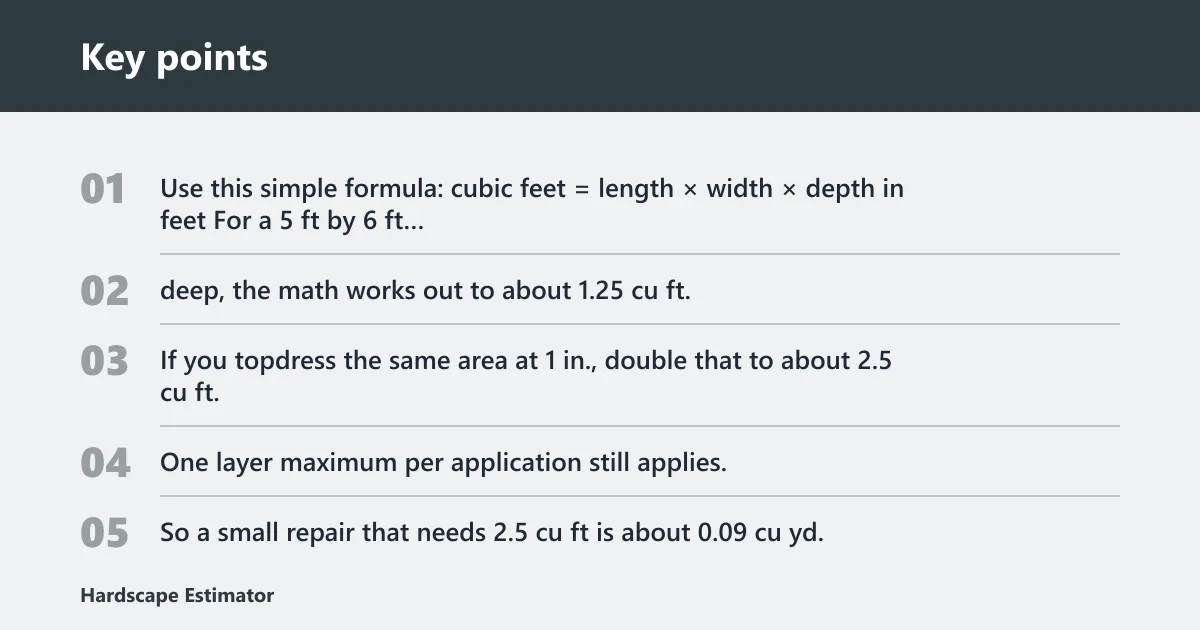
Use this simple formula:
cubic feet = length × width × depth in feet
For a 5 ft by 6 ft spot at about 1/2 in. deep, the math works out to about 1.25 cu ft. If you topdress the same area at 1 in., double that to about 2.5 cu ft. One layer maximum per application still applies.
Bag and cubic yard estimates
One cubic yard equals 27 cubic ft. So a small repair that needs 2.5 cu ft is about 0.09 cu yd. A 0.5 cu ft bag would cover about five bags for that same example, depending on how much settles into the turf.
Suppose a 10 ft by 10 ft patch has a shallow dip averaging about 1/2 in. That works out to about 4.17 cu ft, or about 0.15 cu yd. That is still a small hand job, but it is enough material to check twice before buying.
One thin pass at a time
Do not dump the full amount into the spot at once. Spread a thin layer, water lightly, let it settle, and measure again. If the grass is still low, add another thin pass. This is slower, but it avoids burying crowns and leaves less cleanup later.
What can go wrong?
The most common failure is overfilling. Other problems are the wrong mix, thatch trapped under fill, and hidden leaks or drainage faults that recreate the dip. Small repairs fail when the material choice or depth limit does not match the problem.
Overfilling and burying grass
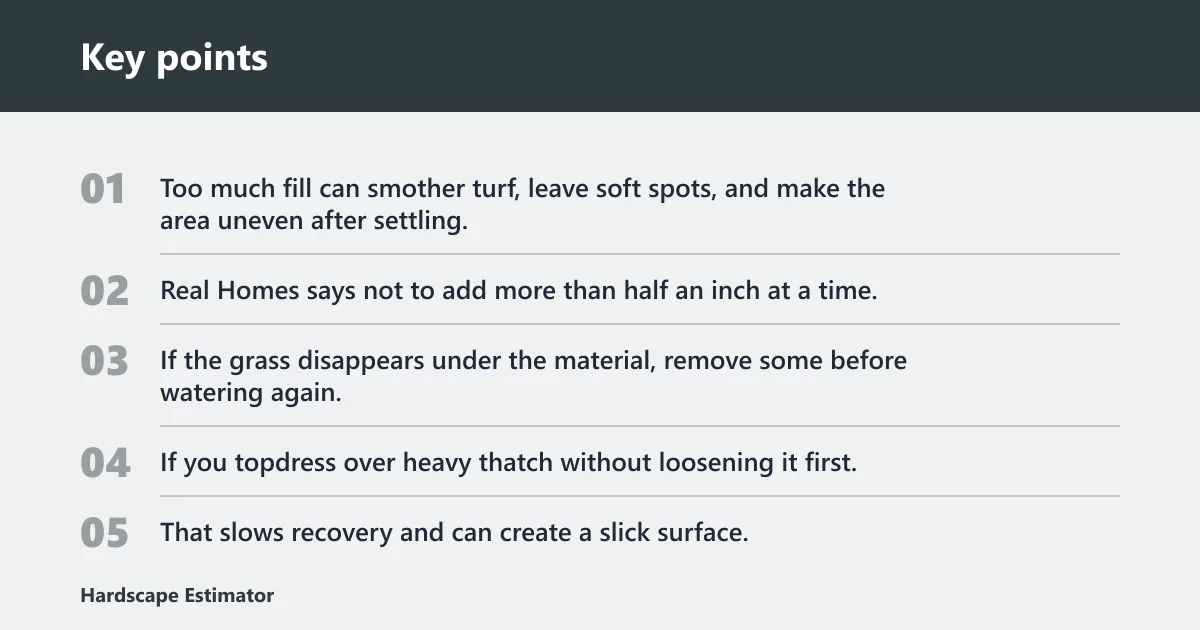
Too much fill can smother turf, leave soft spots, and make the area uneven after settling. The same source says not to add more than half an inch at a time. If the grass disappears under the material, remove some before watering again.
Thatch trapped under fill
If you topdress over heavy thatch without loosening it first, the new soil can sit on top of the thatch layer instead of reaching the root zone. That slows recovery and can create a slick surface. Rake or dethatch first when the mat is thick enough to block contact.
Leaks, roots, and drainage problems
Recurrent low spots can come from irrigation leaks, underground utilities, or tree-root movement. Check before digging. A root hump may be better flattened than filled, while a wet hollow may keep settling until the leak or drainage problem is fixed. A repair cannot outwork a bad grade or a saturated base.
A common first-timer mistake is spreading a thick layer of topsoil over a slight dip and leaving it unfirmed, which can make a small lawn settle unevenly after watering. depression with one deep dump of soil and then watering hard. The surface may look level for a day, then sink, crust, and sit too high around the edges. Thin passes and a final straightedge check prevent that.
Frequently asked questions
How do I level a small area of lawn by hand?
Start by mowing low, clearing debris, and checking the depth with a straightedge. If the dip is about 1 in. or less, topdress with a thin layer. If it is deeper than 1 to 2 in., lift the sod and refill under it instead of burying the grass.
How do I level a lawn by hand?
Use a lawn rake or leveling rake to spread a screened mix across the low area, then feather the edges into the surrounding turf. Work in thin layers and verify the grade after each pass. Keep water flow away from structures, even when the surface looks flatter.
How do I level a small lawn?
For a small lawn, pick the least aggressive fix that matches the depth. Shallow dips get topdressed. Deeper localized holes get sod lift-and-reset. Broad grade problems need a bigger plan. The goal is a smooth surface with a gentle slope, not a dead-flat yard.
How do I level a small backyard?
A small backyard can usually be handled with hand tools if the uneven area is limited and the drainage direction still makes sense. Mark the highs and lows, fix bumps first, then fill the dips in thin passes. If water is heading toward the house, stop and reassess the slope.
What can I use to fill low spots in a small lawn?
Use screened topsoil, fine sand, or a leveling mix made from 40% fine sand, 40% topsoil, and 20% compost. The exact choice depends on the depth and the existing soil. For most small hand repairs, screened material spreads better and is easier to work into the turf.
How deep can I topdress a lawn by hand?
Topdress only about 1/4 to 1/2 in. per pass, and do not bury the grass deeper than 1/2 in. at once. Shallow dips of about 1 in. or less can usually be fixed this way. Anything deeper should move to a lift-and-reset approach.
When should I lift sod instead of topdressing?
Lift sod when the depression is deeper than 1 to 2 in., when a shallow topdress would take too many passes, or when the low area is tightly bounded by a walkway or patio edge. That method lets you place fill under the turf instead of smothering it.
Will leveling kill the grass?
Not if the fill stays thin and the grass crowns remain exposed. Grass can recover from a light topdress, especially when the mix is screened and watered lightly afterward. Burying the turf too deeply, trapping thatch, or filling over a leak is what raises the risk.
How do I know if my lawn needs regrading?
If the unevenness covers much of the yard, if water keeps pooling after repairs, or if the slope sends runoff toward a structure, the lawn may need regrading rather than spot leveling. A small hand repair works for local dips. Large drainage errors usually do not.