How to Convert Cubic Feet Bags to Cubic Yards
Multiply bag volume in cubic feet by bag count, then divide by 27. That converts bags to cubic yards. Skip that step, and you can come up short by a full load or buy material that never gets used. The same math works for mulch, soil, and gravel; concrete mix must use the manufacturer’s stated yield after mixing, not just the dry bag volume.
What you need before you calculate
Use the cubic-foot yield printed on the bag, not the weight alone. Weight shifts with moisture and product density; the printed volume is what drives the estimate. Have the project area or target yardage, a calculator, and a waste allowance target before you order.
- Bag label with cubic-foot yield
- Project area or target cubic yards
- Calculator or a quick reference chart
- Waste allowance target is commonly about 10% to 15%.
How bag volume becomes yards
One cubic yard equals 27 cubic feet. To convert bags to cubic yards, multiply the bag count by the bag size in cubic feet, then divide by 27. The reverse formula works too: cubic yards × 27, then divide by bag size to get bag count.
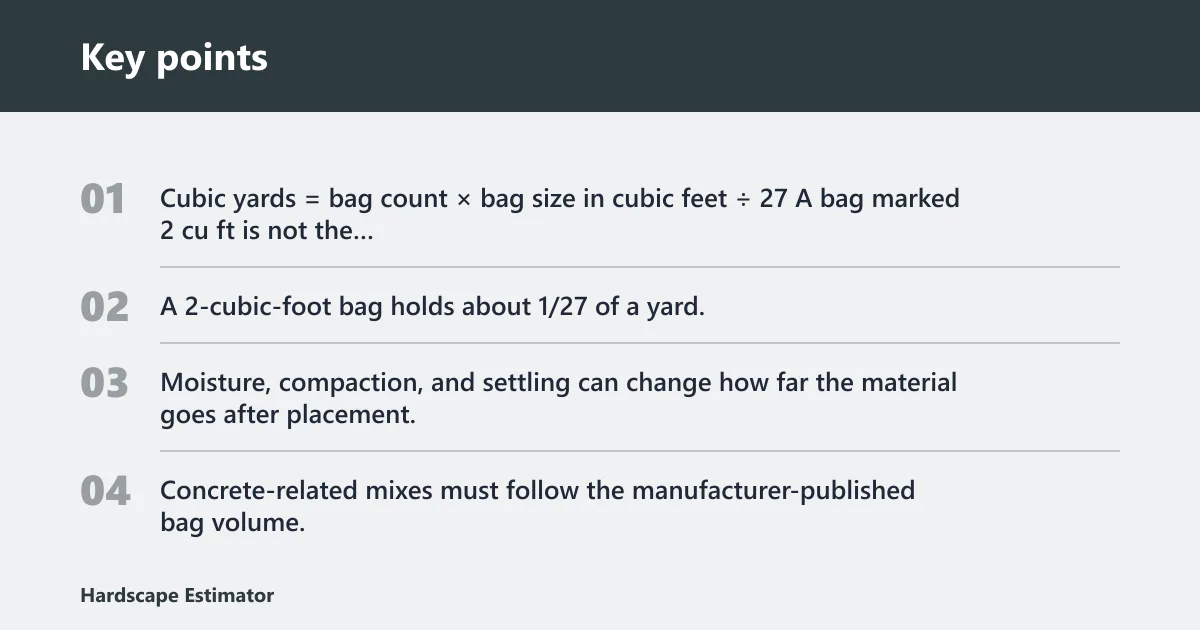
Formula
Cubic yards = bag count × bag size in cubic feet ÷ 27
Why the label matters
A bag marked 2 cu ft is not the same as a bag marked 1.5 cu ft, even if the weights are close. A 2-cubic-foot bag holds about 1/27 of a yard, so it takes roughly 14 two-cubic-foot bags for one cubic yard. A 1-cubic-foot bag takes 27 bags per yard.
Material behavior changes the usable yield
Moisture, compaction, and settling can change how far the material goes after placement. Soil often compresses more than mulch. Gravel settles into voids. Concrete-related mixes must follow the manufacturer-published bag volume, because the yield is tied to that label volume, not to a guess based on bag weight.
How do you convert bags to cubic yards?
Convert by multiplying the bag count by the printed cubic-foot yield, then dividing by 27. If the result is a fraction, round your order up to the next whole bag because partial bags are not sold. Then check coverage, because the same yardage can cover very different areas at different depths.
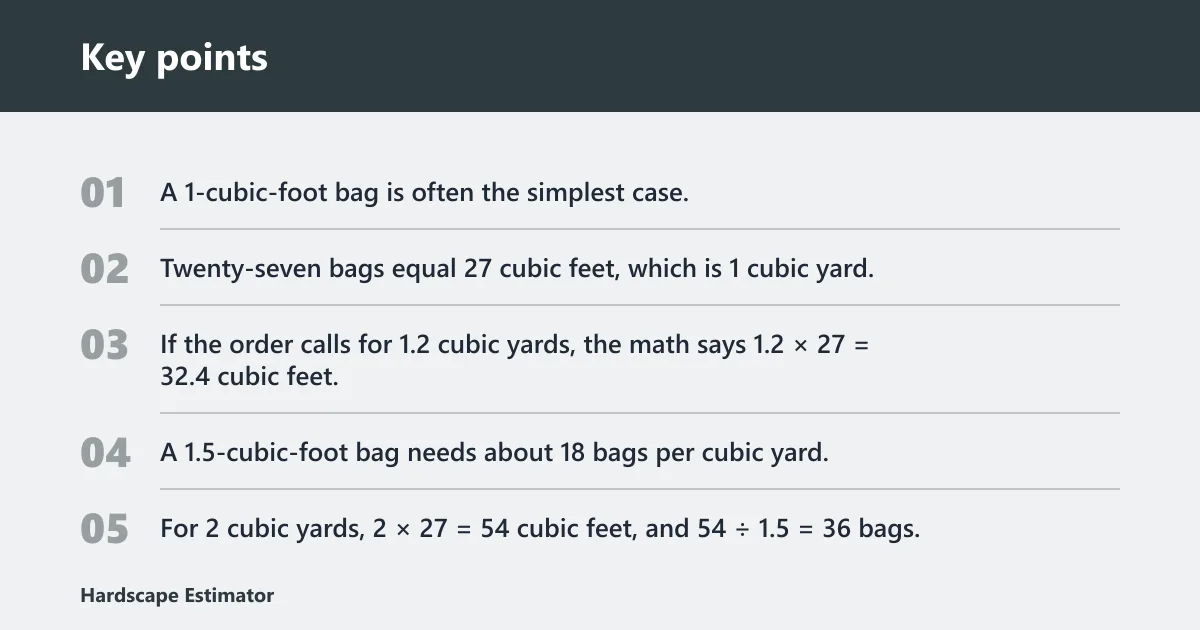
Worked examples
A 1-cubic-foot bag is often the simplest case. Twenty-seven bags equal 27 cubic feet, which is 1 cubic yard. If the order calls for 1.2 cubic yards, the math says 1.2 × 27 = 32.4 cubic feet, or 33 one-cubic-foot bags after rounding up.
A 1.5-cubic-foot bag needs about 18 bags per cubic yard. For 2 cubic yards, 2 × 27 = 54 cubic feet, and 54 ÷ 1.5 = 36 bags. If you add 10% waste, the target becomes 59.4 cubic feet, which rounds to 40 bags.
A 2-cubic-foot bag is common for mulch. One cubic yard takes 27 ÷ 2 = 13.5 bags, so the practical order is 14 bags. Two cubic yards equals 54 cubic feet, and 54 ÷ 2 = 27 bags. A 3-cubic-foot bag requires 9 bags per cubic yard.
Coverage check
Say your mulch bed is 20 ft by 4 ft at 3 in deep. That equals 20 cubic feet, or 0.74 cubic yards. In 2-cubic-foot bags, that is 10 bags before waste allowance. The same calculation tells you whether a bag stack covers the square footage you expect, not just the volume on paper.
Bag size conversion table
This table shows the bag counts for roughly 1 cubic yard, 2 cubic yards, and 3 cubic yards with a 10% waste allowance built in. The exact cubic feet column shows the volume that order covers after rounding up.
| Bag size | 1 cu yd + 10% waste | Exact cubic feet | 2 cu yd + 10% waste | Exact cubic feet | 3 cu yd + 10% waste | Exact cubic feet |
|---|---|---|---|---|---|---|
| 1 cu ft | 30 bags | 30 cu ft | 60 bags | 60 cu ft | 90 bags | 90 cu ft |
| 1.5 cu ft | 20 bags | 30 cu ft | 40 bags | 60 cu ft | 60 bags | 90 cu ft |
| 2 cu ft | 15 bags | 30 cu ft | 30 bags | 60 cu ft | 45 bags | 90 cu ft |
| 3 cu ft | 10 bags | 30 cu ft | 20 bags | 60 cu ft | 30 bags | 90 cu ft |
Should you add waste allowance?
Yes. A 10% to 15% waste allowance is common for spills, uneven ground, and the way material shifts during placement. That extra margin matters more with mulch, topsoil, and rock than with a tightly measured concrete pour, but every bagged estimate benefits from a small buffer.
How waste changes the order
If the base need is 1 cubic yard, a 10% allowance raises the target to 1.1 cubic yards. In 2-cubic-foot bags, that is 29.7 cubic feet, which rounds up to 15 bags. Without the allowance, the same yard would be 13.5 bags, rounded to 14. The buffer is one extra bag in this case.
Simple rule by job type
- Mulch: use about 10% when the bed is level.
- Topsoil: use 10% to 15% if the grade is uneven or settling is expected.
- Gravel: add a small buffer when the base is rough or porous.
- Concrete mix: follow the manufacturer’s yield and add only what the pour needs.
When are bags better than bulk?
Bags are better for small jobs, narrow access, and cleanup-focused work. Bulk is usually better for larger projects because it is typically cheaper per cubic yard. If the driveway, path, or yard cannot accept a delivery truck, bagged material can be the practical choice even when the unit cost is higher.
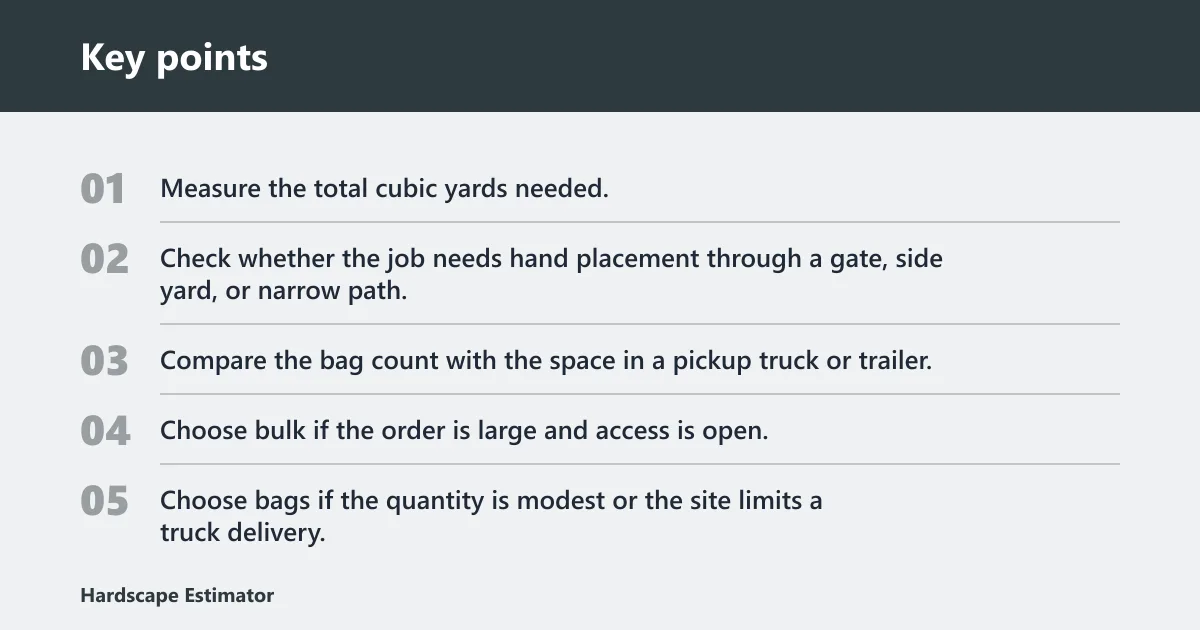
Use this decision check
- Measure the total cubic yards needed.
- Check whether the job needs hand placement through a gate, side yard, or narrow path.
- Compare the bag count with the space in a pickup truck or trailer.
- Choose bulk if the order is large and access is open.
- Choose bags if the quantity is modest or the site limits a truck delivery.
Pickup truck limits
A pickup truck is limited by both weight and physical space. Soil and concrete mix can reach the weight limit before the bed is full. Mulch and many lightweight materials can fill the bed first. That is why a bag count that looks manageable on paper may still be awkward to haul in one trip.
Common mistakes
The biggest error is using bag weight instead of printed cubic-foot yield. A second error is forgetting to round up, which leaves the order short. A third is skipping waste allowance, especially on uneven ground or when the material settles after spreading.
What goes wrong and how to avoid it
- Using weight as the input: read the cubic-foot number on the label.
- Stopping at the formula: check square-foot coverage and depth.
- Ignoring product type: mulch, soil, rock, and concrete do not behave the same.
- Ordering exact fractions: round up to the next whole bag.
- Skipping waste allowance: add 10% to 15% when the job is not perfectly uniform.
Quick sanity check before you buy
Suppose a shopper needs 2 cubic yards of mulch in 3-cubic-foot bags. The math says 18 bags without waste, and 20 bags with 10% waste. If a store cart only shows 18 bags, that order is short once spreading losses and uneven depth are included.
Frequently asked questions
How do I convert cubic feet bags to cubic yards?
Multiply the bag count by the cubic feet per bag, then divide by 27. For example, 18 bags at 1.5 cubic feet each equal 27 cubic feet, which is 1 cubic yard. Round up any partial result to the next whole bag before ordering.
How many cubic feet are in a cubic yard?
One cubic yard equals 27 cubic feet. That is the fixed conversion used for mulch, soil, gravel, and concrete-related materials. Once you know that number, you can move between yardage and bag counts with simple multiplication and division.
How many 1 cubic foot bags make a yard?
You need 27 one-cubic-foot bags for 1 cubic yard. If you add a 10% waste allowance, the order moves to 30 bags because 27 × 1.10 = 29.7, and the count must round up to a whole bag.
How many 2 cubic foot bags are in a cubic yard?
A cubic yard takes about 13.5 bags of 2-cubic-foot material, so the practical order is 14 bags. With 10% waste, the target rises to 29.7 cubic feet, which rounds to 15 bags. That is why 2-cubic-foot mulch is often easy to estimate.
How many 3 cubic foot bags are in a cubic yard?
A cubic yard takes 9 bags in 3-cubic-foot material, so the order is 9 bags if no waste is added. With a 10% allowance, the target is 29.7 cubic feet, which rounds to 10 bags.
How do I convert bag count to cubic yards for mulch?
Use the bag’s printed cubic-foot yield, not the weight. Multiply the number of bags by the bag size, then divide by 27. A 2-cubic-foot mulch bag covers about 8 square feet at 3 inches deep, so 14 bags is about 1 cubic yard before waste.
Should I round up when buying bags for a project?
Yes. Partial bags are not sold, and the estimate should already include the chance of spill, settling, or uneven depth. Rounding up is the safer choice, especially for mulch, topsoil, and rock where coverage can thin out during placement.
When is it better to buy bulk instead of bags?
Bulk is usually better when the order is large enough that bag handling becomes inefficient or expensive. If the project needs several cubic yards and the site has open access, bulk delivery often makes more sense. Bags fit smaller jobs, narrow access, and pickup transport limits better.