How to Level a Large Lawn Without Tearing Up the Grass
Topdress a large lawn in about 1/4 to 1/2 in. lifts at a time, and use core aeration or slit seeding first if the soil is compacted; deeper lows generally need multiple passes over weeks, not one thick blanket. Heavy fill can smother grass, leave ridges, and waste material. This guide shows how to choose the fix, measure the depth, and schedule the work so you level the lawn without tearing up healthy turf.
What lawn leveling can fix
Lawn leveling without digging up the grass means topdressing: spreading a thin layer over existing turf and working it into the canopy. It works best for minor to moderate depressions, surface ripples, and small heaved areas. It is not a cure for major grade failure or ongoing drainage trouble.
Surface smoothing versus drainage correction
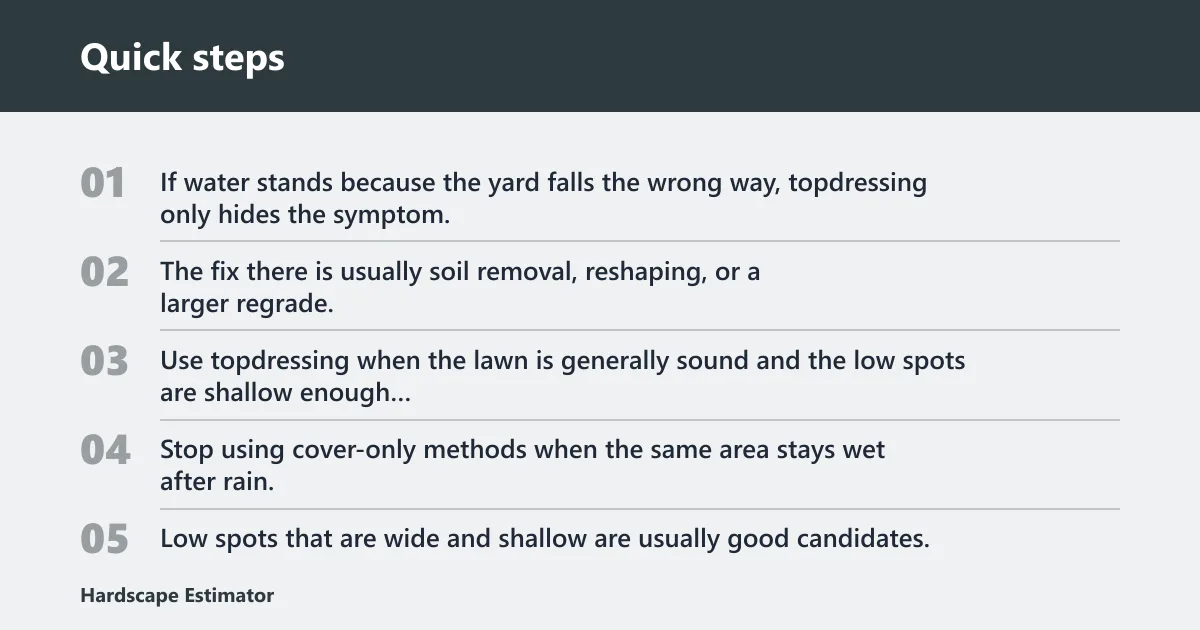
Surface smoothing is a shallow repair. Drainage correction is a shaping job. If water stands because the yard falls the wrong way, topdressing only hides the symptom. The fix there is usually soil removal, reshaping, or a larger regrade.
Use topdressing when the lawn is generally sound and the low spots are shallow enough that grass can keep growing through the added layer. Stop using cover-only methods when the same area stays wet after rain, collects runoff from upslope, or shows a settled trench rather than a dip.
When low spots are still a topdressing job
Low spots that are wide and shallow are usually good candidates. A slight dip around a patio edge, mower rutting in one strip, or a few settled spots after installation can often be corrected without removing turf. In those cases, the goal is to build the surface up gradually.
Say your backyard has a roughly 12 ft by 18 ft section with shallow dips around sprinkler heads and footpaths. That is a smoothing job. The low areas can be lifted in thin passes, then rechecked after settlement and watering.
When the lawn needs regrading instead
Deep holes, sharp depressions, and broad grade errors usually need more than topdressing. If a spot would require burying the surrounding grass to reach level, the work has crossed into regrading. High spots also belong in a different category; they often need shaving or soil removal, not more material on top.
A common first-timer mistake is trying to fill about a 3 in. hole with one heavy pass. The grass at the edge gets covered too deeply, the center settles unevenly, and the repair often looks worse after the next rain.
Large-lawn leveling plan
On a large lawn, the method matters as much as the mix. Measure the depth, choose the pass size, and stage the work so one section finishes before the next begins. That keeps traffic down and prevents one wet, overworked area from being walked into ruts.
Depth ranges and method choices
Minor dips can usually be handled with one thin pass of topdressing. Deeper low spots need repeated applications, with recovery time between passes. If the soil is compacted, build the plan around aeration first. If thatch blocks contact, dethatch first.
Topdressing works best when it stays light enough for grass blades to reach through the material. Thick cover blocks light and air. Thin cover lets the turf keep growing while the surface slowly rises.
Mix ratio, layer limit, and repeat passes
There is no single blend that fits every lawn. A tighter sand-heavy mix suits fast-draining soil, while a soil-heavy blend fits clay better. The mix should change with soil texture and the size of the dip.
For a deep low spot, use repeated thin lifts rather than one heavy fill. A useful rule is to stop at the layer limit, let the turf recover, and then build again after the first lift settles. That staged approach is slower, but it protects the grass.
When to aerate, dethatch, or overseed
Core aeration belongs before topdressing on compacted lawns because it pulls soil plugs and improves movement of air, water, and nutrients. Dethatching belongs first when a thick thatch layer keeps the new material from reaching soil. Overseed when the surface repair leaves gaps or when the grass needs help filling in.
Skip aeration or dethatching if the turf is already drought-stressed, recently seeded, or otherwise fragile. In those cases, extra disturbance can slow recovery. Wait for active growth and better moisture conditions if the lawn is not ready for work.
Do you need to aerate first?
Core aeration is the right first step when the soil is tight, water beads on the surface, or the yard feels hard underfoot. It is more effective than spike aeration for compaction because it removes plugs instead of simply punching holes. If the lawn is already stressed, though, delay aeration until it can recover.
Compaction signs that point to core aeration
Compacted lawns often drain slowly, resist root growth, and hold puddles after rain. Those conditions make topdressing less effective because the material sits on a tight surface instead of settling into it. Core aeration opens the profile first, so the leveling mix can work down into the turf.
When to skip aeration on stressed turf
If the lawn is droughty, thin, or newly seeded, aeration can add too much stress. The same caution applies when the grass is already struggling from heat or disease. In those cases, wait until the turf is growing actively and can close back over the openings.
Why core aeration beats spike aeration for compaction
Spike tools poke holes and often compress the sides of the hole. Core aeration removes soil and creates more useful opening space for water and nutrients. For a leveling project on compacted ground, that difference matters because the topdressing has a better path into the root zone.
What mix should you use?
The usual topdressing mix contains sand, compost, and topsoil. The right ratio depends on the existing soil and the depth of the low spot. Screened compost is preferred, and the material should be clean, with no weed seeds or debris.
Sand, compost, and topsoil roles
Sand adds structure and helps the mix move through the grass. Compost adds organic matter and improves water retention. Topsoil helps match the surface grade and gives the repair more body than sand alone. A common general-purpose blend is equal parts sand, compost, and topsoil.
For loam, some guides use a sand-heavier blend; one example is 70% sand and 30% compost. For clay, a 50/50 sand-soil base is often used as a starting point. Those are examples, not universal rules.
How soil texture changes the blend
Sandy lawns usually need more compost or topsoil in the mix so the repair does not dry out too fast. Clay lawns usually need a more open blend so the surface does not crust. Matching the blend to the native soil reduces sharp texture changes between the old surface and the new layer.
Do not dump a sand-heavy mix on clay just because it sounds free-draining. That can leave the surface hard and uneven. It can also create a rough transition between the amendment and the native soil below.
Why screened compost and clean material matter
Screened compost spreads more evenly and is less likely to leave sticks, clumps, or trash on the lawn. Clean material matters because weed seeds and debris become new problems after the leveling job is done. A good mix should spread smoothly and disappear into the canopy with light raking.
Can you level without tearing up the grass?
Yes. The key is to keep the layer thin, limit traffic, and work in sections. Topdressing over existing turf can smooth the lawn without stripping it bare, as long as the grass is mowed short enough to accept the material and the added depth stays modest.
Mow shorter and section the yard
Start by mowing about one-third of the blade height off before spreading material. Then divide the lawn into manageable sections. That makes it easier to keep the layer even and to avoid walking across the same spot all day.
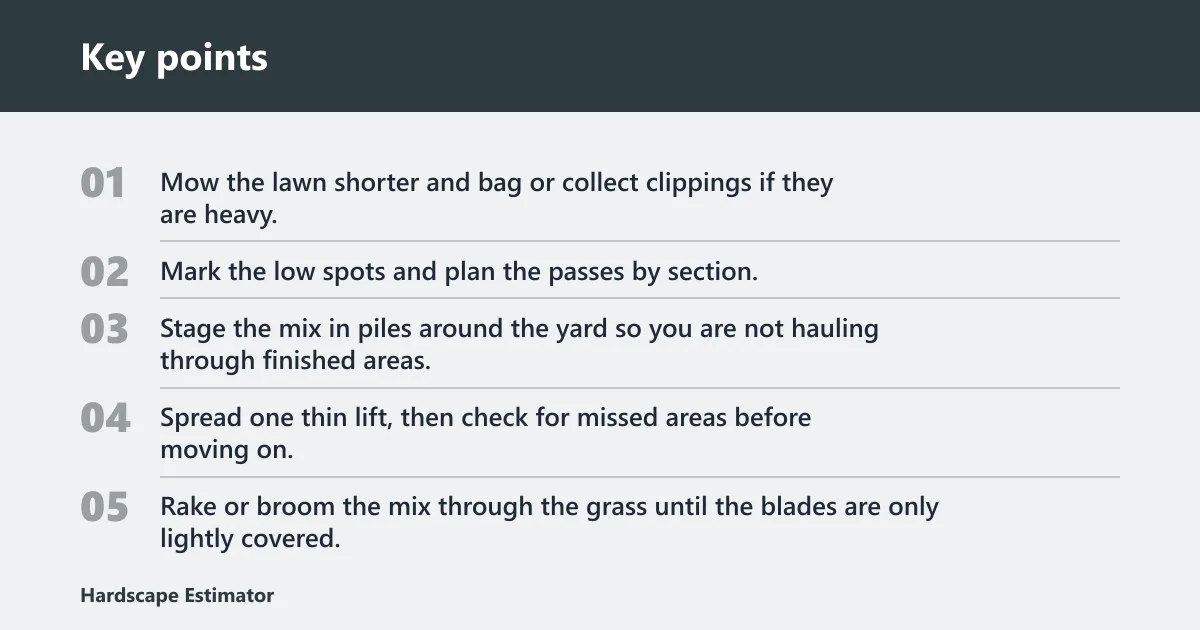
- Mow the lawn shorter and bag or collect clippings if they are heavy.
- Mark the low spots and plan the passes by section.
- Stage the mix in piles around the yard so you are not hauling through finished areas.
- Spread one thin lift, then check for missed areas before moving on.
- Rake or broom the mix through the grass until the blades are only lightly covered.
Spread thin layers and work them
Use a lawn levelling rake to pull the material across the turf and break up small piles. The goal is an even film over the low areas, not a buried lawn. Thin applications are easier for grass to recover from and easier to correct if one area settles more than another.
Water lightly and protect traffic lanes
Light watering helps settle the material and starts recovery. Keep foot traffic off the area while the mix settles, especially in the first few days. On a large lawn, temporary traffic lanes help prevent new depressions from forming while you work.
Picture a front yard with two shallow dips along the driveway and a healthy stand of fescue. If the work is split into two sections, the first pass can settle before the second pass begins, and the grass keeps more of its leaf area through the process.
When should you level your lawn?
Timing matters because grass needs an active growth window to recover. Cool-season grass does best in spring or fall. Warm-season grass does best in late spring or early summer. Leveling outside those windows slows recovery and makes stress more likely.
Cool-season grass timing
Fescue, ryegrass, and bluegrass recover best when temperatures support active growth. Spring and fall are the usual windows. Those periods give the lawn time to grow through the added material before heat or cold slows it down.
Warm-season grass timing
Bermuda, zoysia, and centipede should be leveled in late spring or early summer. That is when they are growing fastest and can close over the topdressing more quickly. Avoid doing the work when the lawn is still dormant or just waking up.
Weather and recovery window checks
Choose a dry forecast with moderate temperatures if possible. Wet soil can smear, compact, or rut underfoot. Hot, windy weather can dry the mix too fast and stress the grass. The best window is one where the lawn can keep growing while the surface settles.
Large-lawn leveling plan by low-spot depth and soil type
| Depth range | Recommended method | Mix ratio | Max layer per pass | Aerate or dethatch? | Overseed? |
|---|---|---|---|---|---|
| Up to 1/4 in. | One light topdressing pass | Equal parts sand, compost, and topsoil for most lawns | 1/4 in. | Only if compacted or thatchy | Usually no |
| 1/4 to 1/2 in. | Topdress in a thin pass, then recheck after settling | Sandy soil: slightly more compost; clay: lighter, more open blend | 1/2 in. | Yes, if plugs or thatch block contact | Sometimes, if thin spots remain |
| 1/2 to 1 in. | Repeated thin passes over several weeks | Adjust to soil texture; keep the mix screened and clean | 1/2 in. | Usually yes on compacted ground | Often yes |
| More than 1 in. | Staged repair; check whether regrading is a better fit | Site-specific blend, often with more soil than a surface mix | 1/2 in. per pass | Case by case | Often yes, if the turf thins |
This table is for surface smoothing, not drainage correction. If water movement is the real issue, a bigger grade fix may be needed. If the low spot is so deep that repeated lifts would bury the surrounding grass, stop and reconsider the method.
Should you use a lawn roller?
A lawn roller has a narrow job here. Use it sparingly on small bumps or heaved spots, and only on slightly moist soil. It is not a main leveling tool for a large lawn. Overuse increases compaction and can make future topdressing less effective.
Small bumps versus broad low spots
Rolling can help settle a minor heave after frost or light surface lifting. It does little for broad depressions because it does not add material. If the problem is a shallow dip, topdressing is the better tool.
Moisture level and compaction risk
Slightly moist soil gives the roller some effect without smearing the surface. Soil that is too wet compacts too easily. Soil that is too dry does not settle much at all. Even in the right moisture range, the roller should be used only where it is truly needed.
When rolling is the wrong tool
Do not use a roller to force a large low spot level. That just compresses the surrounding turf and can worsen drainage. If the lawn needs grade correction, or if the soil is already tight, a roller is the wrong fix.
Frequently asked questions
How do you level a large lawn without digging up the grass?
Use topdressing in thin lifts over the existing turf, then work the material into the grass with a rake or broom. On compacted lawns, core aeration first helps the mix settle. Keep the work in sections so the lawn is not covered too heavily in one area at a time.
Can you topdress a big lawn without smothering the grass?
Yes, if the layer stays thin and the grass is growing actively. The safest approach is repeated light applications instead of one thick blanket. If the turf is already stressed, recently seeded, or droughty, delay the work so it can recover more easily.
How thick can topdressing be on existing grass?
A common limit is 1/4 to 1/2 in. at a time. Thicker layers can block light, slow airflow, and smother the grass. For deeper low spots, build up the surface in several passes and let the lawn recover between applications.
Do you need to aerate before leveling a lawn?
Not always, but core aeration is a good first step on compacted soil. It improves movement of air, water, and nutrients and helps the leveling mix reach the root zone. Skip it if the turf is drought-stressed or newly seeded and cannot handle the disturbance.
What mix should I use to level low spots in grass?
Use a screened, clean blend of sand, compost, and topsoil, adjusted to the soil texture. Equal parts is a common general-purpose starting point. Clay usually needs a lighter, more open mix, while sandier soil often benefits from more compost and topsoil.
When is the best time to level a lawn without damaging it?
Cool-season grass is usually leveled in spring or fall, while warm-season grass is best leveled in late spring or early summer. Choose a period when the grass is actively growing and the weather is mild enough for quick recovery.
Will rolling a lawn level it without tearing up the grass?
Rolling can flatten very small bumps or heaved spots, but it does not fix broad low areas. Use it only sparingly and on slightly moist soil. Too much rolling raises compaction, which makes future leveling harder and can hurt turf health.