What to Do If Your Patio Slopes Towards the House
If your patio slopes toward the house, confirm the pitch first: the surface should fall about 1/4 in. per ft away from the foundation. If it does not, fix reverse pitch, settlement, or runoff at the source. Water against the wall raises leak risk and can turn a small grading issue into repair costs. This guide shows how to tell which failure you have and which repair is least invasive.
This guide is part of our Patio slope: how much pitch you need for drainage series.
Patio slope decision table
This table separates the symptom from the cause. Start with the water pattern, then check the slab, then look at roof runoff and edge details. The same wet patio can come from three different problems, and each one calls for a different fix.
| Symptom | Likely cause | Quick check | Best fix | When to call a contractor |
|---|---|---|---|---|
| Water stays near the house after rain | Reverse pitch or settled slab | Measure fall over 4 ft and 8 ft; if the surface does not drop away from the house, the slope is wrong | Regrade the base, raise low spots, or lift settled sections if the problem is localized | If the slab is broadly out of plane or the foundation edge is wet |
| Water pools only after heavy roof runoff | Downspout discharge overload | Watch where gutter outlets land during rain; check whether the discharge hits the same patio edge | Move the discharge, extend downspouts, or add a surface drain where water collects | If runoff reaches siding, thresholds, or the foundation wall |
| A low strip remains wet for 6 to 24 hours | Minor settlement or erosion | Set a level or straight board across the area and check for a dip that holds water | Mud jacking, localized patching, or a drainage channel along the edge | If the low spot is long, the slab cracks, or the patio adjoins a wall |
| Water tracks to the house wall or basement side | Grade and runoff are both wrong | Check gutters, downspouts, and the patio slope together | Combine drainage correction with base repair; a drain alone is not enough if the slope is backward | If water reaches the foundation, basement, or crawl space |
| The patio edge is against siding or a threshold | Clearance is too tight for a simple overlay | Check how much room exists below siding and door thresholds | Rebuild, lower the edge, or use a detail that preserves clearance | If the edge is already too high or any water can bridge into the wall |
What should I do if my patio slopes toward the house?
Start with diagnosis, not a drain. A patio should fall away from the house, and a common target is about 1/8 to 1/4 inch per foot, which is roughly a 1% to 2% drop in elevation. If the patio is reversed, the fix depends on whether the slab was built wrong, settled after placement, or is getting too much roof runoff.
Check gutters, downspouts, and where they discharge first. If roof water hits the same edge that already ponds, the patio can look like the cause when the roof system is driving it. Then measure the patio itself. A patio that is only slightly out of plane may be corrected locally. A slab that slopes the wrong way across most of its width usually needs a larger repair.
What a normal slope looks like
For most patios, the surface should fall away from the house by about 1/8 to 1/4 inch per foot. That range is commonly described as about a 1% to 2% slope. Over 4 ft, that works out to about 1/2 in. to 1 in. of fall. Over 8 ft, a common rule of thumb is about 1 in. to 2 in. of fall.
That is enough to move water off the slab without making the surface feel abrupt underfoot. If the patio is flat or tips back toward the wall, water can linger at the edge and move toward the foundation.
When a patio is only marginally out of plane
A small low spot is different from a full reverse pitch. If the patio generally falls away from the house but one area holds a shallow puddle, a localized repair may be enough. If the entire slab drains inward, the problem is in the slab or the base below it.
What usually causes the slope to reverse?
Reverse pitch usually comes from poor initial grading, settlement, erosion, or runoff overload. The slab may have been set with the wrong fall from day one. Or the base may have moved after placement, creating a dip that now sends water toward the house.
Poor initial grading or base work
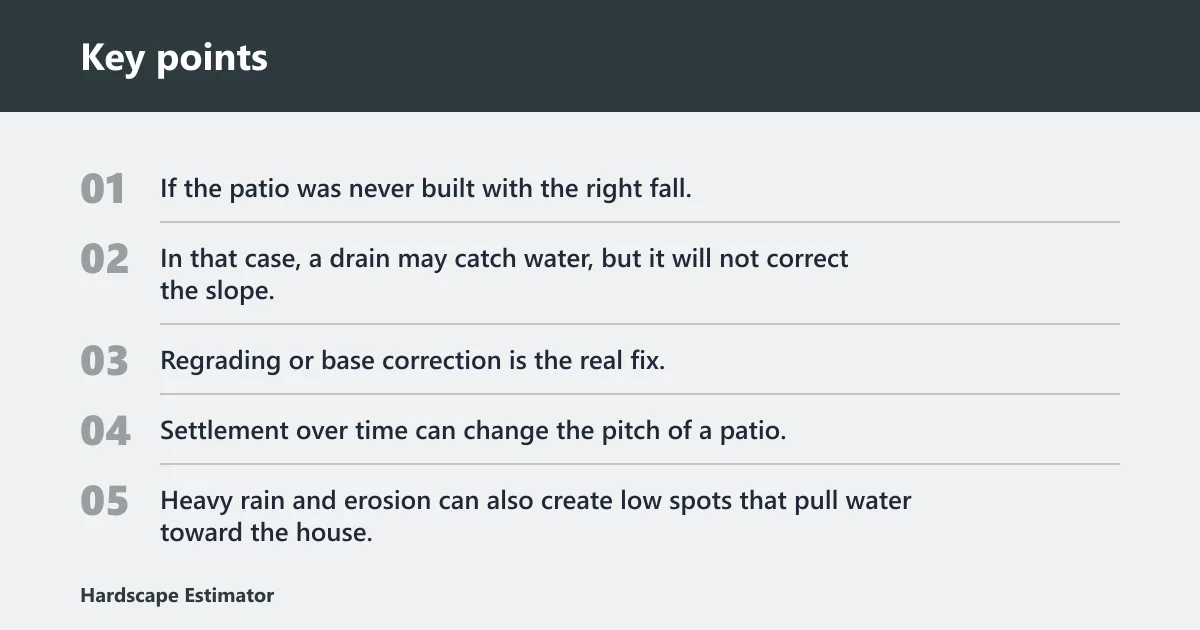
If the patio was never built with the right fall, the slab may be structurally fine but shaped wrong. In that case, a drain may catch water, but it will not correct the slope. Regrading or base correction is the real fix.
Settlement, erosion, or washout
Settlement over time can change the pitch of a patio. Heavy rain and erosion can also create low spots that pull water toward the house. Where the slab has dropped only in one area, mud jacking or base repair may restore the slope without full replacement.
Downspout discharge and roof runoff overload
Do not treat every wet patio as a patio-only problem. A downspout that empties near the same edge can overload a slab that is only mildly out of grade. The patio may be doing its job poorly, but the roof water may be adding more volume than the surface can carry away.
Picture a 10 ft-wide patio beside a roof corner that dumps into a single splash point. Even if the slab has a slight fall away from the house, the combined runoff can still pool at the edge. Fixing the downspout may solve more than adding a drain would.
How do you tell if it is bad enough?
Measure it, then watch what the water does. If a patio misses the common 1/8 to 1/4 inch per foot target and water remains after rain, it is worth correcting, especially when the dampness lasts about 6 to 24 hours. Standing water at the wall is generally more serious than a brief damp sheen.
Measure fall over 4 ft and 8 ft
Use a level or straight board with a tape measure. Place the board flat on the patio so one end starts at the house edge and the other reaches away from the house. Hold the level on the board, raise the low end until the bubble centers, then measure the gap between the board and the patio at the low end with the tape measure. Over 4 ft, a patio that slopes correctly should drop about 1/2 in. to 1 in. away from the house. Over 8 ft, the expected fall is about 1 in. to 2 in. These numbers are easy to check and easy to compare across a slab.
If the reading is flat or backward, note where the change starts. A local dip points toward settlement. A uniform reverse slope points toward bad grading or a build error.
Watch how long water remains
If puddles disappear within a short time, the issue may be minor. If water is still sitting after 6 to 24 hours, the patio is holding moisture long enough to matter. That kind of lingering water increases the chance that it will reach the foundation line, basement wall, or crawl space edge.
Look for signs at the house edge
Foundation areas can suffer seepage and deterioration when water is directed toward the wall. Basements can become damp or flooded, with higher mold and mildew risk. Crawl spaces can collect moisture and debris. If any of those spaces already show dampness, treat the patio slope as a water-path problem, not only a surface problem.
Which fix fits which problem?
The best repair is the one that changes the water path with the least disturbance. A surface drain can catch water at the edge. A French drain can move water away from the patio line. Mud jacking can lift a settled section. Regrading can rebuild the base. Full replacement is the last step when the slab or layout is too far gone.
Regrading or base correction
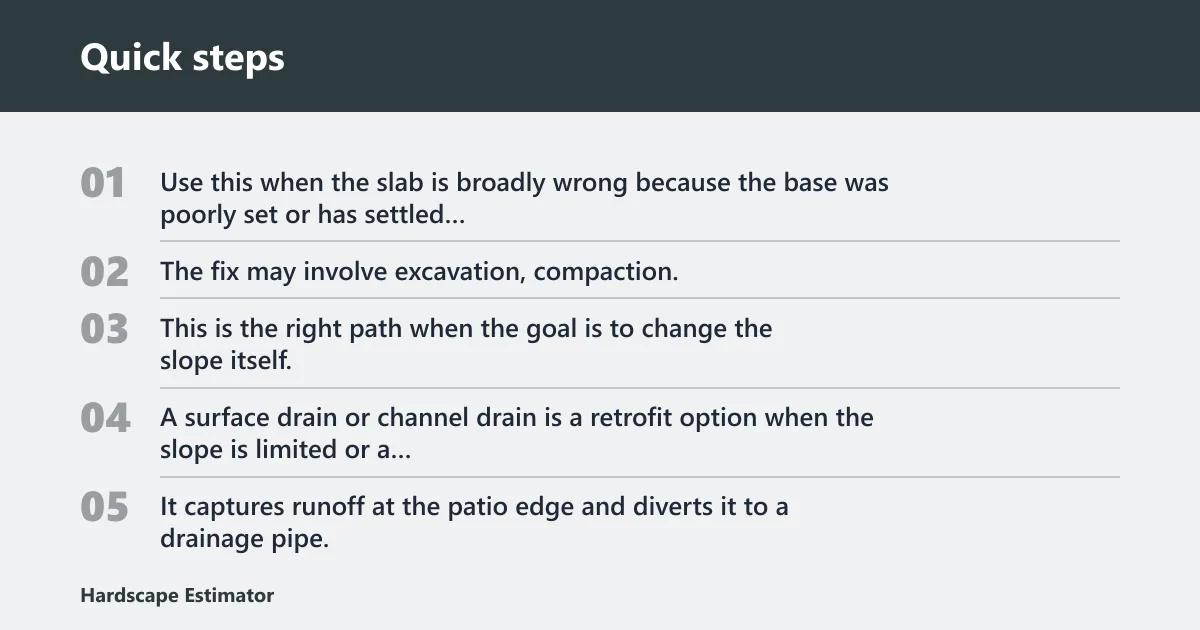
Use this when the slab is broadly wrong because the base was poorly set or has settled unevenly. The fix may involve excavation, compaction, and resetting the support layer so the finished surface can fall away from the house. This is the right path when the goal is to change the slope itself, not just catch the water after it arrives.
Surface drain or channel drain
A surface drain or channel drain is a retrofit option when the slope is limited or a small area collects water. It captures runoff at the patio edge and diverts it to a drainage pipe. A drainage channel can be fitted along the patio edge as a fix. This works best when the drain has a clear outlet and is not expected to solve a wide reverse pitch by itself.
French drain along the patio edge
A French drain can be used along the patio edge to divert water away from the slab and foundation zone. It is a perimeter drainage option, not a slope correction. It helps when water is arriving at the edge from both the patio and nearby soil, but it will not repair a slab that drains backward across its full width.
Mud jacking, overlay, or full replacement
Mud jacking or concrete lifting can work when a settled slab has localized low areas. It raises the low spot and can restore the fall without tearing out the whole patio. A concrete overlay can be an alternative in some cases, but it must be planned so it preserves clearance and matches the site conditions. A concrete contractor should confirm whether the added thickness and reinforcement are appropriate for the patio and whether the edge height still works with siding and thresholds.
A full replacement is safer when the slab is badly cracked, the slope is wrong across most of the patio, or the edge height leaves no room for a proper fix. If the patio sits too close to siding or a threshold, a new surface can fail right away if the clearance is too small.
A common first-timer mistake is to regrade only the middle of the patio and leave the edge beside the foundation untouched. If the gutter outlet is dumping onto the same corner, the drain may need to handle roof water and patio water at once. That can overwhelm a small retrofit in a heavy storm.
Can you fix it without replacing the patio?
Yes, sometimes. If the problem is a settled section, a small low spot, or runoff from one edge, a local fix can work. If the slab is flat in the wrong direction across most of its area, a patch, lift, or drain may help with water collection but will not fully correct the slope.
When a local lift or patch is realistic
Local lift is most realistic when the slab has one or two depressed areas and the rest of the patio still falls away from the house. Mud jacking can restore the grade if the slab is structurally sound and the low area is limited. Patching can help with surface defects, but it does not reengineer the base.
When an overlay can work
An overlay can work when the existing slab is stable, the extra thickness can be added without causing clearance problems, and the reinforcement plan is appropriate. It is not a cure for every inward slope. If the patio edge already sits close to siding or a threshold, adding thickness may create a new clearance issue.
When tear-out is the safer choice
Tear-out is the safer choice when the patio slope is broadly wrong, when the slab has severe cracking, or when the wall edge is already too high for a proper correction. It is also the better call when a foundation, basement, or crawl space has already shown signs of water entry.
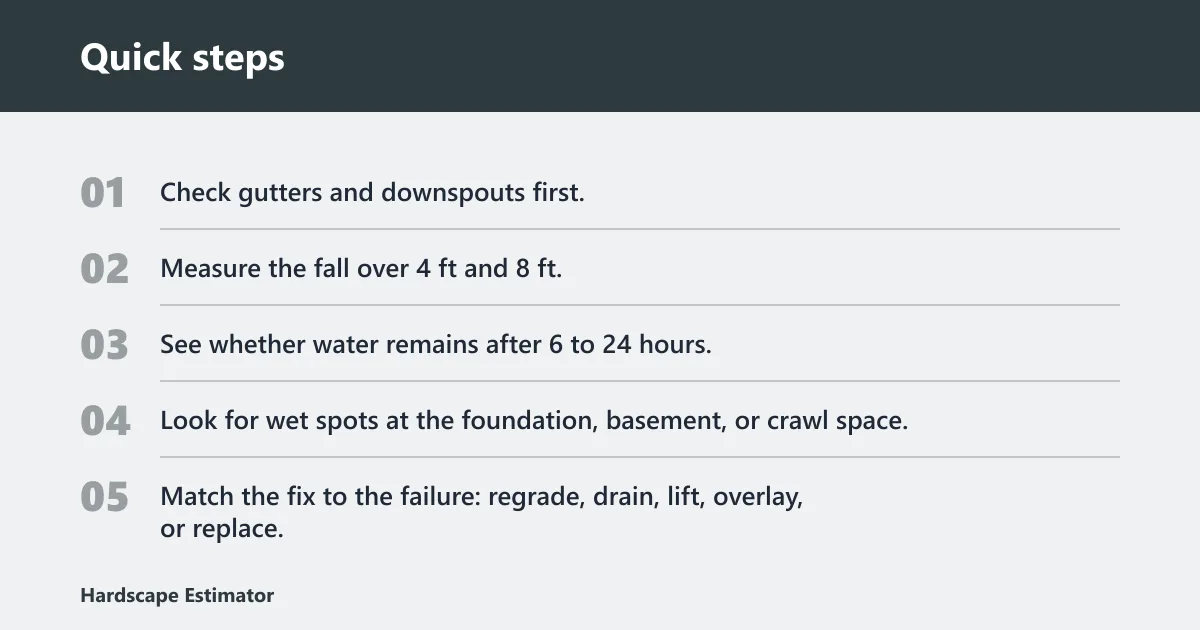
- Check gutters and downspouts first.
- Measure the fall over 4 ft and 8 ft.
- See whether water remains after 6 to 24 hours.
- Look for wet spots at the foundation, basement, or crawl space.
- Match the fix to the failure: regrade, drain, lift, overlay, or replace.
Suppose a 12 ft patio drops 1.5 in. away from the house, except for a 3 ft strip next to the wall that sits low and keeps a shallow puddle for a day. That is a localized settlement problem, not necessarily a full replacement. A lift or base correction may be enough if the slab is otherwise stable.
When should a contractor be involved?
Bring in a contractor when the patio is tied to the house edge, the slab is widely out of grade, or the water path reaches the foundation. If the issue includes a basement leak, crawl-space dampness, or wall-adjacent cracking, the repair choice should account for more than the patio surface alone.
Any time the fix depends on excavation, structural lifting, reinforcement, or a new drainage outlet, the details matter. Siding clearance, threshold height, and the patio-to-wall joint can change whether the right answer is regrading, drainage, overlay, or full replacement. If the original contractor is available, that is a reasonable first call. For serious water intrusion or uncertain slab movement, a qualified concrete lifting contractor, drainage contractor, or foundation water-intrusion specialist should be involved.
Frequently asked questions
Is it safe for a patio to slope toward the house?
No, not as a normal condition. Water directed toward the house can cause foundation seepage and deterioration, and it can also lead to basement dampness, flooding, mold, and crawl-space moisture. A brief puddle is one thing; repeated drainage toward the wall is another.
How much slope should a patio have away from the house?
A common target is 1/8 to 1/4 inch per foot away from the house, which is often described as a 1% to 2% drop in elevation. Over 4 ft, that means about 1/2 in. to 1 in. of fall. Over 8 ft, the drop is about 1 in. to 2 in.
Can I fix a patio that slopes toward the house without replacing it?
Sometimes. A settled corner can often be lifted, and a small drainage problem can sometimes be corrected with a surface drain or French drain. If the whole slab was built with the wrong slope, or if clearance at siding and thresholds is tight, replacement may be the safer route.
Should I add a drain if my patio pitches the wrong way?
Only if the drain matches the problem. A surface drain or channel drain can catch runoff at the edge, and a French drain can move water away from the patio line. But if the slab slopes backward across most of its width, drainage alone will not fix the pitch.
How do I tell if the patio slope is bad enough to matter?
Measure the fall over 4 ft and 8 ft, then watch how long water sits. If the patio does not meet the common 1/8 to 1/4 inch per foot target and water remains after 6 to 24 hours, the slope deserves correction. Water reaching the foundation makes it more urgent.