How to Round Square Feet and Square Yards for Materials
Round square feet up to the next whole square foot for small jobs, and round square yards up to the next whole square yard only after converting from square feet. For ordering, add waste first, then round again. Rounding down can leave you short by a bag, a yard, or an entire delivery. This guide shows the rounding rule for area-only estimates, waste factors, and bag or bulk material orders.
What you’ll need
- Measuring tape or site plan with dimensions in feet
- Calculator
- Paper or notes app for intermediate values
- Material spec or supplier pack size
- Waste percentage for the material type
- Delivery unit for the order: bags, cubic yards, square feet, or square yards
Should you round up or down?
Round up for purchase quantities. That is the default, because it cuts the odds of a shortage and usually costs less than a second trip or a partial re-delivery. Round down only for rough planning, side-by-side comparisons, or sketch math where the number will not be used to place an order.
A square foot is an area unit equal to 144 square inches. It is common for small measurements and finish quantities. A square yard is an area unit equal to 9 square feet, and it is common for bulk material estimates.
Use the unit that matches the order
If the supplier sells by the square foot, stay in square feet until the final rounding step. If the supplier sells by the square yard, convert first, then round the square yard total up. If the supplier sells by bag or cubic yard, convert to that unit before you round the order quantity.
Say your patio measures 24.7 square feet. If you need a finish material sold by the square foot, the safe order quantity is 25 square feet. If the same area must be ordered as square yards, divide by 9 first: 24.7 ÷ 9 = 2.74 square yards, then round up to 3 square yards.
When should you convert first?
Convert first when the supplier sells in square yards, cubic yards, or bags. Do not round square feet to a whole number and then convert if that changes the final order total in the supplier’s unit. A common conversion factor is 9 square feet per square yard, so divide square feet by 9 to get square yards and multiply square yards by 9 to get square feet.
This matters most when the area is not a clean multiple of 9. A 37.1 square foot estimate becomes 4.12 square yards. If you round the square feet first to about 38 and then convert, you get about 4.22 square yards. For bulk orders, that can change the final quantity after waste is added.
Round after waste for purchases
Waste factor means the extra percentage added for cuts, spillage, and irregular shapes. It is often added before rounding because the waste should stay in the final order, not get shaved off by early rounding. The right waste amount depends on pavers, stone, mulch, concrete, or sand.
Rounding workflow
The safest workflow is simple. Measure the area, apply waste if the material needs it, convert to the supplier unit, then round up the final order amount. That order avoids shortages and keeps the rounding rule consistent across materials that sell in different units.
-
Measure the area.
Start with square feet if the dimensions are in feet. If the space is irregular, break it into rectangles or triangles and add the parts before any rounding. -
Add waste first.
Apply the material’s waste factor before converting or rounding. A common range is about 5% for simple layouts and about 10% to 15% for cut-heavy paver or stone patterns, while loose materials may need less depending on spread and compaction. -
Convert to the order unit.
Divide square feet by 9 for square yards. For bagged products, use the bag coverage shown by the supplier, then divide the adjusted area by that coverage. -
Round the final number up.
Round up to the next whole bag, square yard, or delivery unit. That final step is the one that protects the order from shortage. -
Recheck the total.
If the result leaves less than one full unit, add one more unit and recheck. This is the practical top-up step that keeps a short load from slipping through when the area is uneven or the cut count is high.
Suppose a mulch bed measures about 89.6 square feet and the supplier sells by the cubic yard. If the coverage rate is 100 square feet per cubic yard at the chosen depth, the raw estimate is 0.896 cubic yard. Adding about 10% waste first makes the order about 0.986 cubic yard, which rounds to 1 cubic yard. Rounding the area first would not change the purchase, but the waste-first step protects the order when the number is close to the cutoff.
Rounding decision table
This table shows the practical rule for common material types and the sample outputs for 10.2, 24.7, 37.1, and 89.6 square feet. The examples assume no special slope, no unusual breakage, and ordinary site fit. When the material has a specified waste factor, add that waste before the final rounding step.
| Material type | Order unit | Rounding rule | 10.2 sq ft | 24.7 sq ft | 37.1 sq ft | 89.6 sq ft |
|---|---|---|---|---|---|---|
| Pavers | Square feet or pallets | Add waste first, then round up | 11 sq ft | 25 sq ft | 38 sq ft | 90 sq ft |
| Natural stone | Square feet | Add waste first, then round up | 11 sq ft | 26 sq ft | 39 sq ft | 95 sq ft |
| Mulch | Cubic yards | Convert first, add waste first, then round up | 0.12 yd³ equivalent | 0.31 yd³ equivalent | 0.46 yd³ equivalent | 1.00 yd³ equivalent |
| Gravel | Cubic yards or bags | Convert first, add waste first, then round up | 0.12 yd³ equivalent | 0.31 yd³ equivalent | 0.46 yd³ equivalent | 1.00 yd³ equivalent |
| Concrete mix | Bags | Convert to bag yield, then round up | Depends on bag yield | Depends on bag yield | Depends on bag yield | Depends on bag yield |
| Soil | Cubic yards | Convert first, then round up | 0.12 yd³ equivalent | 0.31 yd³ equivalent | 0.46 yd³ equivalent | 1.00 yd³ equivalent |
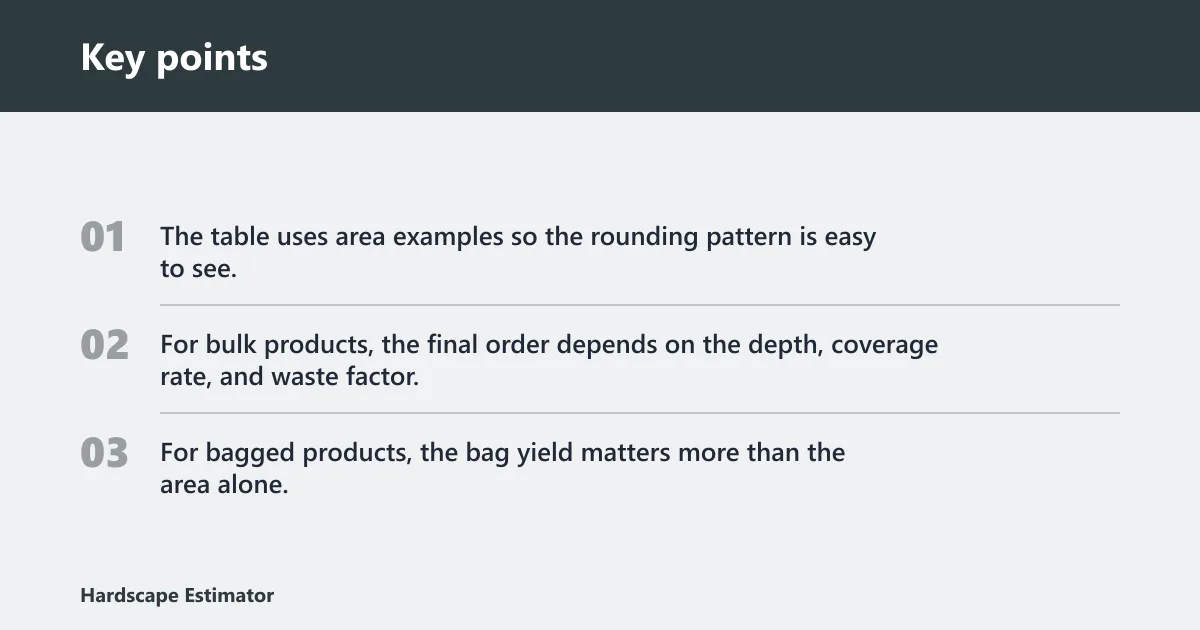
The table uses area examples so the rounding pattern is easy to see. For bulk products, the final order depends on the depth, coverage rate, and waste factor. For bagged products, the bag yield matters more than the area alone.
Common mistakes
Rounding down is the most common miss. It can leave a short load, force a second delivery, or create a lot match problem if the next batch comes from a different dye lot or quarry run. That risk is bigger with pavers, stone, and other finish materials that need a close color match.
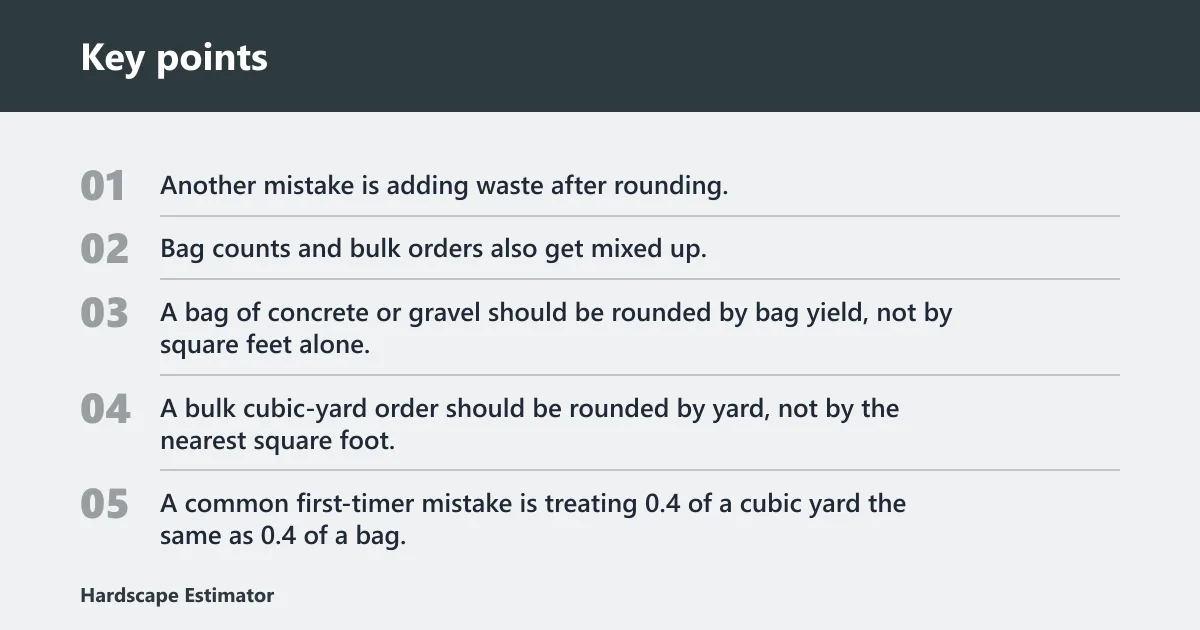
Another mistake is adding waste after rounding. That turns the waste factor into an afterthought and can trim the buffer away. For example, 37.1 square feet rounded to 37 before adding 10% becomes 40.7 square feet after waste, but the safe order is based on the waste-adjusted number first.
Bag counts and bulk orders also get mixed up. A bag of concrete or gravel should be rounded by bag yield, not by square feet alone. A bulk cubic-yard order should be rounded by yard, not by the nearest square foot.
A common first-timer mistake is treating 0.4 of a cubic yard the same as 0.4 of a bag. They are not the same unit. One may require an extra truckload charge, while the other may simply mean buying one more bag.
If that didn’t work, try this next
If your first calculation still looks short, move up one order unit and recalculate the waste-adjusted total. For bagged products, add one bag and check the supplier coverage again. For bulk delivery, round the cubic-yard amount up to the next full yard and confirm whether the supplier has a minimum load.
Write the waste factor, conversion factor, and order unit on the same line before you round. That keeps the math in one place and cuts the chance of rounding the wrong number.
Frequently asked questions
Do I round up square feet when ordering materials?
Yes. For a purchase, round the final square-foot total up to the next whole number unless the supplier accepts decimals. That avoids shortages on finish materials and keeps the order aligned with real coverage. If waste applies, add it first and then round the final number.
Should I round square yards up or down for pavers and mulch?
Round square yards up. For pavers, that prevents shortages at the edge cuts. For mulch, the same rule protects the order when the bed shape is irregular or when the depth is uneven. Convert from square feet first, then round the square-yard total up.
When is it okay to round to the nearest square yard?
Use nearest-yard rounding only for planning, pricing comparisons, or early sketches. For an actual order, the safer move is rounding up. A difference of 0.2 or 0.3 square yard can become a shortage once waste, cuts, or delivery minimums are added.
How much extra material should I add for waste?
The waste factor depends on the material and the layout. Straight runs may need about 5%, while cut-heavy paver or stone work often needs 10% to 15%. Loose materials can vary by depth and spread, so use the supplier’s coverage rate when it is available.
Do bags of concrete or gravel require rounding differently than bulk delivery?
Yes. Bags are rounded by bag count, while bulk delivery is rounded by cubic yards or tons, depending on how the supplier sells it. A bag order should be rounded after dividing by bag yield. A bulk order should be rounded after converting to the delivery unit and adding waste.
Should I convert square feet to square yards before or after adding waste?
Convert after adding waste if the supplier orders in square yards. That keeps the waste percentage attached to the real area, not a rounded intermediate number. Use 1 square yard = 9 square feet, divide square feet by 9, then round the final square-yard result up.
What rounding rule avoids shorting my material order?
Add waste first, convert to the supplier unit, and round up last. That rule works for square feet, square yards, bags, and bulk orders. It reduces shortage risk, which matters more than small extra precision on the planning sheet.
How do I round irregular areas without overbuying too much?
Break the shape into simple sections, add the areas, then apply a modest waste factor before rounding. For irregular borders, the math is usually more accurate than guessing the full shape and rounding early. That limits overbuying while still leaving enough material for cuts and fit-up.