How Much Does 2 Inches of Topsoil Cost for 1,000 Sq Ft?
For 1,000 sq ft at 2 inches deep, plan on about 6.2 cubic yards of topsoil and roughly $250 to $700 delivered, depending on local pricing and delivery minimums. Buy too little, and the lawn stays thin or uneven. Buy too much, and you pay to move dirt you do not need. This guide shows the volume math, bag and bulk costs, and when a shallow topsoil layer is the wrong buy.
Typical cost range
At 2 inches deep, the material-only cost for 1,000 sq ft is about $62 to $310, assuming bulk topsoil is around $10 to $50 per cubic yard. Delivered pricing is usually higher because of truck fees, minimum loads, and local handling charges. A practical delivered total often lands around $250 to $700.
Material-only price range
The math starts with volume. A 1,000 sq ft area at 2 inches deep needs about 6.2 cubic yards. Multiply that by bulk prices of $10 to $50 per cubic yard, and the material cost comes out to about $62 to $310 before delivery or labor.
Delivered price range
Delivery changes the bill more than the material does. A topsoil delivery may be bundled into the quote or added as a separate fee, and that fee can swing the total by a lot for a small order. For this project size, a delivered total around $250 to $700 is a practical planning range.
What changes the total
-
Choose the soil type.
Screened topsoil usually costs more than unscreened material, and organic planting soil costs more still. The cleaner and more refined the blend, the higher the price per cubic yard. -
Check the delivery minimum.
Some suppliers charge a flat delivery fee, while others price by load size. A small 1,000 sq ft order can carry a larger delivery share per yard than a larger project. -
Add a small buffer.
Order a little extra for settling, low spots, and trimming to grade. A 5% to 10% overage is a common planning buffer for a shallow layer like this.
How much topsoil do you need for 1,000 sq ft?
For 1,000 sq ft at 2 inches deep, plan on about 6.2 cubic yards of topsoil, or about 84 common 2-cu-ft bags. A small overage is smart because topsoil settles and the ground is rarely perfectly flat. For most projects, ordering 6.5 to 7 cubic yards keeps the job from coming up short.
Cubic yards at 2 inches
One cubic yard is 27 cubic feet. At 1,000 sq ft and 2 inches deep, the project needs about 166.7 cubic feet of fill, which works out to about 6.2 cubic yards. That is the number to use when comparing bulk quotes.
Bag equivalent for 2 inches
Using common 2-cu-ft bags, 6.2 cubic yards equals about 84 bags. Bagged soil is easy to carry and place in small sections, but the count climbs fast at this size. A few missing bags can leave the surface thin at the end.
A small overage for waste
A little extra material helps cover settling, the edges of the lawn, and small dips that only show up once the soil is spread. For a 1,000 sq ft project at 2 inches, a modest buffer of about 0.3 to 0.8 cubic yard is usually enough.
Topsoil coverage calculator
This table uses 1,000 sq ft as the project size and shows how the yardage changes with depth. The cost ranges use the bulk price figures in this guide, with unscreened topsoil at $10 to $28 per cubic yard and screened topsoil at $20 to $40 per cubic yard.
| Depth | Cubic yards needed | Common 2-cu-ft bags | Unscreened bulk cost | Screened bulk cost |
|---|---|---|---|---|
| 1 inch | 3.1 | 42 | $31 to $87 | $62 to $124 |
| 2 inches | 6.2 | 84 | $62 to $174 | $124 to $248 |
| 3 inches | 9.3 | 126 | $93 to $260 | $186 to $372 |
| 4 inches | 12.3 | 167 | $123 to $344 | $246 to $492 |
For reference, the common rounded estimate for 1,000 sq ft at 4 inches deep is about 13 cubic yards, which is why some suppliers and calculators will show a slightly higher figure than the math-based table above.
Is topsoil cheaper by the bag or by the yard?
For a 1,000 sq ft project at 2 inches deep, bulk topsoil is usually cheaper than bags. Bags can make sense for small touch-ups, tight access, or a few isolated low spots, but the price per cubic yard is typically much higher once the order grows. Delivery can tilt the answer if the bulk load has a steep minimum fee.
When bags make sense
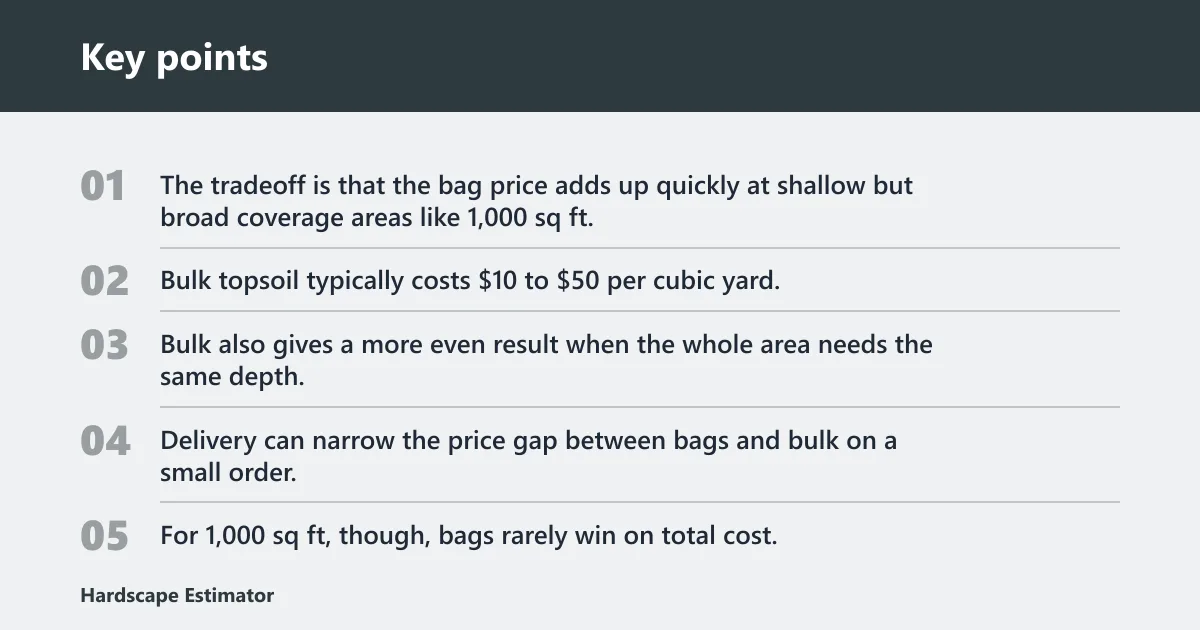
Bagged topsoil costs $2 to $5 per bag. It works when the job is small, the truck cannot reach the site, or you only need soil for a few planting beds. The tradeoff is that the bag price adds up quickly at shallow but broad coverage areas like 1,000 sq ft.
When bulk is cheaper
Bulk topsoil typically costs $10 to $50 per cubic yard. At 6.2 cubic yards, that is usually the lower-cost route for 1,000 sq ft at 2 inches, even before considering the time needed to open and move dozens of bags. Bulk also gives a more even result when the whole area needs the same depth.
How delivery changes the answer
Delivery can narrow the price gap between bags and bulk on a small order. If a supplier has a high delivery minimum or a short-load fee, the delivered bulk total can rise enough that bagged soil looks competitive for a small patch. For 1,000 sq ft, though, bags rarely win on total cost.
Screened, unscreened, and organic soil prices
Topsoil price varies by quality. Unscreened material is the least expensive option, screened topsoil costs more because debris is removed, and organic planting soil sits in a higher price band because it is blended for richer planting conditions. The right choice depends on what the surface needs to do after the install.
Screened topsoil
Screened topsoil costs $20 to $40 per cubic yard. It is the cleaner choice for lawns and garden areas because it has fewer rocks, twigs, and clumps. For a 1,000 sq ft lawn, screened material often gives a smoother finish and less cleanup at the end.
Unscreened topsoil
Unscreened topsoil costs $10 to $28 per cubic yard. It is cheaper, but it may contain rocks, roots, and debris. That can be fine for rough fill or lower-visibility areas, but it is less predictable for a finished lawn surface.
Organic planting soil
Organic planting soil with manure costs $30 to $50 per cubic yard. It is the priciest of the common options here and is better suited to planting beds or nutrient-focused work than to a basic lawn fill. For a large shallow layer, the added cost can be hard to justify unless plant performance is the goal.
When 2 inches is enough
Two inches can be enough for topdressing, minor grade correction, or refreshing a thin lawn surface. It is usually too shallow for full replacement or major leveling. If the goal is to improve the top layer without changing the entire grade, 2 inches is a practical target; if the lawn has deep low spots, a deeper layer is usually better.
Say your yard has a few shallow depressions near a walkway and the rest is already close to level. A 2-inch layer can help smooth those areas without burying existing turf. If the same lawn has several low areas deeper than that, a 2-inch order will still leave visible dips after settling.
Suppose a homeowner wants to topdress a 1,000 sq ft lawn before overseeding. Two inches may be enough if the current surface is already close to grade and the goal is coverage, not rebuilding the yard. If the lawn is patchy and uneven across the whole area, a deeper fill will do a better job.
For shallow projects like this, a short planning list helps keep the order accurate:
- Measure the area in square feet.
- Set the depth in inches.
- Convert to cubic yards.
- Add a small overage.
- Compare bulk, bags, and delivery together.
Frequently asked questions
How much does 2 inches of topsoil cost for 1,000 sq ft?
Expect about 6.2 cubic yards of topsoil, with a material-only bulk cost around $62 to $310. Delivered pricing is often higher, and a practical total for this size project is about $250 to $700 once delivery minimums and local pricing are included.
How many cubic yards do I need for 1,000 square feet at 2 inches deep?
You need about 6.2 cubic yards. That figure comes from converting 1,000 sq ft at 2 inches into cubic feet and then dividing by 27. Add a little extra if the ground has low spots or if you want margin for settling.
Is topsoil cheaper by the bag or by the cubic yard?
For 1,000 sq ft at 2 inches, topsoil is usually cheaper by the cubic yard. Bags cost $2 to $5 each, but the total bag count gets high fast at this depth. Bulk pricing is usually the better fit unless the project is tiny or delivery access is limited.
What does delivery add to the price of topsoil?
Delivery can add a flat fee, a short-load surcharge, or a charge tied to truck size and location. That extra cost matters more on small orders because it is spread over fewer cubic yards. For a 1,000 sq ft project, delivery can move the total well above the material-only price.
How much does screened topsoil cost per cubic yard?
Screened topsoil costs $20 to $40 per cubic yard. That is higher than unscreened material because it has fewer rocks and debris. It is often the better choice for lawns, garden beds, and any job where a smoother finish matters.
How much area does one cubic yard of topsoil cover?
One cubic yard covers about 81 square feet at 4 inches deep, or about 40 square feet at 8 inches deep. At 2 inches deep, one yard covers about 162 square feet. Coverage always changes with depth, so compare quotes using the thickness you actually need.
Why does topsoil price vary so much?
Topsoil price varies by quality, project size, and delivery. Screened material costs more than unscreened, organic blends cost more than standard fill, and small loads often carry a larger delivery share. Local supply also changes the price, so quotes can differ a lot from one supplier to the next.