Screened Topsoil vs Fill Dirt: Which One Do You Need?
Screened topsoil is commonly used for the top about 4 to 6 in of lawns and planting beds, while fill dirt is commonly used for grading, subgrade building, and non-planting backfill; if a layer must support plants and load, use fill below and topsoil above. The wrong material can leave low spots, slow drainage, weak support, or dead plantings. Fixing a bad base usually costs more than getting the layers right the first time. This guide explains when to use each material, when to combine them, and how to estimate the volume you need.
| Decision factor | Screened topsoil | fill dirt | Winner |
|---|---|---|---|
| Plant growth | Best for seed, sod, beds, and finish grade | Poor on its own because it has little organic matter | Screened topsoil |
| Compaction and support | Not the right choice for load-bearing lifts | Compacts into a more stable base | fill dirt |
| Regrading and raising grade | Can be used in thin finish layers, not deep structural lifts | Best for changing elevation and building a base | fill dirt |
| Cost | Usually costs more | Usually costs less | fill dirt |
| Finish surface quality | Cleaner texture after screening removes rocks, roots, and clumps | More variable and often rougher | Screened topsoil |
What is the difference between screened topsoil and fill dirt?
Screened topsoil is the upper soil layer, cleaned by screening so rocks, roots, and clumps are removed. fill dirt is low-organic subsoil taken from below the top layer. One supports growth. The other supports grade, backfill, and compaction where structure matters more than fertility. (Wikipedia)
What each material
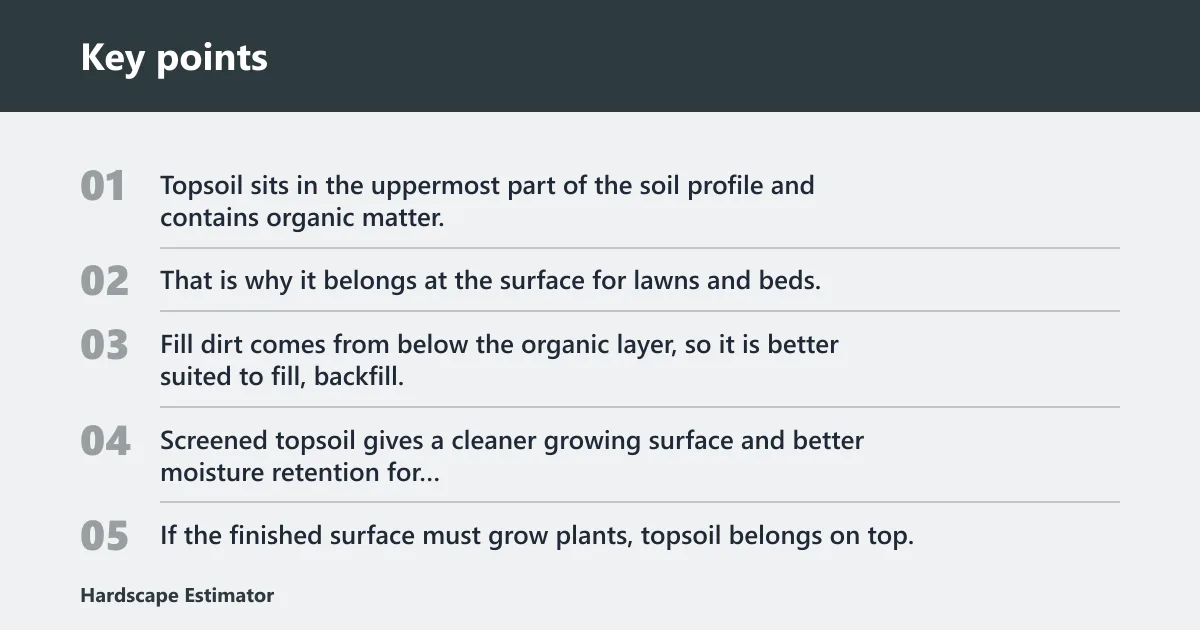
Topsoil sits in the uppermost part of the soil profile and contains organic matter, nutrients, roots, and decomposed plant material. That is why it belongs at the surface for lawns and beds. Fill dirt comes from below the organic layer, so it is better suited to fill, backfill, and base work.
The main trade-off
The trade-off is simple. Screened topsoil gives a cleaner growing surface and better moisture retention for plants, while fill dirt gives a denser, more stable mass that can be compacted in lifts. If the finished surface must grow plants, topsoil belongs on top. If the layer must carry load, fill dirt belongs below.
When both are used together
Most mixed projects use both materials. Fill dirt changes grade first, then screened topsoil caps the finished surface. That sequence matters because organic material in a structural layer decomposes over time and can leave voids, which leads to settling.
Side-by-side comparison
The real decision is not plants versus no plants. It is whether the layer must carry load, stay dimensionally stable, or support growth at the finished surface. Screened topsoil wins on planting performance. fill dirt wins on support, compaction, and grading.
| Factor | Screened topsoil | fill dirt | Winner |
|---|---|---|---|
| Organic matter | High enough to support plant growth | Low organic content | Screened topsoil for growth; fill dirt for structure |
| Compaction | Not intended for load-bearing compaction | Compacted in lifts for stable grade | fill dirt |
| Drainage and settling | Can settle if used as fill in structural areas | More stable when properly placed and compacted | fill dirt |
| Finish quality | Cleaner texture after screening | Less refined surface | Screened topsoil |
| Typical cost drivers | More screening and better finish usually raise cost | Usually cheaper, but haul distance and moisture still matter | fill dirt |
Organic matter and plant growth
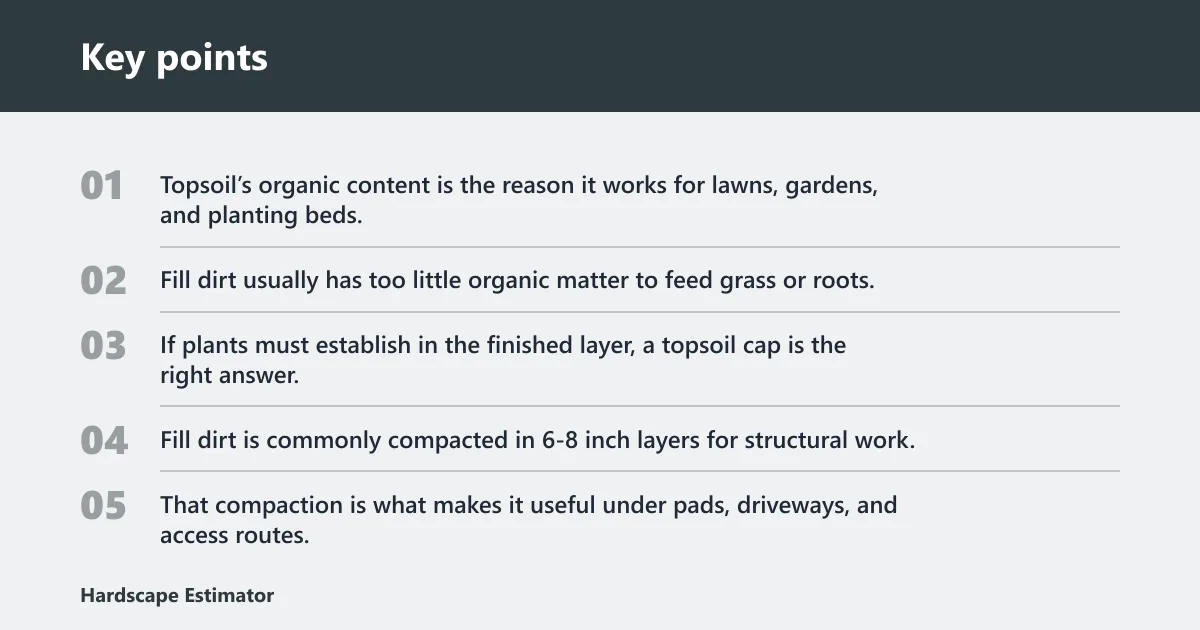
Topsoil’s organic content is the reason it works for lawns, gardens, and planting beds. Fill dirt usually has too little organic matter to feed grass or roots. If plants must establish in the finished layer, a topsoil cap is the right answer.
Compaction and stability
Fill dirt is commonly compacted in 6-8 inch layers for structural work. That compaction is what makes it useful under pads, driveways, and access routes. Topsoil should not be counted on where density and load-bearing performance matter.
Drainage and settling
Topsoil includes decomposed plant material, and organic matter continues to break down over time. In a structural lift, that can create settlement. The risk is highest under patios, retaining walls, driveway subgrades, and foundation-adjacent work, where movement shows up as cracks, dips, or poor drainage.
A common example is a 20-by-30 ft patio base needing about a 4 in lift to correct grade. If that lift is made from topsoil, it may look fine at first and then settle unevenly. If the same lift is made from compacted fill dirt, the base has a much better chance of staying level.
Typical cost drivers
fill dirt usually costs less than screened topsoil, but delivered price is not fixed. Moisture adds weight, screening adds processing, and haul distance changes freight. In Austin, fill dirt typically costs $10 to $20 per cubic yard delivered, while topsoil runs $25 to $50 per cubic yard.
Soil decision matrix
Use the matrix below to match the material to the finished use, load condition, and layer order. Choose fill dirt for the base and screened topsoil for the surface when a project needs both support and growth.
| Finished use | Load condition | Recommended material | Topsoil cap needed? | Common failure if chosen wrong |
|---|---|---|---|---|
| Lawn establishment | Light surface traffic, root growth needed | fill dirt below, screened topsoil on top | Yes, usually 4 to 6 in | Poor germination, thin turf, settling under sod |
| Flower bed or garden | No structural load, plant growth needed | Screened topsoil | No, unless regrading first | Plants struggle in subsoil with low organic matter |
| Retaining wall backfill | Structural support and drainage control | fill dirt or specified backfill material | No | Wall movement, poor drainage, settlement behind wall |
| Driveway subgrade | High load, compacted base required | fill dirt | No | Ruts, cracking, and soft spots |
| Foundation-adjacent grading | Load and drainage both matter | fill dirt below, thin topsoil finish away from foundation | Only where plants are intended | Settlement, water pooling, grading errors near the foundation |
When should you use fill dirt?
Use fill dirt when the project needs grade change, support, or a compacted base. It is the right choice for raising or lowering site elevation, backfill around foundations or walls, and structural fill under pads, driveways, and access routes. It is not the planting layer.
Grading and changing site elevation
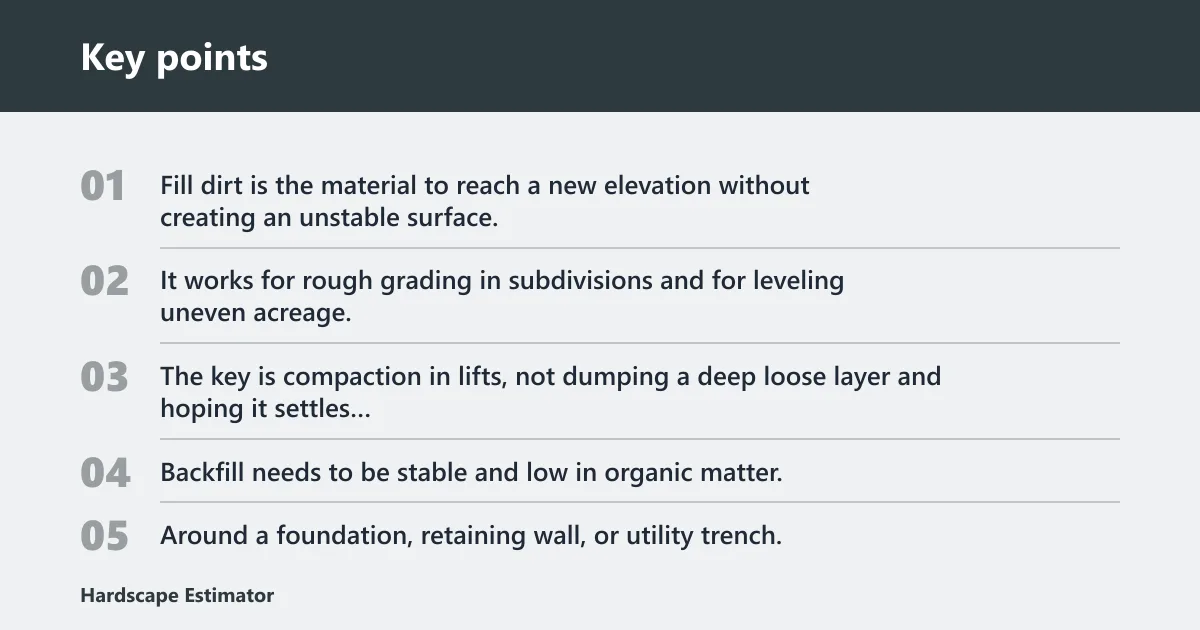
Fill dirt is the material to reach a new elevation without creating an unstable surface. It works for rough grading in subdivisions and for leveling uneven acreage. The key is compaction in lifts, not dumping a deep loose layer and hoping it settles correctly later.
Backfill around foundations, walls, and trenches
Backfill needs to be stable and low in organic matter. Around a foundation, retaining wall, or utility trench, settling can create drainage problems or visible movement. Fill dirt is commonly used here because its low organic content makes it less likely to break down after placement.
Structural fill under hardscape and pads
Under a patio, driveway, or building pad, the base has to carry load. fill dirt is commonly used for building pad preparation and for supporting driveways and access routes. Topsoil should not be the structural layer in these areas because it is designed for growth, not support.
A common first-timer mistake is using a thin layer of topsoil to save money under a driveway apron. The surface may look smooth at first, but the organic content and lower density can lead to ruts or a dip near the edge after use.
When should you use screened topsoil?
Use screened topsoil when the finished surface needs to grow grass, flowers, or garden plants. It is the right top layer for lawns, planting beds, and finish grade over a properly built base. The typical lawn target is a 4 to 6 in topsoil layer after grading.
Lawns and turf establishment
Seed and sod need a growing medium, not just any dirt. After yard grading projects, a 4 to 6 in topsoil layer gives grass roots room to establish and helps retain moisture near the surface. Shallow coverage can work for patching, but full lawn establishment usually needs that deeper finish layer.
Planting beds and gardens
Screened topsoil is commonly used for flower beds and gardens because screening removes rocks, roots, and clods that interfere with planting. That cleaner texture makes raking, watering, and root penetration easier. It also gives a more even finish grade than unscreened material.
Finish layer over graded fill
Use screened topsoil as the top layer after the site has been shaped with fill dirt. That sequence solves two different problems: the fill dirt builds the grade, and the topsoil supports plants. This is the standard approach when a yard needs both slope correction and a usable lawn.
When should you use both in the same project?
Use both materials whenever the project needs a stable base and a growing surface. fill dirt should go below, and screened topsoil should go above. That layer order is the safest choice for regrading a yard, building up low spots, and finishing the surface for grass or beds.
Fill dirt below
The lower layer should do the structural work. That means compacted fill dirt for grade correction, backfill, and support. If this layer is wrong, the finished surface may sink, hold water, or shift under use.
Topsoil above
The top layer should do the growing work. A 4 to 6 in cap is a common target for lawn areas after grading. If the project is a bed or garden, the cap can be the full growing layer rather than a thin finish coat.
Layer order for regrading and lawn work
Start with fill dirt to establish the shape, then finish with screened topsoil where plants will grow. That order keeps organic material out of the structural zone and puts the better-growing material where roots need it. For a lawn, this is usually the cleanest path from rough grade to finish grade.
Choose Screened topsoil if… / Choose fill dirt if…
Choose Screened topsoil if the finished area is a lawn, garden, or planting bed, or if you need a cleaner finish surface over already-stable grade. Choose fill dirt if the project needs elevation change, compacted support, backfill, or a base under hardscape. Choose both when the job needs grade below and growth above.
Choose Screened topsoil if…
- The finished use is turf, seed, sod, or a planting bed.
- You need the top 4 to 6 in of a lawn area.
- The surface must be clean and workable for planting.
- The layer is finish grade, not structural fill.
Choose fill dirt if…
- You need to raise or lower grade.
- You are backfilling around a foundation, wall, or trench.
- The layer must compact into a stable base under a patio, driveway, or pad.
- You want the lower-cost material for non-planting work.
If the project combines both goals, do not force one material to do both jobs. Structure below, growth above.
Frequently asked questions
Can I use fill dirt for a lawn or garden?
Not by itself. fill dirt does not contain enough organic matter for healthy planting, so grass, seed, and garden plants usually struggle in it. If you use fill dirt to correct the grade, cap it with screened topsoil before planting or laying sod.
Can I use screened topsoil as fill dirt?
Only in shallow finish layers where load is not the issue. Topsoil is generally not used as deep structural fill because it can settle as organic matter decomposes. Under patios, driveways, retaining walls, and foundation-adjacent work, fill dirt is the safer choice.
When should you use both fill dirt and topsoil in the same project?
Use both when the site needs a new grade and a finished growing surface. Fill dirt goes below to build elevation and support compaction, then screened topsoil goes on top for lawns, beds, or sod. That is the standard layer order for regrading work.
How much topsoil do I need over fill dirt for grass?
A common target is 4 to 6 in of topsoil over the graded fill for lawn areas. That depth gives grass roots enough room to establish and helps the surface hold moisture. Shallower coverage may work for touch-ups, but full lawn establishment usually needs the deeper layer.
Is fill dirt cheaper than screened topsoil?
Usually yes. fill dirt usually costs less than screened topsoil, but delivered price depends on moisture, screening quality, and haul distance. In Austin, the quoted range is $10 to $20 per cubic yard delivered for fill dirt and $25 to $50 per cubic yard for topsoil.
What should go below topsoil when regrading a yard?
Fill dirt should go below topsoil when the yard needs elevation changes or a compacted base. It gives the site the shape and support the finish layer cannot provide. Once the grade is set, screened topsoil can be added on top where grass or plants will grow.