Lawn Leveling Sand vs Topsoil: Which Should You Use?
Use topsoil for shallow lawn dips under about 1 inch, sand for very thin topdressing over firm soil, and a sand-topsoil mix or soil repair for anything deeper than about 1 to 2 inches or for sinking spots. Pick the wrong material and you can bury grass crowns, make drainage worse, or leave a dense layer that keeps the lawn uneven. This guide shows how depth, drainage, and soil type decide which material to use.
| Decision factor | Lawn leveling sand | topsoil | Winner |
|---|---|---|---|
| Best use | Thin surface smoothing and sand topdressing | Shallow grading and filling low spots | tie |
| Depth it fits best | Very thin layers | Under about 1 inch, with staged fills for some 1 to 3 inch spots | topsoil |
| Drainage risk | Can help surface texture, but is not a drainage fix | Can hold more moisture if used too thickly | Lawn leveling sand |
| Working into turf | Often easier to screed and brush in thinly | Must be screened and worked in carefully | Lawn leveling sand |
| Soil match | Often useful on clay soil; can be counterproductive on sandy soil | More flexible for mixed yard repairs, but source quality varies | topsoil |
| Stop-DIY risk | High if the lawn is sinking or pooling water | High if deep depressions are present or grading is failing | tie |
Picking the right material for lawn leveling
Use topsoil for shallow depressions, Lawn leveling sand for a thin surface dress, and a layered fix when a low spot needs bulk fill plus a smoother finish. The first call is depth. The second is whether the problem is cosmetic or structural.
Why drainage changes the answer
If water pools after rain, stop and diagnose before adding material. A level lawn reduces pooling, but a low spot can also point to poor grading or settlement. Adding the wrong fill can trap water near the surface and make the spot worse.
Say your side yard has a 2 ft by 4 ft depression that stays muddy after storms. Filling it with more material may hide the dip for a while, but if water keeps collecting there, the fix may need drainage work or regrading instead of another topdressing pass.
When a layered fix makes sense
A layered approach works when the low spot needs bulk fill but the turf still needs a finish that can be spread and worked in. Use screened topsoil for the main fill, then a thin sand topdressing only at the surface if the final pass needs easier screeding. That keeps the repair close to the grass canopy without piling on either material too thickly.
Lawn leveling decision table
This table separates cosmetic leveling from deeper repair. Measure the low spot first. Then match the depth and the drainage symptom to the material that fits the job.
| Low-spot depth | Drainage symptom | Best material choice | Red-flag reasons to stop DIY |
|---|---|---|---|
| Under 1 inch | No standing water; turf is healthy | Screened topsoil for shallow repairs, or Lawn leveling sand for very thin topdressing on firm soil | Recurring sinkage, exposed roots, or a spot that grows larger after rain |
| Under 1 inch | Light pooling but grade looks stable | Screened topsoil first; diagnose drainage before any thicker fill | Water remains after the area is reshaped or the dip returns in the same place |
| 1 to 3 inches | No pooling, but the surface is uneven | Staged filling with screened topsoil, possibly in more than one pass | Large area of settlement, soft ground, or a hollow that keeps deepening |
| 1 to 3 inches | Pooling water or soggy edges | Stop DIY and inspect drainage or grading before adding material | Any sign of a drain path, buried line issue, or repeated mud after rain |
| Over 3 inches | Any drainage symptom | Deeper reconstruction or regrading, not a simple topdress | Active sinkage, spreading depression, or multiple low areas across the lawn |
| Any depth with clay soil | Surface seals over after rain | Lawn leveling sand may help the surface, but only after drainage is checked | Hardpan, standing water, or compacted subsoil that keeps the area wet |
When sand is the better choice
Lawn leveling sand is the better pick when the goal is surface smoothing, not filling a hole. Fine quartz sand with a grain size of 0-2 mm is the right type for sand topdressing. Construction sand containing limestone should never be used.
Clay soil and sand topdressing
Clay soil often benefits more from sand topdressing than sandy soil does, because clay compacts easily and tends to need better permeability near the surface. Aeration is often paired with sanding so the sand has open spaces to settle into and the root zone can open up a bit more. On sandy soil, extra sand can leave the surface drier and less stable without solving a real low spot.
Picture a lawn with heavy clay, shallow footprints that linger after rain, and a few small humps from mower traffic. A thin sand topdress after aeration can smooth those minor irregularities. A thick layer would not.
Why sand is not a drainage fix
Sand can improve surface feel, but it does not fix a drainage problem by itself. If water pools because the lawn slopes toward a low corner or because the subgrade has settled, adding sand over the top can leave the water path unchanged. In some cases, it can seal the surface enough to slow drying.
When topsoil is the better choice
topsoil is the better choice for shallow lawn repairs, grading low spots, and filling depressions that need real depth. Screened topsoil suits shallow lawn repairs and is the safer default when you need to add material above the turf crown without creating a hard, compacted cap.
Source quality and texture differences
Topsoil is not one standard product. Texture and quality vary by source, and a screened blend is usually more suitable than clumpy fill. That matters because a poor mix can leave rocks, roots, or uneven fines that make the lawn harder to level the next time.
Grading low spots without smothering turf
For shallow irregularities, spread screened topsoil or a compatible blend in a thin layer and work it into the grass. Topdressing means a thin surface application, so the turf should still show through. If the layer is too thick, grass blades get buried and recovery slows.
Can you use a layered mix?
Yes. A layered mix makes sense when the low spot needs bulk fill below the surface and a cleaner finish at the top. Use topsoil for the body of the repair, then a thin sand layer only if the surface needs easier screeding or a finer finish.
Topsoil for bulk fill
Topsoil should do the heavy lifting in a mixed repair because it is better suited to filling shallow lawn repairs and grading than sand alone. That is especially true when the low area needs more than a cosmetic pass but less than a full regrade.
Sand for the finish layer
Lawn leveling sand can help make the blend easier to screed and can smooth the last fraction of an inch across the turf. Use it sparingly. A finishing layer should not become the main fill under a lawn that is still settling.
How deep can you level a lawn?
Use gradual topdressing for less than about 1 inch, staged filling or spot repair for roughly 1 to 3 inches, and deeper reconstruction or regrading for more than roughly 3 inches. Those ranges matter because grass tolerance drops fast as fill gets deeper.
Under 1 inch
Less than about 1 inch calls for gradual topdressing. That is the range where screened topsoil or a thin sand topdress can work without burying the lawn, as long as the material is worked down into the turf and applied in a light pass.
1 to 3 inches
Roughly 1 to 3 inches suggests staged filling or spot repair. At this depth, a one-pass blanket is too much for most lawns. Build the area in layers, let the grass keep breathing, and check whether the low spot is still sinking between passes.
Over 3 inches
More than roughly 3 inches needs deeper reconstruction or regrading. That is no longer a simple leveling job. The issue is likely beyond a surface correction and may involve settlement, slope correction, or drainage work.
Tools, application, and warning signs
A lawn levelling rake, screeding tool, or drag mat helps spread material evenly. Use the tool that matches the material: a screeding tool is useful when sand topdressing needs a smooth finish, while a rake or broom helps work thin material into turf. Spring and early fall are the best times to level a lawn.
How much material you need
A rough estimating guide is simple: the deeper the low spot, the more material you need, and the wider the area, the faster the volume climbs. On 100 m² of lawn, about 1 metric ton of sand is commonly applied. For small repairs, measure length × width × depth before you buy.
If a 10 sq ft spot needs about a 1 inch fill, that is about 0.83 cu ft of material. Double the depth, and you roughly double the volume. For deeper depressions, the material demand can climb fast enough that a layered fix or regrading makes more sense than one heavy fill.
How to apply it
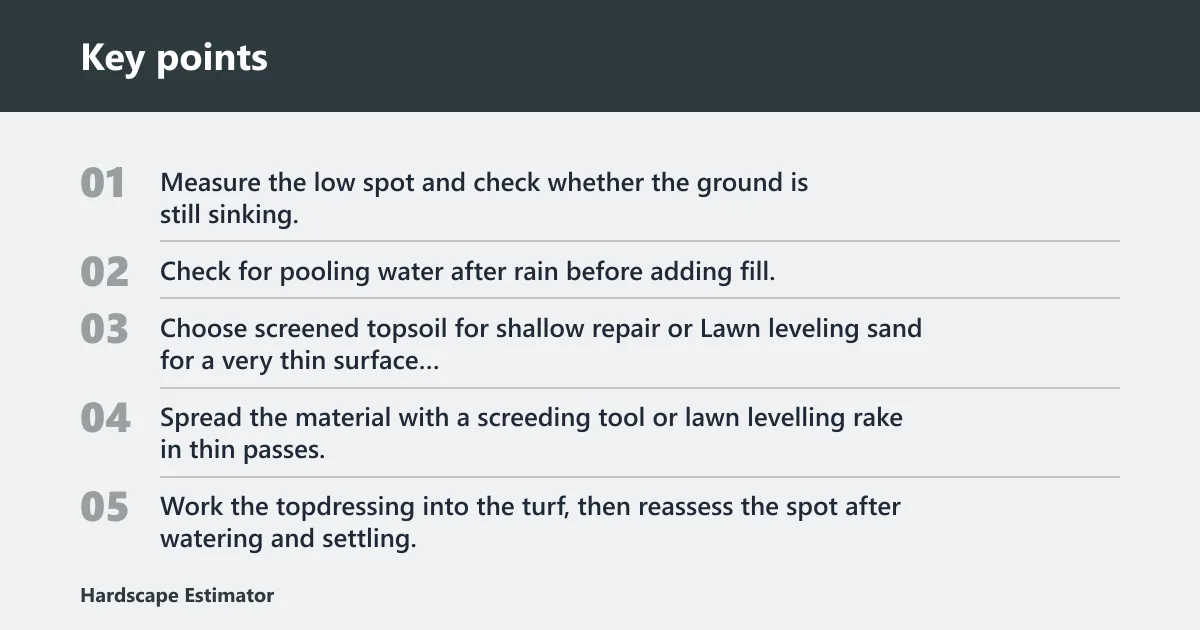
- Measure the low spot and check whether the ground is still sinking.
- Check for pooling water after rain before adding fill.
- Choose screened topsoil for shallow repair or Lawn leveling sand for a very thin surface dress.
- Spread the material with a screeding tool or lawn levelling rake in thin passes.
- Work the topdressing into the turf, then reassess the spot after watering and settling.
When to stop and get help
Stop DIY if the same area keeps sinking, the depression is deep enough to exceed the shallow repair range, or the site holds water after each storm. Those are signs that the problem may be structural grading or drainage, not a surface-level fix. A fill job will not cure that on its own.
Frequently asked questions
Should I use sand or topsoil to level my lawn?
Use topsoil for shallow lawn dips and Lawn leveling sand for very thin topdressing over firm ground. If the low spot is deeper than about 1 to 2 inches, a layered repair or a drainage check usually makes more sense than a single material choice.
Can I use sand to level a lawn with clay soil?
Yes, clay soil often benefits more from sand topdressing than sandy soil does, especially when aeration comes first. The sand should be fine quartz sand with a grain size of 0-2 mm. Do not use sand as a fix for standing water or a sinking subgrade.
How deep can I topdress a lawn without killing grass?
Less than about 1 inch is the safe target for gradual topdressing. That range lets you work material into the turf without burying the grass. Thicker layers can bury blades, trap moisture, and leave the lawn uneven for longer.
When should I use topsoil instead of sand for low spots?
Use topsoil when the low spot needs real fill rather than just a surface smooth. Screened topsoil suits shallow lawn repairs and grading. It is commonly the better choice when the dip is under about 1 inch or when a staged repair is needed in the 1 to 3 inch range.
Can sand fix drainage problems in a lawn?
No. Sand can help with surface smoothing and can work well on clay soil after aeration, but it does not correct grading errors, settlement, or a drainage path that sends water into the low spot. If water pools after rain, diagnose the cause first.
How much sand or topsoil do I need for a low spot?
Measure the spot’s length, width, and depth before buying material. The volume rises quickly with depth, so a small hollow may need only a thin topdress while a larger depression can require staged fill. On 100 m² of lawn, about 1 metric ton of sand is usually applied.
Do I need to diagnose drainage before leveling my lawn?
Yes. If the same place pools water or keeps sinking, leveling alone may hide the symptom without fixing the cause. Drainage issues can get worse after the wrong fill is added, so the cause should be identified before adding topsoil or Lawn leveling sand.
Choose Lawn leveling sand if…
Choose Lawn leveling sand if the job is a very thin topdressing, the surface only needs smoothing, or the lawn has heavy clay and has already been aerated. It is the better finishing material, not the better drainage repair. For anything deeper than a light pass, switch to topsoil or a layered fix.
Choose topsoil if…
Choose topsoil if the lawn has shallow depressions, the repair needs real grading fill, or the spot is under about 1 inch deep. It is also the safer choice when you need to build a low area in stages. If the area is over roughly 3 inches deep or keeps sinking, stop and move beyond DIY leveling.