Bagged Mulch vs Bulk: Which Is Cheaper for Your Project?
Bulk mulch is usually cheaper once a project reaches about 3 cubic yards or more with delivery included. Bagged mulch can come out ahead below that point when you skip a truck fee and keep waste low. Paying the wrong way can add $50 to $150 in delivery or leave unused mulch. This guide compares bag size, delivery, hauling effort, and leftover risk so you can find the real break-even point.
Where the savings shift from bags to bulk delivery
The short answer is this: bagged mulch is often cheaper for small jobs, while bulk is usually cheaper for larger beds once delivery is spread across enough volume. The break-even point depends on the bag price, the bulk yard price, and the delivery fee, so sticker price alone is not enough.
| Decision factor | Bagged mulch | bulk | Winner |
|---|---|---|---|
| Small-project cost | Lower on tiny top-offs and partial beds when you only need a few bags | Delivery fee can make a small order expensive | Bagged mulch |
| Medium-project cost | Cost rises quickly as bag count grows | Lower yard price usually starts to pull ahead around 3 cubic yards in this model | bulk |
| Hauling and loading | Many trips, but each bag is light enough to handle one at a time | One delivery drops the pile where you need it, but you need space to stage it | Tie |
| Waste and leftovers | Less risk of ordering too much, but more plastic waste | Bulk can leave a pile if the estimate is high | Bagged mulch |
| Appearance consistency | Often easier to keep one color lot for a small front bed | Often better for covering large areas with one load | bulk |
Small-project cost
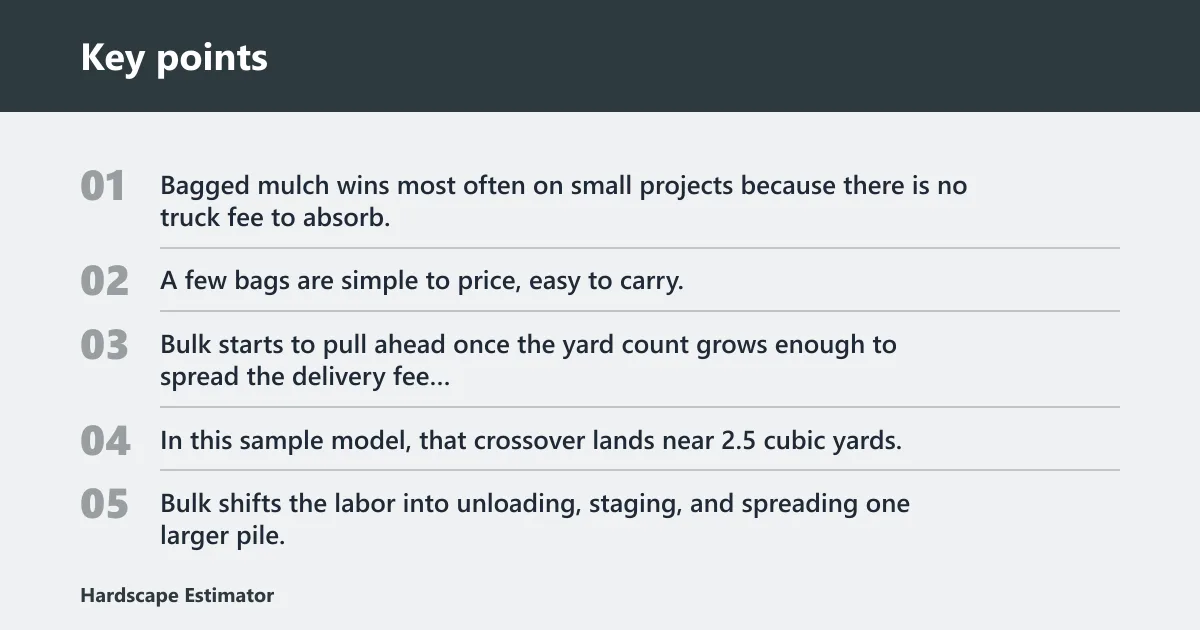
Bagged mulch wins most often on small projects because there is no truck fee to absorb. A few bags are simple to price, easy to carry, and less likely to leave a leftover pile sitting in the driveway.
Medium-project cost
Bulk starts to pull ahead once the yard count grows enough to spread the delivery fee over more material. In this sample model, that crossover lands near 2.5 cubic yards, so the exact answer is not a fixed “3-yard rule.”
Hauling and loading
Bagged mulch shifts the labor into many small carries. Bulk shifts the labor into unloading, staging, and spreading one larger pile. Either option can be sensible; the better choice is the one that fits your access and your truck situation.
Waste and leftovers
Bagged mulch reduces the risk of ordering too much because you can stop at the exact number of bags. Bulk is efficient, but a small overage can leave you with several wheelbarrows of unused material.
Appearance consistency
Front-yard curb appeal can favor bulk when the project is large enough that one load covers the whole bed. Bagged mulch can still be the cleaner choice for a tiny area where a single product batch matters and you want less handling.
How many bags of mulch equal one cubic yard?
One cubic yard equals 27 cubic feet. That means a standard 2 cubic foot bag takes about 13.5 bags to make 1 cubic yard, and the bag size on the label can change the math quickly. A 1.5 cubic foot bag needs 18 bags per yard, while a 3.0 cubic foot bag needs only 9 bags per yard.
| Bag size | Bags per cubic yard | Math |
|---|---|---|
| 1.5 cu ft | 18 | 27 ÷ 1.5 = 18 |
| 2.0 cu ft | 13.5 | 27 ÷ 2.0 = 13.5 |
| 3.0 cu ft | 9 | 27 ÷ 3.0 = 9 |
Why the bag label matters
Many store ads are built around the standard 2 cubic foot bag, but some sale tags use 1.5 cubic foot bags. If you compare prices without checking bag size, the cheaper-looking option can actually cost more per cubic yard.
How delivery fees change the break-even point
Delivery is the biggest reason bulk mulch can lose on small jobs. A flat fee adds the same dollar amount whether you order half a yard or several yards, so it hurts the total much more on a small project than on a larger one. In the sample model below, a $25 delivery fee shifts the crossover to about 2.5 cubic yards.
Suppose a gardener needs 3 cubic yards to mulch a long foundation border. If bulk mulch is $45 per yard plus a $25 delivery fee, the total is $70 for that same order, so bagged mulch is cheaper by a wide margin.
Now picture a 4 cubic yard job. Bagged mulch at the same bag price runs about $214.38, while bulk comes to $205 with delivery in this model. That is where bulk starts to make sense, because the delivery fee is spread across more volume.
What to do if you only need part of a yard
If the job is under 1 cubic yard, bags are usually the safer cost choice unless a store is very close and you already have hauling capacity. A partial-yard order is also where leftover risk matters most, because a small overestimate can leave too much mulch sitting unused.
What hidden costs should you factor in?
The real cost includes more than the mulch price. Hauling time, loading effort, leftover mulch, storage space, and cleanup all affect the final bill. For many homeowners, those factors decide the job, not the per-yard sticker price.
Hauling and loading effort
Bagged mulch requires repeated lifting and carrying. Bulk usually requires a truck or delivery truck access, plus time to move the pile once it arrives. If the bed is far from the driveway, that labor can matter as much as the price gap.
Leftover mulch and waste risk
Bagged mulch lowers the chance of overbuying because the order is counted bag by bag. Bulk can save money when the estimate is tight, but a generous estimate can leave a pile that takes space and still needs to be used somewhere.
Storage space and cleanup
Bulk mulch needs room for a pile. Bagged mulch needs less staging room, but it creates more plastic waste and more empty bags to handle. For a small patio or townhouse driveway, that cleanup difference can be enough to justify the higher unit price.
Bagged mulch cost examples by project size
Here is a simple break-even model using a 2 cubic foot bag at $3.97 and bulk mulch at $45 per cubic yard plus a $25 delivery fee. The bagged cost is based on 13.5 bags per cubic yard, which equals $53.60 per yard before tax or waste.
| Project size | Bagged cost | bulk cost | Delivery fee impact | Winner |
|---|---|---|---|---|
| 0.5 cubic yards | $26.80 | $47.50 | $25 flat | Bagged mulch |
| 1 cubic yard | $53.60 | $70.00 | $25 flat | Bagged mulch |
| 2 cubic yards | $107.19 | $115.00 | $25 flat | Bagged mulch |
| 3 cubic yards | $160.79 | $160.00 | $25 flat | bulk |
| 4 cubic yards | $214.38 | $205.00 | $25 flat | bulk |
| 6 cubic yards | $321.58 | $295.00 | $25 flat | bulk |
| 8 cubic yards | $428.76 | $385.00 | $25 flat | bulk |
0.5 to 2 cubic yards
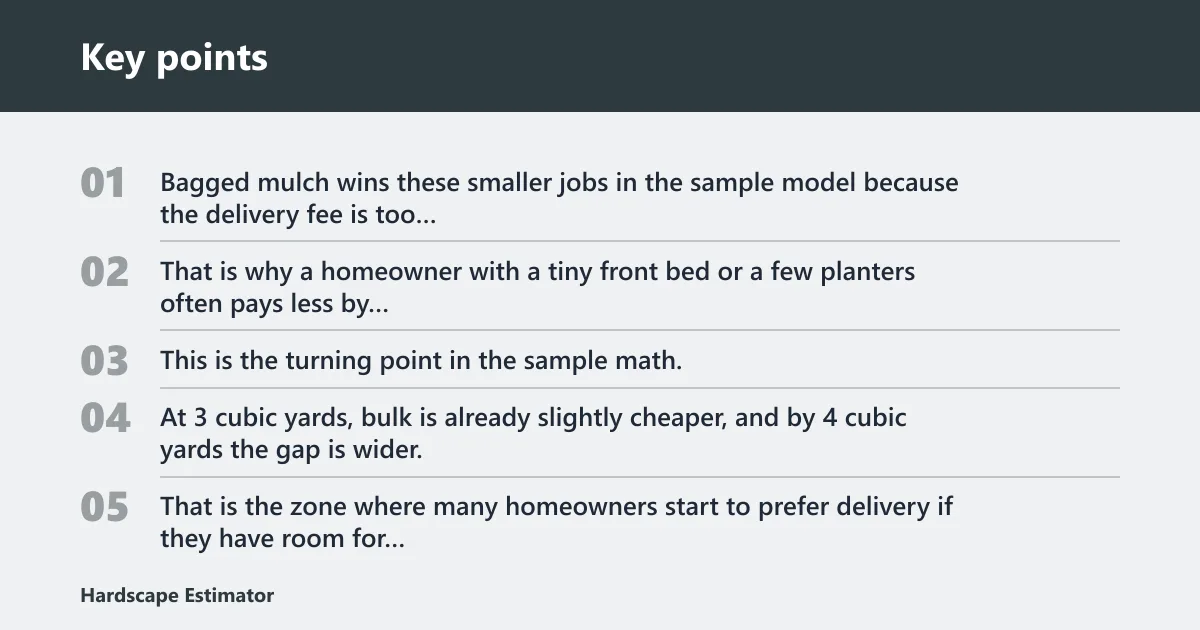
Bagged mulch wins these smaller jobs in the sample model because the delivery fee is too large a share of the total. That is why a homeowner with a tiny front bed or a few planters often pays less by buying bags one at a time.
3 to 4 cubic yards
This is the turning point in the sample math. At 3 cubic yards, bulk is already slightly cheaper, and by 4 cubic yards the gap is wider. That is the zone where many homeowners start to prefer delivery if they have room for the pile.
6 to 8 cubic yards
Bulk is the clear cost winner here. Buying that much mulch in bags adds a lot of carry time and a much higher total bill, so the bagged option only makes sense if access is tight or the project is split into stages.
Choose Bagged mulch if… / Choose bulk if…
Choose Bagged mulch if your project is under about 2.5 cubic yards in this pricing setup, you do not want a delivery fee, or you only need a few bags for planters, touch-ups, or awkward access. Choose bulk if you need roughly 3 cubic yards or more, have space for a pile, and want the lower per-yard cost on a medium or large bed.
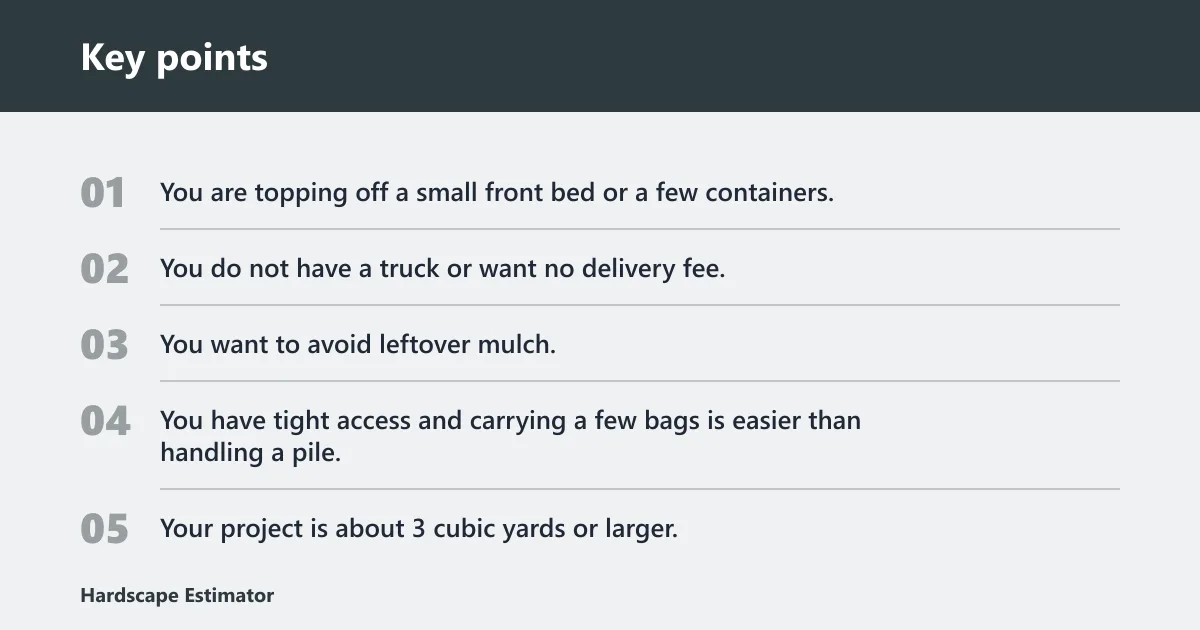
Choose Bagged mulch if…
- You are topping off a small front bed or a few containers.
- You do not have a truck or want no delivery fee.
- You want to avoid leftover mulch.
- You have tight access and carrying a few bags is easier than handling a pile.
Choose bulk if…
- Your project is about 3 cubic yards or larger.
- You want the lower cost per cubic yard after delivery.
- You have a driveway, staging area, or yard space for the pile.
- You want one large load for a more uniform look across a bigger bed.
Cases where either option can work
For a 100 to 200 square foot bed at common depths, both options can be reasonable depending on access and delivery. A 100 square foot bed at 2 inches deep needs about 0.62 cubic yards, while 200 square feet at 2 inches needs about 1.23 cubic yards. Those sizes usually favor bags on price, but bulk can still make sense if delivery is cheap or you are combining several beds into one order.
Frequently asked questions
Is bagged mulch cheaper than bulk mulch for my project?
Bagged mulch is usually cheaper for small projects because it avoids a delivery fee and keeps leftover risk low. Bulk becomes cheaper when the order is large enough to spread delivery across more yards. In the sample model here, that crossover happens around 2.54 cubic yards.
At what project size does bulk mulch become cheaper?
With the sample prices used here, bulk mulch becomes cheaper at about 2.54 cubic yards once a $25 delivery fee is included. If the delivery fee is higher, the crossover moves upward. If the bulk yard price is lower, the crossover moves downward.
Do delivery fees make bulk mulch more expensive than bags?
Yes, especially on small orders. A flat delivery fee can erase bulk’s lower yard price when you only need a half yard or one yard. Once the project gets larger, that same fee matters less per cubic yard and bulk usually pulls ahead.
What hidden costs should I factor in besides mulch price?
Count hauling, loading, leftover material, storage space, and cleanup. Bagged mulch creates more handling and more plastic waste. Bulk mulch can be cheaper per yard, but it needs room for the pile and can leave extra material if the estimate is high.
When is bagged mulch still the better choice?
Bagged mulch is still the better choice for small touch-ups, planters, and tight access where delivery is awkward or impossible. It also helps when you want exact quantity control and less mess. For a small front bed, that convenience can outweigh the higher per-yard cost.
Does bulk mulch save money on larger beds?
Yes. Once the project is large enough, bulk mulch usually saves money because the per-yard price is lower and the delivery fee is spread over more material. It also works well for larger beds where one load can cover the whole area with better color and texture consistency.