How Much Does a Bag of Mulch Cover? Coverage by Depth
A 2-cubic-foot bag of mulch covers about 24 sq ft at 1 in. deep, 12 sq ft at 2 in., and 8 sq ft at 3 in.; for small beds, buy by square feet × depth ÷ 12. Thin spreads dry faster and leave more weed pressure. Thick spreads use more bags and raise cost. This guide gives a coverage-by-depth table, the bag math, and a quick rule for estimating small beds.
This guide is part of our Bagged mulch: how much to buy, cost, and best uses series.
How much does a bag cover?
A bag’s volume, not its weight, tells you coverage. For mulch, the standard formula is square feet covered = (bag cubic feet × 12) ÷ depth in inches. At the common 3 in. reference depth, a 2 cu ft bag covers 8 sq ft and a 3 cu ft bag covers 12 sq ft.
Why depth changes coverage
Depth and coverage move in opposite directions. Add depth, and each square foot takes more material. Reduce depth, and coverage rises, but moisture hold and weed blocking can drop too. Most mulch beds are spread in the 2 to 4 in. range, and 3 in. is the common reference depth.
Bag size matters first. Two-cubic-foot and 3-cubic-foot bags are commonly sold bagged mulch sizes, and 4-cubic-foot bags may be less common. Weight can mislead here, because moisture and material type change how heavy a bag feels without changing the volume inside it.
Mulch coverage matrix
This table shows how far 2 cu ft and 3 cu ft bags go at common depths. It also includes the exact bag counts for 50, 100, and 200 sq ft projects with a 10% overage buffer, rounded up to whole bags.
| Bag size | 1 in. | 2 in. | 3 in. | 4 in. | 6 in. | 50 sq ft with 10% buffer | 100 sq ft with 10% buffer | 200 sq ft with 10% buffer |
|---|---|---|---|---|---|---|---|---|
| 2 cu ft | 24 sq ft | 12 sq ft | 8 sq ft | 6 sq ft | 4 sq ft | 7 bags | 14 bags | 28 bags |
| 3 cu ft | 36 sq ft | 18 sq ft | 12 sq ft | 9 sq ft | 6 sq ft | 5 bags | 10 bags | 19 bags |
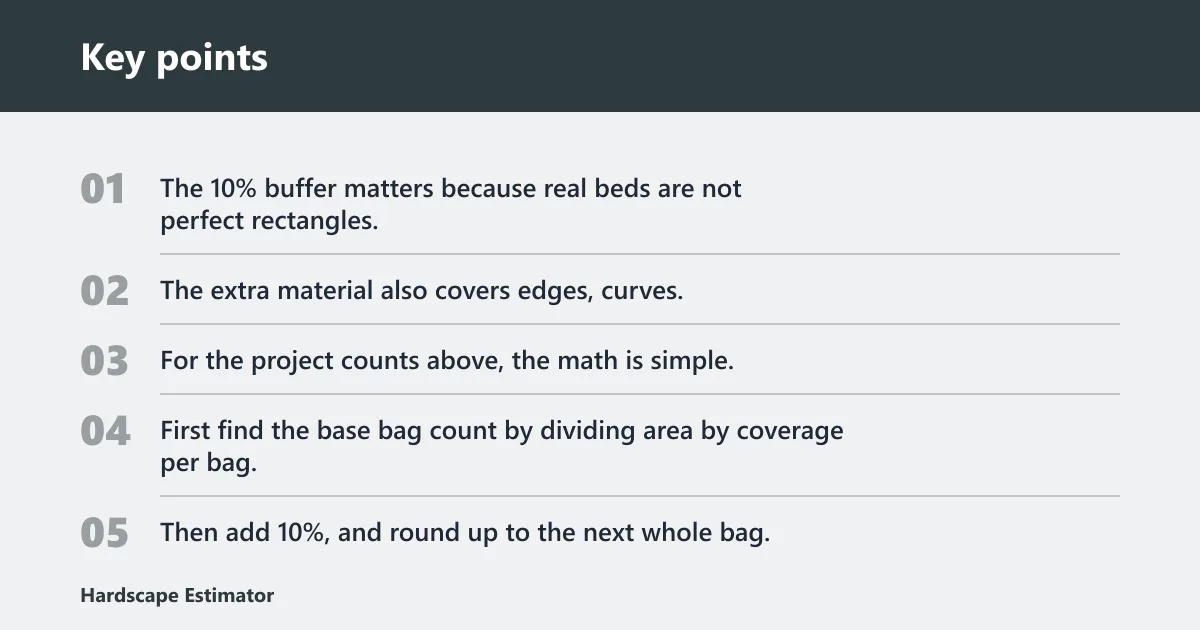
The 10% buffer matters because real beds are not perfect rectangles, and mulch settles after spreading. The extra material also covers edges, curves, and thin spots without forcing a second trip to the store.
For the project counts above, the math is simple. First find the base bag count by dividing area by coverage per bag. Then add 10%, and round up to the next whole bag. That rounding step is what keeps a project from running short.
Say your front bed measures 10 ft by 5 ft. That is 50 sq ft. At 3 in. deep with 2 cu ft bags, the base need is 50 ÷ 8 = 6.25 bags. Add 10% and round up, and the order becomes 7 bags.
How many bags do you need?
For a 50 sq ft bed at 3 in. deep, plan on 7 bags of 2 cu ft mulch or 5 bags of 3 cu ft mulch after the 10% buffer. For 100 sq ft, that becomes 14 bags of 2 cu ft mulch or 10 bags of 3 cu ft mulch. For 200 sq ft, it is 28 bags of 2 cu ft mulch or 19 bags of 3 cu ft mulch.
50 square feet example
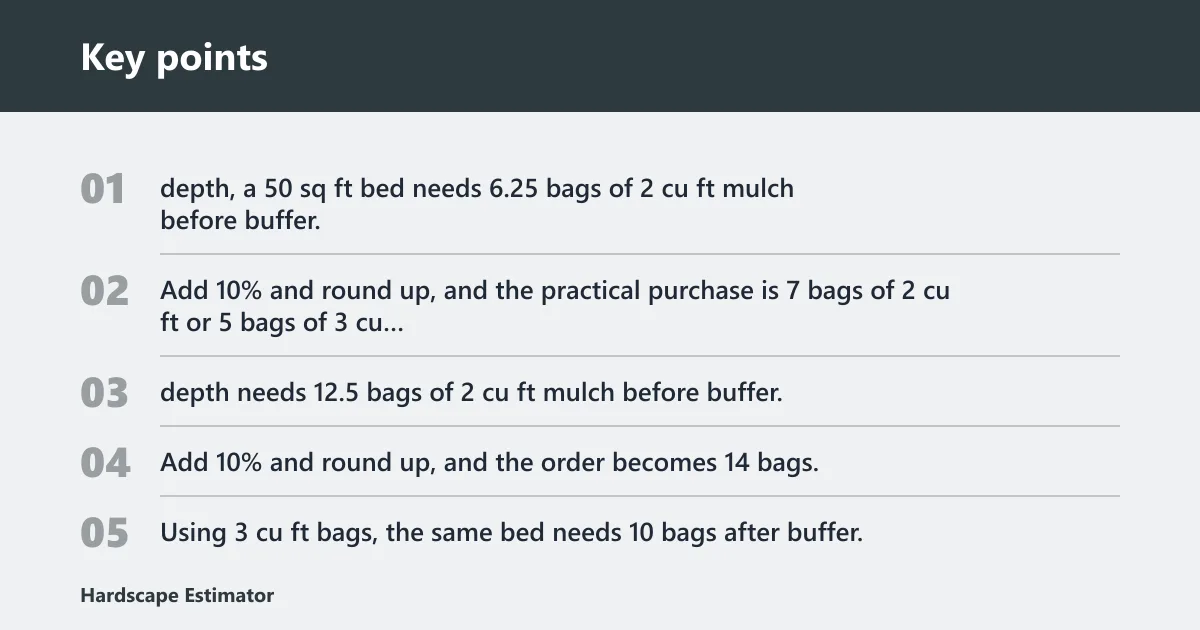
At 3 in. depth, a 50 sq ft bed needs 6.25 bags of 2 cu ft mulch before buffer, or 4.17 bags of 3 cu ft mulch. Add 10% and round up, and the practical purchase is 7 bags of 2 cu ft or 5 bags of 3 cu ft.
100 square feet example
A 100 sq ft bed at 3 in. depth needs 12.5 bags of 2 cu ft mulch before buffer. Add 10% and round up, and the order becomes 14 bags. Using 3 cu ft bags, the same bed needs 10 bags after buffer.
200 square feet example
A 200 sq ft bed at 3 in. depth needs 25 bags of 2 cu ft mulch before buffer. Add 10% and round up, and the order becomes 28 bags. With 3 cu ft bags, the total comes to 19 bags after buffer.
A common first-timer mistake is to buy exactly the base count and skip the buffer. That works on paper, then falls short when the bed has a curved edge, a root flare, or a few low spots that need extra material.
Does mulch type change coverage?
Yes. Mulch type changes practical handling, and it can shift coverage slightly because density and moisture vary. Bag volume is still the main measure, but the feel of the bag and the spread pattern can differ from one product to another.
Wood mulch
Wood mulch bags usually weigh about 20 to 30 pounds. That weight is only a handling clue, not a coverage rule. A wetter bag can weigh more without covering more area, and a fluffier blend can settle more after spreading.
Rubber mulch
Rubber mulch bags weigh about 40 to 50 pounds. The heavier bag does not automatically cover more ground. Rubber is denser and often more awkward to spread evenly, so the bag count should still come from volume and depth, not from weight.
Straw mulch
Straw mulch is lighter and less dense than many wood products, so it may spread differently and settle in its own way. Even so, the estimating method stays the same: use the bag volume, the target depth, and the square footage of the bed.
How do you measure bed area?
Start with the shape. For rectangles, multiply length by width. For circles, use radius-based area math. For irregular beds, break the space into smaller simple shapes, measure each one, then add them together. That keeps the estimate close enough to buy the right number of bags.
Rectangle area
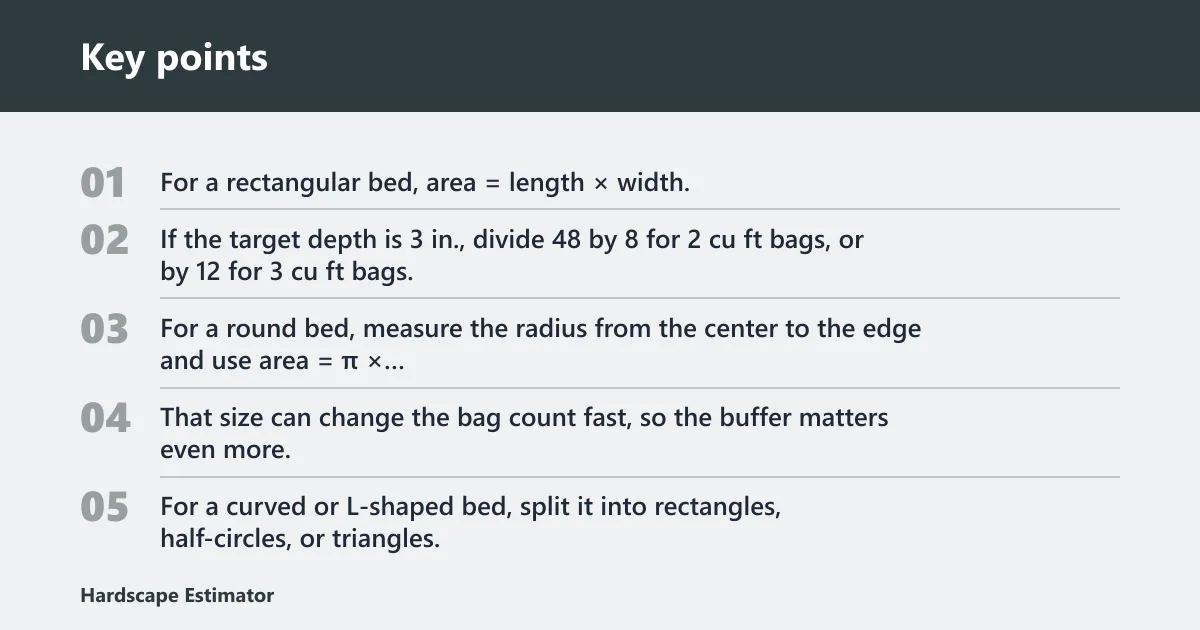
For a rectangular bed, area = length × width. A 12 ft by 4 ft bed is 48 sq ft. If the target depth is 3 in., divide 48 by 8 for 2 cu ft bags, or by 12 for 3 cu ft bags, then add the 10% buffer and round up.
Circle area
For a round bed, measure the radius from the center to the edge and use area = π × radius squared. A 5 ft radius circle is about 78.5 sq ft. That size can change the bag count fast, so the buffer matters even more.
Irregular beds
For a curved or L-shaped bed, split it into rectangles, half-circles, or triangles, then total the pieces. This is the safest way to avoid underbuying. The more edges and curves a bed has, the more likely the real spread area differs from a quick guess.
Bagged mulch vs bulk mulch
Bagged mulch makes sense for small to medium jobs, tight access, and precise color matching. Bulk mulch becomes more practical when the bed area grows, because 1 cubic yard equals 27 cubic feet and the per-volume economics usually improve as the project gets larger.
When bags make sense
Bags are easier to move, store, and split across several small beds. They also help when you need only a few cubic feet and want to control overage closely. For a porch bed or a small front-yard border, bagged mulch is often the simpler buy.
When bulk makes sense
Bulk becomes more attractive as the square footage climbs, especially when the project needs many bags. The labor changes too: bulk can save unloading time, while bags can save cleanup time. The better choice depends on access, total area, and how much material the beds actually need.
If a project is large enough that the bag count starts to look unwieldy, bulk is worth pricing. If the beds are small, bagged mulch usually gives more control and less leftover material.
Frequently asked questions
How much does a bag of mulch cover per square foot?
It depends on bag volume and depth. At 3 in. deep, a 2 cu ft bag covers 8 sq ft and a 3 cu ft bag covers 12 sq ft. Shallower spreads cover more area; deeper spreads cover less area. Weight is not the coverage measure.
How much area does a 2 cu ft bag of mulch cover at 3 inches?
A 2 cu ft bag covers 8 sq ft at 3 in. deep. That is the common reference point used on many coverage charts. If the bed is deeper than 3 in., the same bag covers less area. If the bed is shallower, it covers more.
How much area does a 3 cu ft bag of mulch cover at 3 inches?
A 3 cu ft bag covers 12 sq ft at 3 in. deep. That is why the 3 cu ft size is useful for larger beds or faster installs. The same formula applies: bag cubic feet times 12, divided by the desired depth in inches.
How many bags of mulch do I need for 100 square feet?
For 100 sq ft at 3 in. deep, plan on 14 bags of 2 cu ft mulch or 10 bags of 3 cu ft mulch after the 10% buffer. Without the buffer, the raw math is 12.5 bags or 8.33 bags, which is why rounding up matters.
How many bags of mulch do I need for 200 square feet?
For 200 sq ft at 3 in. deep, plan on 28 bags of 2 cu ft mulch or 19 bags of 3 cu ft mulch after the 10% buffer. Larger beds make the buffer more important, because a small shortage turns into a visible thin spot across a wide area.
How deep should I spread mulch for best coverage?
Most mulch beds are spread 2 to 4 in. deep, with 3 in. as the common reference depth. Thin layers cover more area per bag, but they may need refreshing sooner. Deeper layers cover less area per bag, and they can hold moisture and suppress weeds better.