Paver Sand vs Paver Base: What Goes Where?
Paver sand belongs in the bedding layer and joints only; paver base belongs below it as the load-bearing layer, usually 4 in to 8 in compacted for patios and walkways, more for light-driveway use. Swap them and the surface shifts, drains poorly, and can rut or settle. This guide lays out each layer, what each material does, and the failures that show up when sand and base are reversed.
| Decision factor | Paver sand | paver base | Winner |
|---|---|---|---|
| Where it goes | Bedding layer under pavers, or joints after installation | Structural layer under the bedding sand | paver base |
| What it does | Creates a flat setting bed and fills joints | Supports load, drainage, and long-term stability | paver base |
| Structural strength | Not structural | Structural and compacted in thin lifts | paver base |
| Best-fit use case | Fine bedding layer and joint lock-up | Patios, walkways, and heavier-load areas | tie |
| Failure risk if swapped | Base built from sand can move, rut, and settle | Used as bedding, it will not create a stable setting bed | paver base |
What goes under pavers?
The standard stack is subgrade, paver base, bedding sand, pavers, then joint material. Pavers should not go directly on dirt. The soil below must be firm before any base goes in, because soft or organic ground keeps moving after the surface is finished.
Subgrade: the soil below the build
Subgrade is the native soil after excavation and compaction. If it is soft, wet, or full of organic material, it needs correction before the base is placed. Weak subgrade leads to settlement, which shows up later as dips, rocking pavers, and uneven joints.
Paver base: the structural layer
Paver base is the load-bearing layer under the pavers. It is usually crushed stone or dense graded aggregate, compacted in thin lifts, with a common compacted depth of 4 to 6 inches for a standard patio. For vehicle areas, the base depth is typically greater.
Bedding sand: the setting bed
Bedding sand sits above the base and below the pavers. It is typically about 1 inch thick and is screeded flat before pavers are set. It is not there to carry load; it is there to create a uniform bed for final placement and small adjustments.
How thick should each layer be?
A standard patio stack is often about 8 to 9 inches below finish grade when you factor in paver thickness, about 1 inch of bedding sand, and about 4 to 6 inches of compacted base. Heavier loads need more excavation because the base gets deeper, not because the sand layer gets thicker.
Excavation depth for a standard patio
Standard patio dig depth can be roughly 8 to 9 inches below finish grade. That total comes from the paver thickness, the bedding sand, and the compacted base. If the slope changes or the patio meets a threshold, the dig depth must still leave enough room for the full stack and drainage fall.
Common compacted base depth
For patios and walkways, 4 to 6 inches of compacted base is common. Driveway or vehicle areas typically need 8+ inches of base. The extra depth belongs in the structural layer, not in a thicker sand bed.
Bedding sand thickness and screeding
The bedding layer is typically 1 inch of coarse concrete sand. It is screeded flat, then the pavers are set on top. If the bedding layer gets too thick, the surface can shift under load and create lippage between adjacent pavers.
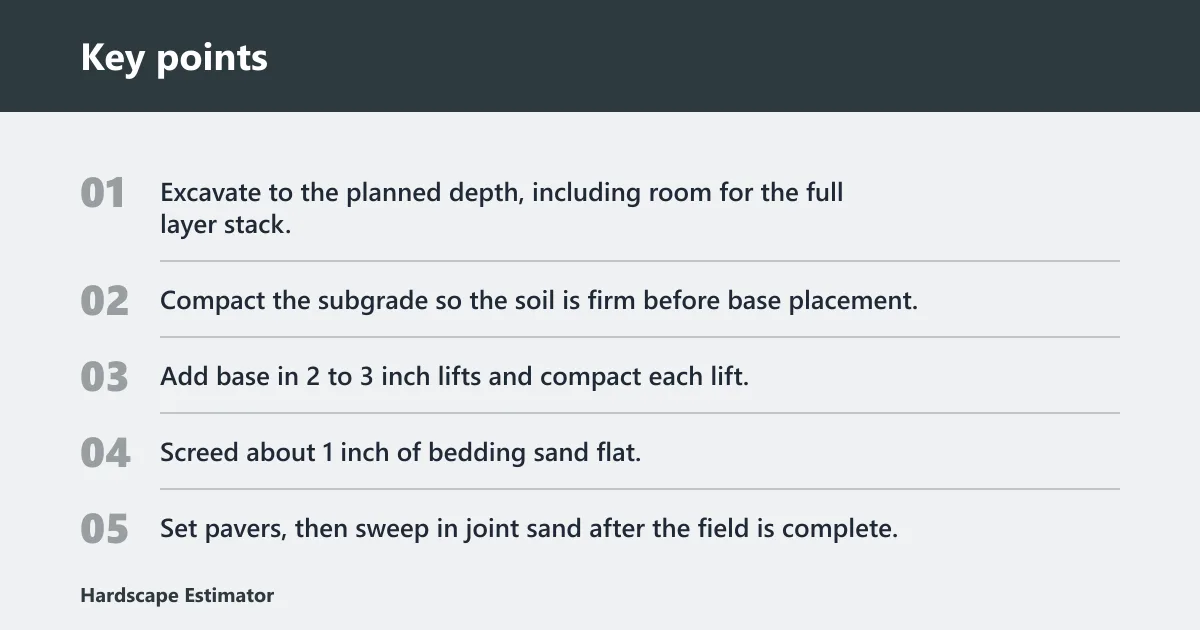
- Excavate to the planned depth, including room for the full layer stack.
- Compact the subgrade so the soil is firm before base placement.
- Add base in 2 to 3 inch lifts and compact each lift.
- Screed about 1 inch of bedding sand flat.
- Set pavers, then sweep in joint sand after the field is complete.
Paver base materials and compaction
Base should be compacted in 2 to 3 inch lifts, not dumped thick. Compaction energy does not fully reach a deep loose layer, so a thick dump can look packed on top while staying loose underneath. That hidden weakness shows up later as settlement.
Crushed stone base vs rounded gravel
Crushed angular aggregate locks together better than rounded gravel. That interlock is why crushed stone base aggregate is preferred, whether the local name is road base, class 5, or crusher run. Rounded gravel can drain, but it does not lock as well for a paver base.
Why thin lifts matter for compaction
Plate compactor use matters because the machine’s energy does not fully penetrate a thick dump. Thin 2 to 3 inch lifts let each layer compact evenly. If the base is left loose below the surface, the patio can settle after the pavers are installed.
When geotextile fabric belongs below the base
Geotextile fabric belongs between weak soil and the base when the subgrade is clayey or unstable. When used below the base, a non-woven, needle-punched fabric can help reduce migration of fines into the base. It is a separator, not a replacement for compaction.
Paver sand, regular sand, and play sand
Paver sand is a bedding material; regular sand and play sand are not direct substitutes. Bedding sand needs to screed evenly and stay stable under pavers. Joint sand has a separate job after installation, and polymeric sand is used there, not in the bedding layer.
Bedding sand vs all-purpose sand
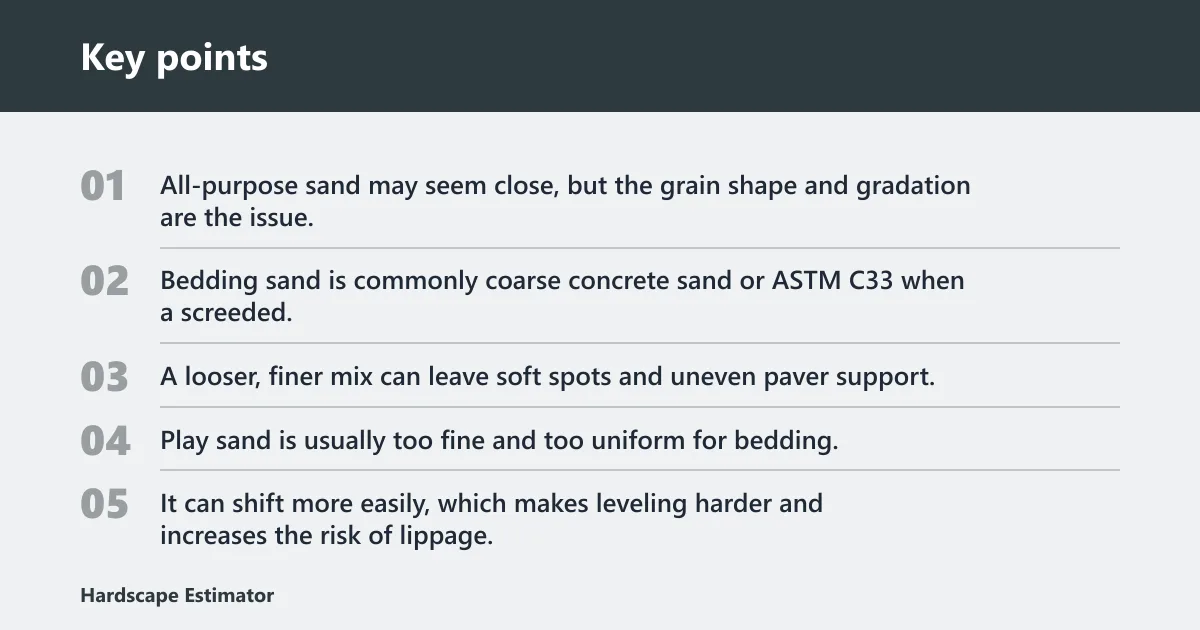
All-purpose sand may seem close, but the grain shape and gradation are the issue. Bedding sand is commonly coarse concrete sand or ASTM C33 when a screeded, stable layer is needed. A looser, finer mix can leave soft spots and uneven paver support.
Play sand vs paver sand
Play sand is usually too fine and too uniform for bedding. It can shift more easily, which makes leveling harder and increases the risk of lippage. It also is not the right choice for joint filling when a harder, more stable joint is needed.
Why thick sand beds fail
Thick sand beds do not fix a bad base. They can hide uneven excavation for a while, but they do not carry the load the way a compacted base does. The result is rocking pavers, washout at the edges, and settlement after rain or freeze-thaw cycles.
Say your 12 ft by 16 ft patio is dug only 4 inches deep and filled mostly with sand. It may look level on day one. After the first hard rain, the sand can move, the pavers can rock, and the surface may begin to dip where chairs and foot traffic concentrate.
Paver base and bedding layers matrix
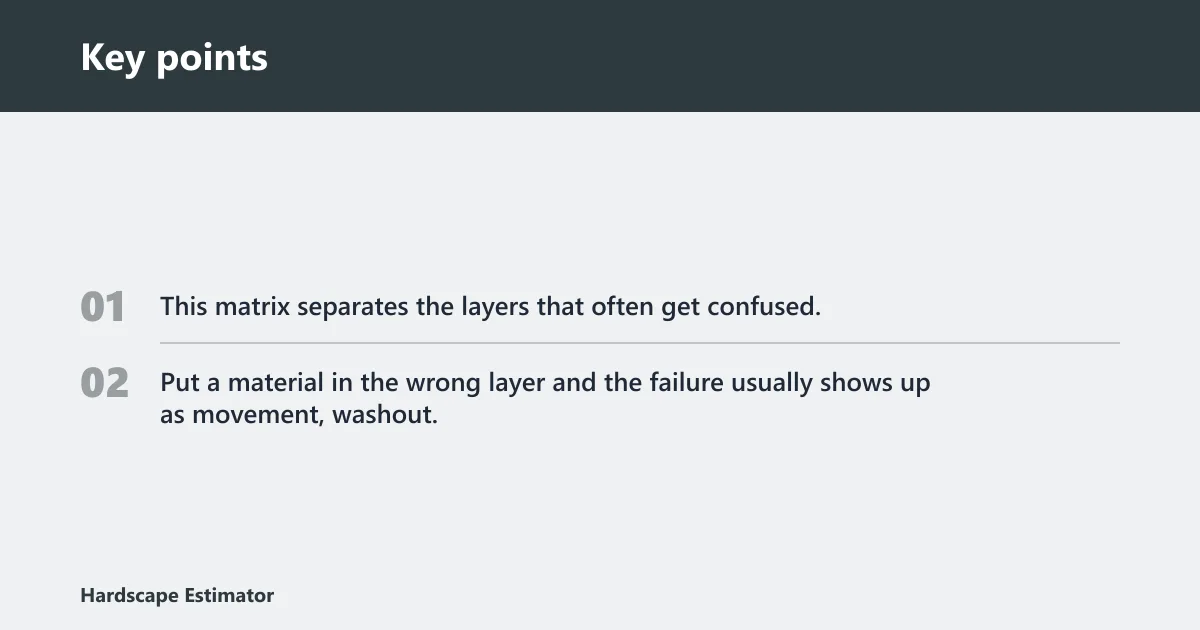
This matrix separates the layers that often get confused. Base carries the load. Bedding sand sets the pavers. Joint material locks the finished surface. Put a material in the wrong layer and the failure usually shows up as movement, washout, or uneven joints.
| Material | Location in the assembly | Function | What happens if it is used in the wrong layer |
|---|---|---|---|
| Paver base | Below the bedding layer, above the subgrade | Structural support and drainage | If used as bedding, it will not screed flat and can leave an uneven paver seat. |
| Bedding sand | About 1 inch above the base, under the pavers | Flat setting bed for paver placement | If used as base, it cannot carry load and the patio can settle or rut. |
| Polymeric sand | In the joints after pavers are installed | Locks joints and helps resist weeds | If used as bedding, it clumps and does not create a proper setting bed. |
| Play sand | Not recommended for either layer | Loose fine sand, not a paver-specific material | In bedding, it can shift; in joints, it can wash out more easily. |
| Regular sand | Not recommended as a direct substitute | General fill material with variable grading | It can leave voids or soft spots and does not perform like coarse concrete sand. |
| Gravel | May appear in drainage or subbase uses, not as a paver setting bed | Drainage and bulk fill, depending on size and gradation | Rounded gravel under pavers can shift because it does not lock as well as angular base. |
What fails when layers are swapped?
When sand and base are swapped, the first problems are usually rocking pavers, lippage, and surface dips. Later failures include washout at the edges, settlement in traffic paths, and frost heave in colder climates. The symptom tells you which layer is wrong.
Rocking pavers and lippage
Rocking means the paver is not fully supported. Lippage means adjacent pavers sit at different heights. Both often trace back to a weak base, too much bedding sand, or poor compaction in the layers below the surface.
Washout and joint loss
Washout shows up after rain or runoff moves loose material. If the base is too sandy or the bedding is too thick, water can carry fines out of the assembly. Joint loss is a separate issue; it points to missing or poorly installed joint sand, not a base problem by itself.
Settlement and frost heave
Settlement happens when the subgrade or base keeps compressing after installation. Frost heave happens when water in the system freezes and lifts the surface. Good excavation depth, a compacted base, slope away from structures at about 1/8 inch per foot, and proper drainage all reduce both risks.
Picture a driveway apron built over soft soil with only a shallow sand layer underneath. The first winter can push the surface up, then spring thaw can drop it unevenly. The result is a wavy edge and pavers that no longer meet cleanly at the joint lines.
Choose Paver sand if…
Choose Paver sand if you are building the bedding layer or filling joints after installation. It is the right choice when the base below it is already compacted and level, and when the surface needs a thin, screeded bed rather than structural support.
Choose paver base if…
Choose paver base if you need the structural layer under the pavers. It is the right choice for patios, walkways, and heavier-load areas because it supports the system, drains properly, and resists movement when compacted in thin lifts.
Frequently asked questions
Paver sand vs regular sand
Paver sand is graded for use under pavers and in the joints, while regular sand is a general fill material with variable particle shape and size. The practical difference is stability. Regular sand can bridge, shift, or wash more easily, so it is a poor substitute for bedding or joints.
Paver sand vs all purpose sand
All-purpose sand is not the same as coarse concrete sand or ASTM C33 bedding sand. It may work in some fill uses, but under pavers it can leave a softer or less uniform bed. The bedding layer needs consistent screeding and support, not a generic sand blend.
Leveling sand vs paver base
Leveling sand is the bedding layer, usually about 1 inch thick, and it sits above the base. Paver base is the structural layer below it. If the base is weak, a thicker sand bed does not solve the problem; it only hides it for a while.
What type of sand goes under pavers
Coarse concrete sand is the usual choice under pavers, and ASTM C33 bedding sand is a common specification. It should be screeded flat and kept to about 1 inch thick. That layer is for setting pavers, not for replacing the structural base beneath it.
Paver base vs gravel
Paver base is usually crushed angular aggregate or dense graded aggregate, compacted in lifts. Gravel can mean rounded stone, which does not lock together as well. Rounded gravel may drain, but it is not the best choice for a stable paver base.
Is paver sand coarse?
Yes, bedding sand is typically coarse compared with play sand or fine all-purpose sand. That coarser grading helps it screed and hold shape under pavers. It still is not structural, and it should not be confused with the base layer below it.
Paver sand vs polymeric sand
Paver sand usually means the bedding sand under the pavers. Polymeric sand goes in the joints after the pavers are installed, then activates with water to help lock the joints and resist weeds. They are different materials for different layers, and they are not interchangeable.
Play sand vs paver sand: play sand is usually too
Play sand is usually too fine and too uniform for paver bedding. It can move under load and create uneven support. Paver sand is chosen for bedding and joint performance, while play sand is generally the wrong choice for either job in a hardscape assembly.
Paver panels vs paver base
Paver panels are a different product category and do not replace the structural base below them. Even if a panel system changes how the surface is assembled, it still needs stable support over prepared subgrade. The load path still has to reach a compacted base or an engineered support system.