Is Landscape Edging Necessary for Landscaping?
Edging is not always necessary, but it pays off when you need to hold mulch or gravel in place, keep mower lines sharp, manage slope movement, or cut yearly cleanup time. Skip it in low-traffic beds with stable soil, and you may spend more on repairs, re-edging, and lost material. This guide gives a simple yes-no decision framework by bed type, slope, traffic, movement, and maintenance goals.
Do you really need edging?
Usually, no. Edging is a tool, not a requirement. It matters most when a bed edge has to hold material in place, separate lawn from loose aggregate, or keep a mower from chewing into the border. If the bed is flat, quiet, and easy to reset, a soft edge can be enough.
What edging does in a bed
Edging separates materials and defines the bed edge. That helps hold mulch and soil in place, reduces grass intrusion, and gives mowers a cleaner boundary to follow. The job changes by site: mulch needs light restraint, gravel needs firmer restraint, and lawn borders need better definition for trimming.
When edging is optional, not required
Edging is optional in small beds, low-traffic yards, and areas where the planting design can tolerate a looser line. A soft edge is often enough where the bed sits level, drainage is ordinary, and the owner is willing to refresh mulch or re-cut the edge once in a while. In those settings, hard edging may add cost without enough benefit.
The main signs you need a firmer edge
Install edging when you see material spilling into the lawn, mower tracks cutting the border, or soil and mulch drifting downhill after rain. Gravel that migrates onto walks, bare spots where grass keeps creeping in, and a bed line that needs constant repair are all signs that the border is doing too little.
Mulch and gravel edge matrix
The right answer depends on what the border is holding. Mulch moves differently from gravel, and both behave differently from a lawn edge. This table scores six common scenarios so you can compare need level, best edging type, failure risk, and maintenance burden before you buy anything.
| Scenario | Need level | Best edging type | Failure risk | Maintenance burden |
|---|---|---|---|---|
| Mulch bed | Moderate | Soft edge or light metal edging | Medium | Low to medium |
| Gravel bed | High | Hard edging, trenched metal, concrete, or stone | High without restraint | Medium |
| Sloped bed | High | Hard edging with deeper installation | High | Medium to high |
| Lawn border | Moderate | Mower edge, metal, or aluminum | Medium | Low to medium |
| High-traffic edge | High | Steel, concrete, or paver-integrated edging | High with plastic or no-dig systems | Medium |
| Low-maintenance native bed | Low to moderate | Soft edge or discreet metal edging | Low | Low |
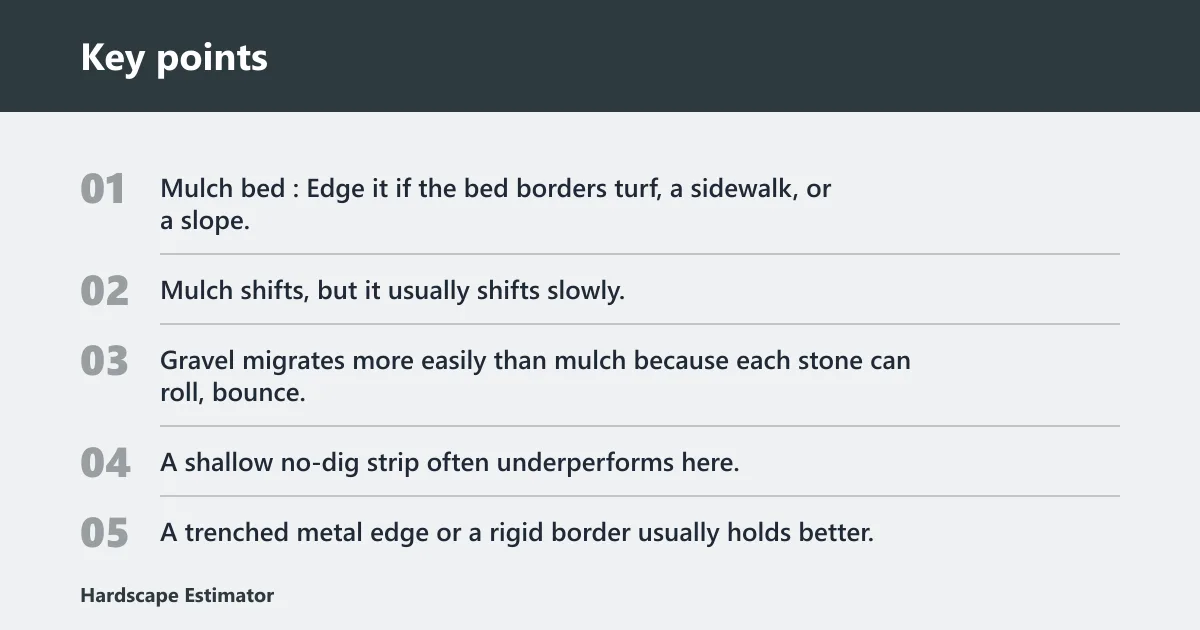
Mulch bed: Edge it if the bed borders turf, a sidewalk, or a slope. Mulch shifts, but it usually shifts slowly, so a soft edge or light metal restraint can be enough in a calm site. If the bed is flat and wide, the need drops.
Gravel bed: Give it a firmer border. Gravel migrates more easily than mulch because each stone can roll, bounce, and spread under foot traffic and runoff. A shallow no-dig strip often underperforms here. A trenched metal edge or a rigid border usually holds better.
Sloped bed: Treat slope as a force multiplier. Runoff can wash mulch and gravel downhill, and repeated movement can expose the edge itself. The steeper the bed, the more the edge has to resist washout and the less useful a light, surface-only solution becomes.
Lawn border: Edge it if trimming time matters. A clean mower edge can reduce string-trimming along long runs of grass and beds. In a tiny yard with short borders, the savings may be modest, but along a long front walk or curb line, it adds up quickly.
High-traffic edge: Use a tougher system. Foot traffic, mower wheels, or carts can bend plastic, loosen no-dig stakes, and blur the line. Hard edging pays off here because the edge needs both shape and strength, not just visual definition.
Low-maintenance native bed: Skip hard edging unless the site is unruly. Native plantings often look best with a softer transition, and the bed may not need a crisp border if it is not holding loose aggregate. Keep the edge simple unless grass intrusion or runoff becomes a problem.
Which edging type fits your yard?
Soft edging and hard edging solve different problems. Soft edging gives a natural transition and costs less, but it does less to hold material. Hard edging is more rigid, more durable, and more expensive to install. It is the better choice when the bed needs real containment or a crisp edge that stays put.
Soft edging versus hard edging
Soft edging is best where you want a low-visibility border and the bed does not face much traffic or runoff. Hard edging fits places that need shape retention, mower protection, or material separation. If the border has to work as a barrier, hard edging is usually the safer choice.
Common edging materials
Metal and aluminum edging are popular for thin, clean lines. Steel is stronger and usually better for holding shape in tougher sites. Plastic is lower cost but can flex, lift, or warp sooner. Concrete, stone, and brick are heavier and more permanent, and they fit projects that need both restraint and a more substantial visual edge.
Installation methods
No-dig edging is common for DIY work and temporary or low-traffic areas. It installs without trenching, which keeps labor down, but it is less suited to steep beds or places that get hit by mowers. Trenched edging sits deeper and usually holds better. Paver-integrated edging works when the border is part of a patio, walk, or step layout.
Suppose a 20 ft mulch bed runs beside a lawn on a slight slope. A no-dig plastic edge may look fine at first, but after a few storms the mulch can move downhill and the edge can start to lean. In that case, a deeper metal or steel border is more likely to hold its line.
A common mistake is skipping edging around a mulched flower bed, only to watch the mulch spill into the lawn after the first heavy rain. Gravel needs restraint because it migrates. If the edge is too soft, the stones spread into the turf and onto hardscape, and cleanup becomes part of the routine.
Does edging help mulch beds?
Yes, especially where mulch meets lawn, turns a corner, or sits on a slope. Mulch tends to creep, spread, and thin out at the edge without a defined border. Edging does not stop movement completely, but it slows it and keeps the bed line easier to maintain.
How mulch moves without a border
Without restraint, mulch is pushed by rain, foot traffic, string trimmers, and raking. On level ground, that usually means gradual spreading and a fuzzier bed edge. Near turf, the mulch can spill into the grass, while the grass itself grows into the bed and blurs the line.
Where mulch beds need the most restraint
The highest-risk spots are corners, curves, sloped sections, and any edge next to a lawn mower path. Mulch near downspouts or at the low end of a grade also moves more easily because water has more force there. In those places, edging is worth more than it is in a flat interior bed.
When a soft edge is enough
A soft edge works when the bed is small, flat, and easy to refresh. It can also fit native plantings or beds where some blur in the boundary is acceptable. If the mulch stays in place and trimming is simple, a hard border may be more effort than benefit.
What changes on slopes and in drainage?
Slope changes the answer quickly. It raises runoff, increases washout risk, and can make both mulch and gravel move farther than expected. Drainage matters too, because edging that blocks water can create pooling, soil saturation, or maintenance problems near low spots and downspouts.
Why slope raises washout risk
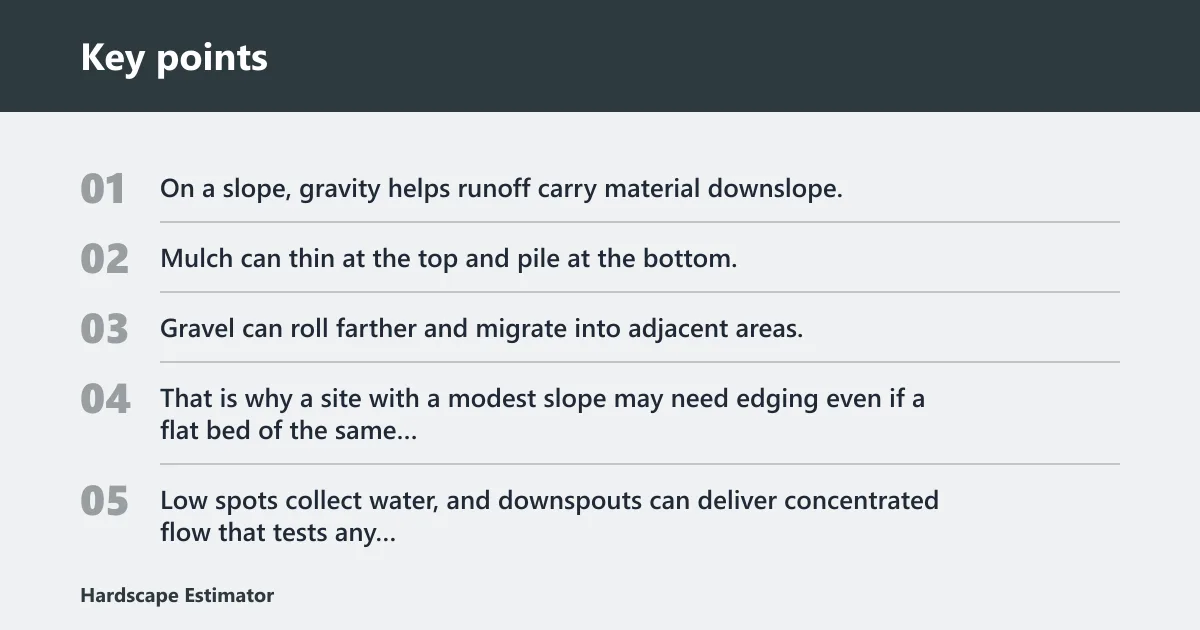
On a slope, gravity helps runoff carry material downslope. Mulch can thin at the top and pile at the bottom. Gravel can roll farther and migrate into adjacent areas. That is why a site with a modest slope may need edging even if a flat bed of the same size would not.
Low spots and downspouts
Low spots collect water, and downspouts can deliver concentrated flow that tests any border. Edging placed across a flow path may trap water if the grading is not handled first. In those cases, drainage and grading should be corrected before the edge is set, or the border can become a dam rather than a restraint.
When edging helps and when it can trap water
Edging helps when it is part of a drainage plan that lets water move where it should. It can hurt when it forms a lip at the wrong point in the grade. Near a downspout, a low bed, or a place where water already pools, the right move may be regrading first and choosing a lower-profile edge.
ASLA-NY is the New York Chapter of the American Society of Landscape Architects, and it serves the New York Metropolitan-Long Island region. That region extends to Dutchess and Orange Counties in the lower Hudson Valley and includes New York City and Montauk. For projects that need grading, drainage, and bed layout to work together, that kind of regional planning context matters.
Garden Design NYC offers end-to-end support including budgeting and cost estimating, and it works on rooftop terraces, townhouse gardens, large properties, vacation properties, and public spaces. It says it has earned 12 Houzz awards from 2015 to 2024, and says Todd’s work has been featured in The New York Times and Architectural Digest. Those are the kinds of details that matter when edging is tied to a larger site plan.
Can you skip edging around a lawn?
Yes, if the border is short, the site is calm, and you do not mind occasional trimming. But where lawn meets beds over a long run, edging can save time by creating a clear mower edge and reducing grass intrusion. The more visible the line and the more often it gets cut, the more useful edging becomes.
Mower edge benefits
A mower edge gives the blade a cleaner path and helps define the transition between turf and bed. That reduces string trimming along the border and can keep the line looking cleaner with less hand work. It is most useful where beds run straight along walks, drives, or open lawn.
Grass intrusion control
Edging helps keep grass out of flower beds by creating a physical or visual break at the boundary. It does not stop runners forever, and it will not remove weeds by itself, but it makes intruding grass easier to spot and cut back before it overtakes the edge.
Small yards and low-traffic borders
You can skip edging on a small yard if the bed is stable and you do not need a crisp line. In a compact space, the extra cost and labor may not buy much. In a larger yard with more mowing and trimming, the same choice can create extra work every season.
Ascape offers weed control, mulch installation, and drainage and grading services, and serves parts of Westchester and Orange counties. It also lists hardscape features including patios, walkways, and outdoor steps. That mix shows why edging decisions often sit at the overlap of bed maintenance, drainage, and hardscape layout.
- Check whether the bed holds mulch, gravel, or soil that moves.
- Look at slope, runoff, and any low spots or downspouts.
- Decide whether the border needs mower definition or only a soft transition.
- Match the edging type to the traffic level and the material being contained.
- Choose the least complex edge that still solves the movement problem.
Frequently asked questions
Is edging necessary for beds?
No, not in every yard. It becomes useful when a bed needs containment, a mower edge, or a firmer transition between lawn and loose material. In flat, low-traffic beds with stable soil, a soft edge can be enough. The real test is whether the border is failing, not whether it looks unfinished.
Do I really need edging around mulch beds?
Often yes, but not always. Mulch beds near lawn edges, slopes, or walkways often benefit most because mulch can spread and thin without restraint. A simple border can reduce cleanup and keep the bed line clearer. If the bed is flat and sheltered, a soft edge may be enough for a while.
What happens if I don’t install edging?
You may see grass creep into the bed, mulch spread into the lawn, gravel migrate onto hardscape, and the bed line get blurrier over time. You may also spend more time trimming and resetting the edge. The risk is highest where water, traffic, or slope keeps moving material out of place.
When is edging worth the cost?
It is worth the cost when it prevents recurring loss or labor. That usually means gravel beds, sloped beds, long lawn borders, or high-traffic edges that keep failing. If the edge will save repeated cleanup, protect the mower line, or reduce washout, the added cost is easier to justify.
Should I use soft edging or hard edging?
Use soft edging when the bed is low-stress, low-visibility, and not holding much loose material. Use hard edging when you need stronger containment, a crisp line, or better durability. Hard edging costs more and takes more labor, but it usually holds up better where movement and wear are real.
What type of edging is best for my yard?
Match the material and install method to the problem. Metal or aluminum works well for clean lawn borders; steel, concrete, stone, or brick fit tougher or more permanent edges; plastic is best reserved for lighter-duty use. No-dig works for simple sites, while trenched or paver-integrated edging fits harder-working borders.