How to Convert Dry Quarts of Soil to Cubic Yards
Divide dry quarts by 694.3 to get cubic yards. That comes from 1 cubic foot equaling 25.714 dry quarts and 1 cubic yard equaling 27 cubic feet. Use the result for soil orders, add a settling buffer, and round up to whole bags so you do not come up short.
Dry quarts to cubic yards
A dry quart is a dry-measure volume used for granular materials like soil and potting mix. It is not the same as a liquid quart. For soil buying, cubic feet is the useful bridge: bag labels often use it, and cubic yards are the bulk unit suppliers use for larger orders.
The direct path is simple: dry quarts to cubic feet, then cubic feet to cubic yards. The arithmetic is based on two fixed conversions: 1 dry quart = 0.038889 cubic feet and 1 cubic yard = 27 cubic feet.
The direct conversion formula
Use this formula:
cubic yards = dry quarts ÷ 25.714 ÷ 27
That is the same as:
cubic yards = dry quarts ÷ 694.278
For the reverse direction, multiply cubic yards by 694.278 to get dry quarts. That reverse check matters later when you compare your target volume to bag labels.
How many dry quarts are in a cubic yard?
One cubic yard of soil equals about 694.278 dry quarts, because 1 cubic yard contains 27 cubic feet and each cubic foot contains 25.714 dry quarts. For buying soil, that means a small bag count can add up fast once you move past a few cubic feet.
Step 1: convert dry quarts to cubic feet
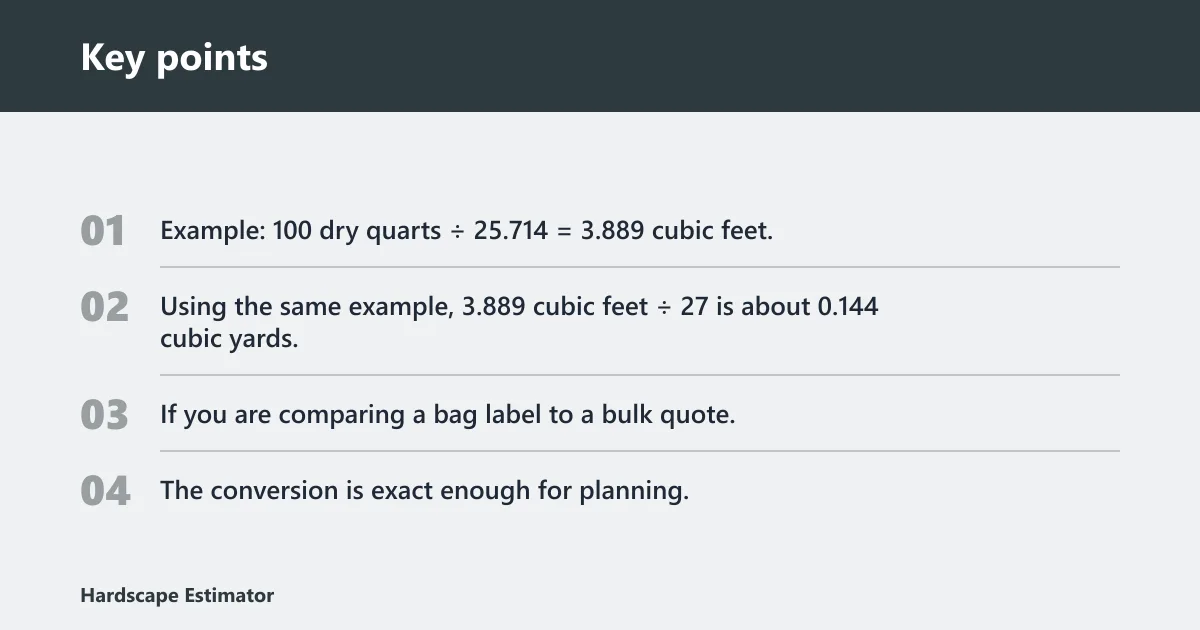
Divide dry quarts by 25.714. That gives the volume in cubic feet. Example: 100 dry quarts ÷ 25.714 = 3.889 cubic feet.
Step 2: convert cubic feet to cubic yards
Divide cubic feet by 27. Using the same example, 3.889 cubic feet ÷ 27 is about 0.144 cubic yards.
Quick answer for ordering soil
If you are comparing a bag label to a bulk quote, use cubic yards as the order unit once the total passes a few cubic feet. The conversion is exact enough for planning, but you should still round up because real soil volume changes with settling, moisture, and how the material is packed.
Soil bags and yard counts
Bag size matters. Soil may be sold in dry quarts or cubic feet, and the label can vary by brand. Check the package before you calculate, then round up to whole bags. Do not assume every “large” bag is the same fill volume.
A common buying mistake is to stop at the cubic-foot number and forget the bag math. Suppose you need 1.2 cubic yards for a raised bed. That is 32.4 cubic feet. If the bags are 1 cubic foot each, you need 33 bags before adding any settling allowance.
Convert common bag sizes to cubic yards
These are the bag sizes this guide uses for comparison:
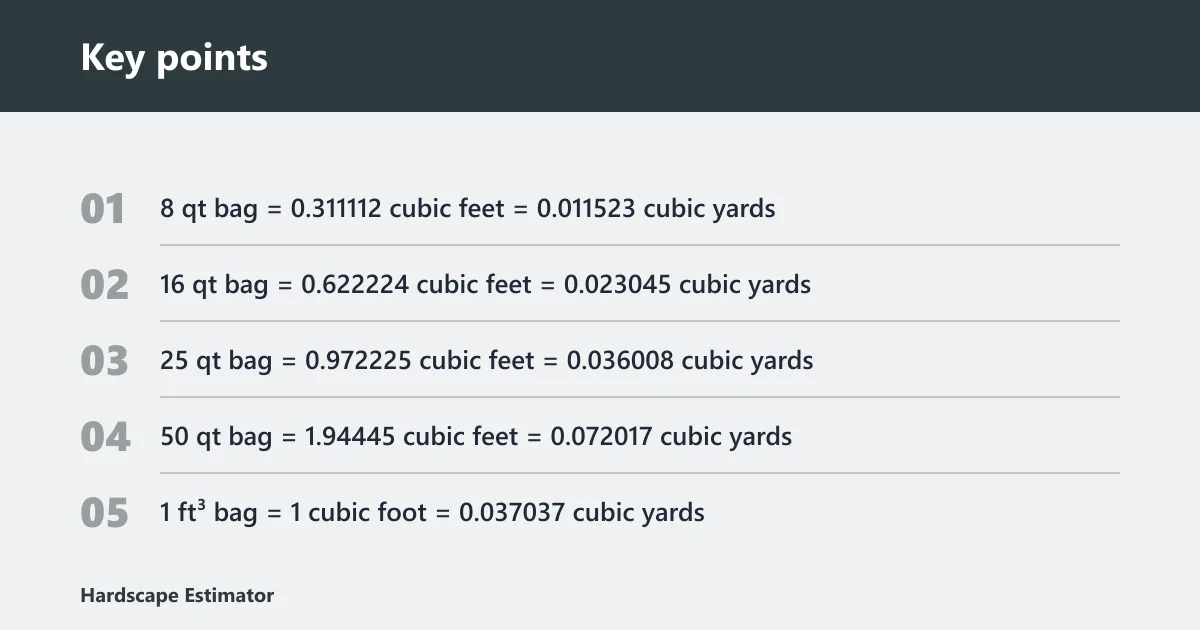
- 8 qt bag = 0.311112 cubic feet = 0.011523 cubic yards
- 16 qt bag = 0.622224 cubic feet = 0.023045 cubic yards
- 25 qt bag = 0.972225 cubic feet = 0.036008 cubic yards
- 50 qt bag = 1.94445 cubic feet = 0.072017 cubic yards
- 1 ft³ bag = 1 cubic foot = 0.037037 cubic yards
Round up to whole bags
Round up every time. A bag count that lands at 18.1 still means 19 bags. That is the safer purchase choice when labels, fill levels, and settling all work against you.
Check the label before you buy
Some bag labels list quarts, some list cubic feet, and some list both. If the label says 25 qt, use the quart conversion. If it says 1.5 cubic feet, use the cubic-foot conversion. Mixed labeling is normal, so the printed size is the number that matters.
Soil conversion table
This table starts with dry quarts, converts to cubic feet, then to cubic yards, and finishes with estimated bag counts for common bag sizes. The bag counts are rounded up to whole bags, which is the safer purchasing choice.
| Dry quarts | Cubic feet | Cubic yards | 8 qt bags | 16 qt bags | 25 qt bags | 50 qt bags | 1 ft³ bags | 10% settling | 15% settling |
|---|---|---|---|---|---|---|---|---|---|
| 8 | 0.311112 | 0.011523 | 1 | 1 | 1 | 1 | 1 | 9 quarts | 9.2 quarts |
| 16 | 0.622224 | 0.023045 | 2 | 1 | 1 | 1 | 1 | 18 quarts | 18.4 quarts |
| 25 | 0.972225 | 0.036008 | 4 | 2 | 1 | 1 | 1 | 27.5 quarts | 28.8 quarts |
| 50 | 1.94445 | 0.072017 | 7 | 4 | 2 | 1 | 2 | 55 quarts | 57.5 quarts |
| 100 | 3.8889 | 0.144033 | 13 | 7 | 4 | 2 | 4 | 110 quarts | 115 quarts |
| 694.278 | 27 | 1 | 87 | 44 | 28 | 14 | 27 | 763.7 quarts | 798.4 quarts |
Should you add settling allowance?
Yes. A 10% to 15% settling buffer is a common allowance for raised beds and fluffy mixes. Soil density changes with moisture and compaction, so the same yard count can weigh differently and settle to a lower finished level after watering and handling.
10% allowance for most fills
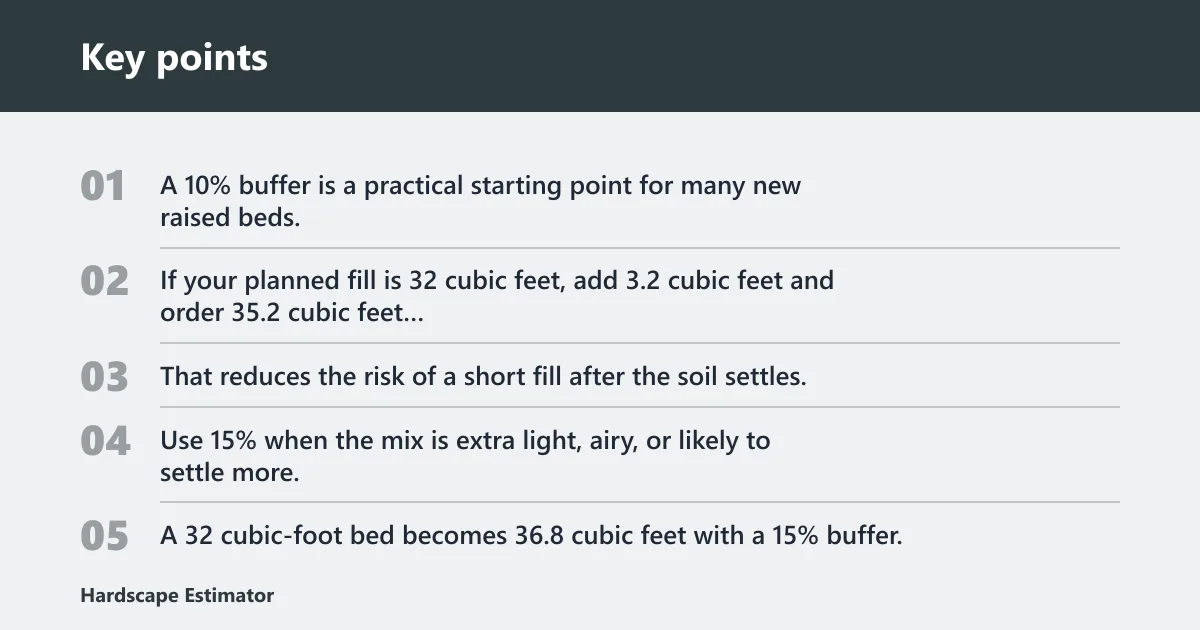
A 10% buffer is a practical starting point for many new raised beds. If your planned fill is 32 cubic feet, add 3.2 cubic feet and order 35.2 cubic feet before rounding to bags or bulk. That reduces the risk of a short fill after the soil settles.
15% allowance for loose or fluffy mixes
Use 15% when the mix is extra light, airy, or likely to settle more. A 32 cubic-foot bed becomes 36.8 cubic feet with a 15% buffer. Using 1.5-cubic-foot bags, that example requires 25 bags.
When compaction changes the order size
Topsoil example density is approximately 1.2 tons per cubic yard, but soil density can range from 0.6 to 1.5 tons per cubic yard. That spread is why weight, volume, and finished height do not always line up neatly. The more compact the soil, the less it may appear to settle after placement, but the more a bulk quote can differ by moisture content.
Bag count reverse-check
Start with the target cubic yards, convert that number back to dry quarts, and compare it to the bag labels. This catches under-ordering when a package is mislabeled, when the bag size is smaller than expected, or when the project total was rounded too early.
- Write down the target volume in cubic yards.
- Multiply by 27 to get cubic feet.
- Multiply cubic feet by 25.714 to get dry quarts.
- Divide by the bag size in quarts or cubic feet.
- Round up to the next whole bag.
Say your project needs 0.5 cubic yards. That equals 13.5 cubic feet. At 50 qt per bag, each bag is 1.94445 cubic feet, so 13.5 ÷ 1.94445 = 6.94 bags. The reverse-check says 7 bags, which is the safer order.
A common first-timer mistake is to trust the bag name instead of the printed volume. A “large” bag with 16 qt is not close to a 1 cubic-foot bag. The reverse-check exposes that mismatch before the order is placed.
Frequently asked questions
How many quarts in 1 cubic yard
One cubic yard equals about 694.278 dry quarts. The path is 27 cubic feet per cubic yard and 25.714 dry quarts per cubic foot. If the bag label uses quarts, this is the number that lets you compare a small bag count to a bulk yard quote.
What is the difference between dry quarts and liquid quarts?
Dry quarts and liquid quarts are different units, so the numbers do not match. Soil, potting mix, and other granular materials are usually sold by dry measure, not liquid measure. When the label says quarts, confirm that it is a dry-volume package before you convert it to yards.
How many bags do I need after converting quarts to cubic yards?
Divide the total dry quarts by the bag size in dry quarts, or convert the target to cubic feet and divide by the bag’s cubic-foot volume. Then round up. If you need 1 cubic yard, that is about 694.278 dry quarts, which becomes 87 bags at 8 qt each or 27 bags at 1 ft³ each.
Should I add extra for settling when buying soil?
Usually yes. A 10% buffer works for many beds, and 15% is safer for loose, fluffy mixes that will settle more after watering. Soil density changes with moisture and compaction, so the finished volume can come in lower than the loose fill volume you measured at the start.