How Many Cubic Yards Does a Wheelbarrow Hold?
Most wheelbarrows are commonly reported to hold about 6 to 10 cubic feet, or about 0.22 to 0.37 cubic yards; a 6-cu-ft barrow is about 1/4 yard. Overfilling slows each run, spills material, and throws off delivery counts. This guide converts wheelbarrow size to yards and shows planning loads for mulch, gravel, soil, and concrete.
How many cubic yards does a wheelbarrow hold?

Most wheelbarrows hold a fraction of a cubic yard, not a full yard. Use 1 cubic yard = 27 cubic feet, then divide the wheelbarrow’s cubic-foot rating by 27 to get its cubic-yard equivalent. A 6 cubic foot barrow is about 0.22 cubic yards.
Use cubic feet to find cubic yards
The tub rating is usually listed in cubic feet. Start with that number. Divide the stated cubic feet by 27, and you get cubic yards per load at a level fill.
For example, 4 cubic feet ÷ 27 = 0.148 cubic yards. A 5 cubic foot wheelbarrow is 0.185 cubic yards, and 8 cubic feet is 0.296 cubic yards. The math is simple, but the load you can actually carry still depends on the material.
Why 27 cubic feet equals 1 cubic yard
A cubic yard is the bulk-ordering unit for soil, gravel, mulch, and concrete. One yard contains 27 cubic feet. That is why even a large homeowner wheelbarrow usually carries only part of a yard at a time.
If a supplier quotes 3 cubic yards of mulch, that means 81 cubic feet total. A 6-cubic-foot wheelbarrow would need about 13.5 level loads to move 3 cubic yards by volume, before any practical reduction for settling, spillage, or heavy material.
Quick answer for common wheelbarrow sizes
For planning, a 4 cubic foot wheelbarrow is about 0.15 cubic yards, a 5 cubic foot wheelbarrow is about 0.19 cubic yards, and a 6 cubic foot wheelbarrow is about 0.22 cubic yards. A 7 cubic foot wheelbarrow is about 0.26 cubic yards, and an 8 cubic foot wheelbarrow is about 0.30 cubic yards.
Wheelbarrow capacity by size
Wheelbarrow capacity changes with size and maker. A standard wheelbarrow is sometimes described as holding about 2 cubic feet, while other common garden and landscaping models fall in the 4 to 6 cubic foot range. Large wheelbarrows can hold 6 cubic feet or more, and some heavy-duty models reach 8 to 10 cubic feet.
Typical homeowner wheelbarrow range
The usual homeowner range starts around small 2.5 to 4 cubic foot tubs and moves up through medium 4 to 6 cubic foot models. That spread matters. A 2 cubic foot barrow and an 8 cubic foot barrow do not plan the same way, even though both are called wheelbarrows.
Large wheelbarrow capacities
Large wheelbarrows can hold 6 cubic feet or more. A 10 cubic foot wheelbarrow converts to about 0.37 cubic yards. That is still short of half a yard per load, so large barrows help, but they do not change the basic yard math.
How to read the manufacturer’s rating
- Look for the tub capacity in cubic feet.
- Check whether the rating is struck or heaped.
- Convert cubic feet to cubic yards by dividing by 27.
- Compare that number with the material you plan to move.
- Check the stated weight limit before loading gravel, wet soil, or concrete.
Wheelbarrow to yard conversion table
This table uses level, struck capacity for the yard conversion. The practical load columns are planning assumptions, not manufacturer ratings. They reflect the fact that soil, gravel, mulch, and concrete do not behave the same in a barrow, and that weight can limit the load before volume does.
| Wheelbarrow size | Cubic yards at struck fill | Practical load for soil | Practical load for gravel | Practical load for mulch | Practical load for concrete | Trips for 1 yard | Trips for 3 yards | Trips for 5 yards |
|---|---|---|---|---|---|---|---|---|
| 4 cu ft | 0.148 yd³ | 0.11 yd³ | 0.09 yd³ | 0.13 yd³ | 0.07 yd³ | 6.75 | 20.25 | 33.75 |
| 5 cu ft | 0.185 yd³ | 0.14 yd³ | 0.11 yd³ | 0.15 yd³ | 0.09 yd³ | 5.40 | 16.20 | 27.00 |
| 6 cu ft | 0.222 yd³ | 0.17 yd³ | 0.13 yd³ | 0.18 yd³ | 0.11 yd³ | 4.50 | 13.50 | 22.50 |
| 7 cu ft | 0.259 yd³ | 0.19 yd³ | 0.15 yd³ | 0.21 yd³ | 0.13 yd³ | 3.86 | 11.58 | 19.29 |
| 8 cu ft | 0.296 yd³ | 0.22 yd³ | 0.19 yd³ | 0.24 yd³ | 0.15 yd³ | 3.38 | 10.14 | 16.89 |
The trip counts above are based on level capacity only. For a 6 cubic foot wheelbarrow, one cubic yard takes 4.5 full loads by volume. Three cubic yards take 13.5 loads, and five cubic yards take 22.5 loads.
What changes real load size?
Struck capacity is the level fill, measured to the top rim. Heaped capacity is piled above the rim, which looks larger but is less stable and spills more easily. For planning, struck capacity is the better starting point. Heaped loads are a caution sign, not a standard.
Struck capacity versus heaped capacity
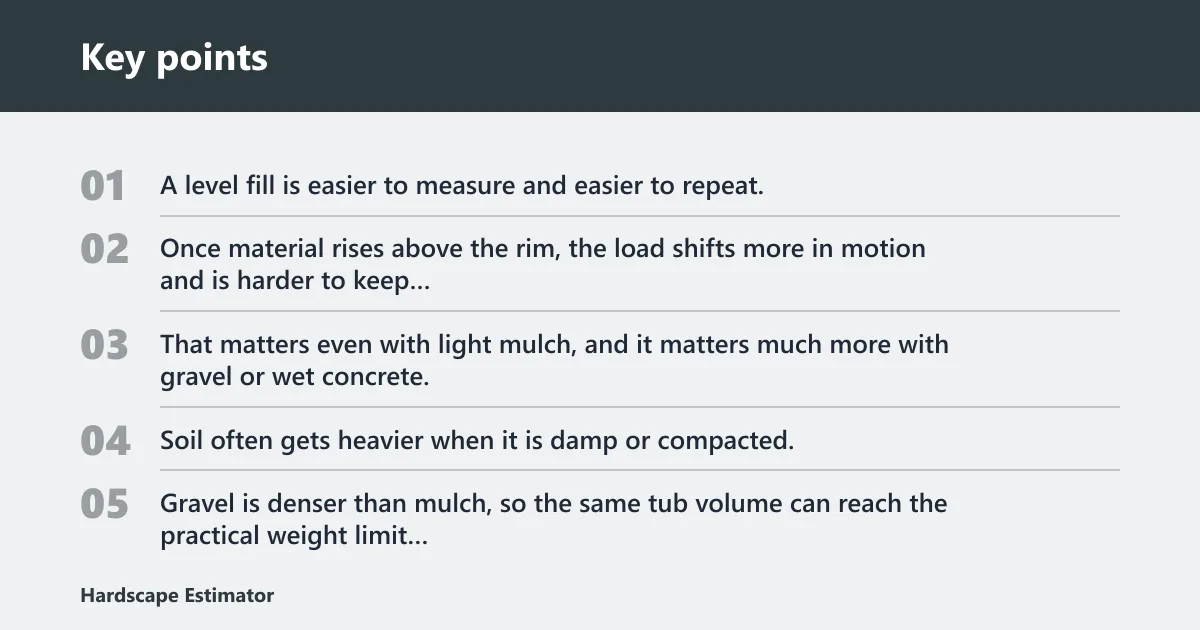
A level fill is easier to measure and easier to repeat. Once material rises above the rim, the load shifts more in motion and is harder to keep balanced. That matters even with light mulch, and it matters much more with gravel or wet concrete.
Material density and moisture
Material density changes usable load size. Soil often gets heavier when it is damp or compacted. Gravel is denser than mulch, so the same tub volume can reach the practical weight limit sooner. Concrete is the clearest case: weight may become the limit before the tub is anywhere near full.
Weight limits before volume limits
Do not let volume math hide the weight rating. A wheelbarrow that can physically hold 0.22 cubic yards may not safely carry that full volume of wet gravel or concrete. In those cases, a smaller, steadier load is safer and usually faster.
Say your 6 cubic foot wheelbarrow looks easy to fill with dry mulch. The same barrow filled with damp gravel may feel overloaded at a much lower line because the weight rises faster than the volume does. The tub size did not change. The material did.
Soil, gravel, mulch, and concrete
Different materials need different planning loads. Soil is a common middle case. Gravel is usually the hardest of the four on weight. Mulch is lighter and can be loaded more generously. Concrete is the most limited by weight, so a lower fill is the safer plan.
Soil loading assumptions
Soil often works well near a struck fill, but moisture changes the picture. Dry topsoil is easier to move than wet, sticky soil. For planning, treat a soil load as close to level fill when it is loose and dry, then reduce it when the pile is damp or compacted.
Gravel loading assumptions
Gravel usually needs a more conservative load than soil because it is heavier and shifts in the tub. Even when the volume fits, the weight may push the wheelbarrow past a comfortable carry. A lower fill helps keep the load stable and easier to dump.
Mulch loading assumptions
Mulch is light and airy, so it can be carried closer to the struck volume than gravel or concrete. It still should not be piled too high. The taller the mound, the more likely it is to shed material on turns and ramps.
Concrete loading assumptions
Concrete is the case where weight matters most. A full tub can become awkward before the volume is maxed out. For that reason, the right load is often below the tub’s stated cubic-foot capacity. Manufacturer weight limits matter here more than with mulch.
Wheelbarrow load examples

These examples use the struck-capacity conversion and then show how the practical load changes by material. The goal is planning, not a single universal answer. A wheelbarrow can hold different usable amounts depending on what is in it.
1 cubic yard example
Suppose you need 1 cubic yard of mulch and you have a 6 cubic foot wheelbarrow. At level fill, that is 4.5 trips by volume. If the load is reduced for spill control, the trip count rises. The job still takes a small number of rounds, but not one scoop per trip.
Now change only the material to gravel. The same 6 cubic foot barrow still converts to 0.222 cubic yards by volume, but the practical load may be smaller because of weight. That means more trips than the simple yard math suggests.
3 cubic yard example
Three cubic yards is 81 cubic feet total. A 5 cubic foot wheelbarrow needs 16.2 level loads by volume, while a 6 cubic foot wheelbarrow needs 13.5. If the material is wet soil or gravel, plan for more trips than those volume-only figures.
5 cubic yard example
Five cubic yards equals 135 cubic feet. A 4 cubic foot barrow would take 33.75 loads by volume, and a 6 cubic foot barrow would take 22.5. That is a lot of pushing. For a project that size, trip time starts to matter as much as the yard count.
A common first-timer mistake is to look only at the cubic yard number and forget the loading cycle. A barrow that is easy to move once can still make a large order slow if the path is long, the ground is soft, or the material is heavy.
Frequently asked questions
How many cubic feet does a standard wheelbarrow hold?
A standard wheelbarrow is often described as holding about 2 cubic feet, but common garden and landscaping models are usually larger. Many widely sold barrows fall in the 4 to 6 cubic foot range, and large models can hold 6 cubic feet or more.
How many cubic feet can a large wheelbarrow hold?
Large wheelbarrows can hold 6 cubic feet or more, and some heavy-duty models reach 8 to 10 cubic feet. A 10 cubic foot wheelbarrow equals about 0.37 cubic yards. Even then, weight and balance still matter, especially with gravel, soil, and concrete.
How many wheelbarrows does it take to make one cubic yard?
It depends on the barrow size. A 4-cubic-foot wheelbarrow takes about 6.75 loads to make one cubic yard at level fill. A 5 cubic foot model takes 5.4 loads, and a 6 cubic foot model takes 4.5 loads. Smaller tubs need more trips.
How do you convert wheelbarrow capacity from cubic feet to cubic yards?
Divide the cubic-foot rating by 27. That is the conversion from cubic feet to cubic yards. For example, 6 cubic feet ÷ 27 = 0.222 cubic yards. Use the same method for 4, 5, 7, or 8 cubic foot wheelbarrows.
What is the cubic yard equivalent of a 6 cubic foot wheelbarrow?
A 6 cubic foot wheelbarrow is about 0.222 cubic yards, which is close to 1/4 yard. By volume, it takes 4.5 full loads to make 1 cubic yard. Real loading may be lower for gravel or concrete because of weight.