How Much Grass Seed Do I Need for My Lawn?
Many lawns need about 4 to 8 lb of grass seed per 1,000 sq ft, but the exact buy amount depends on lawn area, the seed label rate, and a common 10% to 15% waste allowance. Buy too little and coverage turns thin; buy too much and leftover seed may lose germination. This guide shows the math for new lawns, overseeding, patch repair, and full renovation.
How to calculate Grass seed needed
Use this formula: area ÷ 1,000 × seeding rate = pounds needed. A new lawn usually needs more seed than overseeding, and the label rate should override a generic estimate when the bag gives a specific number. Add an order buffer after you calculate the agronomic rate, not before.
The one-line calculation
If your lawn is 2,500 sq ft and the label rate is 6 lb per 1,000 sq ft, the math is 2,500 ÷ 1,000 × 6 = 15 lb. If you add a 10% order buffer, the buy amount becomes 16.5 lb, which usually means round up to the next bag size.
Why area and rate both matter
Grass seed quantity changes with both the size of the lawn and the target rate. A small lawn at a high rate can need less seed than a large lawn at a lower rate. That is why bag coverage depends on the rate you choose.
When to use the bag label rate
Use the label rate when it differs from a generic calculator default. That matters most with blends, coated seed, and products rated for a narrow use case. If the bag lists a rate for new lawns and a different rate for overseeding, use the right line for the project type.
How much grass seed do I need for my yard?
Your yard may be larger than the seeded area. Measure the full usable lawn, then subtract patios, driveways, walkways, beds, sheds, pools, and any other hardscape. The buy amount should reflect only the square footage that will actually get seed.
How to measure your lawn
- Measure length and width for simple rectangles.
- Use radius for circles and divide complex shapes into smaller parts.
- Subtract non-seeded areas such as patios, beds, and driveways.
- Add the remaining zones together for total seeded square feet.
Handling irregular shapes
Irregular lawns are easiest when broken into rectangles, triangles, and circles. Measure each section, then subtract anything that will not be seeded. For curved edges or mixed yard zones, round each section separately and total the result.
Say your front yard is 40 ft by 30 ft, but a 10 ft by 12 ft patio sits inside it. The gross area is 1,200 sq ft. The patio is 120 sq ft. The seeded area is 1,080 sq ft, and that is the number to use in the seed formula.
When mixed yard zones need separate rates
A common first-timer mistake is treating patchy turf and bare ground the same way. If most of the lawn is established turf with a few bare spots, use overseeding for the full area and then add a small amount for the bare patches. If the lawn is mostly bare, use a new-lawn or renovation rate instead.
How much grass seed do I need to overseed my lawn?
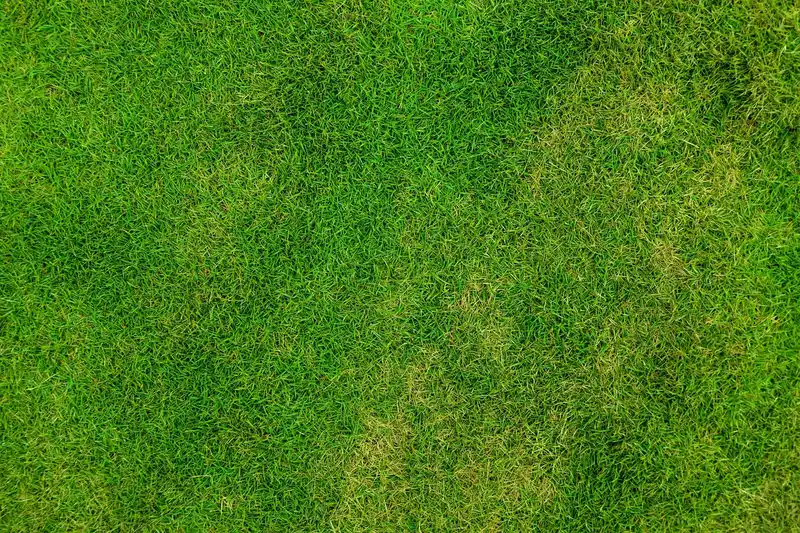
Overseeding usually needs about half the seed used for a new lawn: 2 to 5 lb per 1,000 sq ft. That lower rate fills thin turf without burying the existing grass. If the lawn is mostly bare, though, overseeding rates are too light and a renovation rate is a better fit.
New lawn vs overseeding vs patch repair
- New lawn: use the higher end of the label range because the soil surface is open.
- Overseeding: use a lighter rate because existing turf is already there.
- Patch repair: seed the damaged spots at the new-lawn or repair rate, then seed the rest of the yard only if needed.
- Renovation: use the stronger rate when large parts of the lawn are bare or the old stand is being reset.
Renovation cases that need more seed
Renovation is the right call when the lawn has large dead zones, poor density, or major erosion. In that case, use a rate closer to a new lawn than to a light overseed. Seed-to-soil contact matters here, because bare soil accepts more seed than a thin turf canopy.
How site conditions change the starting rate
Shade, poor soil, slopes, and erosion can all push the starting rate upward. One calculator notes that shady areas require 25% more seed. Poor soil and slopes often need a stronger starting rate too, because some seed is lost to runoff, crusting, or weak establishment.
Suppose a 1,000 sq ft shaded side yard is being overseeded at 3 lb per 1,000 sq ft. A 25% shade adjustment raises the target to 3.75 lb per 1,000 sq ft before any waste allowance is added.
What type of grass seed do I need for my lawn?
The right type depends on your climate, sun exposure, and whether you need cool-season or warm-season grass. Cool-season lawns and warm-season lawns do not use the same target rates. When a blend has its own label rate, that rate should guide the order.
Common grass types and general rates
| Grass type | Typical rate per 1,000 sq ft | Common use case |
|---|---|---|
| Kentucky bluegrass | 2 to 4 lb | Cool-season lawns, finer texture |
| Tall fescue | 6 to 10 lb | Cool-season lawns, full sun to part shade |
| Perennial ryegrass | 6 to 10 lb | Fast germination, overseeding, repairs |
| Fine fescue | 4 to 6 lb | Shade-tolerant cool-season areas |
| Bermuda | 1 to 2 lb | Warm-season lawns |
| Zoysia | 1 to 3 lb | Warm-season lawns, slower establishment |
| Centipede | 1 to 2 lb | Warm-season, lower-input lawns |
| Bahia | 8 to 10 lb | Warm-season, coarse texture, lower fertility sites |
The exact figure on the bag matters most. Tall fescue and ryegrass are listed as heavy sowing grasses at about 10 lb per 1,000 sq ft. Kentucky bluegrass is listed at about 4 lb per 1,000 sq ft. Bermuda is listed at about 2 lb per 1,000 sq ft. One rate table also lists Kentucky bluegrass at 2 to 3 lb per 1,000 sq ft and Bermuda at 1 to 2 lb per 1,000 sq ft, which is why the label should win when it gives a tighter range.
Cool-season and warm-season grasses differ
Cool-season grasses often use higher seeding rates than warm-season grasses. That is why tall fescue and ryegrass can land around 6 to 10 lb per 1,000 sq ft, while Bermuda may be only 1 to 2 lb per 1,000 sq ft. Do not transfer one species rate to another.
How much is a bag?
Bag coverage changes with the seeding rate. A 50 lb bag covers far more area at a light rate than at a heavy one. For example, a 50 lb bag at 6 lb per 1,000 sq ft covers about 8,333 sq ft. At 10 lb per 1,000 sq ft, the same bag covers about 5,000 sq ft.
Common bag sizes
- 5 lb bag: useful for patches and small repairs.
- 10 lb bag: good for small lawns or spot work.
- 25 lb bag: common for medium lawn orders.
- 50 lb bag: better for larger lawns or renovation work.
How to convert pounds into bags to buy
- Calculate pounds needed from lawn area and rate.
- Add the order buffer separately.
- Divide by bag size.
- Round up to the next whole bag.
For a 5,000 sq ft lawn at 6 lb per 1,000 sq ft, the seed need is 30 lb. At 10% extra for purchase planning, that becomes 33 lb. If the seed comes in 25 lb bags, one bag is not enough, and two bags is the practical order.
Seed order worksheet
This worksheet separates agronomic rate from the order buffer. Use the rate to find pounds needed, then add the allowance for overlap, edges, and touch-ups. The example bag counts assume common 5 lb, 10 lb, 25 lb, and 50 lb bag sizes, rounded up to the next full bag.
| Lawn area | Seed rate | Bags to buy |
|---|---|---|
| 500 sq ft | 3 lb per 1,000 sq ft | 2 lb needed; buy 1 ten-pound bag |
| 1,000 sq ft | 4 lb per 1,000 sq ft | 4 lb needed; buy 1 five-pound bag |
| 2,500 sq ft | 6 lb per 1,000 sq ft | 15 lb needed; buy 1 twenty-five-pound bag |
| 5,000 sq ft | 6 lb per 1,000 sq ft | 30 lb needed; buy 2 twenty-five-pound bags |
| 10,000 sq ft | 6 lb per 1,000 sq ft | 60 lb needed; buy 2 fifty-pound bags |
Separate order allowance line
Order allowance: add 5% for a tight order, 10% for standard overlap and edge loss, or 15% for rough grading, slopes, or touch-up risk. Keep that line separate from the base seeding rate so the bag count stays clear.
Add 10% and the order target becomes 16.5 lb. That is a different number from the agronomic rate, and it should stay separate on the buy list.
Should I buy extra grass seed for waste and touch-ups?
Yes. A small buffer helps cover overlap, edges, calibration error, and bare spots that need a second pass. A 10% overage buffer is a common standard, while 5% can work on a simple rectangle and 15% makes sense for slopes, erosion, or patchy areas that usually need touch-ups.
Leftover risk and quality adjustments
Seed quality changes how much live seed is actually in the bag. Germination percent, purity percent, and coating all affect live-seed equivalent. If the label lists those values, use them to judge whether the bag’s nominal weight is equal to its effective seeding weight.
If a bag says 90% germination and 95% purity, the live-seed equivalent is lower than the printed weight. Coated seed can also weigh more per bag, which means bag weight alone does not always equal usable seed. The label data should control the order when it is available.
Practical buffer choices
- 5% for a simple layout and a careful application.
- 10% for most lawn projects.
- 15% for slopes, erosion, or heavy touch-up risk.
Frequently asked questions
How much grass seed do I need for my lawn?
Start with area ÷ 1,000 × seeding rate. Most new lawns need 5 to 10 lb per 1,000 sq ft, while overseeding usually needs 2 to 5 lb per 1,000 sq ft. Then add a 5% to 15% order buffer so the buy amount covers overlap and touch-ups.
How much grass seed do I need to reseed my lawn?
Reseeding depends on how much of the lawn is still alive. Small bare spots can be treated like patch repair. If the lawn has broad dead sections, treat it like renovation or a new lawn, because the seed demand will be much higher than a simple overseed.
How much will a 50 lb bag of grass seed cover?
Coverage depends on the rate.
How do I calculate grass seed for an irregular lawn?
Break the yard into simple shapes, measure each one, and subtract non-seeded areas. Add the remaining sections together, then apply the rate. If one zone is shady and another is full sun, calculate them separately so the order reflects both area and site condition.