Should You Order Extra Pavers From the Same Pallet or Batch?
Order extra pavers from the same batch when you can; add 5% for simple layouts and 10% for cuts or patterns, then keep 10-20 matching pavers for repairs if the color run is close. Missing that split can leave you short on waste coverage or force a repair with a visible color mismatch. This guide explains how to size the waste allowance, how many spares to keep, and when same-batch inventory is worth the added cost.
When same-Batch pavers matter most
Yes, when color match matters and the supplier can keep you on the same dye lot or production run. Same-batch pavers are the best protection against shade change, texture change, and finish mismatch. Manufacturer guidance commonly warns that concrete pavers can vary from one production run to another, so the safest move is to secure enough from one lot for the visible field and a few repairs. If the project will weather evenly and repairs are unlikely to be seen, a close match from a different batch may be good enough.
When same-lot matching matters most
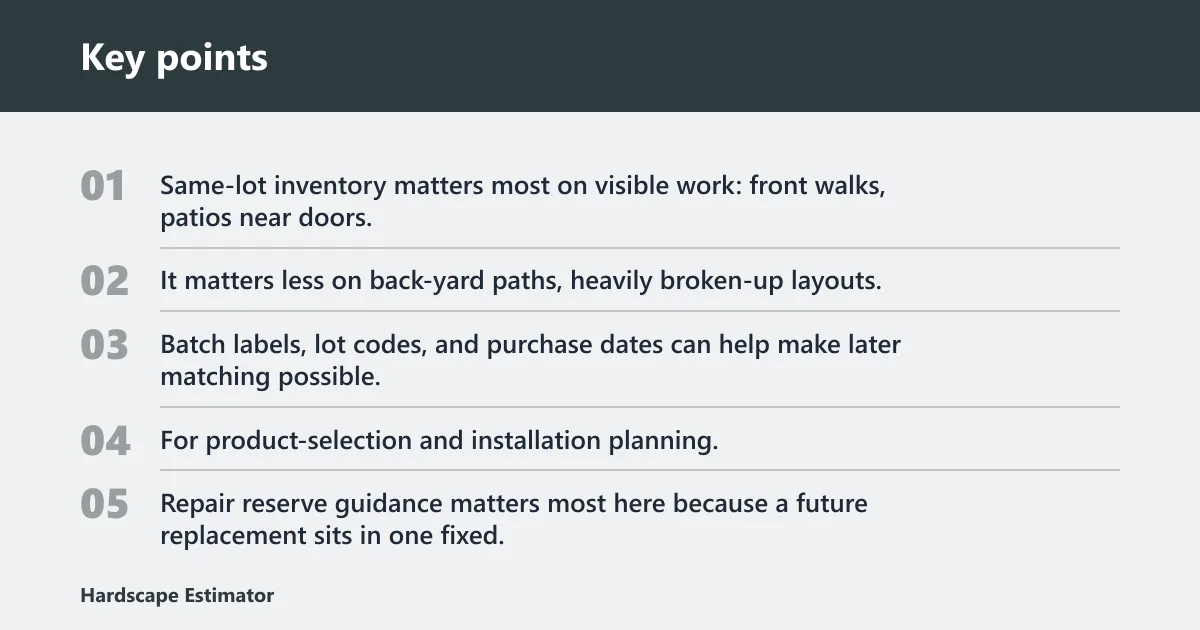
Same-lot inventory matters most on visible work: front walks, patios near doors, and small areas with long sight lines. It matters less on back-yard paths, heavily broken-up layouts, or places where the pattern hides small differences. Batch labels, lot codes, and purchase dates can help make later matching possible. For product-selection and installation planning, that is the point at which lot control pays off most. Repair reserve guidance matters most here because a future replacement sits in one fixed, visible spot.
Sun exposure changes the answer over time. Fresh pavers can show a slight production-run difference at installation, but a weathered surface often narrows that gap after months outdoors. That does not remove the value of same-batch spares; it only means the repair may be less obvious if the original field has already aged evenly. Manufacturer literature from concrete paver producers commonly notes that shading and minor lot differences can be normal, which is why many installers blend units from multiple pallets during placement. See the maker’s installation instructions for the specific product you buy, since run-to-run behavior varies by finish and color blend.
When a close color match is good enough
A close match is usually acceptable when the pavers are split by borders, cut into small pieces, or laid in a mixed pattern that interrupts the eye. Mixed production dates can still work on many jobs, especially if the installer blends pallets during the installation and the layout avoids large uninterrupted fields of one color. On many manufacturers’ installation guides, that blending step is recommended specifically to reduce visible banding from batch variation.
Suppose a 240 sq ft patio uses a busy running bond with several border cuts. A spare from a different pallet may be fine for the waste bucket if the visible field already includes slight blend variation. The repair reserve is different: that future replacement should match as closely as possible, because a single patched paver sits in a fixed, visible spot.
Why separate waste from repair reserve?
These are two separate buys. Installation waste covers cuts, breakage, and trimming errors. Future repair reserve is the hidden stock you keep for matching after the job is finished. Treating them as one number often creates the wrong result: either too few pavers for the install or too little matching material for later repairs.
Installation waste factor
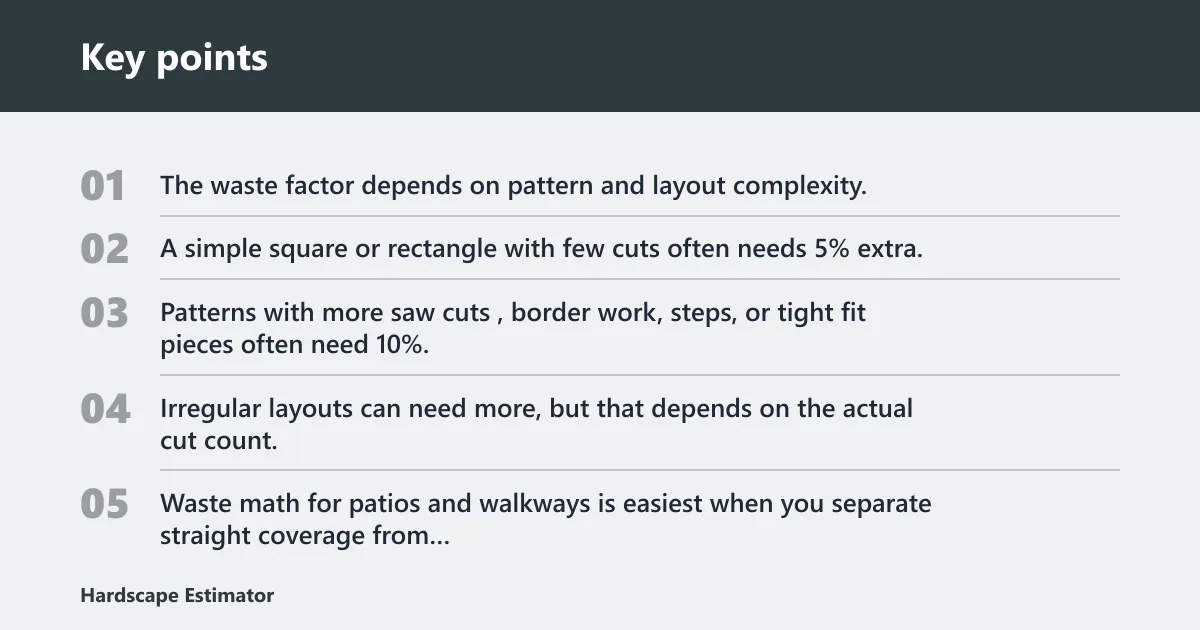
The waste factor depends on pattern and layout complexity. A simple square or rectangle with few cuts often needs 5% extra. Patterns with more saw cuts, border work, steps, or tight fit pieces often need 10%. Irregular layouts can need more, but that depends on the actual cut count, not just the total square footage. Waste math for patios and walkways is easiest when you separate straight coverage from cut-heavy sections before you place the order.
That means the same project can have two different extra quantities. A 200 sq ft patio at 5% waste needs 10 extra pavers’ worth of coverage. A repair reserve is separate, because those pavers are not consumed during installation. They are saved for later use if a cracked or stained unit needs replacement. Supplier and manufacturer planning sheets often recommend ordering extra units specifically to account for breakage, trimming, and field sorting.
Future repair reserve
A repair reserve is usually smaller than the waste allowance. For many residential projects, about 10-20 matching pavers is often enough for a few broken pieces, a spill-stain repair, or a future pull-and-replace task. Larger projects often justify a larger reserve, especially when the style may be discontinued later or the site is highly visible. Manufacturer and supplier documentation also tends to favor keeping labeled leftovers from the original run so a future repair can stay close to the installed field.
That can hide the real decision. Waste is consumed now. Reserve is insurance for the future. The reserve should be tied to matching risk, not to cut count.
How many extra pavers should I buy?
For a small patio or walkway, start with 5% to cover waste and keep 10-20 matching pavers for repairs if the batch is close and the style is likely to stay available. For bigger jobs, use the same waste percentage, but the repair reserve should reflect visibility, color risk, and the chance that a future order will come from a different run. If the supplier has minimum-order rules or limited stock, the threshold for buying a full extra pallet drops quickly.
Small patio or walkway
On a compact project, the waste allowance is usually easy to calculate, and the reserve is often the more important decision. A 120 sq ft walkway with a simple layout at 5% needs 6 sq ft of extra coverage for waste. If the pavers are sold by piece, that often translates to only a handful of extra units. For a compact job, this is also the point where small-project waste guidance is most useful because a few extra pieces can cover both cuts and later repairs without pushing you into an oversized order.
Large patio or driveway
On larger areas, the repair reserve can be worth more than the difference between one pallet and the next. If the project is a driveway or a large patio with long open runs, same-batch inventory is more valuable because a later repair may stand out across a bigger visual field. A repair reserve of 15-30 pavers is common on these higher-visibility jobs.
Higher-risk projects with cuts or borders
Projects with curves, herringbone, soldier-course edges, or multiple borders usually need the higher end of the waste range. The reserve can stay modest if the pavers are expected to weather evenly and the area is not tightly inspected, but the lot number should still be saved. That note matters if one section later needs a small repair.
What does the decision depend on?
The right extra quantity depends on project size, how visible the field is, how many cuts you expect, and how likely the supplier is to have the same lot later. For a small, low-risk area, a modest waste allowance and a limited reserve is usually enough. For a highly visible or hard-to-match project, same-batch inventory becomes the safer choice.
This table separates installation waste from future repair reserve. The point is to avoid overbuying for the wrong reason and to make the same-batch decision based on visible risk, not on square footage alone.
| Project size and risk level | Recommended extra quantity | When same-batch inventory is worth paying for | Project notes to save |
|---|---|---|---|
| Small patio, simple layout, low visibility | 5% waste + 10 matching pavers | Worth it if the patio faces the house or uses a light color | SKU, lot code, supplier, purchase date, pallet count, leftover count |
| Small walkway, moderate cuts, medium visibility | 5-10% waste + 10-15 matching pavers | Worth it if the walkway is in full sun or near a front entry | SKU, lot code, supplier, purchase date, leftover storage location |
| Large patio, mixed pattern, high visibility | 10% waste + 15-20 matching pavers | Worth it if the color blend is tight or the pavers have a smooth finish | SKU, lot code, pallet count, leftover quantity, date installed |
| Driveway, heavy cuts, border detail, high wear | 10% waste + 20-30 matching pavers | Worth it if replacements must match a broad visible field | SKU, lot code, supplier, purchase date, storage location, count by stack |
| Any project with discontinuation risk | Waste allowance plus the largest reserve that budget allows | Worth it if the style may be discontinued or production changes are likely | SKU, lot code, pallet count, leftover quantity, photo of label |
Will different batches look different?
They can, but not always in a way that stands out. Different batches may vary slightly in color, texture, or finish because concrete products are made in production runs. The visible result depends on the product, lighting, how closely the batches are placed together, and how much the pavers weather after installation. Supplier literature commonly treats this as normal manufacturing variation, which is why lot tracking matters.
Color variation between runs
Color variation is the main reason same-batch matching matters. Two runs with the same model can still show small shade differences, especially in lighter colors or in products with a broad surface blend. A small mismatch is easier to ignore when the area has movement, joints, and cuts that break up the field.
Texture and finish differences
Finish consistency matters too. Some pavers show a slightly different surface sheen, edge crispness, or aggregate exposure from one run to another. That can be hard to spot across a whole patio, but it can show up in a repair where one new piece sits beside older, weathered units. Manufacturer installation guides sometimes mention blending, sorting, or overage language for this reason.
Blending from multiple pallets
Mixing from multiple pallets can reduce the look of batch streaks if the installer pulls from each pallet during the lay. That approach helps the field read as one blend instead of separate blocks. It does not erase lot differences, but it spreads them out so the eye sees a broader pattern rather than a sharp shift. Manufacturer guidance on installation frequently recommends pulling from multiple bundles or pallets as a way to minimize shade banding and visual patchiness.
How should you label and store leftovers?
Store leftovers so they stay dry, clean, labeled, and easy to find. Save the exact SKU, lot code, supplier name, purchase date, pallet count, and leftover quantity before the pallet leaves the project site. Without that record, matching later is guesswork, even if the spare pavers themselves are still usable. Handling guidance from manufacturers typically stresses dry, level storage and protection from contamination because dirt, moisture, and damage can compromise a future repair match.
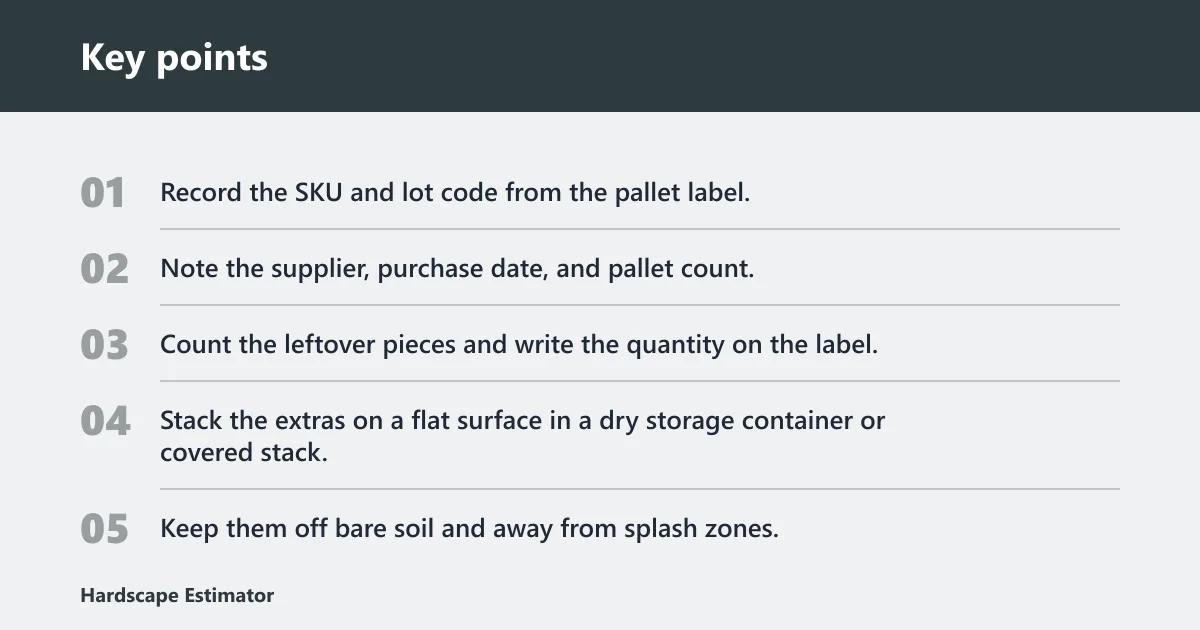
- Record the SKU and lot code from the pallet label.
- Note the supplier, purchase date, and pallet count.
- Count the leftover pieces and write the quantity on the label.
- Stack the extras on a flat surface in a dry storage container or covered stack.
- Keep them off bare soil and away from splash zones.
- Label the stack with the project name and storage location.
What to record before the pallet leaves
Capture the label details while they are still available. The most useful notes are the SKU, lot code, and count of leftover pavers from each pallet. If the supplier only had mixed pallets or partial lots, that should be written down too. Mixed inventory can still work, but the exact source matters if a repair is needed later.
How to keep pavers dry and clean
Moisture stains, dirt, and chipped corners can ruin a good reserve. Keep extras wrapped or under cover, but allow drainage so water does not sit against the stack. A dry, stable place is better than a damp corner of a yard. If a few pieces chip during handling, remove them from the reserve count so the usable total stays honest. Manufacturer storage guidance commonly recommends keeping units off the ground, covered, and protected from standing water until they are needed.
Picture a small front walk where only eight spare pavers were kept, but the labels were thrown away. Two years later, one cracked paver needs replacement. The remaining stack looks close, yet nobody can confirm the exact lot. The repair may still work, but the risk of visible mismatch is much higher than if the SKU and lot code had been saved.
Where to keep the spare count
Keep the spare count where it can be found quickly, not buried with general yard material. A marked shelf, covered rack, or taped bundle in a dry storage area works better than an unmarked corner. The goal is simple: a future repair should take minutes, not a search through unrelated leftovers.
Frequently asked questions
How do I tell if pavers are from the same dye lot or run?
Check the pallet label, invoice, or shipping paperwork for the lot code, dye lot, or production run number. If the supplier cannot confirm it, assume the match is uncertain. Keep in mind that some mixed pallets include multiple runs, so the label on the individual bundle matters more than the product name alone.
Can I mix pavers from different pallets without visible color shifts?
Often yes, especially if the installer blends them as the pavers are laid and the pattern breaks up the field. The risk is higher on open, single-color areas and lower on busy layouts. Even then, a slight shift may still be visible in strong sun or right after installation.
What if the original pavers are discontinued later?
That is when the repair reserve becomes most valuable. If the style is discontinued, the saved pieces may be the only exact match available. If no reserve exists, the repair may need a close substitute or a larger replacement zone. That is why the lot code and leftover count should be recorded now.
When is it worth buying a full extra pallet instead of a few extras?
A full extra pallet is easier to justify on large jobs, high-visibility areas, or products with a strong shade blend that may vary between runs. It is also useful when the supplier warns that the lot is limited. For a small patio, a full pallet is often more than the repair reserve needs.
Do I need to order extra pavers before installation or after?
Before installation is better. Same-batch inventory is easiest to secure when the original order is still being filled, and the supplier may not be able to match the lot later. Ordering after the job is done can still work for waste replacement, but it is weaker protection for color matching.
How much extra should I keep for a small patio or walkway?
For a small patio or walkway, a practical target is 5% for waste plus 10-20 matching pavers for future repairs, depending on visibility and lot availability. If the project is very simple and the area is low-profile, the reserve can stay near the low end. Save the label details either way.