How Much Paver Waste Should You Add for a Patio or Walkway?
Add about 5% waste for straight paver runs, around 10% for many patios and walkways with borders or a few cuts, and around 15% for curves, angles, or mixed patterns. Too little waste can stop the job short; too much raises material and delivery cost. This guide shows how to choose the right allowance and round your order by layout.
This guide is part of our Paver waste: how much extra to order series.
What you’ll need
- Measured patio or walkway area in square feet
- Paver size and pattern choice
- A way to round orders to full pallets or boxes
- Separate estimates for gravel base and leveling sand
- A calculator or notepad for area math
How much waste should you add?
Start with 5% for a straight layout with few cuts. Use 10% for most patios and walkways, especially when the edges need trimming. Move to 15% when the layout has herringbone, diagonal runs, curves, borders, or inlays that raise cut loss and edge waste.
The waste allowance is a percentage buffer for cuts, breakage, and odd-shaped areas around edges or features. It applies to the pavers only. Gravel base and leveling sand are estimated separately by area and depth.
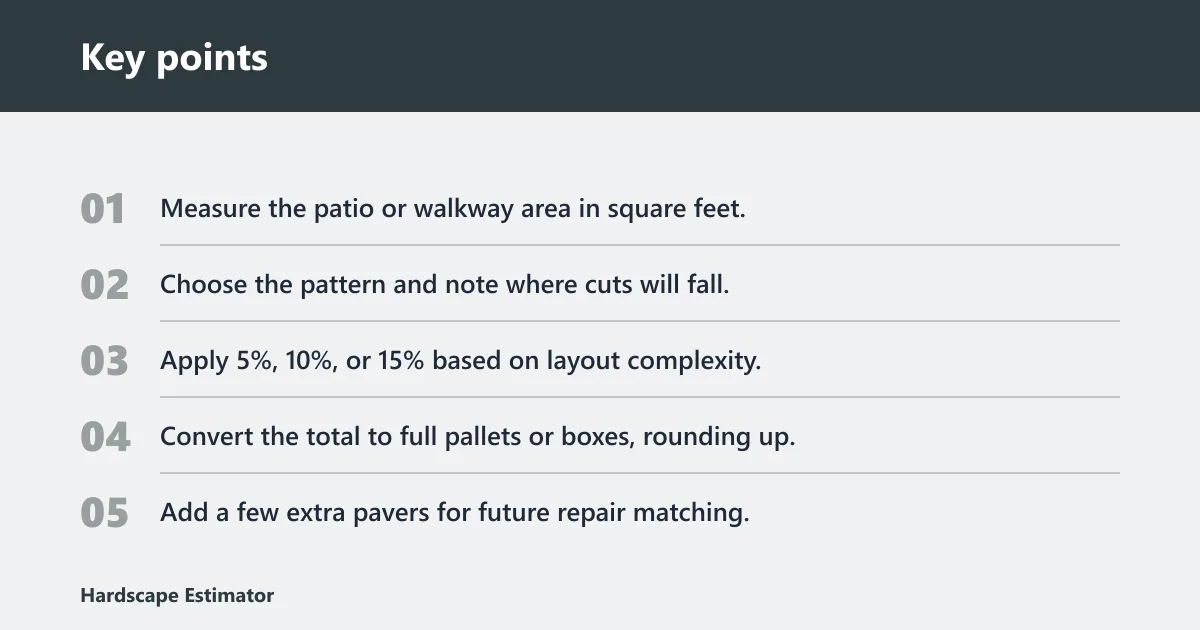
- Measure the patio or walkway area in square feet.
- Choose the pattern and note where cuts will fall.
- Apply 5%, 10%, or 15% based on layout complexity.
- Convert the total to full pallets or boxes, rounding up.
- Add a few extra pavers for future repair matching.
Say your 12 ft by 16 ft patio uses 6×9 pavers in a straight run. The calculator example uses 10% waste and lands at about 564 pavers. That same area with more border trimming or a diagonal field would call for a higher buffer.
Paver waste decision table
| Project type | Recommended waste | Why it changes | When to round up |
|---|---|---|---|
| Straight patio | 5% to 10% | Running bond on a straight field keeps cuts low, but perimeter trimming still creates some loss. | Round up when the order lands close to a partial pallet or when the pattern shift would leave you short. |
| Straight walkway | 10% | Narrow runs can create more edge cuts, so even a simple path often needs a fuller buffer. | Round up if the path is long and thin, or if the supplier sells by box count with limited break points. |
| Patio with borders | 15% | Border cuts raise waste because the field and the frame both need trimming and fitting. | Round up when the border uses a different paver size or color, since matching extras matter more. |
| Curved or diagonal layout | 15% | Curves and diagonal lines increase cut pieces, odd angles, and offcut loss. | Round up if the curve is tight, the layout has multiple corners, or the install includes inlays. |
Which pattern changes waste the most?
Running bond is the simplest pattern and wastes the least material. Basketweave sits in the middle with moderate difficulty. Herringbone usually needs the most waste because it creates more cuts and more direction changes, and the calculator recommends 15% for herringbone or diagonal layouts.
That pattern difference matters more than most people expect. A straight field in running bond can often stay near 5% to 10%, while the same area in herringbone can need a full 15% allowance even before border cuts are counted.
Herringbone is also described as the strongest pattern for driveways, but strength does not lower waste. It often raises it. The shape of the layout drives the order size.
Running bond
Use running bond as the baseline for straight layouts. It keeps joints simple and leaves fewer awkward offcuts. For a patio or walkway with clean edges, this is the pattern most likely to stay near the low end of the waste range.
Basketweave
Basketweave has moderate difficulty. It can fit decorative patios well, but the alternating blocks create more layout decisions than running bond. Plan for more waste than a plain straight run, especially if the perimeter has corners or a short return.
Herringbone
Use 15% when the field is herringbone or diagonal. Those layouts create more cut pieces at the edges and more small losses during fitting. For a patio or walkway with a tight footprint, that extra buffer is safer than hoping the cuts line up cleanly.
How do paver size and order quantity affect waste?
Paver size changes how many pieces you need per square foot, but it does not replace the waste allowance. Smaller units usually mean more joints and more pieces to handle. Larger units mean fewer pieces, yet border cuts and odd edges still create waste.
| Paver size | Pieces per square foot | What that means for ordering |
|---|---|---|
| 4×8 in | 4.5 | More pieces to sort and cut, so short orders show up faster if the waste buffer is too low. |
| 6×9 in | 2.67 | A common middle size that still needs a real buffer for edge cuts and pattern changes. |
| 8×8 in | Varies by layout | Useful for square fields, but the pattern can create leftover offcuts that are not all reusable. |
| 12×12 in | 1 | Fewer pieces per square foot, but one bad cut on a border can still leave you short. |
Suppose a walkway uses 12×12 pavers in a straight line. The piece count is simpler, but the order still needs a waste allowance because the last row, the entry edge, and any side trim can consume more material than expected.
Round up to the next full pallet or box when the total lands near a supplier break point. A small gap in the count can be more expensive than the extra material because a second delivery or a rush pickup costs time and money.
For separate layers, keep the math apart. The calculator says a 4-inch base is typical for patios and walkways, while driveways need a deeper base of 6 to 8 inches. It also uses 1 inch of leveling sand before setting pavers. Those layers are not part of paver waste.
How do curves, borders, and inlays affect paver waste?
Curves, borders, and inlays push waste higher because they create more cuts and more odd shapes. A straight rectangle can leave reusable offcuts. A curved edge or a framed border often leaves pieces that are too small or too angled to reuse cleanly.
Use 15% once the layout stops being a simple field. That applies to curved walks, diagonal patios, framed borders, and mixed design zones. If more than one of those features appears in the same project, 15% is usually the safer order size.
A common first-timer mistake is treating a border as only a visual detail. It is also a cut multiplier. Every added edge means another place where the pattern has to fit the shape instead of the other way around.
Common mistakes
- Using one waste percentage for every pattern instead of matching the layout.
- Mixing paver waste with gravel base or leveling sand math.
- Forgetting that narrow walkways often need more edge cuts than broad patios.
- Ordering no repair extras, then having nothing left after the job.
- Ignoring border cuts, curves, and inlays when the design looks simple on paper.
- Rounding down when the order is close to a pallet or box break.
Say your patio is a 10 ft by 20 ft rectangle with a soldier-course border. The field may look straight, but the border adds cuts on both the inner and outer edges. That is the kind of job where 15% is safer than trying to force a 10% order to fit.
If that order still feels tight, add 1 more box or a few more pavers, then recheck the count. Use the same supplier lot if possible. Color and texture shifts between batches can make a small shortage harder to solve later.
Frequently asked questions
How much paver waste should I add for a straight patio layout?
Start at 5% for a clean straight patio with few cuts. Move to 10% if the perimeter has several corners, short returns, or a trim-heavy edge. Running bond is the simplest baseline, so it usually stays at the low end unless the shape forces extra cutting.
How much extra paver waste should I add for a walkway?
Use 10% for most walkways because narrow runs create more edge cuts than open patios. A straight path with simple sides may stay lower, but long, thin layouts often lose more material at the edges. Round up to the next full box when the count lands near a break point.
Do herringbone paver patterns need more waste than running bond?
Yes. Herringbone usually needs more waste than running bond, and the calculator recommends 15% for herringbone or diagonal layouts. Running bond is the simplest pattern and wastes the least material. Herringbone is also the strongest pattern for driveways, but strength does not reduce cut loss.
Should I use 10% or 15% waste for pavers?
Use 10% for most straight patios and walkways with normal edge cuts. Use 15% when the layout includes herringbone, diagonal runs, borders, curves, or inlays. If the design has more than one of those features, 15% is the safer order because small fitting losses add up quickly.
Does the size of the paver change the waste allowance?
It changes the piece count, not the need for waste. A 4×8 paver needs 4.5 pieces per square foot, a 6×9 needs 2.67, and a 12×12 needs 1. Larger units may cut differently, but every size still needs a buffer for breakage and odd edge pieces.
How many extra pavers should I keep after the job for repairs?
Keep a small repair reserve after installation, usually at least a few matching pieces from the same lot. Store them flat and dry. That reserve is separate from the waste allowance, which is for ordering. If the project is small, one full box kept back is often easier to use later.