How Much Do Cap Blocks Weigh?
Cap blocks usually weigh 20 to 80 lb each. Concrete caps are often 30 to 60 lb, while large natural-stone caps can reach 100 lb or more. Underestimating weight can injure workers, overload shipments, and make caps hard to set cleanly on the wall. This guide gives a size-and-material weight table, plus a quick formula for custom caps and hauling estimates.
What affects cap block weight
Cap block weight changes with size, profile, and material. For concrete caps, a small 4x8x16 piece may land around 30 to 45 lb at common concrete densities, while larger solid caps can climb past about 100 lb. Natural stone can be lighter or heavier than concrete, so check the product listing for the exact line.
What changes the weight most
Three things move the number most: total dimensions, whether the cap is solid or hollow, and the material density. Concrete is commonly estimated with unit weights around 100 to 150 pcf. Clay can run higher, with published examples from 120 pcf to 190 pcf. Natural stone varies by stone type.
When to check the manufacturer listing
Check the listing whenever the cap has a bullnose, split-face, hollow core, or unusual thickness. Exact weight can vary by product line even when the nominal dimensions look the same. If the cap is going on a wall system, the wall maker’s specs matter too.
Cap block weight table
This table uses the formula weight = length × width × thickness × density, with dimensions converted to feet. For concrete, the range below uses 100 pcf to 150 pcf, which matches common concrete paving density figures. Hollow caps are shown with a simple void assumption so the handling call is clearer.
| Cap size, nominal | Material / profile | Estimated weight per piece | Handling note |
|---|---|---|---|
| 4 x 8 x 16 in | Solid concrete | 29.6 to 44.4 lb | One-person lift for many adults; two-person lift if access is awkward or the piece must be carried far |
| 4 x 8 x 16 in | Hollow concrete, about 25% void | 22.2 to 33.3 lb | One-person lift in most cases; watch for awkward grip and chipped corners |
| 4 x 12 x 18 in | Solid concrete | 50.0 to 75.0 lb | Two-person lift is the safer call for most installs |
| 4 x 12 x 24 in | Solid concrete | 66.7 to 100.0 lb | Two-person lift; machine-assisted handling if the route is long or uneven |
| 6 x 12 x 24 in | Solid concrete | 100.0 to 150.0 lb | Machine-assisted handling is the practical choice for most crews |
| 4 x 8 x 16 in | Natural stone, density varies by stone type | Varies by stone | Confirm the listing; granite caps can be heavy for their size |
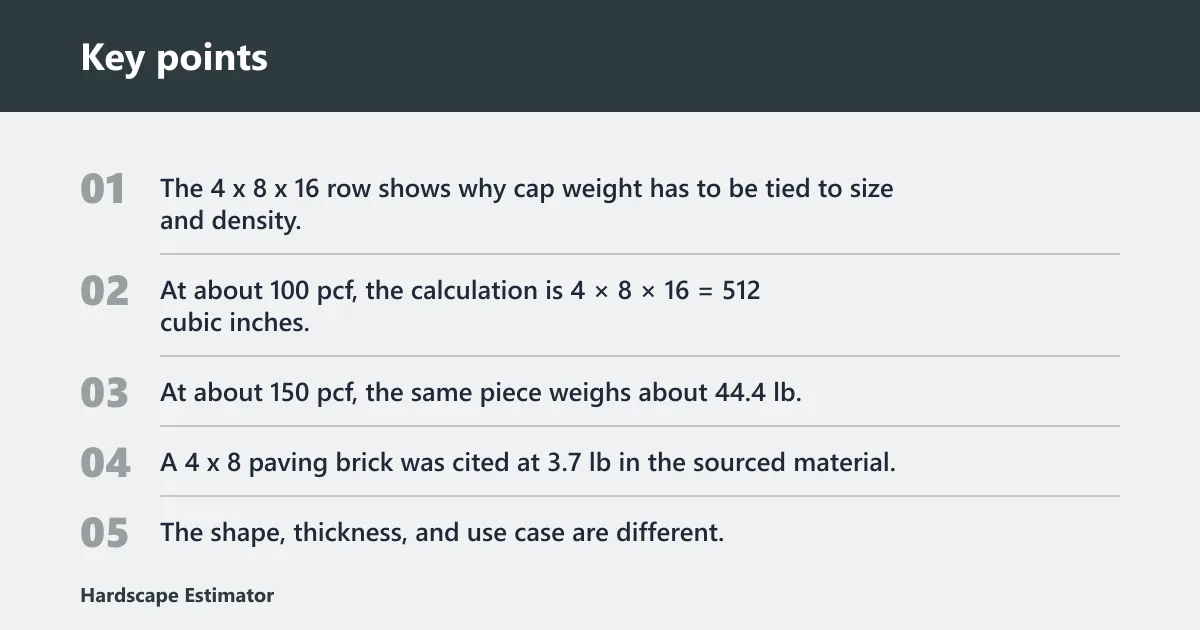
The 4 x 8 x 16 row shows why cap weight has to be tied to size and density. At about 100 pcf, the calculation is 4 × 8 × 16 = 512 cubic inches, or about 0.296 cubic feet, which gives about 29.6 lb. At about 150 pcf, the same piece weighs about 44.4 lb.
A 4 x 8 paving brick was cited at 3.7 lb in the sourced material, but that is a paving brick, not a cap block. The shape, thickness, and use case are different, so do not transfer that weight to a wall cap.
What makes a cap block heavier?
A cap block gets heavier as the volume increases and as the material density rises. A solid cap is heavier than a hollow cap because more of the block is concrete or stone. Clay can also run heavier than standard concrete, with published paving densities from 120 pcf to 190 pcf.
Concrete density and unit weight
For estimating, concrete density is commonly stated in pounds per cubic foot. The example density used here is 100 pcf, and the common concrete paving range cited was 100 pcf to 150 pcf. That gives a usable low-to-high estimate without pretending every product line is identical.
Length, width, and thickness
Longer caps weigh more than short ones, and thicker caps weigh more than thin ones. A 4 inch cap block with the same footprint will weigh less than a 6 inch cap block. This is why nominal thickness matters as much as the face length when you plan handling and freight.
Solid, hollow, and stone options
Solid cap block means the full volume is material, so the piece is heavier and usually better for durable edge conditions. Hollow cap block reduces material volume and weight, which can make setting easier. Natural stone caps can be either lighter or heavier than concrete, depending on stone type; granite is one common option.
How do you estimate cap block weight?
Use the same three-step math every time: convert inches to feet, calculate cubic feet, then multiply by density. For concrete caps, the estimating density can be 100 pcf for a light estimate and 150 pcf for a heavy estimate. That gives a realistic range for hauling and install planning.
Step-by-step formula
- Measure length, width, and thickness in inches.
- Multiply the three dimensions to get cubic inches.
- Divide by 1,728 to convert cubic inches to cubic feet.
- Multiply cubic feet by density in pcf.
- Use the result as pounds per piece.
Worked example for a 4x8x16 cap block
Say your cap is 4 in thick, 8 in deep, and 16 in long. The volume is 4 × 8 × 16 = 512 cubic inches. Divide by 1,728 and you get 0.2963 cubic feet.
How to estimate custom sizes
Suppose the cap is 4 x 12 x 24 in. The volume is 1,152 cubic inches, or 0.6667 cubic feet. At 100 pcf, that is 66.7 lb. At 150 pcf, it is 100.0 lb. That same method works for any custom size once you know the actual dimensions.
How do I estimate cap block weight for hauling and installation?
Use the piece weight first, then scale up to the pallet and the crew. A cap that is fine to carry one at a time may still be a poor freight choice if the pallet load is too heavy for the delivery equipment. For install planning, access matters as much as the number on the scale.
One-person lift versus two-person lift
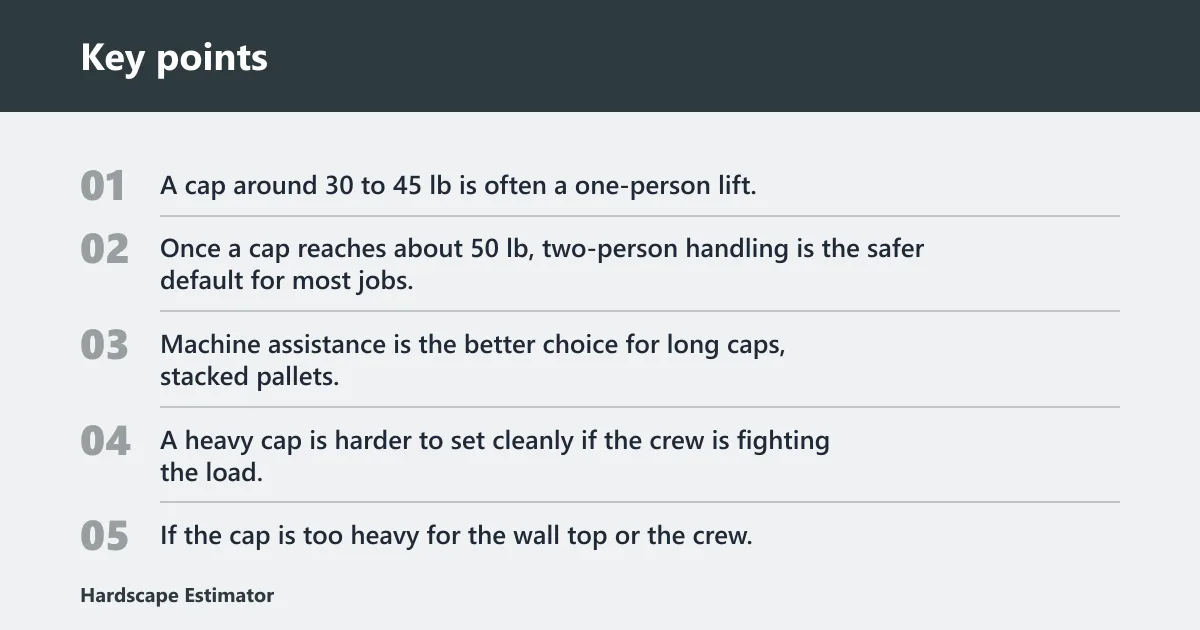
A cap around 30 to 45 lb is often a one-person lift, but only when the route is short and the grip is good. Once a cap reaches about 50 lb, two-person handling is the safer default for most jobs. Above 100 lb, plan on machine assistance.
Machine-assisted handling
Machine assistance is the better choice for long caps, stacked pallets, and sites with stairs, slopes, or tight turns. A heavy cap is harder to set cleanly if the crew is fighting the load. If the cap is too heavy for the wall top or the crew, the risk is a chipped edge or a poor adhesive bed.
Pallet weight and shipping planning
Palletized cap blocks need two checks: pieces per pallet and total pallet weight. If a pallet carries 40 pieces of a 29.6 lb cap, the pieces alone total 1,184 lb before pallet wrap and the pallet itself. Freight planning should use the per-piece weight plus the pallet count, not just the piece number.
A common first-timer mistake is ordering a long, solid cap by piece count alone and forgetting the lift path. A 24 in cap at 100 lb each may look manageable on paper, then become awkward once the crew has to carry it across soft ground or up a step.
How do cap blocks work on retaining walls?
Retaining wall caps usually sit on top of wall units, often with a small overhang at the face. Nominal thickness matters because it affects the finished look, the adhesive bed, and the load on the wall top. Edge and corner caps can weigh differently from straight runs because the profile changes.
Nominal thickness and overhang
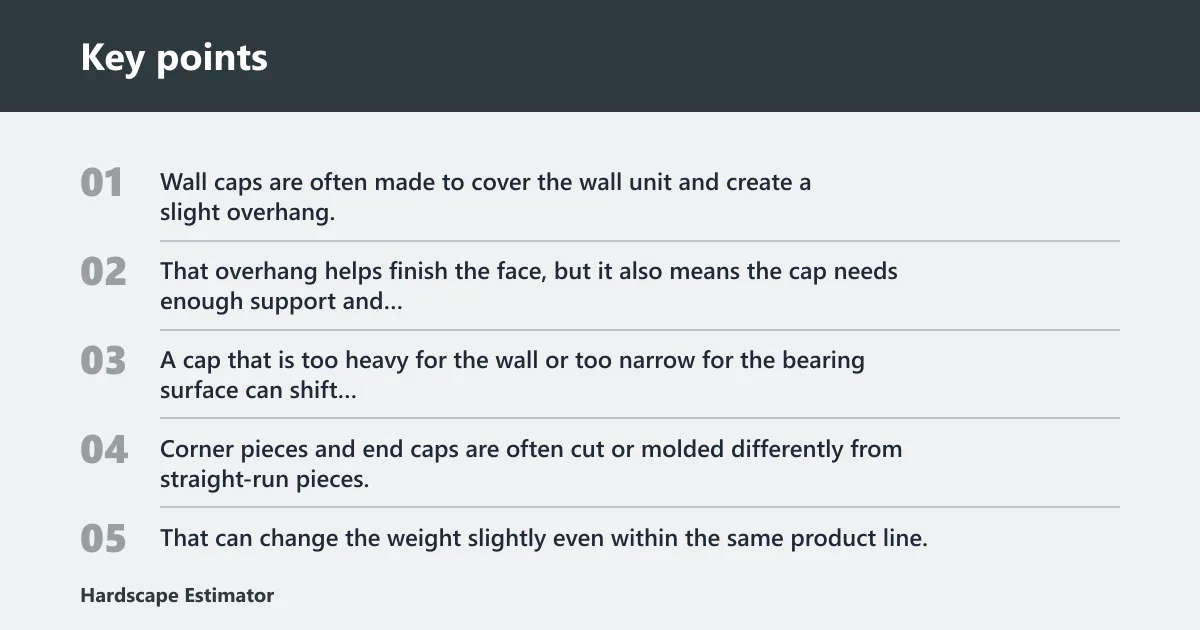
Wall caps are often made to cover the wall unit and create a slight overhang. That overhang helps finish the face, but it also means the cap needs enough support and adhesion to stay seated. A cap that is too heavy for the wall or too narrow for the bearing surface can shift during setting.
Edge and corner variants
Corner pieces and end caps are often cut or molded differently from straight-run pieces. That can change the weight slightly even within the same product line. If the project has returns, inside corners, or outside corners, check the exact listing for those pieces rather than assuming the straight cap weight applies.
Adhesive-set and wall-load considerations
Many caps are adhesive-set rather than mechanically fastened. That works well when the cap weight and wall strength are matched to the product design. If a cap is too heavy, the adhesive bed has to resist more sliding and creep, and the wall top must provide solid support. If the cap is too light and hollow, the fit and bond still need to be right.
Frequently asked questions
How much do cap blocks weigh?
Most cap blocks weigh about 20 to 80 lb each, but the actual number depends on size, material, and whether the cap is solid or hollow. Concrete caps are often in the 30 to 60 lb range. Large stone caps can exceed 100 lb, so check the product listing before ordering.
How much does a 4x8x16 cap block weigh?
If the cap is hollow, the weight is lower because less material is present. Exact weight varies by manufacturer and profile, so confirm the listing for your model.
How much does a concrete cap block weigh?
A concrete cap block commonly weighs 30 to 60 lb, but larger solid pieces can go higher. The best estimate comes from the dimensions and the concrete density. Using 100 pcf to 150 pcf gives a realistic range for planning transport, lifting, and wall installation.
How much does a 4 inch cap block weigh?
A 4 inch cap block weight depends on its footprint and length. A 4 x 8 x 16 piece is one example, and it estimates at 29.6 to 44.4 lb in solid concrete. If the 4 inch cap is longer or wider, the weight rises with the added volume.
How much does a solid cap block weigh?
A solid cap block weighs more than a hollow cap block because the full volume is material. For a common concrete cap, that can mean roughly 30 to 100 lb depending on size. Larger solid pieces may need two-person handling or machine assistance, especially on tight sites.
How much does a 4×8 cap block weigh?
A 4×8 cap block cannot be pinned to one exact weight without the third dimension. If you mean a 4 x 8 x 16 cap, the estimate is 29.6 to 44.4 lb for solid concrete. If the product line uses a different length, recalculate from the actual dimensions.