Can You Lay Pavers Without a Base?
No, pavers need a compacted base unless they go over a structurally sound existing slab or a pedestal system made for that use. Skip the base in the wrong place and you get settling, rocking pavers, pooled water, and costly rework. This guide shows where a base is required, when an existing hard surface can work, and when failure is almost certain.
What you’ll need
- Crushed angular aggregate base
- Bedding sand
- Plate compactor
- Edge restraint
- Level, string line, and straightedge
- Polymeric sand
- Shovel and rake
- Hand tamper for tight spots
- Rubber mallet
- Cutting saw or splitter for edge cuts
Can you lay pavers without a base?
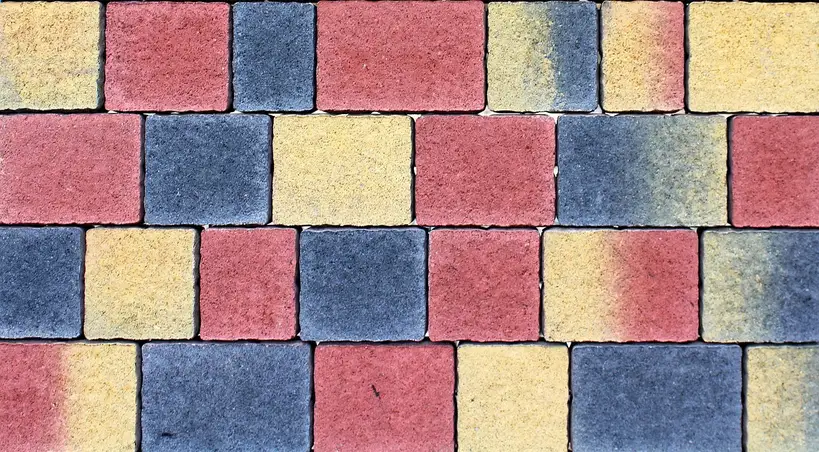
Pavers are commonly laid without a traditional base only over a structurally sound existing slab or on a pedestal system made for that purpose. For standard interlocking pavers on soil, sand, or weak fill, the answer is no. Bedding sand is not a base. It is the thin leveling layer above the base.
A crushed angular aggregate base is the load-bearing layer under the bedding sand. Its angular particles lock together better than rounded gravel, and it compacts in thin lifts. Bedding sand sits above it, usually about 1 inch thick, and is used for screeding and final leveling.
When an existing hard surface can work
If the slab is structurally sound, drained, and free of major cracks or heave, pavers can be installed on top with a bonding or leveling method suited to the system. This is a surface-over-surface build, not a no-base build. The slab already provides the structural support.
When no base leads to failure
On soil, sand only, or loose fill, the pavers carry point loads into a surface that moves. That movement shows up as settlement, rocking, open joints, edge spread, and low spots that hold water. In freeze-thaw climates, trapped water expands and makes the movement worse.
Why sand or soil alone is not enough
Sand can help with leveling, but it does not replace a compacted base. Soil can be even less reliable, especially if it is clay. Clay subsoils are weak and may need amendment. Sandy subsoil drains better, but it still does not create a load-bearing paver base by itself.
Say your 10 ft by 10 ft patio sits on bare soil and you skip the base to save time. The first rain softens the subgrade, the sand bed shifts, and one corner drops. The fix is not a top-up of joint sand. The area must be lifted and rebuilt from the subgrade up.
Paver base decision table
| Scenario | Base required? | Minimum layer needed | If skipped, likely failure mode |
|---|---|---|---|
| Patio over soil | Yes | Excavation, compacted subgrade, 4 in minimum base for pedestrian use; 6 in in freeze-thaw climates | Settlement, rocking, ponding |
| Walkway over soil | Yes | Compacted base and about 1 in bedding sand | Uneven walking surface, open joints |
| Shed base | Yes | Compacted base sized to the shed load and soil condition | Tilt, frame racking, door binding |
| Pavers over concrete | Sometimes | Sound slab, drainage, thin setting layer or approved system | Bond failure, rocking if the slab moves |
| Pavers over sand | Yes | Actual compacted base under bedding sand | Fast settlement and joint loss |
| Dry-climate landscape strip | Usually yes | Compacted base, even if traffic is light | Edge creep and sunken patches |
| Permeable system | Yes | Open-graded base sized for infiltration and storage | Clogging, ponding, structure movement |
| Pedestal porcelain | No traditional base | Structurally sound slab or engineered support system | Tile movement, pedestal instability |
The practical rule is simple. Standard interlocking pavers on soil need a full build. Decorative strips may use a thinner build, but they still need structure. Pedestal porcelain and some over-slab systems are different products, so the support method changes too.
How do you build a paver base?
Build the base in layers, then compact every lift. For pedestrian applications, the minimum base depth is 4 inches. In climates with freeze-thaw cycles, the minimum base depth increases to 6 inches. On clay, minimum base is 6 inches, and many builders go deeper; 8 inch on top of clay is a common conservative choice.
- Mark the area and excavate to the planned depth.
- Shape the subgrade so water drains away from structures, with a common rule of thumb of about 1/8 inch per foot.
- Compact the subgrade with a plate compactor.
- Add crushed angular aggregate base in 2- to 3-inch lifts and compact each lift.
- Screed about 1 inch of bedding sand.
- Set the pavers, cut the edges, install edge restraint, and sweep polymeric sand into the joints.
Edge restraint matters because it keeps the pavers from spreading sideways. Install it around the perimeter and secure it with spikes or fixed edging. The base should extend past the final border pavers by a distance equal to the base depth, which helps keep the edge supported.
Polymeric sand goes in after the pavers are placed. It fills the joints, helps lock them, and reduces washout. Clean the surface carefully before activation. If residue stays on the pavers, it can haze the face.
Suppose a 12 ft by 16 ft walkway sits on clay in a cold climate. A 4 inch base may be enough in mild areas, but freeze-thaw raises the risk. The safer build is 6 inches minimum, with good drainage and compacted lifts. That change is small; the difference in movement is not.
What happens if you skip the base?
Skipping the base turns the pavers into a surface layer over unstable support. The pavers may look fine at first, but the system loses level control. In a season or two, weak points show up as dips, rocking stones, and open joints that admit more water.
Settlement and low spots
The most common failure is vertical movement. Soil compresses unevenly, bedding sand migrates, and the surface drops in patches. Water then collects in those low spots, which speeds up the damage.
Rocking pavers and open joints
When the support underneath changes, individual pavers begin to rock under foot traffic. The joints open and the locking effect weakens. That movement also breaks polymeric sand lines sooner.
Edge spread and creeping rows
Without edge restraint and a stable base, rows can spread sideways. The border loosens first, then the field follows. Repair usually means lifting a section and rebuilding the edge support, not just adding more joint sand.
Freeze-thaw movement in cold climates
Freeze-thaw cycle is a major risk factor. Water trapped under or beside the pavers expands when it freezes. That expansion can heave the surface and break the level even if the pavers themselves are still sound.
Drainage failures and washout
When slope is missing, water ponds under the pavement instead of moving away. That trapped water softens the support, carries fines out of the joints, and shortens the life of the installation. A paver surface cannot stay stable if the water has nowhere to go.
Common first-timer mistake: a 6 ft by 8 ft path is set on a sand layer over dirt because the area is “small.” The footprint is small, but the failure mode is the same. A few heavy rains later, the edges spread and the middle sags.
Common mistakes
- Using rounded gravel instead of crushed angular aggregate base.
- Skipping compaction between 2- to 3-inch lifts.
- Making bedding sand too thick.
- Ignoring slope for drainage.
- Leaving out edge restraint.
- Using polymeric sand before the joints are clean and dry enough for activation.
A common source of failure is confusing bedding sand with base material. Bedding sand helps the pavers sit flat. It does not carry the load. The base does that work, and the plate compactor is what turns loose stone into a stable layer.
Another mistake is treating clay and sandy subsoil the same. Clay holds water and moves more. Sandy subsoil drains better, but it still needs a proper base for standard pavers. Soil type changes the build, not the need for one.
Frequently asked questions
What happens if you put pavers directly on dirt?
The dirt moves, so the pavers move. Expect settlement, uneven joints, rocking corners, and pooled water after rain. In cold weather, trapped moisture can freeze and heave the surface. A dirt-only install is a short-term layout, not a durable pavement.
Do pavers need gravel underneath?
Standard interlocking pavers need a compacted crushed aggregate base underneath, not loose gravel dumped in one layer. The base should be installed in thin lifts and compacted. Bedding sand goes above it. The two layers do different jobs and should not be mixed together.
Can you use sand instead of a paver base?
No. Sand is for bedding and leveling, usually about 1 inch thick. It is not a substitute for the load-bearing base below it. If sand replaces the base, the pavers can shift as soon as the subgrade wets, dries, or freezes.
What is the minimum base depth for pavers?
For pedestrian applications, the minimum base depth is 4 inches. In climates with freeze-thaw cycles, the minimum base depth increases to 6 inches. Clay subsoils may need more support, and the build should always match traffic, drainage, and soil conditions.
Is a base needed for a small paver patio?
Yes, if the patio is on soil. Small size does not remove load, drainage, or frost movement. A compacted base, bedding sand, edge restraint, and slope are still needed. A tiny patio built without those layers can fail just as fast as a larger one.
What problems happen when pavers are installed without a base?
Settlement is the first problem, followed by rocking, open joints, edge spread, and drainage trouble. In freeze-thaw climates, the damage can accelerate. The pavers may still look structurally sound, but the surface below them is no longer stable enough to hold level.