How Much Does Lawn Leveling Cost for DIY vs a Service?
DIY lawn leveling usually costs about $0.20 to $1.25 per sq ft in materials for shallow topdressing and small low spots, while a professional service often runs $1 to $3 per sq ft, with regional labor and delivery fees pushing those numbers up or down. DIY is usually cheapest for thin topdressing and small low spots; once the work turns into grading or drainage correction, a pro quote often makes more sense.
Lawn leveling cost at a glance
The best value depends on depth, not just square footage. Thin topdressing can stay in DIY territory, but deeper fill, repeated trips, and finish grading quickly raise the real cost. Delivery minimums, bag-vs-bulk pricing, and local labor rates are the biggest reasons the same job can cost very different amounts in different regions.
DIY vs pro: quick decision checklist
Use DIY if the repair is shallow, the lawn is healthy, and you already have basic tools. Hire a pro if the lawn has broad unevenness, compaction, bare patches, or drainage problems. If the job needs aeration, reseeding, and grading together, the labor and risk usually outweigh the savings.
| Factor | How much does lawn leveling cost for DIY | a service | Winner |
|---|---|---|---|
| Cost | About $0.20 to $1.25 per sq ft in materials, before tools or delivery. | Often $1 to $3 per sq ft, with labor included. | How much does lawn leveling cost for DIY |
| What the quote includes | Mainly material, plus delivery, tool rental, and seed if needed. | Labor, equipment, setup, cleanup, and a minimum charge. | How much does lawn leveling cost for DIY |
| Best-fit use | Best for thin topdressing, small low spots, shallow correction, and simple spread-and-rake work. | Best for bigger jobs, broad unevenness, grading, drainage issues, or more complex leveling. | Tie |
| Performance / risk | Higher risk of error if the mix is too deep or prep is skipped. | Lower risk when the crew matches fill to slope and turf condition. | a service |
| Maintenance / extra work | DIY may require handling reseeding, aeration, rentals, delivery, and repeated trips yourself. | A service can bundle aeration, reseeding, grading, cleanup, and labor into one job. | a service |
| Size and depth sensitivity | Stays cheapest when the job is small and shallow; deeper fill raises the real cost quickly. | Becomes the better buy when the lawn needs a large correction, multiple loads, rentals, or extra labor. | Tie |
| Regional variation | Material, delivery, and store pricing vary by market. | Labor rates and minimum charges vary by area. | Tie |
How much does lawn leveling cost by size and depth?
Cost rises in a predictable way: area first, then depth, then whether you buy bagged material or bulk delivery. A light topdressing on a small patch is usually inexpensive, while a full-yard correction can become a major project once materials, rentals, and labor are included.
What changes the total most
Square footage drives the bill, but depth changes it faster. A 1/4-inch topdressing uses far less material than a 1-inch correction, and deeper fill can bury grass crowns if spread too heavily. Local labor rates, minimum charges, and delivery fees can also change the final total significantly.
When the cheaper option changes
DIY stays ahead when the job is small, shallow, and finished in one visit. A practical single-pass limit is about 1/2 inch; anything deeper should be built up in thin lifts so grass crowns stay exposed. A pro becomes the better buy when the lawn needs grading, drainage help, or a large correction that would take multiple loads, rentals, and extra labor. At that point, the service fee may buy certainty as much as convenience.
📊 Professional lawn reseeding typically costs between $436 and $1,763. Source: Thisoldhouse.
What do DIY and professional quotes usually include?
DIY cost is mostly material, plus delivery, tool rental, and seed if needed. A service quote usually includes labor, equipment, setup, cleanup, and a minimum charge. The quoted total may look higher, but it often covers the same extras a homeowner would have to handle separately.
Material-only DIY cost
For basic topdressing, the material line is the first number to check. If the lawn only needs a thin fill, DIY can stay near the low end of the per-square-foot range. Deeper corrections cost more because the needed volume increases quickly as depth increases.
Tool and rental add-ons
A rental overseeder was quoted at $79 for 24 hours in the supplied facts. That matters if the leveling plan includes reseeding, especially on bare patches or thin turf. Delivery or pickup fees should be treated separately unless the quote already includes them.
Common DIY tools include a lawn rake, shovel, wheelbarrow, and a spreader for even placement. For larger jobs, a homeowner may also need a soil aerator or overseeder rental. Check the manufacturer’s listing for your model before loading or towing any rented equipment, and follow the manual for safe use.
Service quote components
A professional quote often reflects labor, equipment, travel, overhead, and region rather than a simple hourly wage. Hourly lawn care labor rates range from $25 to $60, but the final job quote may be packaged by square foot or by visit. Minimum charges can matter a lot on small jobs.
How much fill do you need?
Fill quantity depends on lawn area and target depth. A small patch may only need a few bags, while a full-yard topdressing can move into cubic yards. The cleanest math is square feet multiplied by depth, then converted into cubic yards or bags.
Square feet to cubic yards
One cubic yard covers 324 sq ft at 1 in deep. That means 1/2 in over 324 sq ft needs 0.5 cubic yard, and 1/4 in over the same area needs 0.25 cubic yard. This is the best way to decide whether bagged product or bulk delivery makes more sense.
Bags versus bulk loads
With 0.5 cu ft bags, one cubic yard equals 54 bags. That coverage math matters because undercounting bags understates the real cost. For example, 0.39 cu yd is about 21 bags, not 16, when each bag is 0.5 cu ft.
Typical breakpoints for bagged vs bulk
Bagged material is usually practical for small patches, touch-ups, and one-off repairs. Bulk is usually better once the job moves into multiple cubic yards, because bag counts, hauling time, and waste add up quickly. Delivery minimums can erase the savings on very small bulk orders, so compare both formats before buying.
Material price guide: sand, topsoil, or leveling mix?
Sand, topsoil, and leveling mix all solve different problems. Sand is often chosen for drainage and fine smoothing, but straight sand can create layering problems on some lawns and soil types. Topsoil is common for general fill, and leveling blends are sold for convenience. Prices vary by region, but coverage and delivery terms matter as much as the label on the bag.
| Material | Typical use | Typical price range | Coverage note | Best for |
|---|---|---|---|---|
| Sand | Fine smoothing and drainage-friendly topdressing | Region-dependent; often sold by bag or bulk load | Coverage depends on particle size and depth applied | Thin corrections and sandy blends |
| Topsoil | General fill and shallow leveling | Region-dependent; bulk is often cheaper per cubic yard | Bulk pricing usually beats bags on larger jobs | Basic low spots and fill |
| Leveling mix | Convenience blend for lawn repairs | Usually priced above plain soil due to convenience | Check the listed coverage per bag or yard | Homeowners who want a ready-made mix |
Thin topdressing vs true grading
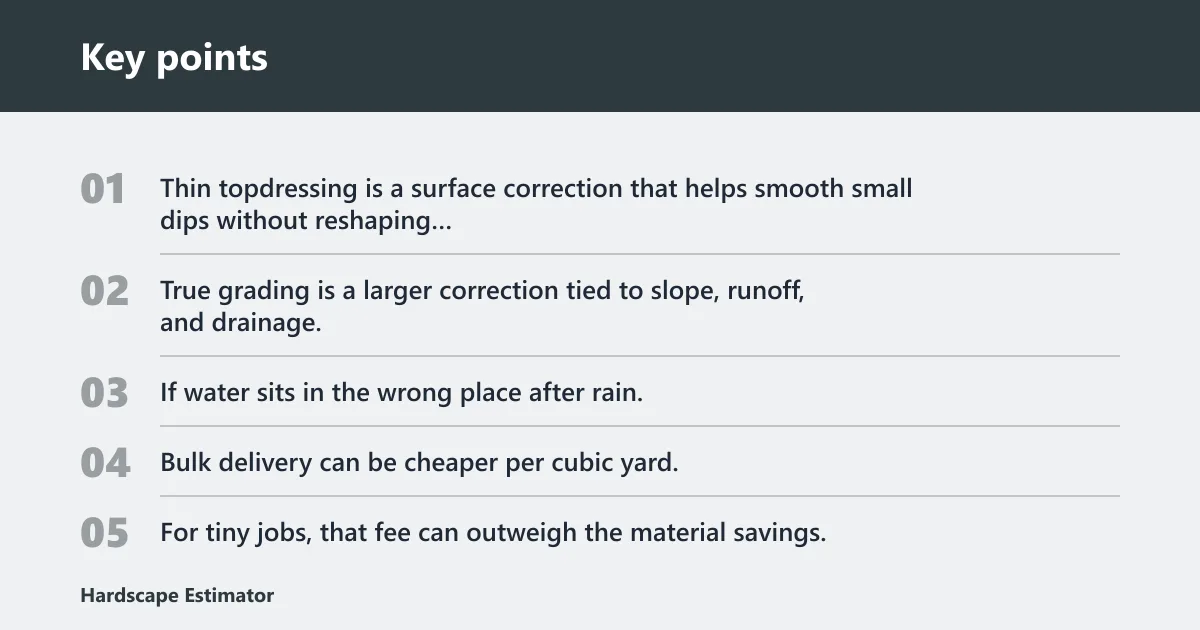
Thin topdressing is a surface correction that helps smooth small dips without reshaping the lawn. True grading is a larger correction tied to slope, runoff, and drainage. If water sits in the wrong place after rain, the problem is usually bigger than a simple topdress and may need professional grading instead.
Delivery and minimum-trip charges
Bulk delivery can be cheaper per cubic yard, but it may come with a minimum order or truck fee. For tiny jobs, that fee can outweigh the material savings. For larger jobs, bulk usually wins because it reduces bag handling, loading time, and repeated store trips.
Lawn leveling cost calculator
This calculator table shows how size and depth translate into material needs, bag counts, and likely cost bands. The DIY range reflects material only. The pro range uses the common per-square-foot service range and should be adjusted for region, drainage complexity, and minimum charges.
| Scenario | Lawn size | Depth | Volume needed | Bag count at 0.5 cu ft | DIY materials / pro quote |
|---|---|---|---|---|---|
| Small patch | 150 sq ft | 1/2 in | 0.23 cu yd | 13 bags | $30 to $188 / $150 to $450 |
| Average yard | 3,500 sq ft | 1/4 in | 2.70 cu yd | 146 bags | $700 to $4,375 / $3,500 to $10,500 |
| Large lawn | 10,000 sq ft | 1/2 in | 15.43 cu yd | 833 bags | $2,000 to $12,500 / $10,000 to $30,000 |
Small patch scenario
On a 150 sq ft spot, the material total is low enough that DIY usually makes sense if the lawn is otherwise healthy. A contractor quote can still be practical if the patch is near drainage trouble or needs blending into a larger repair. Delivery minimums may matter as much as the material itself.
Average yard scenario
At 3,500 sq ft, the material count becomes large enough that bagged product is a time cost as well as a cash cost. A service can be the better buy if the yard also needs aeration, reseeding, or a more even grade across the property. The larger the yard, the more labor changes the decision.
Large uneven lawn scenario
At 10,000 sq ft and 1/2 in depth, DIY material alone is a major load. A crew quote may look expensive, but it can be the safer option when the lawn has slope changes, drainage issues, or widespread compaction. The risk of underfilling or overfilling grows with area.
Do you need aeration or reseeding?
Often, yes. Aeration helps if the soil is compacted, and reseeding helps if leveling exposes thin turf or bare patches. Many lawn plans aerate before topdressing so the fill can settle into open holes, but the right order depends on lawn condition and the scope of the job.
How add-ons change the total
Lawn aeration costs homeowners an average of $120, and the typical range is $75 to $170. DIY reseeding costs around $250 for the average lawn, while professional lawn reseeding typically costs between $436 and $1,763. These add-ons can cost as much as the leveling work itself on a small yard.
A bag of fescue that provides 8,000 square feet of coverage costs around $80. That works out to about $0.01 per square foot for seed alone. If you are seeding a thin lawn after topdressing, that seed line can be small compared with labor, but it still belongs in the budget.
Timing around watering and recovery
After leveling and seeding, watering matters more than speed. The lawn needs steady moisture so the mix settles and new seed can germinate without washing out. If the turf is already stressed, adding too much fill at once can slow recovery and leave weak growth around the repaired area.
What tools do you need to level a lawn yourself?
A simple leveling job needs a few basic tools: a shovel, rake, wheelbarrow, and spreader. Larger jobs may need a soil leveler, aerator, or overseeder rental. The tool list stays short for a small patch, but it grows quickly when the lawn is wide or uneven.
- Measure the area in square feet.
- Choose the fill depth and calculate the material volume.
- Check whether the lawn needs aeration, reseeding, or dethatching first.
- Spread the mix in thin lifts so grass crowns stay exposed.
- Water the area lightly and monitor settling before adding more fill.
When DIY is cheaper
DIY is cheaper when the correction is shallow, the area is small, and the homeowner already owns or can borrow the basic tools. A thin topdressing over a few hundred square feet often keeps material cost low enough that labor savings matter most. If the job needs only one rental and one delivery, the math usually stays on the DIY side.
Say your front yard has a few low spots near the sidewalk but the rest of the turf is healthy. A 200 sq ft repair at 1/2 in depth needs only about 0.31 cu yd of mix, so the material bill is still modest. A crew quote may still be the better buy if the surface also has drainage trouble or a slope that needs correction.
When to call a pro instead
Call a service when the lawn has broad unevenness, compaction, bare patches, or a grade issue that keeps water in the wrong place. Those jobs can require more than fill, and the extra labor often outweighs the savings from DIY. A pro is also the safer choice when the job needs multiple steps in the same visit, such as aeration, topdressing, and reseeding.
Picture a 5,000 sq ft backyard with low spots after a drainage fix. That is no longer a simple spread-and-rake job. A quote that includes grading and cleanup may cost more upfront, but it can be the lower-risk option if the lawn would otherwise need repeat corrections.
Choose DIY if the job is small; choose a service if the lawn needs correction beyond topdressing
Choose lawn leveling DIY if the area is small, the fill is shallow, and the lawn already has decent drainage. Choose a service if the lawn needs grading, broad topdressing, aeration, reseeding, or a crew to fix the surface in one pass. The right pick is the one that matches the scope.
DIY wins on price when the job is mainly material. A service wins when labor, timing, and mistake risk matter more than the raw mix cost. If the low spots are deep or the lawn is damaged, paying for the crew can be the better spend.
Frequently asked questions
How much does lawn leveling cost for DIY vs a service?
DIY leveling usually lands around $0.20 to $1.25 per sq ft in materials for shallow topdressing, while a professional service often runs $1 to $3 per sq ft. DIY is usually cheaper for thin topdressing and small areas. A service becomes more practical when labor, grading, or add-ons dominate the job.
How much topsoil or leveling mix do I need for lawn leveling?
Use the area and depth together. One cubic yard covers 324 sq ft at 1 in deep, or the same area at shallower depths in proportion. For bagged mix, 1 cubic yard equals 54 bags at 0.5 cu ft each, so the bag count rises fast as area grows.
What do lawn leveling companies charge per square foot?
Many contractors quote by square foot, and the broad range in this guide is $1 to $3 per sq ft for professional service. The final number depends on yard size, slope, soil condition, and whether the quote includes aeration, reseeding, or cleanup. Minimum charges can also affect small jobs.
Is DIY lawn leveling cheaper than hiring a pro?
Yes, when the correction is light and the lawn is not badly uneven. DIY avoids labor charges, which are often the biggest part of the service quote. If the yard needs extra prep, delivery, or multiple steps, the savings shrink and the DIY risk goes up.
What costs more: sand, topsoil, or a leveling mix?
The exact price depends on region and supplier, so the safest answer is to compare by coverage rather than by name alone. A sand-heavy blend may spread easily, while topsoil can be better for some lawns, and a leveling mix can be priced for convenience. Check the coverage rate before buying.
Do I need aeration or overseeding before leveling my lawn?
Not always, but both are common add-ons. Aeration helps compacted soil accept new fill, and overseeding helps thin turf recover after leveling. Many plans aerate before topdressing, but the right order depends on the lawn’s condition and the contractor’s scope.
What tools do I need to level a lawn myself?
At minimum, you need a shovel, rake, and a way to move and spread the mix. A wheelbarrow helps with transport, and a spreader or overseeder can help with even distribution or reseeding. For rented gear, check the manufacturer’s listing for your model and follow the manual.
When is the best time to level a lawn?
The best time is when the turf can recover quickly and the soil is workable. That usually means a period with active growth and steady watering, not heat stress or frozen ground. Timing also depends on whether aeration, seeding, or dethatching is part of the plan.
How much does it cost to reseed after lawn leveling?
The total changes with lawn size, seed choice, and whether the work is bundled with leveling. A small patch can stay low; a full yard can climb fast.
How much does lawn aeration cost if I add it to leveling?
If the lawn is compacted, adding aeration before or with leveling can improve the result. It is usually cheaper to bundle the work than to make separate visits for each step.