What Is the Best Lawn Leveling Mix for Top Dressing?
A commonly used lawn leveling mix is about 70% clean sand and 30% screened topsoil for smoothing, about 50/50 sand and compost for seeding, and straight sand for drainage repair; a common rule of thumb is to keep fills under about 1/2 in per pass. The wrong mix can bury grass, clog drainage, or leave bumps and hollows. This guide matches the mix to smoothing, seeding, drainage, and low-spot repair.
Choosing materials for different turf needs
The right mix depends on the job. Use sand-dominant top dressing for minor smoothing on warm-season turf, a soil-dominant or compost-based blend for seed establishment and cool-season renovation, and straight fine sand only where drainage and surface smoothing are the main goals. For deeper hollows, switch to a firmer soil blend and build in thin passes.
A workable DIY mix can use a 3:6:1 ratio of sharp sand, sandy loam topsoil, and compost or leaf mould. That gives a free-draining base, enough soil for rooting, and a small organic fraction. Keep the material weed-free, screened, and clean. Coarse rubble, clay clods, and dirty fill make the surface uneven again.
What makes a good top dressing mix
Good top dressing uses clean particle sizes that spread evenly and settle without crusting. Sharp sand is the main drainage and smoothing component. Sandy loam or screened topsoil supplies the soil base. Fine compost or leaf mould belongs in a minority fraction, because too much organic matter can hold water and make the layer soft.
Use sand-dominant blends where the goal is to smooth minor bumps. Use soil-dominant blends where the goal is rooting or seed contact. If the material is not weed-free, not screened, or full of fines and lumps, it will create patchy growth and a rough finish.
What you’ll need
- Sharp sand, not builder’s sand
- Screened topsoil or sandy loam
- Fine compost or leaf mould
- Mower
- Rake
- Shovel
- Spreader or broadcast scoop
- Broom or leveling drag
- Wheelbarrow
- Core aerator or aeration service
- Tape measure
- Straightedge or level board
Which mix fits your lawn?
Match the mix to turf type and repair goal. Bermuda and zoysia usually take a sand-dominant blend for minor leveling. Fescue and other cool-season lawns usually do better with a soil-dominant or compost-based blend, especially when seed is part of the plan. Small hollows need hand-filling, not a full sand layer.
Bermuda and zoysia
For Bermuda and zoysia, a fine sand blend is usually the first choice for smoothing because it settles well and does not leave a heavy organic layer at the surface. Sugar Bears notes that Bermuda lawns often benefit from USGA-certified sand leveling. Keep the pass thin so the grass blades still show through.
Fescue and cool-season turf
For fescue, a compost-based or soil-rich mix is usually better than pure sand. The same source notes that fescue lawns may benefit from compost and screened soil blends. That extra soil and organic matter helps seed contact and moisture retention during renovation, but it should still stay fine, screened, and weed-free.
Low spots and hollows
Small depressions can be hand-filled with a firmer soil blend, then topped lightly with sand or a thin leveling mix. Do not try to correct a deep hollow with a pure sand blanket. That can leave a loose, layered patch that settles unevenly. For repeated settlement, fill in stages and recheck between passes.
Overseeding
When overseeding, use a finer topsoil-compost blend that supports seed-to-soil contact. Too much sand can dry the surface too fast for seed establishment, while too much compost can hold water and crust. A screened, weed-free mix gives the seed a cleaner bed and keeps the spread more even.
Lawn leveling mix decision table
| Turf type | Repair goal | Recommended mix | Warning signs |
|---|---|---|---|
| Bermuda or zoysia | Minor smoothing | Sand-dominant blend, such as 70% sharp sand and 30% screened topsoil | Clay soil may smear if the mix is too wet; wrong sand can pack tight or leave streaks |
| Bermuda or zoysia | Drainage correction near the surface | Very fine clean sand, applied in thin passes | Do not use builder’s sand; do not cover turf deeply on slopes |
| Fescue or other cool-season turf | Overseeding or renovation | 50/50 sand-compost or a soil-dominant screened topsoil mix | Too much organic matter can stay soft and hold excess moisture |
| Any turf | Small low spots | Firmer screened topsoil or sandy loam, then a light top dressing | Do not use pure sand for deeper hollows; it can settle unevenly |
| Any turf | Clay soil or tight ground | Clean, screened material with limited organic content | A heavy mix can seal the surface and make runoff worse |
How to top dress a lawn
Top dress in thin layers so the grass blades still show through and the turf can grow up through the material. Gardeners’ World says top dressing is best in early to mid-autumn when grass is growing vigorously, and it recommends around 2-4kg of lawn dressing per square metre. A heavier pass can go up to 6kg per square metre if more correction is needed.
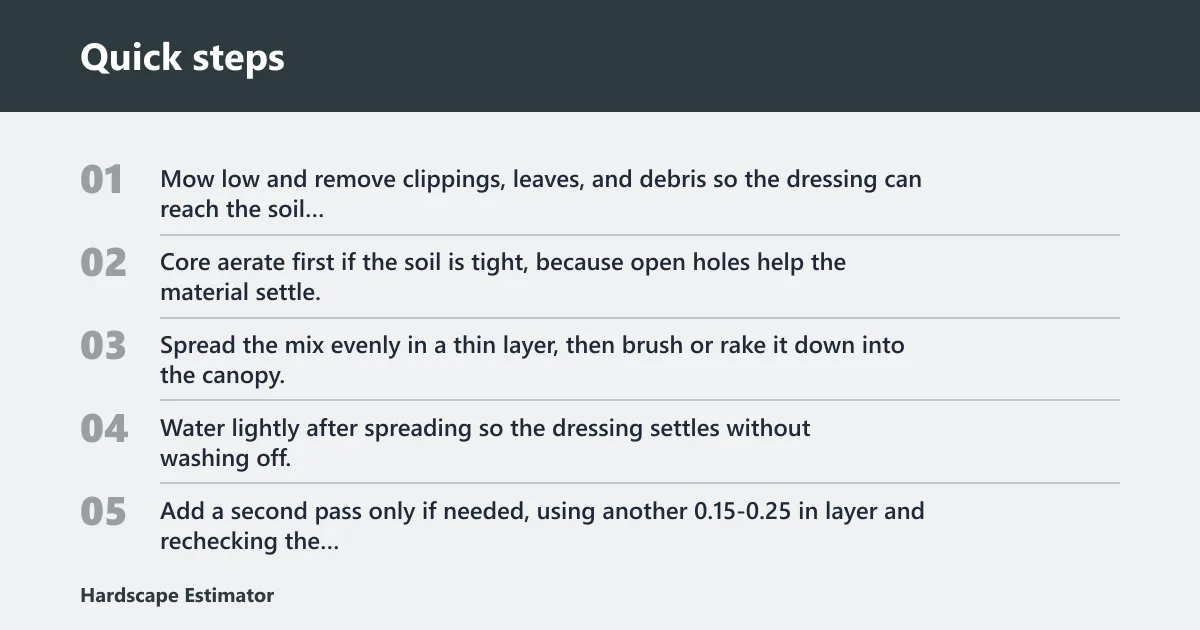
- Mow low and remove clippings, leaves, and debris so the dressing can reach the soil surface.
- Core aerate first if the soil is tight, because open holes help the material settle.
- Spread the mix evenly in a thin layer, then brush or rake it down into the canopy.
- Water lightly after spreading so the dressing settles without washing off.
- Add a second pass only if needed, using another 0.15-0.25 in layer and rechecking the surface before adding more.
Level Lawns says turf should be cut low before top dressing, at least 1.5 inches or lower. That helps the mix reach the base of the grass instead of sitting on top of it. Do not cover the blades completely. If the grass disappears, the layer is too thick.
Scenario examples
Say your Bermuda lawn has a shallow dip near the patio that holds a little water after rain. A thin sand-dominant pass over the low area is the right move. A deep fill is not. Keep the correction small, then recheck after the next watering.
Suppose your fescue lawn is being overseeded in early fall. A 50/50 sand-compost blend gives seed contact and better moisture balance than pure sand. If the surface still shows after the first pass, add another light layer rather than dumping on a heavy one.
How much top dressing do you need?
Use depth, not guesswork. For a light leveling pass, about 0.15-0.25 in is a useful target. At that depth, a 2-4kg per square metre application is a practical working range, and a heavier correction can go up to 6kg per square metre. Small hollows may need a firmer fill first, then a thin finish coat.
Worked coverage examples
For 100 sq ft at a 0.25 in layer, the surface needs about 2.1 cubic ft of material. That is roughly 0.08 cubic yd. If a bag covers 0.5 cubic ft, you would need about 4 to 5 bags. If a bag covers 1 cubic ft, you would need about 2 to 3 bags.
For 10 sq m at 2-4kg per square metre, plan on 20-40kg total. At 6kg per square metre, that rises to 60kg. A 20kg bag would therefore cover about 3.3 to 10 sq m, depending on whether you are doing a light pass or a heavier correction.
That same math shows why bag labels matter. A light cosmetic smoothing job uses less material than a small hollow that needs building up in stages. If the spot is more than a shallow depression, stop and reset the level in passes instead of trying to finish it in one spread.
Common mistakes
Using builder’s sand or dirty fill is a common failure. It can compact badly, leave stones on the surface, and drag the mower. Another mistake is adding too much organic matter. A rich mix can hold water, stay soft, and create a patch that does not match the rest of the lawn.
Do not try to solve major grading with top dressing alone. Top dressing is for minor dips and smoothing, not deep settlement. It also fails when applied to wet ground or frozen turf. Turf Works says top dressing is best between March and October, and Gardeners’ World places the best window in early to mid-autumn when growth is strong.
If that did not work
If the first pass still leaves a dip, add another 0.15 in and recheck with a straightedge. If the area stays soft after two light passes, stop and treat it as a fill problem, not a dressing problem. For repeated settlement, the base soil may need correction before any finish dressing.
When should you top dress?
Top dress when the grass is actively growing. Warm-season lawns such as Bermuda and zoysia usually respond best during their growth period, while cool-season lawns respond best when they are actively pushing growth in mild weather. Avoid frozen or waterlogged ground, because the dressing will not settle well and the turf may be smothered.
Timing matters more than the calendar alone. The same source says top dressing is best between March and October, while Gardeners’ World places the best window in early to mid-autumn for vigorous growth. Use the growth window for your turf type, then pair the work with aeration if the soil is tight.
Frequently asked questions
What is the best lawn leveling mix for top dressing?
The best mix is the one that matches the job. Use a sand-dominant blend for smoothing on Bermuda or zoysia, a soil-dominant or compost-based blend for fescue and overseeding, and straight clean sand for surface drainage work. Keep each pass thin so grass blades still show.
What is the best soil mix for top dressing lawns?
A good soil mix is screened, weed-free, and free-draining. Sandy loam or quality topsoil is the usual base, with a small amount of fine compost or leaf mould if the goal includes rooting or seed support. Avoid heavy, sticky fill or anything with stones and roots.
Should I use sand, topsoil, or compost for lawn leveling?
Use sand for smoothing and surface drainage, topsoil or sandy loam for shallow filling and rooting, and compost only in a minority fraction for renovation or overseeding. Pure compost is usually too soft for leveling, while pure sand is not the best choice for seed establishment or deeper hollows.
How do you top dress a lawn to level it?
Mow low, aerate if the soil is tight, spread a thin layer, and brush it into the canopy. Start with 0.15-0.25 in, then recheck before adding more. The turf should remain visible. If the low spot is deeper than a shallow dip, fill it in stages.
Can top dressing fix small low spots in a lawn?
Yes, if the low spots are small and shallow. Hand-fill the dip with a firmer screened soil blend, then finish with a light top dressing. Do not use pure sand for deeper hollows. Large depressions need grading or a fill repair before any finishing layer.
When is the best time to top dress a lawn?
The best time is during active growth. For many lawns, that means early to mid-autumn or another mild growth window for the turf type. Avoid frozen or waterlogged conditions. A lawn that is growing well will recover faster and grow through the dressing more evenly.