Why Is Water Coming Through My Retaining Wall Backfill?
Water coming through retaining wall backfill usually means the drainage path is blocked, missing, or overloaded; if there is no clean-out, outlet, or free-draining backfill, treat it as a drainage failure, not a surface leak. Left alone, it can raise hydrostatic pressure, bulge or tip the wall, and turn a small fix into a rebuild. This guide shows how to trace the water source, check the backfill and drain parts, and decide when a repair is enough.
What the water pattern tells you
Where the water shows up matters. Damp staining after rain can be normal if it dries out quickly, but a steady trickle, water at the base, or water from a pipe outlet points to a drainage path that is working only partly or not at all. The first job is to separate wall seepage from runoff, plumbing leaks, and groundwater.
Damp staining only
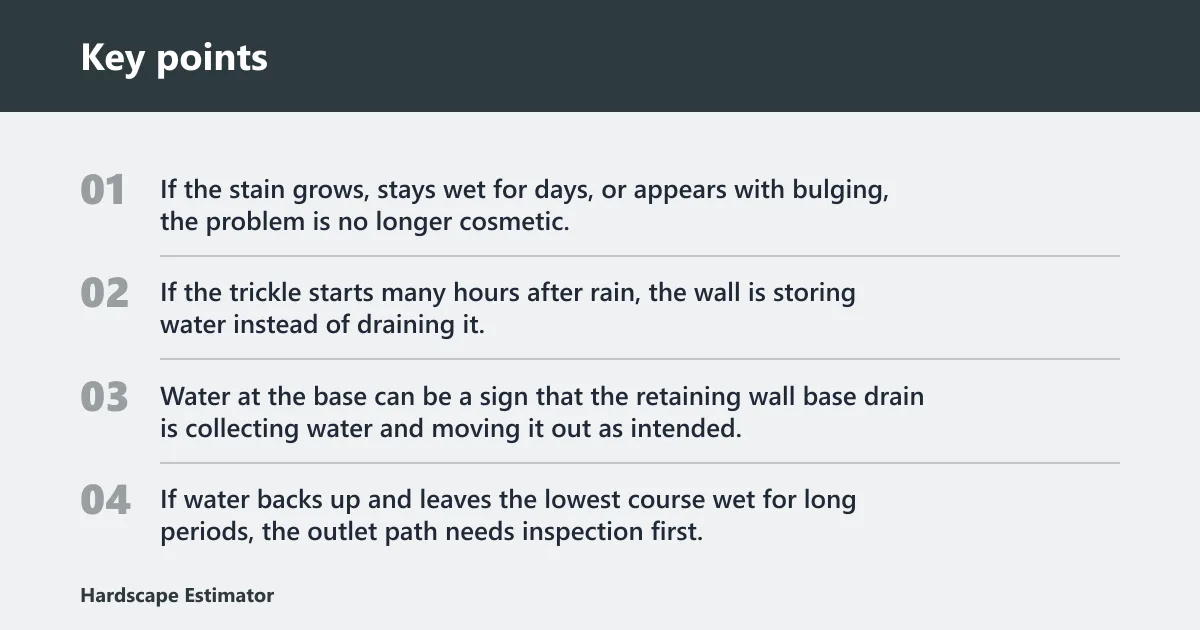
Light staining with no running water often means the wall is shedding a small amount of moisture through joints, block pores, or weep holes. That can be acceptable if it stops after the soil drains. If the stain grows, stays wet for days, or appears with bulging, the problem is no longer cosmetic.
Steady trickle after rain
A steady trickle after a storm usually means water is collecting behind the wall and then escaping through the easiest path. That often points to a clogged drain pipe, a blocked outlet, or backfill that holds too much water. If the trickle starts many hours after rain, the wall is storing water instead of draining it.
Water at the base or outlet
Water at the base can be a sign that the retaining wall base drain is collecting water and moving it out as intended. It becomes a problem when the outlet is absent, buried, crushed, or discharging too slowly. If water backs up and leaves the lowest course wet for long periods, the outlet path needs inspection first.
Backfill and drainage basics
Retaining wall backfill is the drainage zone behind the wall, not just fill dirt packed against the blocks or footing. Its job is to move water downward and sideways to a drain pipe, base drain, or outlet before pressure builds. Free-draining gravel behaves very differently from native soil because its open voids let water move; clay and other fine soils hold water and slow that movement.
What retaining wall backfill should do
A proper backfill zone should collect water, pass it to the drain system, and keep fine soil from washing into the stone. It should also support the wall without creating a saturated wedge behind it. The drainage zone is only effective when the stone, pipe, fabric, and outlet all work together.
Free-draining gravel versus native soil
Free-draining gravel is usually clean crushed stone or drainage stone, often in the 3/4 in to 1 1/2 in range, depending on the wall design. The angular pieces create void space for water to move. Native soil, especially if it has a lot of silt or clay, fills those voids and slows flow.
Suppose the drainage zone is 12 in wide behind the wall. If that space is filled with clean 3/4 in stone, water can move toward the pipe through open gaps. If the same zone is packed with clay soil, water may sit in the backfill long enough to build pressure against the wall face.
Why compaction matters near the wall
Compaction keeps the wall base stable, but it should not crush the drainage zone shut. Many wall systems call for compacting structural fill in lifts, often around 6 to 8 in thick, while keeping the drainage stone less aggressively compacted. A plate compactor is useful near the wall base, but overcompaction in the gravel zone can reduce void space and slow drainage.
- Check the top grade. Make sure surface water is not running toward the wall. A slope toward the wall can overwhelm even a sound drain system, so the first correction may be above the wall, not behind it.
- Inspect the outlet. Find where the drain pipe, base drain, or weep path discharges. If it is buried, crushed, or blocked, clear it before opening the wall face.
- Probe the wet area. Look for damp staining, soft soil, or water concentrated at joints, the base, or one section only. Localized wetness often points to one blocked zone, not the whole wall.
- Separate soil from stone. Confirm that geotextile filter fabric, if used, sits between native soil and drainage stone. Without that separator, fines can migrate into the gravel and close the voids.
Why is water coming through my retaining wall backfill?
Water usually appears because pressure builds behind the wall and the backfill cannot drain fast enough. The common causes are hydrostatic pressure, a clogged drain pipe or blocked outlet, and missing or blocked weep holes. The symptom is the same, but the fix depends on which part has failed.
Hydrostatic pressure behind the wall
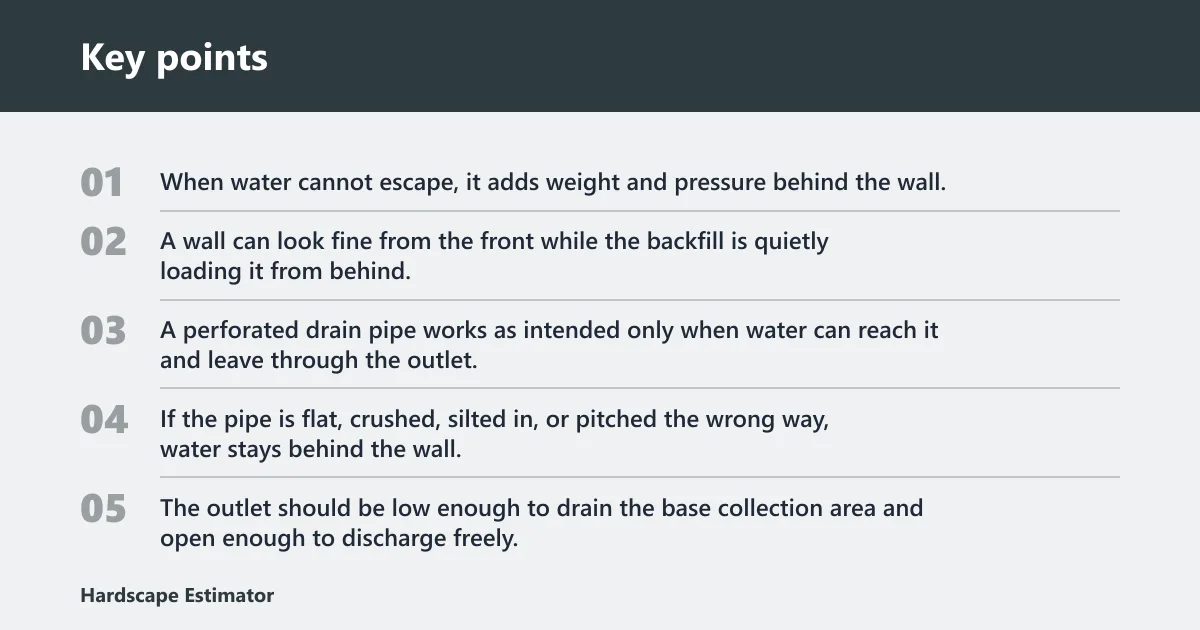
When water cannot escape, it adds weight and pressure behind the wall. That pressure pushes at joints, cracks, and block faces, and it can cause seepage, staining, bulging, or gradual wall movement. A wall can look fine from the front while the backfill is quietly loading it from behind.
Clogged drain pipe or blocked outlet
A perforated drain pipe works as intended only when water can reach it and leave through the outlet. If the pipe is flat, crushed, silted in, or pitched the wrong way, water stays behind the wall. The outlet should be low enough to drain the base collection area and open enough to discharge freely.
Missing or blocked weep holes
Weep holes are small discharge points that let collected water exit through the wall face. If they are missing, buried, or packed with dirt, water will choose another path, often through joints or the lowest course. Active weep holes usually show a clean discharge line after rain, not a muddy smear or clogged opening.
Say a 4 ft wall shows wet joints only near one corner after a storm. If the outlet is buried under mulch and the weep holes there are clogged with silt, the issue is likely local blockage, not a full wall failure. Clear the outlet first and watch the same spot after the next rain.
Should there be gravel behind a retaining wall?
A retaining wall usually needs a free-draining gravel zone behind it so water can move to the drain pipe or outlet instead of sitting against the wall. Gravel alone is not enough, though. It still needs separation from native soil, enough depth to collect water, and a path out at the base.
Gravel size and void space
Clean, angular stone in common drainage sizes like 3/4 in or similar gives water room to move through the backfill. The void space between stones is the reason it drains better than dirt. Rounded river stone can still drain, but angular stone is often preferred because it locks better and resists shifting.
Separation from native soil with geotextile
Geotextile filter fabric keeps fine soil from migrating into the stone. Place it between the native soil and the drainage aggregate, or wrap the drainage zone if the wall design calls for it. Without separation, clay and silt wash into the gravel and reduce its ability to drain.
How deep the drainage zone should
The drainage zone depth depends on the wall system, but it commonly runs the full height of the backfill zone behind the wall or at least along the lower portion tied to the drain pipe. The key point is simple: water must be able to reach the base drain and leave the wall without pooling against the face.
What a failing drainage system looks like
A failing system is more than a damp wall. It shows signs of water storage, pressure, and movement. Bulging, opening joints, and persistent wetness after rain mean the wall is seeing more water than its drainage path can handle, or the path has failed entirely.
Bulging wall or joint opening
Bulging is a structural warning because it can point to hydrostatic pressure behind the wall. If blocks start to lean, slide, or separate, the soil load has exceeded what the wall can resist. At that point, clearing an outlet alone may not be enough if the wall face has already moved.
Water despite gravel backfill
Water can still appear even with gravel backfill if the pipe is clogged, the outlet is blocked, or the gravel has filled with fines. Gravel is a drainage medium, not a guarantee. If the water stays after the soil should have drained, inspect the pipe slope, outlet, and fabric first.
Clay-heavy native soil holding water
Clay native soil absorbs and holds water longer than sandy soil. That means the backfill stays wet for a longer period after rain, which raises pressure behind the wall. In clay sites, drainage details matter more because the surrounding ground feeds water back into the wall zone after each storm.
Backfill troubleshooting matrix
Use this matrix to match the symptom to the most likely cause and the repair scope. Start with the simplest check that can explain the pattern, then decide whether the fix is external, local, or a full excavation.
| Symptom | Probable cause | Quick check | Repair scope |
|---|---|---|---|
| Damp staining only | Minor seepage through joints or weep points after rain | See whether the stain dries within 24 to 48 hours and whether an outlet is open | Often minor; clear the outlet, check grading, and monitor |
| Steady trickle after rain | Drain pipe partially clogged or outlet restricted | Look for flow from the outlet and check for silt, mulch, or crushed pipe | Moderate; clean or replace the drain path |
| Water at the base | Base drain collecting water but not discharging freely | Confirm pipe slope and outlet elevation relative to the footing or wall base | Moderate; open the drain path or add a proper outlet |
| Bulging wall | Hydrostatic pressure has built up behind the wall | Check for leaning, joint opening, or sections that bow outward | Serious; may need excavation and structural rebuild |
| Water despite gravel backfill | Fines have clogged the gravel, pipe is blocked, or fabric placement failed | Look for muddy discharge, buried outlets, and saturated stone | Often major; may require uncovering the drainage zone |
How to fix drainage behind a retaining wall
The repair should match the fault. If the outlet is blocked, clear it. If the drain pipe has failed, repair or replace it. If the wall is already bulging or the backfill is saturated through most of its height, the fix may require excavation and rebuild of the drainage section.
- Clear the outlet first. Remove mulch, soil, or debris from any discharge point and make sure water can leave freely. A blocked outlet can make a healthy drain system look failed.
- Inspect weep holes. Open or clean blocked weep holes, then watch for a clean discharge after rain. If muddy water keeps coming out, fines may be entering the drainage zone.
- Verify pipe slope. Check that the perforated pipe slopes toward the outlet so water moves away from the wall. A flat or back-pitched pipe can trap water at the base.
- Excavate the drainage zone. If the backfill is clay-heavy, the gravel is clogged, or the wall is bulging, expose the drainage section and rebuild it with clean stone, fabric separation, and a working outlet. This is the point where partial patching may fail again.
A common first-timer mistake is to add more gravel on top of a wet area and assume the problem is solved. If the drain pipe is crushed or the outlet is buried, the extra stone only stores more water behind the wall.
Frequently asked questions
Is water coming through a retaining wall normal after rain?
Some dampness can be normal if it dries quickly and there is no movement in the wall. A brief trickle from a proper outlet after heavy rain can also be normal. Water that keeps flowing, stains that stay wet, or any bulging point to a drainage problem that needs attention.
Does my retaining wall need drainage behind it?
Yes. Most retaining walls need a free-draining zone, a way to collect water at the base, and an outlet path that stays open. Without drainage, water builds pressure behind the wall and can force seepage through joints or cause the wall to move.
What backfill causes water pressure behind a retaining wall?
Clay and other fine soils are the biggest risk because they hold water and slow drainage. They can stay wet much longer than clean gravel, which raises pressure behind the wall. Poorly compacted soil can also settle and create pockets where water collects.
How do I fix drainage behind a retaining wall?
Start with the outlet, weep holes, and top grading. If those are open but the wall still stays wet, inspect the drain pipe slope and condition. If the backfill is clogged or the wall is bulging, the fix usually means excavating the drainage section and rebuilding it with clean stone and fabric separation.
Can clay backfill cause water to seep through a retaining wall?
Yes. Clay backfill can hold water long enough to build hydrostatic pressure behind the wall. That pressure often shows up as seepage at joints, damp staining, or water at the base. In clay-heavy soil, drainage details matter more because the soil drains slowly and stays saturated longer.