How to Fix a Patio Slope That Causes Standing Water
If water stays after rain, fix the patio slope first: a hardscape should fall about 1/4 in per ft away from the house, and if that slope is already there, add drainage instead of regrading. Standing water stains pavers, loosens bedding, and can push runoff toward the foundation. Use this guide to decide whether the right fix is regrade, drain, or rebuild before you buy material.
What you’ll need
- 4 ft level or a laser level
- Tape measure
- String line and line level
- Marking paint or stakes
- Shovel and hand tamper
- Gravel or base stone
- Soil for regrading low spots
- Perforated pipe and gravel for a French drain
- Channel drain grate and outlet parts
- Polymeric sand for paver joints
- Exterior overlay material for sound concrete slabs
Patio drainage decision table
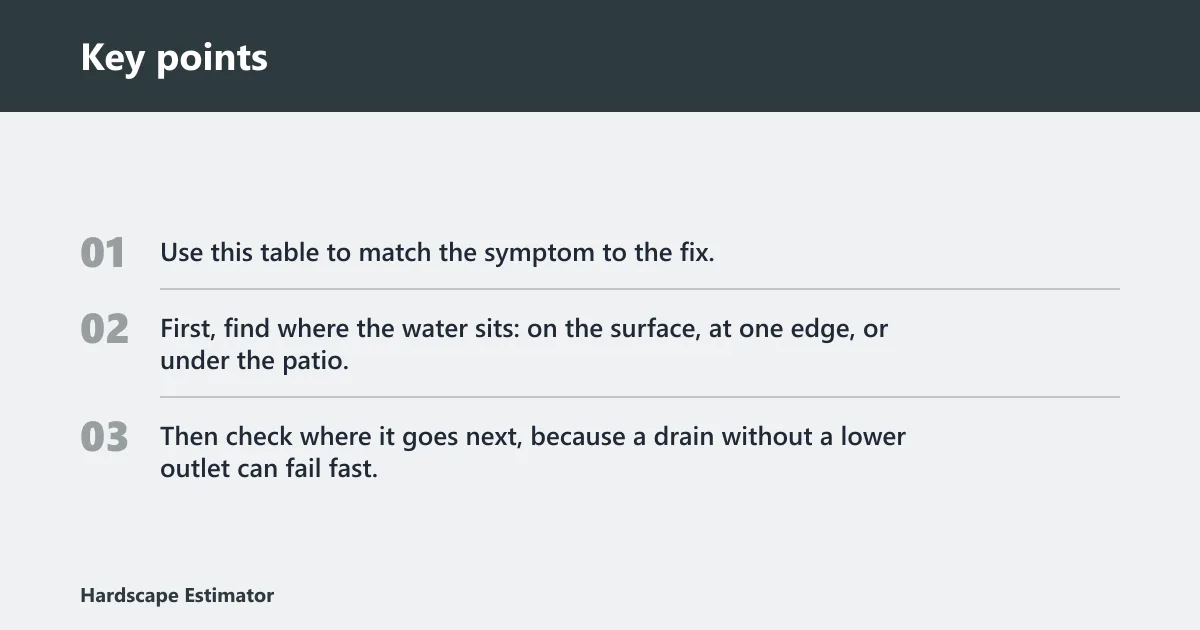
Use this table to match the symptom to the fix. First, find where the water sits: on the surface, at one edge, or under the patio. Then check where it goes next, because a drain without a lower outlet can fail fast.
| Symptom | Likely cause | Recommended fix | When not to use that fix | Rough material category |
|---|---|---|---|---|
| Puddles stay near the house after rain | Flat or reversed slope | Regrade the patio to 1% to 2% fall away from the house | Do not patch over a reversed slab and call it done | Soil, gravel base |
| Water collects at one low edge but the rest sheds | One low line or settling at an edge | Install a channel drain across the low point | Do not use it without a safe outlet lower than the patio | Grate, pipe |
| Wet soil under the patio or seepage from below | Soggy subgrade or trapped subsurface water | Add a French drain with perforated pipe in gravel | Do not use it if there is no discharge point that actually works | Pipe, gravel |
| Water starts at roof edge and runs onto the patio | Downspouts dumping too close | Extend the downspout away from the patio and foundation | Do not send it to another low spot beside the slab | Pipe |
| Paver joints hold grit, weeds, and water | Washed-out joints | Refill joints with polymeric sand | Do not use this to fix a base that is settled or reversed | Sand |
| Shallow ponding on a sound concrete slab | Minor surface low spot | Use a tapered exterior overlay | Do not cover badly cracked or heaved concrete | Overlay |
How do you tell if the slope is wrong?
Measure the fall from the patio back toward the house and toward the edge where water should go. A patio should fall roughly 1% to 2% for drainage, which is about 1/8 to 1/4 inch per foot. If the same puddle returns after each rain, the slope is probably flat, reversed, or broken by settlement.
Check the wettest area first, then follow where the water stops. If it sits near the house, the surface likely needs correction. If it gathers at a low line away from the house, the issue may be local and a drain can work.
How to slope a patio
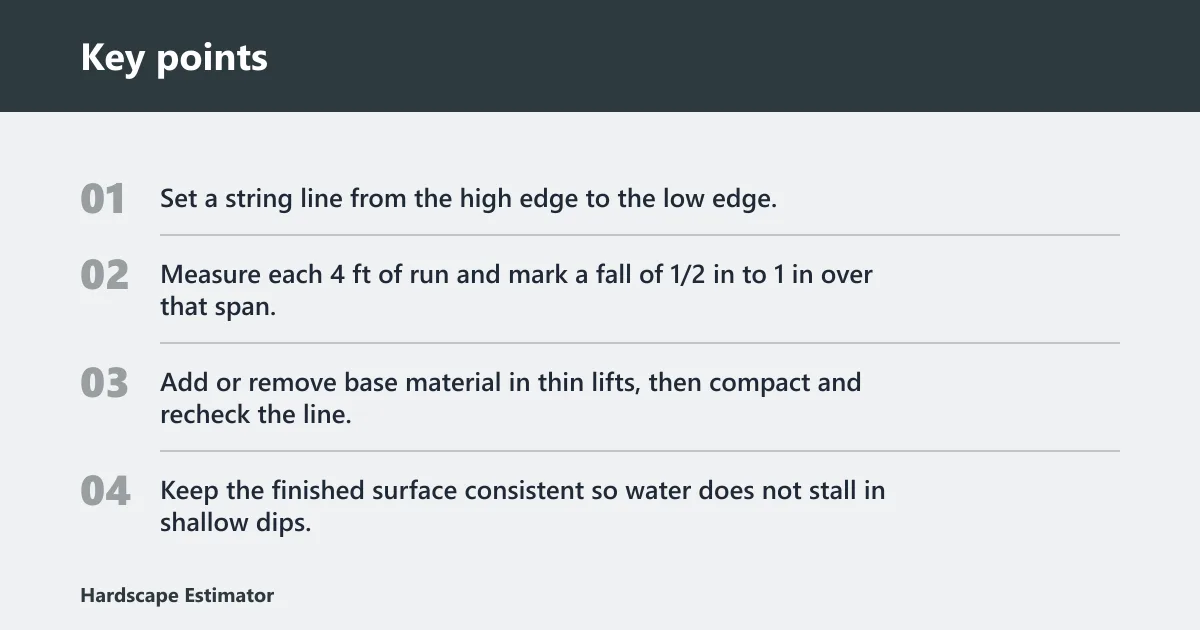
- Set a string line from the high edge to the low edge.
- Measure each 4 ft of run and mark a fall of 1/2 in to 1 in over that span.
- Add or remove base material in thin lifts, then compact and recheck the line.
- Keep the finished surface consistent so water does not stall in shallow dips.
A common first-timer mistake is fixing only the top layer. If the base is wrong, the surface will settle back into the same low spot.
Should a patio slope away from the house?
Yes. A patio next to a house should shed water away from the foundation so runoff does not sit against the wall. That matters more than a neat surface finish. If the patio is freestanding, the slope can send water toward a safe discharge point instead of away from a foundation line.
Suppose a 16 ft paver patio falls just 3/4 in across its length. That is flatter than the 1% to 2% target, so water can linger. On about the same 12 ft run, 1% fall is about 1.44 in and 2% fall is about 2.88 in.
Should you regrade, drain, or rebuild?
Choose the least invasive fix that matches the failure. Regrade when the whole surface is off target. Add a drain when the patio still has usable slope but one low area collects water. Rebuild the base when the slab or pavers sit flat, reversed, or uneven across the full run.
Use a channel drain when the low point is local
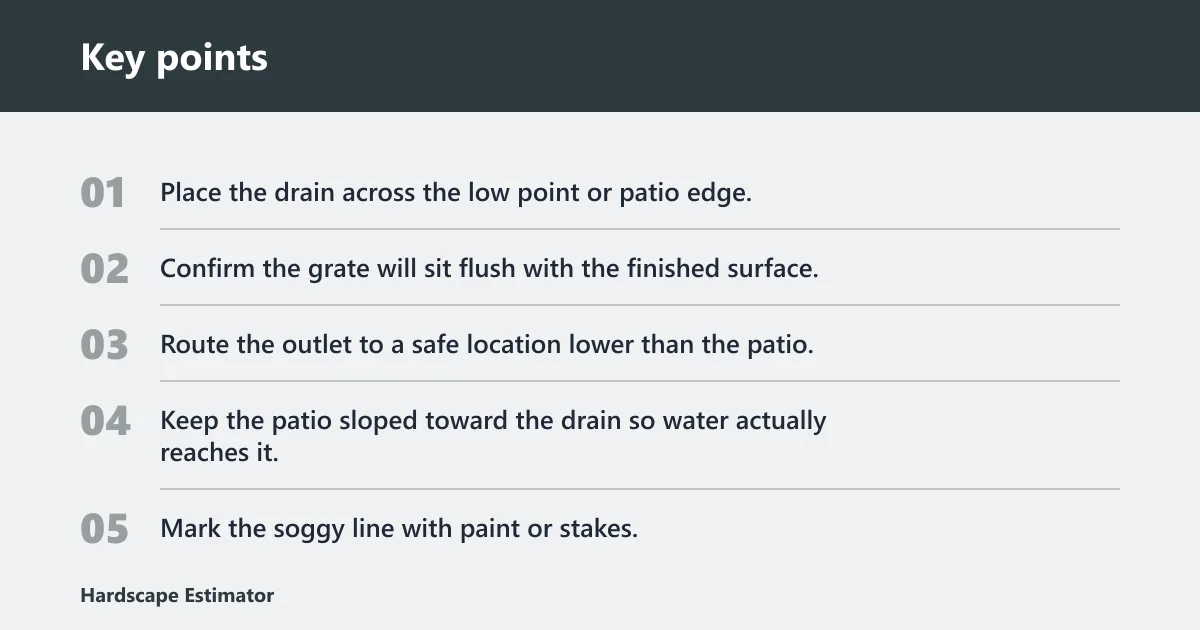
- Place the drain across the low point or patio edge.
- Confirm the grate will sit flush with the finished surface.
- Route the outlet to a safe location lower than the patio.
- Keep the patio sloped toward the drain so water actually reaches it.
A channel drain fails when the outlet is too high, blocked, or too close to the foundation. It collects surface water, but it cannot fix a flat patio.
Use a French drain when the ground stays wet
- Mark the soggy line with paint or stakes.
- Excavate deep enough for perforated pipe and stone bed.
- Set the pipe in gravel and slope it to a discharge point.
- Call 811 before digging.
A French drain works below the surface. It fits soggy soil, seepage, and low spots that stay wet after the rain stops.
Redirect downspouts first when roof runoff is the source
- Extend the downspout away from the patio and foundation.
- Discharge onto stable ground or an approved outlet.
- Recheck the patio after the next rain before changing the hardscape.
Can downspouts cause patio pooling? Yes. Roof runoff can overwhelm a patio edge and make a good surface look broken. Fix the source first when water is falling from above.
How much correction is enough? On a short run, small changes matter. If the patio is about 10 ft long, a 1% fall is about 1.2 in and a 2% fall is about 2.4 in. That tells you how much lift or fill the repair needs before you order material.
Reset pavers and correct the base if the slope is wrong. If the pavers are sound but the joints are washed out, refill them with polymeric sand so water, weeds, and grit do not keep clogging the surface. Add drainage only after confirming the patio still has a workable fall.
- Lift the affected pavers and inspect the bedding and base.
- Add or remove base material until the fall matches 1% to 2%.
- Compact the base, relay the pavers, and verify the surface with a level.
- Brush in polymeric sand and compact again so the joints lock properly.
Picture a 14 ft paver patio that holds water along a 2 ft strip near the house. If the rest of the patio drains well, that is a local settlement or joint issue. If the whole slab feels flat, the base needs more than a patch.
Use a tapered exterior overlay for shallow ponding on a structurally sound slab. Do not coat over badly cracked or heaved concrete. If the pitch cannot be corrected on top of the existing surface, rebuild or replace the slab so the finished fall can be set correctly.
- Check for cracks, heaving, and loose sections.
- If the slab is sound, clean it and apply a tapered exterior overlay at the low area.
- Blend the edge so water can move to the lower side without a sharp lip.
- If the slab is moving or broken, stop and plan for rebuild instead of patching.
A sound slab with a shallow birdbath at one corner can often be corrected. A slab that has settled unevenly or heaved across a seam usually cannot.
Common mistakes
- Installing a drain without a safe outlet. The water still has to go somewhere.
- Trying to coat over a slab that is cracked or heaved.
- Using polymeric sand as a substitute for base repair.
- Ignoring downspouts while changing the patio surface.
- Regrading the top layer only and leaving the base flat.
Keep the finished surface pitched away from the house, send downspouts away from the patio, and check low spots after the first heavy rain. That catches settlement before it turns into a larger repair.
Frequently asked questions
How to fix a patio slope that causes standing water
Start by checking whether the patio still has a usable fall away from the house. If it does not, reset the surface or rebuild the base to reach roughly 1% to 2% slope, which is about 1/8 to 1/4 inch per foot. If the slope is already right, use a drain instead.
How do I know if my patio slope is wrong?
Measure the fall with a level and tape measure. If water lingers in the same spot after rain, or if the surface moves toward the house, the slope is wrong. The target is roughly 1% to 2%, and the finished pitch should not be dead flat.
What is the minimum patio slope for drainage?
A common target is 1% to 2% fall, or about 1/8 to 1/4 inch per foot. That is enough to move water without making the patio feel steep. Less than that often leaves shallow puddles, especially if the base has settled.
Do I need a channel drain or a French drain?
Use a channel drain when the patio still has slope but one low edge collects water, and the drain can discharge safely. Use a French drain when water is coming from wet soil or from under the patio. The wrong outlet makes either system fail.
When should I rebuild the patio base instead of patching it?
Rebuild the base when the whole patio is flat, reversed, or uneven over a broad area. Patch work is for local low spots, washed joints, or shallow ponding on a sound slab. If the surface keeps settling, the problem is below the finish.