Can You Use Screened Topsoil for Grading Around a House?
Screened topsoil is usually used as a thin finishing layer, about 1 to 3 in deep, rather than as the main material for building grade or for correcting drainage around a foundation. Put it in the wrong place, and it can settle, hold water against the house, and leave the slope too flat. This article explains where screened topsoil works, where compacted fill is the right choice, and how much material to order.
Can you use screened topsoil for grading around a house?
Yes, but only for shallow finishing work. Screened topsoil is sieved for easier spreading and raking, so it works well as the top layer where you are smoothing small dips, preparing a lawn, or finishing over fill. It should not be the main material for raising grade or fixing drainage near a foundation.
The depth rule is simple: if the area needs only a thin surface correction, screened topsoil can be the finish layer. If the area needs meaningful height, slope correction, or a low spot deeper than a few inches, use fill dirt first and topsoil on top. Around a house, slope and compaction matter more than soil texture alone.
Screened topsoil vs fill dirt
Screened topsoil is made for finishing. It is easier to rake, spread, and shape than rough fill, and it is better for lawn prep, shallow lawn repairs, topdressing, and general landscaping. It belongs where grass, sod, seed, shrubs, flowers, or garden plants need better growing conditions.
Fill dirt is made for bulk. Serbu says fill dirt is used when you need to raise, fill, or reshape an area. It may be compacted, low in nutrients, or uneven in texture, which makes it better below the growing layer than as the surface soil for a lawn or bed.
That difference matters near a structure. Screened topsoil can finish a grade. Fill dirt can build the grade. If you use topsoil alone to correct a deep low spot, you may end up with settling, soft ground, or a surface that still does not carry water away from the house.
When screened topsoil works near a house
Screened topsoil works best where the change is shallow and the goal is surface finish. It is a good fit for a lawn repair or seeding zone, where the surface needs to be smooth enough for seed, sod, or a light topdressing layer. It is also useful for small edge touch-ups where the grade is already close.
Think of it as the last layer, not the whole build-up. A thin layer can help blend a repaired area into the rest of the yard. A thick layer becomes a structural problem if it is carrying the whole correction by itself.
Say your front lawn has a 1 1/2 in dip beside a walkway and the surrounding grade already slopes away from the wall. Screened topsoil is a reasonable fix there, because the job is surface correction, not bulk fill. The same material would be the wrong choice if that dip were 8 in deep.
Foundation drainage slope and final grade
The finished grade near a house needs proper slope and drainage. Soil choice alone does not create drainage. If the final grade is wrong, water can still collect near the foundation even if the surface soil looks smooth and planted.
Final grade is the finished surface level after fill and the top layer are installed. It should be set with drainage in mind before the last thin layer goes down. Around a foundation, the key question is what soil to use and whether the shape moves water away from the house.
Added soil can make the grade look higher while still trapping water if the slope is too flat or the low point sits beside the wall. A thin topsoil layer does not correct that problem by itself. The subgrade has to be shaped first, then compacted where needed, then finished.
| Screened Topsoil Around a House: Use It / Don’t Use It | Recommended material | Maximum practical use | Compaction needed? | Common failure risks |
|---|---|---|---|---|
| Shallow cosmetic dips | Screened topsoil | Thin finish layer, usually 1 to 3 in | Light shaping only | Settling if placed too thick; uneven finish |
| Lawn edge touch-ups | Screened topsoil | Small surface corrections | Usually no heavy compaction | Soft edge, washed-out soil, low spots reappearing |
| Drainage correction | Fill dirt below, topsoil above | Topsoil only as finish | Yes, in lifts for the fill layer | Water trapped near foundation, slope too flat |
| Foundation regrading | Fill dirt, then screened topsoil | Topsoil as the top layer only | Yes | Settlement, poor drainage, grade dropping toward the house |
| Deep low spots | Fill dirt first, then topsoil | Topsoil only on the upper few inches | Yes | Wasteful material use, future settling, soft ground |
What should go underneath topsoil when regrading a yard?
Under topsoil, you usually want fill dirt when the job involves depth, reshaping, or a change in drainage. The same source recommends using fill dirt for the lower portion of a deep low area, then topsoil on top. That gives you bulk below and a better growing layer above.
For a shallow correction, topsoil can go directly over a firm, already-shaped surface. For deeper work, the order matters: build the base with fill, compact it, shape the slope, then add a thinner topsoil layer. That is the safer way to create a final grade that supports grass and drains away from the house.
A common first-timer mistake is putting 6 in of screened topsoil into a depression beside the foundation and calling it done. The area may look level at first, then settle after rain and leave a new dip where water collects. The better fix is fill below, topsoil above.
Screened topsoil
Use this as a quick rule before ordering. If the job is surface smoothing, screened topsoil may be enough. If the job changes height, drainage, or the ground near the foundation, fill dirt belongs under the finish layer.
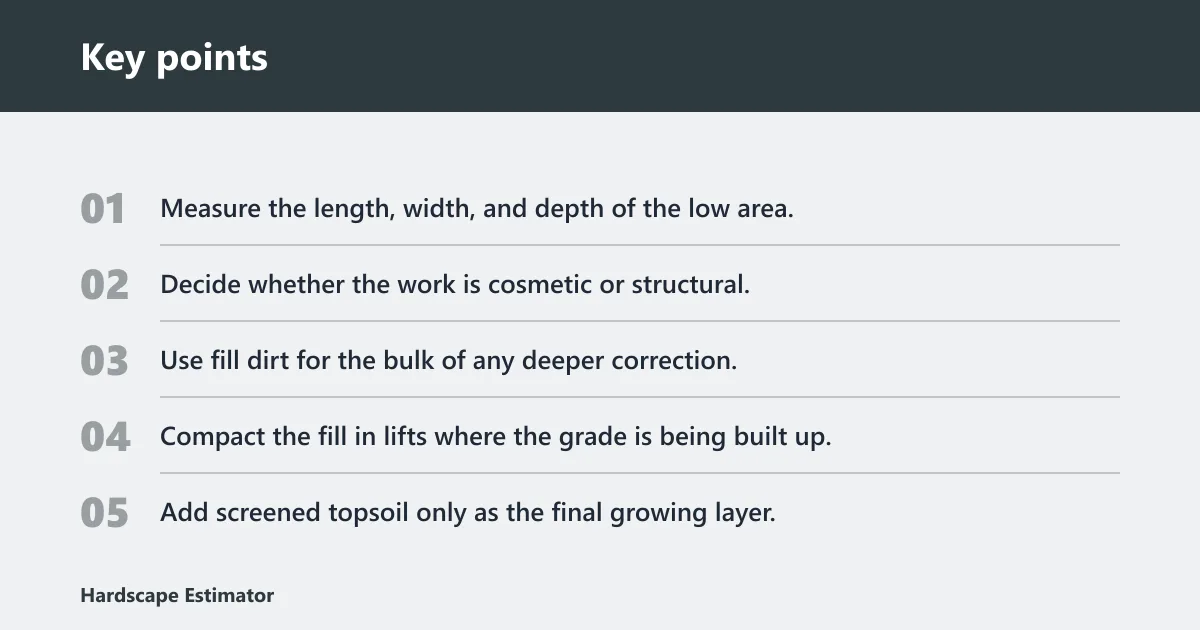
- Measure the length, width, and depth of the low area.
- Decide whether the work is cosmetic or structural.
- Use fill dirt for the bulk of any deeper correction.
- Compact the fill in lifts where the grade is being built up.
- Add screened topsoil only as the final growing layer.
- Shape the surface so water moves away from the house.
Say your side yard has a 12 ft by 8 ft low spot that drops about 5 in toward the foundation. That is a structural fix, not a surface touch-up. The lower section needs fill dirt, then a thin topsoil layer for grass, because the main job is creating a stable slope, not adding a nicer growing medium.
For ordering, measure the length, width, and depth before you buy. That prevents the common mistake of ordering topsoil for a volume problem that really needs fill dirt. It also helps you keep the topsoil layer thin enough to avoid extra settling.
How much topsoil do you need for grading around a house?
Measure length, width, and depth first. Then use topsoil only for the finishing layer you actually need, not for the whole low spot if the area is deep. A thin layer for lawn finish is one job; bulk grade correction is another. The quantity changes fast with depth.
For a rough estimate, multiply length by width by thickness to get cubic feet, then divide by 27 to convert to cubic yards. For example, a 10 ft by 10 ft area at about 2 in thick is 10 × 10 × 0.167 = 16.7 cu ft, or about 0.62 cu yd. If that same area were about 6 in thick, it would need about 1.85 cu yd.
That is why thick topsoil lifts are a bad fit around a house. The deeper the layer, the more likely it is to settle and the more likely it is that you should have used fill dirt below the finish layer instead.
Will topsoil settle after grading?
Yes, topsoil can settle after grading, especially if it is placed too thick or used where a deeper fill layer should have gone. Screened topsoil is good for shallow finishing, but it is still a growing layer. It is not a substitute for compacted fill in deep lifts near a foundation.
Settlement risk comes from thickness, moisture, and the lack of a compacted base. Topsoil has more organic content and looser structure than fill dirt, so a thick placement can drop over time. That can leave low spots, a soggy edge by the house, or a mulch line that sits higher than the soil beside it.
Compaction matters when the grade is being built up. Deeper lifts should be compacted before the final topsoil layer goes on. That does not mean crushing the surface into a hard pan. It means building a more stable base so the grade is less likely to move after rain.
Picture a 4 in topsoil lift placed along a foundation wall because the yard “looked low.” After a season of watering and rainfall, the surface drops enough to expose the edge of the foundation slope. The correction is not more topsoil on top. The correction is to rebuild the base with fill dirt and then finish with a thinner growing layer.
Frequently asked questions
Should I use topsoil or fill dirt around my foundation?
Use fill dirt when you need to raise, fill, or reshape the area near the foundation. Use topsoil only as the thin final layer where grass, seed, sod, or planting needs better growing conditions. If the goal is drainage or height, fill dirt comes first. If the goal is lawn finish, topsoil is the last step.
Can screened topsoil hold slope and drainage near a house?
Only for a shallow finish over an already-built, properly sloped base. Screened topsoil is easier to spread and rake, but it does not replace compaction or proper grading. If the slope near the house is wrong, topsoil alone will not fix drainage and may settle into a low spot.
Will topsoil settle after grading near a foundation?
Yes, especially if it is placed too thick or used as the main fill material. Screened topsoil is meant for finishing, not for building grade. Thick lifts can settle and change the slope near the foundation, which can create drainage problems and soft spots along the wall.
How close to the house can you grade with topsoil?
You can use topsoil close to the house as a finish layer, but only if the subgrade already moves water away from the foundation. The closer the area is to the wall, the more important compaction and slope become. Topsoil should not be used to build a new grade against siding or a foundation by itself.
When do you need fill dirt instead of topsoil around a house?
Use fill dirt when the area needs depth, bulk, or reshaping. That includes deep low spots, drainage correction, and foundation regrading. Topsoil can go on top later, but it should not do the structural work. If the job changes the height of the ground, fill dirt is usually the base material.