Is Screened Topsoil Good for Lawn Leveling and Top Dressing?
Screened topsoil can work for lawn leveling and light top dressing when you keep each application thin, about 1/4 inch to 1/2 inch per pass, and use staged fills for deeper depressions so the grass stays exposed. Apply it too thick and you can bury grass, slow recovery, and leave the lawn uneven. This guide explains when screened topsoil fits, how depth changes the choice, and how to spread it without smothering turf.
Where screened topsoil fits on your lawn
Yes, for shallow lawn correction. Screened topsoil is topsoil passed through screen mesh, so larger pieces are removed. That screening takes out rocks, sticks, weeds, clumps, and other debris, which makes the material easier to shovel, spread, and rake across turf.
It works best when the goal is thin, even surface correction rather than major regrading. For low spots, it can fill shallow dips, smooth humps, and support seed or sod prep. It is not the right answer for a deep depression that needs structural reshaping.
Where screened topsoil works on lawns
Use it for light lawn leveling, top dressing, overseeding prep, and small surface corrections. It fits established turf and shallow low areas where grass blades can still poke through the added material.
St. Marys Landscaping describes screened topsoil as ideal for top-dressing lawns and suitable for laying sod, overseeding, and leveling uneven terrain. That matches the use here: finish work, not heavy fill.
Where it stops working well
Screened topsoil stops being a good single-pass fix once the depression gets deep enough that the grass is buried. A thin application can smooth the surface. A thick one can seal off the canopy, slow recovery, and leave the lawn patchy if the grass cannot reach light.
For fills deeper than about 1 inch, use staged applications instead of one heavy layer. Over about 3 inches, the problem is usually beyond topdressing and starts to look like grading work.
How deep is the low spot?
Depth is the easiest way to choose the material. Under about 1/2 inch, screened topsoil can finish the surface. From about 1/2 inch to 1 inch, it can still work well in one light pass. From 1 to 3 inches, use repeated passes. Over 3 inches, regrading usually makes more sense.
Under 1/2 inch
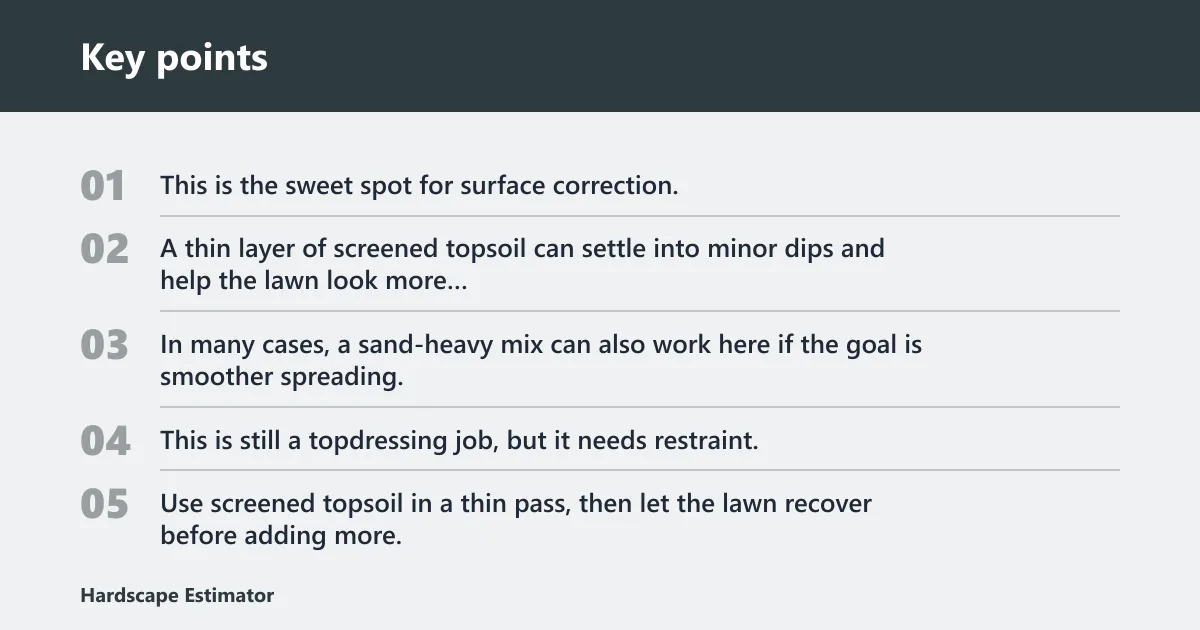
This is the sweet spot for surface correction. A thin layer of screened topsoil can settle into minor dips and help the lawn look more even without burying the grass crowns. In many cases, a sand-heavy mix can also work here if the goal is smoother spreading.
About 1/2 inch to 1 inch
This is still a topdressing job, but it needs restraint. Use screened topsoil in a thin pass, then let the lawn recover before adding more. If the surface is firm or sealed, core aeration first can help the material settle and improve air and water movement.
About 1 inch to 3 inches
This is the staged-fill zone. Screened topsoil can still work, but only in repeated light applications that keep the turf visible. Aeration is especially helpful on compacted lawns before topdressing because it opens the surface and helps the added material knit into the existing soil profile.
Over 3 inches
At this depth, topdressing alone is usually the wrong tool. The low spot may need cut-and-fill work, added base material, or a broader regrading plan. A surface layer will not correct the grade reliably, and too much topsoil over grass can bury the turf.
When should you use screened topsoil?
Use screened topsoil when the lawn already has living turf, the low spots are modest, and you want a cleaner material that spreads easily. It fits established grass, thin top dressing, and areas where the new material should resemble the existing soil as closely as possible.
Established turf with small dips
If the lawn is healthy enough to keep growing through the added layer, screened topsoil is a sensible choice. It gives roots something to live in when fill is deeper than a shallow skim, which is why it is often chosen for repair work on grass.
Thin top dressing on uneven ground
Topdressing means a thin surface application. It smooths shallow unevenness and supports turf recovery and seed-to-soil contact. A common rule is to keep the grass blades visible after spreading. Extension guidance on topdressing lawns recommends thin applications so turf is not buried.
When the soil already matches
Matching the existing soil matters. If the new layer is close to the native soil, you lower the risk of layering problems and odd drainage changes. If the fill is very different in texture, the lawn can behave differently across the same yard.
Screened topsoil vs sand-heavy mix
Use screened topsoil when you need soil body and root support. Use a sand-heavy mix when the job is very shallow and you want smooth spreading. Sand moves and levels easily, but it is not enough by itself for deeper fills on many lawns.
Best use for each material
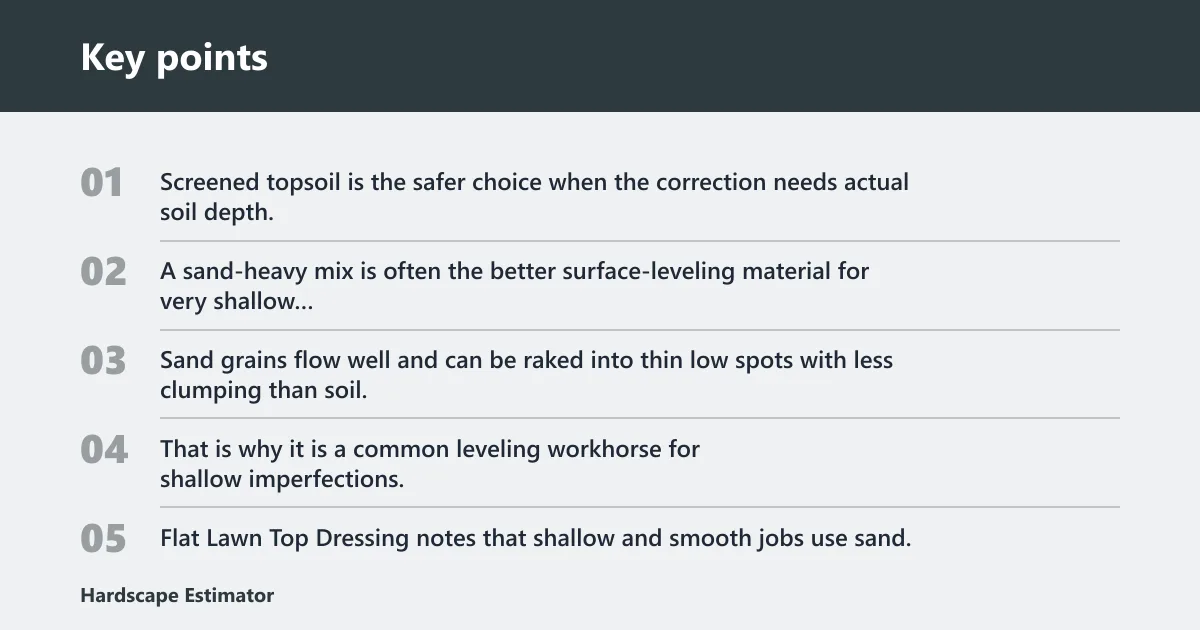
Screened topsoil is the safer choice when the correction needs actual soil depth, root support, or a closer match to existing ground. A sand-heavy mix is often the better surface-leveling material for very shallow imperfections, especially where a smoother rake-out matters more than added organic body.
Why sand spreads smoothly
Sand grains flow well and can be raked into thin low spots with less clumping than soil. That is why it is a common leveling workhorse for shallow imperfections. Flat Lawn Top Dressing notes that shallow and smooth jobs use sand, while deeper jobs need more body.
When soil is the safer choice
Soil is the safer choice when the correction is deeper, when turf roots need a growable layer, or when the existing lawn already has a soil-heavy profile. A sand-heavy mix alone can leave a dry, thin-feeling cap if the repair needs more substance.
Picture a 10 ft by 10 ft area with scattered dips around 1/4 inch deep. A sand-heavy mix can usually smooth that surface problem more cleanly than a heavier soil layer. Now change one variable: if the same area has a 2 inch depression, the material choice shifts toward screened topsoil or a broader regrade.
When does compost or lawnsoil work better?
Compost helps when the turf is stressed and the soil needs more organic matter, while screened lawnsoil works better for mixed jobs that need a screened, soil-based blend. Neither one should be treated as a stand-alone fix for deep low spots. Depth still controls the decision.
Compost for stressed turf
Compost is useful when the lawn needs structure improvement and biology support, especially if the soil is tight or tired. It is often blended with soil rather than used alone for leveling. On its own, compost is usually too light and too changeable to act as a reliable fill.
Screened lawnsoil for mixed jobs
Some suppliers sell screened lawnsoil, which is typically a native topsoil plus compost blend, screened to 1/2 inch. That type of material can work well on established turf and low areas where you want a screened blend with more body than compost alone.
Why matching existing soil matters
Soil texture mismatch can create layering and drainage problems. A fine top layer over a very different subsoil can behave differently in wet weather than the rest of the yard. For lawn repair, a material that is close to the native soil is usually the safer choice.
Lawn leveling decision table
This table gives a simple depth-based rule for choosing screened topsoil, a sand-heavy mix, compost blend, or regrading. It also shows whether to aerate first, how well the fill should match the existing soil, and what warning flag to watch for before you spread anything.
| Low-spot depth | Turf condition | Soil type | Existing soil match | Best material choice | Application thickness | Aerate first? | Warning flag |
|---|---|---|---|---|---|---|---|
| Under 1/2 inch | Healthy, established turf | Similar to native soil | High match preferred | Sand-heavy mix or screened topsoil | About 1/4 inch | No, unless compacted | Keep grass blades visible |
| Under 1/2 inch | Stressed or thin turf | Soil is sandy or low in organic matter | Moderate match preferred | Compost blend or screened lawnsoil | About 1/4 inch | Yes, if compacted | Do not use compost alone for deep fill |
| About 1/2 inch to 1 inch | Established turf | Similar to native soil | High match preferred | Screened topsoil | 1/4 inch to 1/2 inch | Yes, if firm or sealed | Use light passes, not one heavy layer |
| About 1 inch to 3 inches | Living turf, but uneven | Near native texture | High match preferred | Screened topsoil in repeated light applications | 1/2 inch per pass | Often yes | Repeated applications take time |
| About 1 inch to 3 inches | Healthy turf | Very sandy surface | Moderate match acceptable | Sand-heavy mix | Thin pass only | Maybe | Not enough body for deeper fills |
| Over 3 inches | Any turf condition | Any soil type | Match less important than grade correction | Regrading or cut-and-fill work | Not a topdressing job | Usually yes as prep | Surface fill alone will not solve the grade |
How much screened topsoil do you need?
Use a simple volume formula for thin applications: area in square feet × depth in feet ÷ 27 = cubic yards. That works because 27 cubic feet equals 1 cubic yard. For lawn leveling, calculate only the area you plan to topdress, not the entire yard.
Worked example
Suppose you want to topdress 600 sq ft at about 1/4 inch deep. Convert depth to feet: 1/4 inch = 0.0208 ft. Multiply 600 × 0.0208 = 12.48 cu ft. Divide by 27 = 0.46 cu yd. That means you should order about 0.5 cubic yard, then add a little extra for rake losses and uneven patches.
How to order a little extra
Small lawn jobs often need more than the math suggests because low spots are rarely perfectly flat. For that reason, round up slightly when ordering. A small cushion helps if the surface is rougher than expected or if some material sinks into openings after watering.
Start with the shallowest workable layer. Mow low enough to expose the surface, core aerate if the lawn is compacted, spread the material thinly, and rake it into the low spots. If the grass is still visible, the layer is usually thin enough for turf recovery.
- Measure the depth of the low spots.
- Choose screened topsoil, a sand-heavy mix, compost blend, or regrading based on depth.
- Core aerate if the lawn feels hard, sealed, or compacted.
- Spread no more than 1/4 inch to 1/2 inch at a time.
- Rake the material level without burying the grass crowns.
- Water lightly so the material settles.
- Repeat light passes if the dip still shows.
A common first-timer mistake is filling a shallow dip until the surface looks level in one pass. That can bury the turf and create a soft hump after settling. A better method is to build height gradually and let the grass stay exposed between applications.
Can I top dress my lawn with screened topsoil?
Yes, if the layer is thin and the lawn is already established. Screened topsoil is described as ideal for top-dressing lawns, and it is easier to spread than unscreened soil. Keep the application light, then rake and water so the material settles around the turf instead of over it.
For best results, use it as a surface finish on shallow unevenness, not as a dump-and-cover fill. If the soil texture is very different from the native soil, choose a closer match or a screened lawnsoil blend instead.
Is screened topsoil better than unscreened for lawns?
Yes, for visible lawn work. Screened topsoil has been passed through screen mesh to remove larger pieces, which makes it cleaner and easier to handle than unscreened material. That matters when you are spreading a thin layer over grass and want a smoother finish.
Unscreened topsoil can contain rocks, sticks, and clods that make even spreading harder. For lawns, that extra debris can leave the surface rough and harder to rake into a thin layer.
Frequently asked questions
Is screened topsoil good for lawn leveling?
Yes, for shallow leveling and light top dressing. It works best in thin, even layers on established turf, especially when the soil already matches the lawn. For deeper depressions, you usually need repeated applications or a different repair plan.
How deep can screened topsoil be applied on grass?
Keep it around 1/4 inch to 1/2 inch per application on established turf. In low spots, deeper fills can work only in staged passes, and the grass should remain exposed enough to keep growing. Over about 3 inches, topdressing is usually the wrong approach.
Should I use screened topsoil or sand for leveling?
Use sand for very shallow smoothing when you want an easy rake-out and a flatter finish. Use screened topsoil when the low spot needs more soil body or root support. If the depression is deeper, neither one should be treated as a full grading fix.
Will screened topsoil kill grass if I spread it too thick?
It can smother turf if the layer is too thick. Grass needs light, air, and access to the surface. If the blades disappear under the material, recovery slows and the lawn can thin out. Thin passes are much safer than one heavy application.
How much screened topsoil do I need for lawn leveling?
Use area × depth ÷ 27 to estimate cubic yards. For example, 600 sq ft at 1/4 inch needs about 0.46 cubic yard. Round up a little so you have enough for uneven patches and settling after watering.