How to Measure Wheelbarrow Volume
Measure a wheelbarrow’s usable volume by filling the tub with water in measured gallons, or by approximating its shape and using about 55% to 70% of the bounding box volume for a typical single-wheel tub. A bad estimate can overload the cart, leave you short on material, and skew haul counts. This guide shows how to measure an irregular tub, convert the result to cubic feet, gallons, and bucket loads, and estimate mulch, soil, gravel, and concrete carry limits.
What wheelbarrow volume means
Wheelbarrow volume means the usable space inside the tub, not the outside shell. Manufacturers may list a nominal capacity, but the real number depends on the tub shape, the fill line, and whether the load is level or heaped. Cubic feet is the standard estimate unit for this work.
Inside tub capacity vs outside size
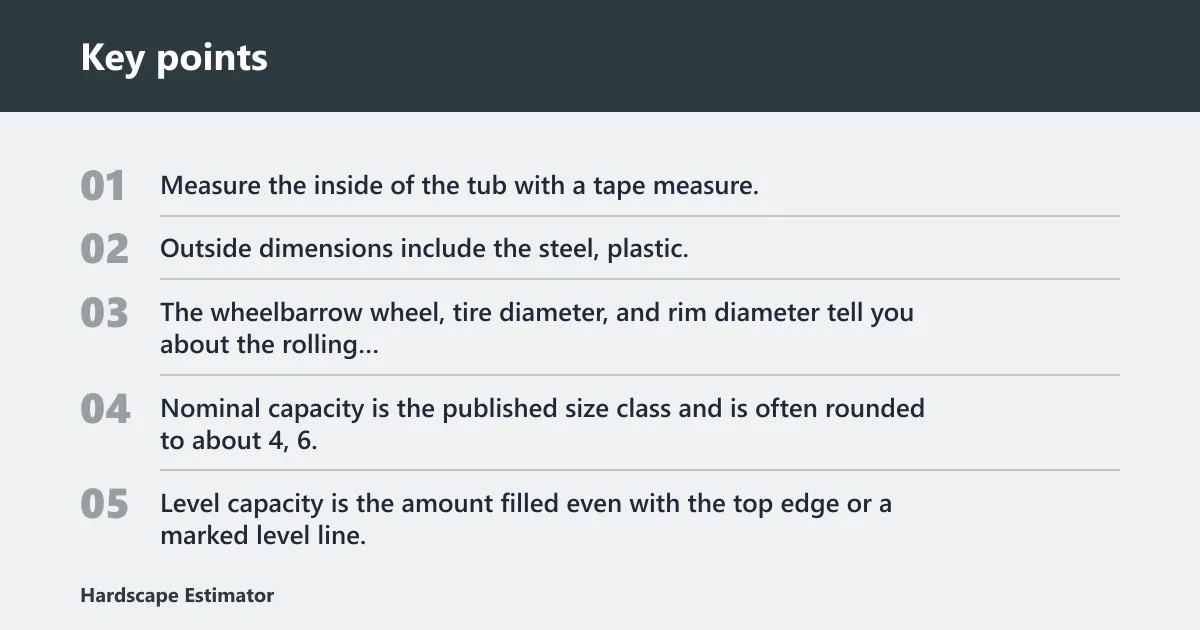
Measure the inside of the tub with a tape measure. Outside dimensions include the steel, plastic, or poly walls and do not show how much material fits inside. The wheelbarrow wheel, tire diameter, and rim diameter tell you about the rolling assembly, not the load volume.
Nominal, level, and heaped capacity
Nominal capacity is the published size class and is often rounded to about 4, 6, or 8 cubic feet. Level capacity is the amount filled even with the top edge or a marked level line. Heaped capacity is the loose mound above the rim, and it varies more by tub shape and material texture.
Why cubic feet are the standard estimate unit
Cubic feet converts cleanly into jobsite quantity planning. One cubic yard equals 27 cubic feet, so a wheelbarrow estimate can move straight into mulch, gravel, soil, and concrete takeoff. That makes it easier to compare load counts, bulk ordering, and hauling limits in one unit system.
How to measure the inside of a wheelbarrow tub
Use inside length, inside width, and inside depth. The tub is irregular, so the result is an estimate, not a perfect box volume. Measure straight across the interior where the material would sit, and keep the tape measure against the inside surfaces, not the outer frame or handles.
Measure inside length, width, and depth
- Set the wheelbarrow on level ground.
- Measure the inside length from the front wall to the inside of the rear wall.
- Measure the inside width at the widest practical point inside the tub.
- Measure inside depth from the bottom to the rim at the same section.
- Write down each number in inches.
Handle the curved tub shape
Most tubs curve inward near the ends and sides, so a simple length × width × depth calculation overstates the exact box volume. A practical way to handle that shape is to treat the result as a starting point, then compare it with a fill test or the manufacturer’s listed capacity.
Say your tub measures 30 in by 20 in by 10 in inside. The bounding box volume is 6,000 cubic inches, or 3.47 cubic feet. If the tub is curved and narrower near the ends, the true usable volume will be lower than that box number.
How do you calculate cubic feet?
Multiply inside length × inside width × inside depth, then divide by 1,728 to convert cubic inches to cubic feet. Because the tub is irregular, this gives an estimate. For most wheelbarrow tubs, that estimate is close enough for planning, but not exact enough for a legal spec or tight material control.
Worked example with real dimensions
Suppose a tub measures 32 in long, 22 in wide, and 11 in deep inside. The box estimate is 32 × 22 × 11 = 7,744 cubic inches. Divide by 1,728 and the result is 4.48 cubic feet.
That 4.48 cubic feet is the starting estimate, not the final answer. If the tub has steeply curved sides, the practical usable volume may land closer to 4.0 or 4.25 cubic feet. If the manufacturer lists 4 cubic feet, that published number is a useful cross-check.
How do I convert wheelbarrow dimensions to cubic feet?
Use this formula: inside length × inside width × inside depth ÷ 1,728 = cubic feet. If the dimensions are in feet already, multiply the three numbers directly. The inch-based method is usually easier because tape measures are marked that way, and most tubs are not exact rectangles.
How do you verify it with water?
Set the wheelbarrow level and fill it with water to the target line or brim, then measure the water in gallons. Convert gallons to cubic feet by dividing by 7.4805. A water-fill check is the best practical verification because it captures the real shape instead of a guessed box.
Convert gallons to cubic feet
One cubic foot is about 7.48 gallons. So 4 cubic feet is about 29.9 gallons, 6 cubic feet is about 44.9 gallons, and 8 cubic feet is about 59.8 gallons. A gallon reading that lines up with those values confirms the measured estimate.
A common mistake is measuring a wheelbarrow while it is tilted on a sloped driveway. If the wheelbarrow tilts, the water line changes and the result no longer matches usable capacity. Keep the wheelbarrow on a level surface, and fill slowly so the water settles before reading the amount.
When the water test is the better check
Use the water-fill method when the tub shape is unusual, when a brand lists only a nominal size, or when the number matters for ordering and hauling. It is also useful when two wheelbarrows look similar but do not hold the same amount. Water does not guess at the curve.
Wheelbarrow volume worksheet
Use this worksheet to move from dimensions to a usable number, then check it against a real fill. The dimension method is quick. The water-fill check is better for verification. For planning material loads, keep the final number in cubic feet and convert to cubic yards only when you need bulk-order math.
Dimension method
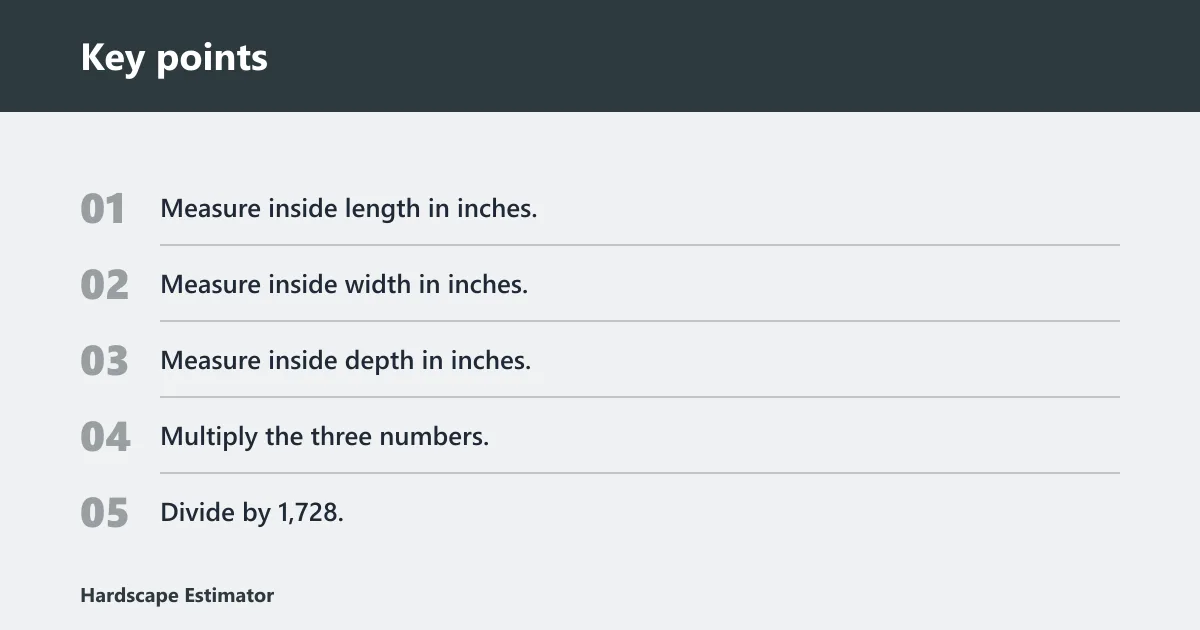
- Measure inside length in inches.
- Measure inside width in inches.
- Measure inside depth in inches.
- Multiply the three numbers.
- Divide by 1,728.
- Round to the nearest quarter cubic foot for estimating.
Water-fill check
- Place the wheelbarrow on level ground.
- Fill with water to the brim or marked fill line.
- Record the gallons used.
- Divide gallons by 7.4805 to get cubic feet.
- Compare the result with the dimension estimate.
| Nominal size | Approximate brimful gallons | Approximate level-fill gallons | When this is accurate enough |
|---|---|---|---|
| 4 cubic feet | 30 gal | 24 to 26 gal | Good for small mulch, soil, and bag-count estimates |
| 6 cubic feet | 45 gal | 36 to 40 gal | Good for general hauling and mid-size takeoff work |
| 8 cubic feet | 60 gal | 48 to 53 gal | Good for larger tubs, but verify if the load is weight-limited |
These gallon figures are approximate conversions from cubic feet. Level-fill gallons are lower because the load sits below the rim. Heaped loads can go above the brimful number, but the extra volume is less predictable and depends on how loose the material piles.
How many cubic feet does my wheelbarrow hold?
Most wheelbarrows fall in the 4, 6, or 8 cubic foot range, but the real usable volume can differ from the label. If the manufacturer lists a capacity, that is often enough for a quick estimate. If the tub shape is unusual or the load will be heavy, measure the inside and verify it.
Typical size ranges
A 4 cubic foot wheelbarrow is common for light yard work. A 6 cubic foot tub is a frequent general-purpose size. An 8 cubic foot wheelbarrow can move more loose material, but it also gets heavy faster when the cargo is dense or wet.
Picture a contractor ordering mulch for a path and a border bed. If the tub is listed at 6 cubic feet and the order is 3 cubic yards, that is 81 cubic feet total. Divide 81 by 6 and the plan is about 14 wheelbarrow loads, before rounding for spill and compaction.
When manufacturer specs are enough
Use the published capacity when the job only needs a rough count and the wheelbarrow is a standard model. Use your own measurement when the tub is older, nonstandard, or visibly curved in a way that changes the usable space. A spec sheet is helpful, but it is still a nominal number.
How do wheelbarrow loads change by material?
Load weight changes much faster than load volume. Soil, sand, gravel, and concrete mix all have different densities, so a full wheelbarrow can be easy to push with one material and awkward with another. Volume tells you space. Density tells you weight.
Soil
Dry topsoil is lighter than wet soil, and screened soil is usually easier to move than clay-rich fill. A 6 cubic foot wheelbarrow full of dry soil may be manageable, but the same volume of damp soil can push the load toward the upper end of what a person can handle comfortably.
Sand and gravel
Sand and gravel are dense enough that the wheelbarrow reaches a useful weight limit before the tub reaches a hard structural limit. For these materials, a level fill is often a better planning number than a heaped one. If the load looks high on the rim, the weight likely rises fast.
Concrete mix and wet material
Wet concrete mix is heavier than loose dry material because water adds mass and changes how the load settles. A heaped load can become unsafe quickly. For concrete work, use the wheelbarrow’s measured volume as a cap, then reduce the load if the mix is wet or the path is steep.
How wheelbarrow size affects hauling limits
Hauling limits are about both weight and volume. A larger tub can move more material per trip, but it also becomes harder to handle when the material is dense. The right estimate depends on whether the job is loose mulch, dense gravel, or wet mix that holds more weight per cubic foot.
Weight vs volume
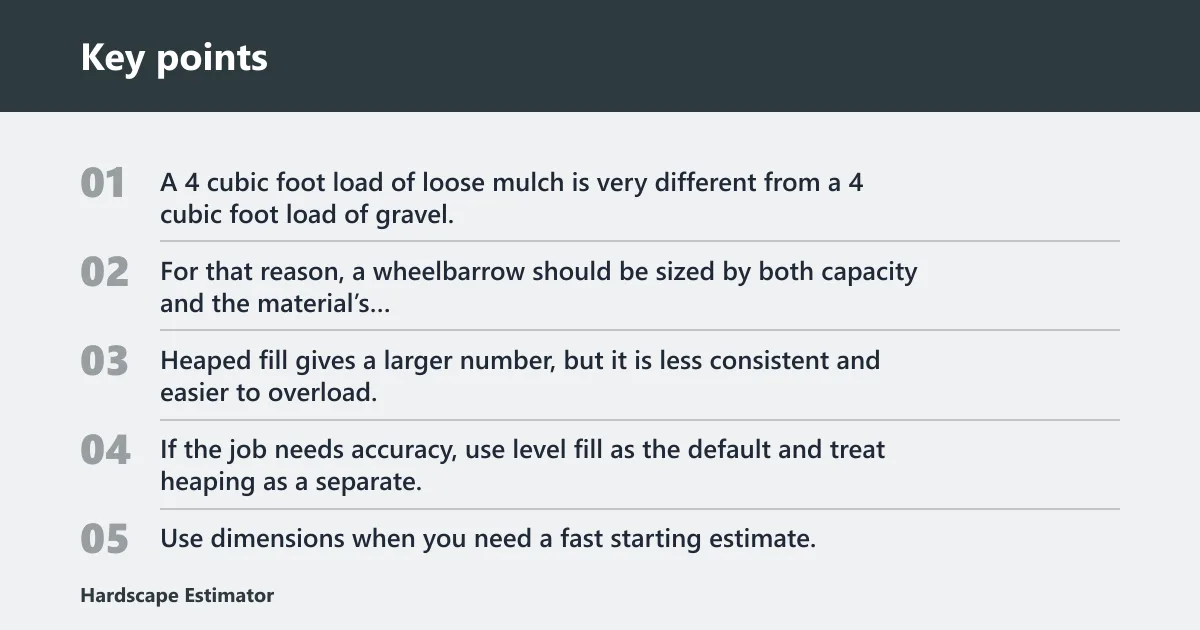
A 4 cubic foot load of loose mulch is very different from a 4 cubic foot load of gravel. The volume is the same, but the mass is not. For that reason, a wheelbarrow should be sized by both capacity and the material’s density, not by tub size alone.
Level fill vs heaped fill
Level fill gives a repeatable number. Heaped fill gives a larger number, but it is less consistent and easier to overload. If the job needs accuracy, use level fill as the default and treat heaping as a separate, looser estimate that should be checked against weight and stability.
Decision rule for estimating, buying, and loading
Use dimensions when you need a fast starting estimate. Use the water test when you need to verify the number or resolve a mismatch between the spec sheet and the tub shape. Rely on the manufacturer spec only when the model is standard and the estimate does not depend on a tight material count.
Frequently asked questions
What is the volume of a wheelbarrow?
The volume is the usable space inside the tub, usually expressed in cubic feet. Common nominal sizes are 4, 6, and 8 cubic feet, but the true usable amount depends on the tub shape, the fill line, and whether the load is level or heaped.
How many cubic feet does my wheelbarrow hold: many wheelbarrows hold about 4?
Many wheelbarrows hold about 4, 6, or 8 cubic feet, but the label is not always exact. Measure the inside tub or check the manufacturer’s spec sheet. If the tub is curved or unusual, a water-fill check gives the best real-world number.
Should I measure a wheelbarrow by bag capacity or brimful volume?
Use brimful volume for the wheelbarrow itself and bag capacity for the material you are buying. A 6 cubic foot wheelbarrow does not equal six bags of every product. Bag size, compaction, and material density all affect the final load count.
How do I convert wheelbarrow dimensions to cubic feet: multiply inside length × inside?
Multiply inside length × inside width × inside depth in inches, then divide by 1,728. That gives cubic feet. Because most tubs are irregular, treat the answer as an estimate and check it against a manufacturer spec or a water-fill test when accuracy matters.
How do I estimate a wheelbarrow load for soil or gravel?
Start with the measured cubic feet, then adjust for material density and fill style. Soil is usually lighter than gravel, and wet material is heavier than dry material. For dense loads, use a level fill and reduce the amount if the wheelbarrow feels unstable or too heavy to move safely.