How Much Concrete Can You Mix in a Wheelbarrow?
A typical 6-cu-ft wheelbarrow holds about 2 to 3 cu ft of mixed concrete safely, which is roughly 2 to 3 eighty-pound bags or 4 to 6 sixty-pound bags at a time. Fill past that and the load gets harder to turn, spills more easily, and can start setting before you place it. This guide shows how wheelbarrow size changes batch limits, how many bags fit safely, and how to estimate spill-free working volume.
How much concrete fits in a wheelbarrow?
For hand mixing, the safe limit is lower than the wheelbarrow’s full tub capacity. A larger wheelbarrow usually works best with a larger load: a 4-cu-ft wheelbarrow at about 1.5 to 2 cu ft of mixed concrete, a 6-cu-ft wheelbarrow at about 2 to 3 cu ft, and an 8-cu-ft wheelbarrow at about 3 to 4 cu ft. Leave headroom so you can fold the mix with a hoe or shovel without pushing it over the rim.
Concrete is the finished mix, and cement is only one ingredient in it. Portland cement combines with sand, gravel, and water to make concrete. For small jobs, hand mixing in a wheelbarrow or similar container is practical, and bagged concrete mix is the common choice for most home work. Family Handyman notes that jobs requiring more than about 30 bags should use ready-mix.
What you’ll need
- Wheelbarrow with sturdy plastic or metal construction
- Hoe or shovel for folding the mix
- Bucket for measured water
- Bagged concrete mix or separately measured sand, gravel, and Portland cement
- Gloves and eye protection
- Stiff-bristle brush for cleanup
Wheelbarrow batch capacity table
This table uses a capacity-first method: start with the wheelbarrow size, then convert that to a safe fill level and an approximate bag count. The bag counts are estimates, not exact yields. Moisture in the aggregate, the brand of mix, and how wet the batch is all change the final volume.
| Wheelbarrow size | Safe fill level | Approx. usable mix volume | Estimated 60-lb bags | Estimated 80-lb bags |
|---|---|---|---|---|
| 4 cu ft | About 40% to 50% full | About 1.5 to 2 cu ft | About 2 to 4 bags | About 1 to 2 bags |
| 6 cu ft | About 40% to 50% full | About 2 to 3 cu ft | About 4 to 6 bags | About 2 to 3 bags |
| 8 cu ft | About 40% to 50% full | About 3 to 4 cu ft | About 6 to 8 bags | About 3 to 4 bags |
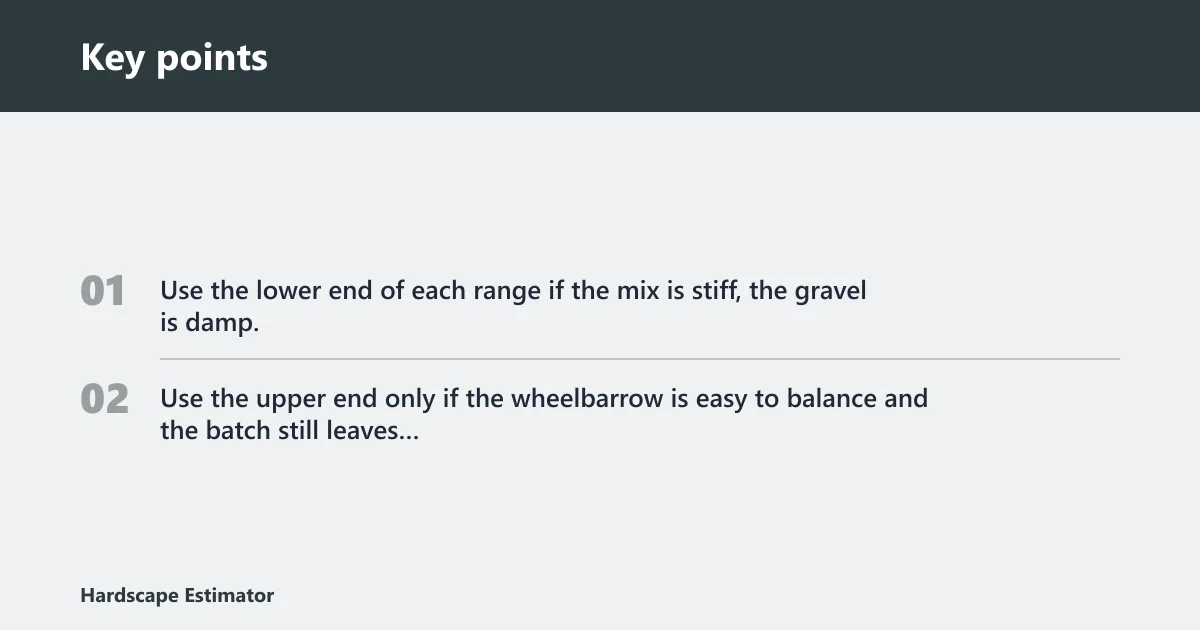
Use the lower end of each range if the mix is stiff, the gravel is damp, or the tub has a narrow shape. Use the upper end only if the wheelbarrow is easy to balance and the batch still leaves room to turn the mix without heaping it.
How many bags can you mix?
Most small jobs land in the 2 to 3 cu ft range per batch in a 6-cu-ft wheelbarrow. That usually works out to 2 to 3 eighty-pound bags or 4 to 6 sixty-pound bags at a time. If the job needs more than that, split it into another batch instead of crowding the tub and making the mix harder to turn.
How many 80lb bags of concrete can you mix in a wheelbarrow at a time?
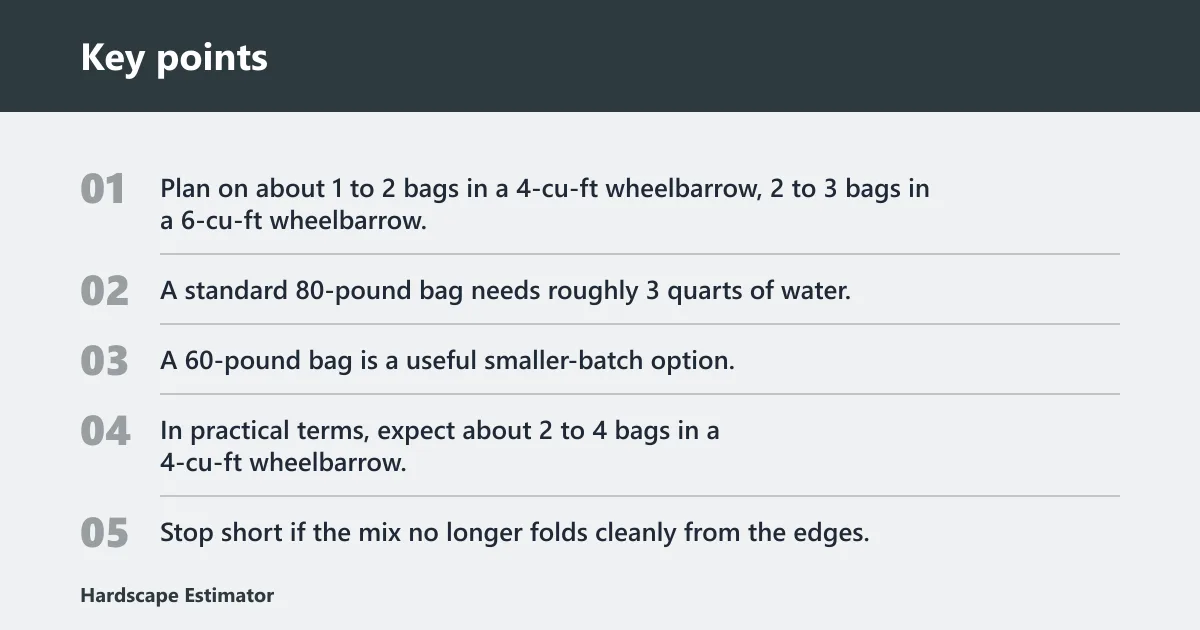
Plan on about 1 to 2 bags in a 4-cu-ft wheelbarrow, 2 to 3 bags in a 6-cu-ft wheelbarrow, and 3 to 4 bags in an 8-cu-ft wheelbarrow. A standard 80-pound bag needs roughly 3 quarts of water, and starting with about 2 quarts first helps prevent a soupy batch.
How many 60lb bags of concrete can you mix in a wheelbarrow?
A 60-pound bag is a useful smaller-batch option. In practical terms, expect about 2 to 4 bags in a 4-cu-ft wheelbarrow, 4 to 6 bags in a 6-cu-ft wheelbarrow, and 6 to 8 bags in an 8-cu-ft wheelbarrow. Stop short if the mix no longer folds cleanly from the edges.
When should you split a batch?
Split the batch when the wheelbarrow gets full enough that the dry material rides up over the sides as you mix. That point usually comes before the tub is physically full. Say your 6-cu-ft wheelbarrow is loaded with three 80-pound bags and the mix still needs more water; it is better to stop there than force in a fourth bag and spill material while turning it.
How do you mix it without spilling?
Put the dry ingredients in first, then blend them before any water goes in. Add water in stages until the mix is evenly damp and workable, not soupy. A stiff, cookie-dough-like consistency is easier to place and stronger than a loose mix with too much water.
- Set the wheelbarrow on level ground and keep the handles braced.
- Empty the dry mix into the tub and break up clumps with a hoe or shovel.
- Add about 2 quarts of water for an 80-pound bag, then mix thoroughly.
- Add the rest of the water in small additions, rechecking after each one.
- Stop when the mix holds together without slumping into slurry.
- Place the concrete right away so it does not stiffen in the tub.
For mixed batches, add water in 1-quart increments after the first charge, then check the texture again. If the bottom stays dry, fold from the edges and add another quart only after the earlier water has been worked through. A batch that starts to set should not be retempered with extra water.
What affects the final yield?
Water-to-cement ratio controls strength. Too much water weakens concrete, even if it makes the mix easier to move. The right amount is only enough to hydrate the cement and make the batch workable. That is why a bag that seems harder to mix should not be fixed by flooding it with water.
Aggregate moisture and grading
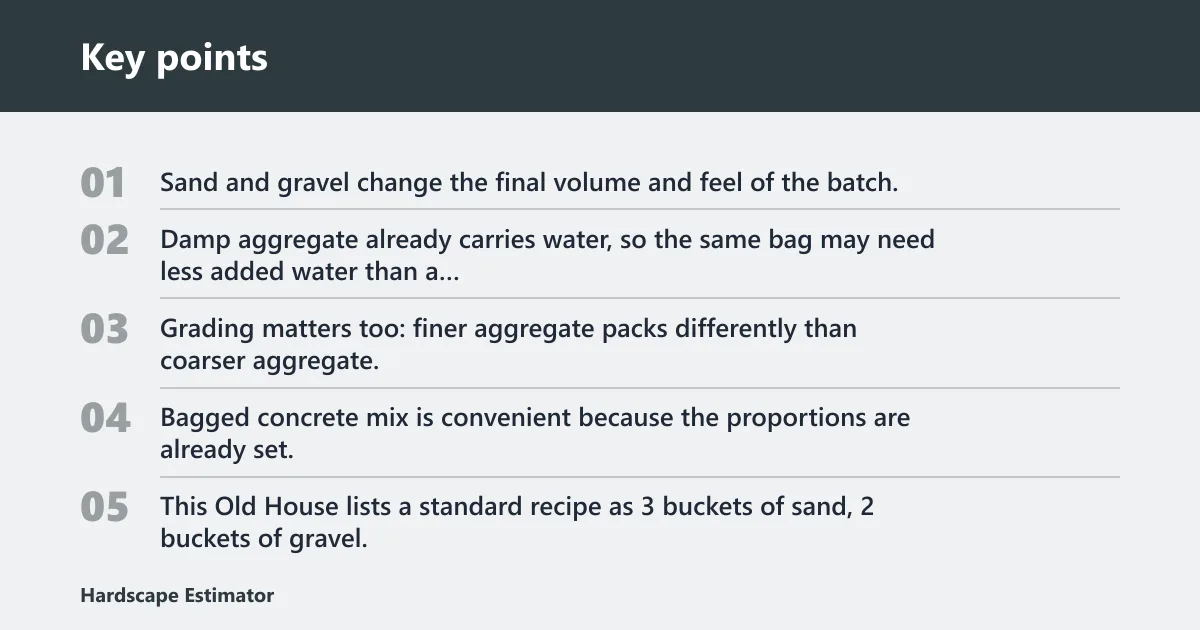
Sand and gravel change the final volume and feel of the batch. Damp aggregate already carries water, so the same bag may need less added water than a dry batch. Grading matters too: finer aggregate packs differently than coarser aggregate, which changes how full the wheelbarrow feels and how much mix it can hold before spilling.
Why bagged mix yield can vary by brand
Bagged concrete mix is convenient because the proportions are already set, but yield still varies by brand and moisture. This Old House lists a standard recipe as 3 buckets of sand, 2 buckets of gravel, and 1 bucket of Portland cement, while bagged products package those ingredients in a different ratio. Check the bag for water instructions, then measure instead of guessing.
Common mistakes
- Overfilling the wheelbarrow. Keep the batch to about half the tub or less, so the mix can be turned without spilling.
- Using too much water. Add water gradually. A wet mix is easier to slump, but it is weaker and messier to place.
- Trying to rework a batch after it starts setting. If it stiffens, stop. Do not add water to bring it back.
- Skipping cleanup and washout. Concrete hardens fast on tools and in the tub, so rinse and brush everything as soon as the batch is placed.
Picture a 4-cu-ft wheelbarrow with two 80-pound bags inside. If the mix is already close to the rim before the water is fully in, that batch is too large for comfortable hand mixing. The fix is not more water. It is a smaller batch, better headroom, and faster placement.
Can you mix concrete in a wheelbarrow?
A wheelbarrow is practical for small jobs when the batch stays under about 5 cu ft, and about 4 to 5 cu ft is a common mixing range. For most small home work, a sturdy wheelbarrow, a hoe or shovel, a measuring bucket, and bagged mix are enough to get consistent results without special equipment.
Choose a wheelbarrow that is large enough to turn the mix but not so large that one person cannot control it. For concrete mixing, a 6-cu-ft model is the best starting point for most small jobs because it leaves room for the batch while still being easy to manage.
What size wheelbarrow is best for mixing concrete?
A 6-cu-ft wheelbarrow is the most practical middle ground for small hand-mixed batches. It gives enough room for about 2 to 3 cu ft of usable mix, which fits the common 80-pound and 60-pound bag ranges without overfilling. Bigger tubs can hold more, but they are harder to mix cleanly by hand.
For very small repairs, a 4-cu-ft wheelbarrow can work. For repeated batches or slightly larger pours, an 8-cu-ft wheelbarrow gives more room, but only if the batch size still stays modest. The right size is the one that keeps the mix below the rim while staying easy to lift and steady.
Frequently asked questions
How much concrete can you mix in a wheelbarrow?
For hand mixing, plan on about 1.5 to 2 cu ft in a 4-cu-ft wheelbarrow, 2 to 3 cu ft in a 6-cu-ft wheelbarrow, and 3 to 4 cu ft in an 8-cu-ft wheelbarrow. Those ranges leave room to fold the mix without slopping material over the sides.
How much concrete can you put in a wheelbarrow?
You can put more concrete in than you can mix well, but that is the wrong target. Keep the load low enough to turn with a hoe or shovel and still see the bottom of the tub during mixing. For most small jobs, half-full is the practical ceiling.
How many bags of concrete can you mix in a wheelbarrow?
The count depends on wheelbarrow size and bag weight. A 6-cu-ft wheelbarrow usually handles about 2 to 3 eighty-pound bags or 4 to 6 sixty-pound bags safely. Use the table above as the starting point, then reduce the batch if the mix is stiff or wet aggregate makes it heavier.
How much water do you add to a wheelbarrow concrete mix?
Start with about 2 quarts for an 80-pound bag, then add the rest slowly until the mix is workable. ConcreteGator says a standard 80-pound bag needs roughly 3 quarts total. The exact amount varies by brand, so stop as soon as the mix holds together without becoming soupy.
What is the best consistency for wheelbarrow-mixed concrete?
Target a stiff, workable mix that holds shape when folded, similar to cookie dough. If it pours like soup, it is too wet. If dry powder remains at the bottom after mixing, it needs a little more water. Add water in small measured amounts and recheck each time.
How much cement can you mix in a wheelbarrow?
Portland cement is only one ingredient, so the practical answer is based on concrete mix, not cement alone. For small jobs, work from the bagged concrete yield or the sand, gravel, and cement ratio. A 6-cu-ft wheelbarrow is a sensible size for small batches, but the finished concrete volume is what matters.
Clean the wheelbarrow, hoe, shovel, and bucket as soon as the batch is placed. A stiff-bristle brush and water remove residue before it hardens. Wear gloves and eye protection during mixing, and rinse wash water where it will not leave hardened buildup in the tub or on nearby surfaces.