How Deep Should You Dig for a Paver Patio?
Dig 7 to 9 in. below finished grade for a typical paver patio: 6 in. of compacted base, 1 in. of bedding sand, plus the paver thickness. Add more for soft soil, drainage, or freeze-thaw areas. Too shallow, and the patio settles, holds water, and can heave or lose joint sand. This guide gives a depth formula, a table by paver thickness and site conditions, and a quick way to estimate excavation volume.
Paver patio dig depth and soil factors
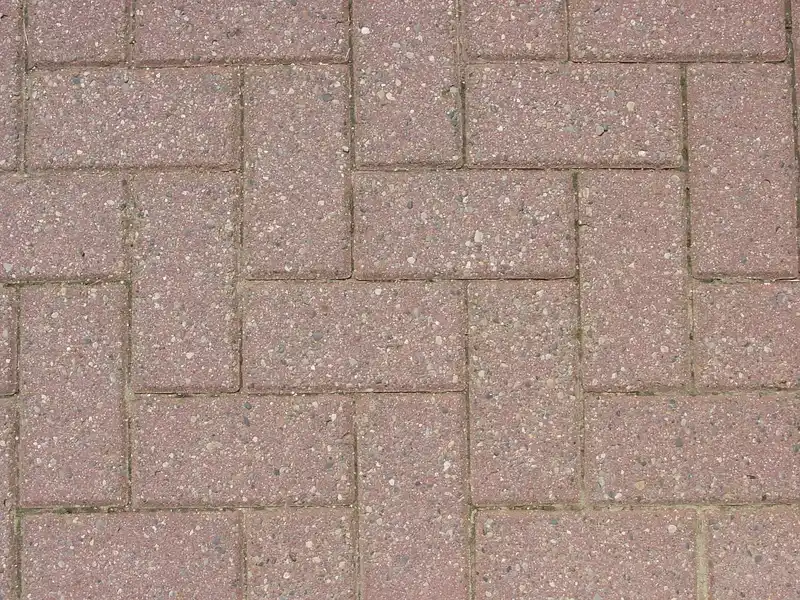
The short answer is that excavation starts at finished grade and usually ends around 7 to 9 in. for a standard pedestrian patio. Clay, poor drainage, and freeze-thaw exposure can push that deeper. Depth is simple math: paver thickness plus base gravel plus bedding sand, all measured below the final surface.
That matters because the top of the pavers has to land at finished grade. If the surface is right but the dig is shallow, the base is too thin and the pavers lose support. If the dig goes too deep and the base is not rebuilt correctly, the patio can settle unevenly.
Paver patio excavation table
Quick takeaway: most pedestrian patios land in the 7 to 9 in. range below finished grade, with 8 3/8 in. and 9 in. both common depending on paver thickness and base depth. Move deeper when the soil is weak, the site drains poorly, or freeze-thaw conditions are a concern.
The table below separates what gets dug from what gets installed. Dig depth is measured below finished grade, while the paver, base, and bedding layers add up to the final section depth. The notes show how normal soil, clay soil, and freeze-thaw conditions usually change the decision.
| Scenario | Paver thickness | Base gravel | Bedding sand | Total dig depth | Site-condition note |
|---|---|---|---|---|---|
| Thin patio unit, normal soil | 2 in. | 4 in. | 1 in. | 7 in. | Works for firm, well-drained subgrade |
| Common patio unit, normal soil | 2 3/8 in. | 5 in. | 1 in. | 8 3/8 in. | A common pedestrian setup |
| Thicker patio unit, normal soil | 3 in. | 5 in. | 1 in. | 9 in. | Matches a typical guide that says about 9 in. |
| Thicker unit, clay soil | 3 in. | 6 in. | 1 in. | 10 in. | Add depth when drainage and support are weaker |
| Freeze-thaw area, standard patio | 2 3/8 in. | 6 in. | 1 1/2 in. | 9 7/8 in. | Extra base and bedding help with movement |
| Heavy pedestrian use | 3 1/2 in. | 6 in. | 1 in. | 10 1/2 in. | Useful for fire pits, entries, and busier paths |
| Clay soil with poor drainage | 3 in. | 6 in. | 1 1/2 in. | 10 1/2 in. | Depth may increase, but drainage fixes come first |
| Pedestrian minimum from one guide | Varies | 7 in. total sub-base minimum | Included in build-up | At least 7 in. below finished grade | Used as a minimum reference, not a universal target |
If the site is flat, firm, and drains well, the low end of the table often works. If the soil is soft, stays wet, or freezes deeply, the excavation usually needs more depth or a different drainage plan. ICPI-style hardscape guidance and APA installation references both emphasize matching the section depth to site conditions rather than using a single number everywhere.
What sets the total dig depth?
Total dig depth is the sum of the paver thickness, the compacted base gravel, and the bedding sand, all measured below finished grade. The excavation has to go deep enough for those layers to fit and compact without leaving the finished patio too high. That is why paver thickness changes the dig depth, even when the base stays the same.
Paver thickness
Typical patio pavers use 3 to 3 1/2-inch thick pavers, though many patio units are also sold in the 2 to 3 in. range. Thicker units add to the total build-up, so the excavation must go deeper to keep the final surface at grade. The paver is one part of the depth math, and it cannot be ignored.
Base gravel thickness
Base gravel is usually 4 to 6 in. under patios, and some guides call for 5 in. for a typical patio build. ICPI hardscape installation details commonly call for a compacted aggregate base suited to the use and soil conditions, while many manufacturer specs for pedestrian patios land in that same 4 to 6 in. range. The base should be compacted in lifts, not dumped all at once, so the finished thickness stays uniform.
Bedding sand thickness
Bedding sand usually goes in at 1 to 2 in. above the compacted gravel base. It is a leveling layer, not the main support layer. If that layer gets too thick, the pavers can ride on a soft bed and move under traffic. APA and manufacturer installation guidance both treat the bedding layer as thin and uniform rather than structural.
Use this simple formula:
Total dig depth = paver thickness + base gravel thickness + bedding sand thickness
Suppose a patio uses 2 3/8 in. pavers, 5 in. of base, and 1 in. of bedding sand. The dig depth is 2 3/8 + 5 + 1 = 8 3/8 in. below finished grade. If the same patio uses 3 in. pavers instead, the depth becomes 9 in.
How do soil and slope change depth?
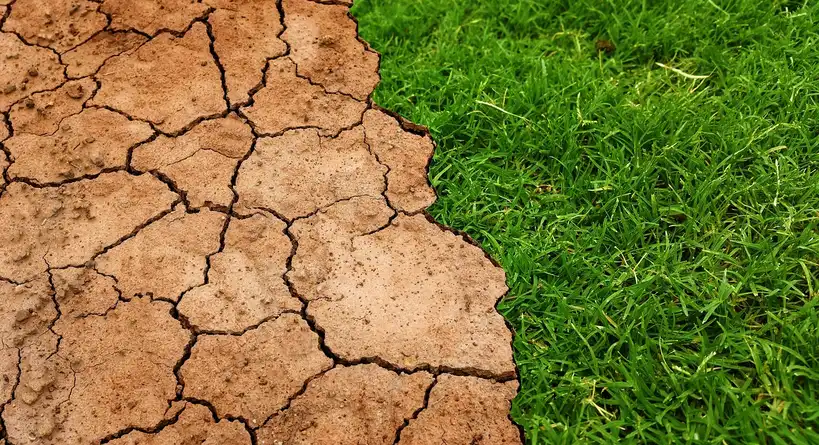
Clay, soft soil, and freeze-thaw conditions often call for more excavation depth or better drainage. The compacted soil sub-base forms the bottom support layer, so the soil under the base must be firm before base placement. If the sub-base is weak, the patio can settle even if the layer thickness looks correct on paper.
Compacted soil sub-base
The compacted soil sub-base is the bottom support layer. It should be trimmed to grade and compacted before the gravel base goes in. A plate tamper is used for the base material, but the soil itself also needs to be firm enough that the patio does not sink under use.
Drainage slope and standing water
Drainage slope changes excavation depth because the patio needs a slight drop for water to move away. If the finished patio must slope away from a house or from a low spot, one side may need a little more excavation than the other. On sloped sites, the depth is not the same everywhere.
If standing water is already a problem, extra depth alone will not fix it. Regrading, drain piping, or correcting runoff may matter more than simply digging deeper. Extra depth helps only when the water has somewhere to go.
When clay needs extra depth
Clay soil holds water and can soften after rain, so it often needs a deeper or better-built base than firm sandy soil. That is why many guides move from 4 to 6 in. of base for patios to 8 to 12 in. for driveways and high-traffic zones. For a patio, clay usually means more base depth, not a thinner one.
On a wet clay lot, do not copy excavation depth from a sandy site just because a neighbor used that number. Clay can support the patio when it is dry and then lose strength after repeated rain, so the safer approach is deeper excavation, stronger compaction, and drainage that keeps water from sitting under the base. A patio that looks fine on day one can develop low spots after a season of wet weather and thaw cycles.
How much gravel and sand go under pavers?
Most patio builds use 4 to 6 in. of base gravel and 1 to 2 in. of bedding sand, with compaction done in lifts. For many pedestrian patios, about 6 in. of compacted base plus about 1 in. of bedding sand is a common planning number. ICPI installation practices, manufacturer specs, and many base-material guides all point to the same principle: keep the base dense, level, and uniform before the sand goes on.
Base gravel depth and compaction in lifts
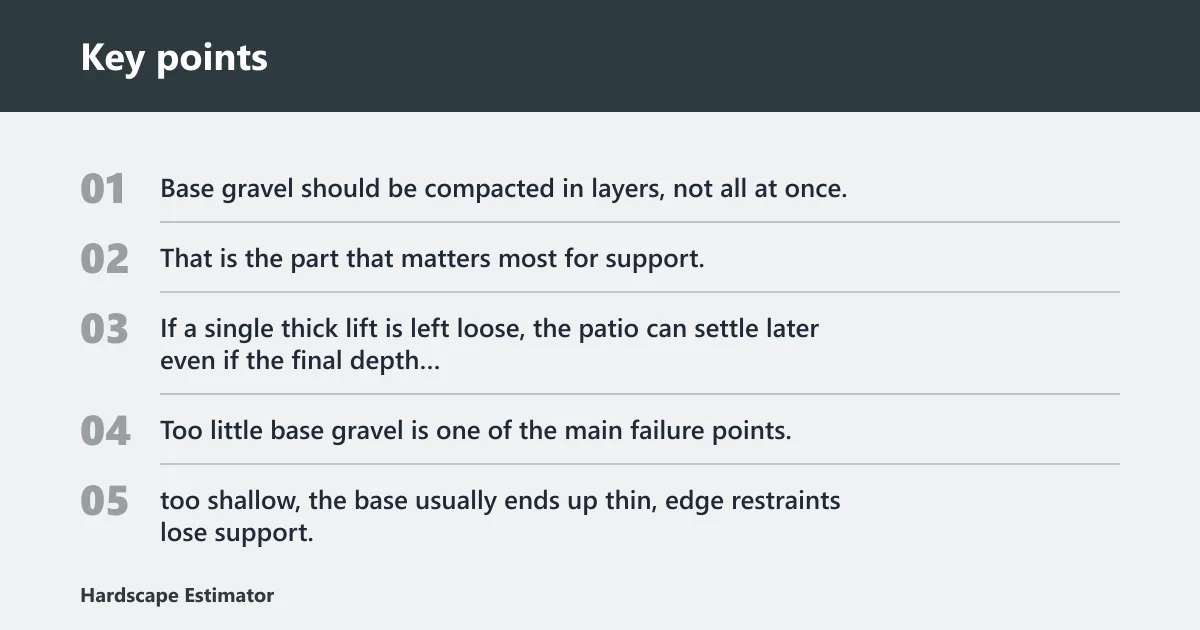
Base gravel should be compacted in layers, not all at once. That is the part that matters most for support, because each lift locks the stone into a denser, flatter layer before the next one goes in. If a single thick lift is left loose, the patio can settle later even if the final depth looked right during excavation.
Too little base gravel is one of the main failure points. If the excavation is 1 to 2 in. too shallow, the base usually ends up thin, edge restraints lose support, and the pavers can rock or sink near joints and borders. That small shortage often shows up first at the corners and along the edges.
Bedding sand depth above the base
Bedding sand should sit above the compacted gravel base, usually at 1 to 2 in. That layer makes final leveling easier, but it should not be treated like structural fill. If the bedding layer is too thick, the patio can feel soft underfoot and shift more easily.
| Total dig depth per 100 sq ft | Approx. base gravel volume | Approx. bedding sand volume | Approx. compacted sub-base allowance | Notes |
|---|---|---|---|---|
| 7 in. | 1.48 cu yd | 0.31 cu yd | Included in total excavation | Thin patio unit with 4 in. base and 1 in. sand |
| 8 in. | 1.77 cu yd | 0.31 cu yd | Included in total excavation | Common patio build with 2 3/8 in. pavers and 5 in. base |
| 9 in. | 1.77 cu yd | 0.31 cu yd | Included in total excavation | Typical 3 in. paver setup with 5 in. base |
| 10 in. | 2.12 cu yd | 0.31 cu yd | Included in total excavation | Useful where clay or freeze-thaw needs a deeper section |
These quantities are based on 100 sq ft and on the layer thicknesses shown in the table. For a larger patio, multiply the volumes by the patio area in hundreds of square feet. For example, 200 sq ft at the 9-in. build uses about 3.54 cu yd of base gravel and about 0.62 cu yd of bedding sand.
Can you install pavers over an existing concrete patio?
Sometimes, yes, but only if the concrete is sound, drains correctly, and leaves enough height for the paver, bedding, and edge details. If the slab is cracked, heaved, or ponding water, removal is often the better call. The depth math changes because the concrete may replace part of the excavation or require a different build-up.
If the existing slab stays in place, the finished surface still has to land at the right height relative to doors, steps, and drainage. That means the paver thickness and bedding layer still matter, even though the base gravel may be reduced or replaced by another approved setting method. If the slab is too high already, the project may not have enough clearance.
Say your concrete patio is level but sits too close to a back door threshold. Adding pavers on top may leave no room for proper transitions. In that case, removing the slab or redesigning the height may solve the problem better than forcing a thinner build-up.
Frequently asked questions
What if my patio needs to slope away from the house?
A patio that slopes away from the house needs consistent fall without changing the finished height at the edge. That usually means one side of the excavation is slightly deeper than the other, but the layer stack still has to stay uniform. The goal is to move water away without creating a low spot that traps it near the foundation.
How do I know if my soil is clay?
Clay soil usually feels sticky when wet, forms a tight ribbon or ball in your hand, and dries into hard clumps that break slowly. It also holds water longer than sandy soil. If the site stays damp after rain, that is another sign the subgrade may need more attention before the patio base goes in.
How much base should I add if the patio gets heavy use?
For busier patios, entries, or areas near fire pits, it is common to move toward the deeper end of the normal range. A thicker paver, 6 in. of base, and careful compaction can help the section stay stable under more foot traffic. The exact amount should still match the soil and drainage conditions on site.
Why does my patio need different depths in different areas?
Uneven slope, soft spots, and drainage changes can make one part of the patio need more excavation than another. That is normal on real sites. What matters is keeping the finished surface level where it should be and keeping the base thickness consistent enough to support the pavers evenly.
Can a shallow excavation still work if the soil is firm?
Only if the full layer stack still fits and compacts correctly. Firm soil helps, but it does not replace the base gravel and bedding sand that the patio needs for long-term support. If the excavation is shallow enough that those layers have to be reduced too much, the patio becomes more likely to settle or shift.
How does paver thickness change excavation depth?
Thicker pavers make the total section deeper because the finished surface still has to land at grade. A patio paver can be 2 to 3 in. thick in many product lines, and some patio pavers are 3 to 3 1/2 in. thick. That difference can change the dig depth by a full inch or more.