Yards to Bags: Convert Cubic Yards Into Bag Counts
To convert cubic yards to bags, multiply yards by 27 to get cubic feet, then divide by each bag’s coverage in cubic feet; for common 0.5-cu-ft bags, 1 cubic yard works out to about 54 bags. Miss that conversion and you either run short in the middle of the job or buy far more bags than needed, often at a higher cost than bulk. This guide covers the formulas, bag-size conversions, overage by material, and when bagged material stops making sense.
The buying rule is simple: convert the required volume into the bag’s printed yield, add an overage that fits the job condition, round once at the end, and only then compare bagged against bulk. That keeps loose fill, leveled beds, and compacted installs from being treated like the same volume when they are not.
A cubic yard contains 27 cubic feet because it measures 3 ft × 3 ft × 3 ft. That fixed volume drives every conversion here: cubic yards = cubic feet ÷ 27, and bags = cubic feet ÷ bag volume. For concrete and similar mixes, use the mixed-volume yield printed on the bag label instead of bag weight.
Converting cubic yards to whole bag quantities
A cubic yard is 27 cubic feet, so the bag count depends entirely on the volume printed on the bag. One yard works out to about 54 half-cu-ft bags, 27 one-cu-ft bags, 13.5 two-cu-ft bags, and 9 three-cu-ft bags before rounding. Retail purchases use whole bags, so some sizes must round up.
Common bag counts per yard
Start with the fixed yard volume, 27 cubic feet, and divide by the bag’s stated cubic-foot coverage to get the raw bag count.
- 0.5 cu ft bags: 27 ÷ 0.5 = 54 bags
- 1 cu ft bags: 27 ÷ 1 = 27 bags
- 2 cu ft bags: 27 ÷ 2 = 13.5 bags, so purchase 14 bags
- 3 cu ft bags: 27 ÷ 3 = 9 bags exactly
That is why a full yard in 2-cubic-foot bags becomes a buying quantity of 14, even though the pure volume math is 13.5. By contrast, 3-cubic-foot bags divide evenly into a yard, so 9 bags is both the calculated result and the purchase result.
50-liter bags in yard-based estimates
Metric bag sizes need one extra step. A 50-liter bag equals about 1.7657 cubic feet, so one cubic yard equals about 15.291 50-liter bags by volume. Because suppliers sell whole bags, one cubic yard in 50-liter bags rounds up to 16 bags before any waste allowance.
Bagged mulch often shows up in 2 cu ft, 3 cu ft, or 50 L packaging. The conversion stays the same: use the stated volume, not a guessed equivalent and not the bag’s shipping weight.
How do I convert cubic yards into bag counts?
Convert yards to cubic feet, divide by the bag’s stated volume or mixed yield, add the waste allowance, then round up once at the end to a whole-bag purchase quantity. That order matters. If each step gets rounded early, mixed bag orders and partial-yard jobs can overshoot by more than expected.
The base formula
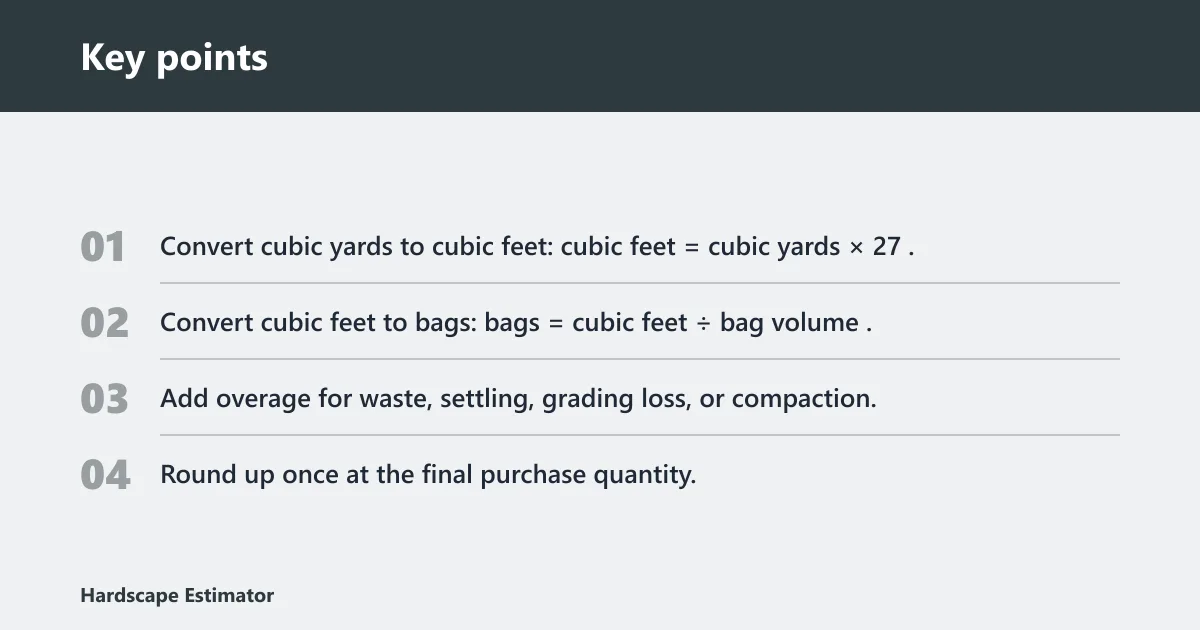
- Convert cubic yards to cubic feet: cubic feet = cubic yards × 27.
- Convert cubic feet to bags: bags = cubic feet ÷ bag volume.
- Add overage for waste, settling, grading loss, or compaction.
- Round up once at the final purchase quantity.
For dry materials sold by volume, that is enough. Sand bag calculators usually take the required cubic feet, divide by the bag volume, and round up, with an optional waste allowance for spillage and settling.
Why the bag label controls the math
Use the volume printed on the bag label, such as 2 cu ft, 3 cu ft, or a stated mixed yield like 0.45 cu ft. Weight does not tell the needed bag count unless the label also gives a mixed yield volume. This matters most for concrete, mortar, and similar products, where a bag’s nominal weight is not the same thing as its finished volume.
For concrete bags, the correct input is the label’s mixed-volume yield. A 60 lb or 80 lb number by itself is a shipping weight, not a yard-to-bag conversion unit.
Worked examples
Example 1: 1 cubic yard in 2 cu ft bags.
27 ÷ 2 = 13.5 bags. Purchase quantity = 14 bags before extra allowance.
Example 2: 0.75 cubic yard in 3 cu ft bags with 10% extra.
0.75 × 27 = 20.25 cu ft.
20.25 ÷ 3 = 6.75 bags.
6.75 × 1.10 = 7.425 bags.
Round once at the end: 8 bags.
Example 3: 1.2 cubic yards in 50 L bags with 10% extra.
1.2 × 27 = 32.4 cu ft.
32.4 ÷ 1.7657 = 18.349 bags.
18.349 × 1.10 = 20.184 bags.
Round once at the end: 21 bags.
Say your bed estimate comes to 0.4 yard of mulch and the store stocks only 2 cu ft bags. The math is 0.4 × 27 = 10.8 cu ft, then 10.8 ÷ 2 = 5.4 bags. With a 10% allowance, 5.4 × 1.10 = 5.94, so the cart gets 6 bags, not 5 and not 7.
When should I add extra material?
Add extra material whenever the purchased bag volume can disappear into spillage, grading correction, settlement, or compaction. A common calculator default is 10%, which works for many loose or lightly leveled jobs. Increase the allowance when the material will be compacted, when the subgrade is uneven, or when the product tends to settle.
Overage guide
| Project condition | Recommended extra | Why it changes |
|---|---|---|
| Loose fill | 5% to 10% | Minor spillage, small grade variation, and bag-to-bag handling loss |
| Leveled beds | 10% to 15% | Raking smooth, uneven subgrade, edge shaping, and small settling after watering |
| Compacted installs | 15% to 25% | Installed depth shrinks during compaction, especially for driveways and base layers |
The default planning allowance used in many calculators is 10%. That fits routine coverage estimates, but compacted work often needs more. For pea gravel, a typical calculator may use 10% waste for most jobs and recommend 25% for a driveway that will compact.
Loose, leveled, and compacted are different volumes
Keep three volumes separate:
- Loose purchased volume: what arrives in bags.
- Leveled in-place volume: what remains after spreading and smoothing.
- Compacted installed volume: the final depth after tamping or rolling.
If those get blended together, estimates come up short. A bagged base material that looked right at loose spread depth can finish low after compaction.
Suppose a walkway base needs 0.9 yard of compacted aggregate. Buying only 0.9 yard worth of bags covers the loose volume, not the post-compaction target. With a 25% compaction allowance, 0.9 × 1.25 = 1.125 yards to purchase, then convert that larger number into bags.
When 10% is enough and when it is not
Ten percent is a sound starting point for mulch, decorative stone, and similar material placed as loose fill or lightly leveled cover. Move above 10% when any of these show up:
- noticeable dips or high spots in the subgrade
- material that will be compacted to a target depth
- products that settle after watering or foot traffic
- jobs with many edges, curves, or grade transitions
Bags versus bulk
Bags usually make sense when the required volume is modest, access is tight, or the site needs clean staged handling. Bulk usually makes more sense once the true purchase quantity gets large enough that carrying and opening bags becomes the bigger cost. Make the bag count first, then compare buying formats on equal volume.
A practical decision rule
Use bagged material when the job is small enough to stage by hand, when a bulk truck cannot get close, or when only a portion of a yard is needed. Use bulk when the job approaches multiple yards, when the material will be spread over a broad area, or when palletized bags create more handling than the placement itself.
The key is clarity about the actual purchase quantity. A nominal “1 yard job” may become 1.1 yards with standard waste or 1.25 yards with compaction. That can change the buying format decision.
Access, minimums, and delivery limits
Site access can outweigh simple volume math. Narrow gates, finished driveways, apartment courtyards, rooftop planters, and interior remodel paths often favor bags even when bulk would otherwise be cheaper per cubic foot.
Bulk orders can also run into supplier minimums or delivery fees. Bags can run into pallet-only quantities or limited loose-bag stock. Confirm the supplier’s order increment before checkout.
How to compare fairly
Compare bagged and bulk only after both are converted to the same volume basis. That means the final bag count, including overage, against the equivalent cubic yards of bulk, also including overage. Otherwise the comparison understates one option.
Material-specific buying rules
Different materials behave differently after purchase, even when the volume math starts the same. Mulch is usually sold by bag volume. Soil, sand, and stone need more attention to settlement and moisture. Concrete and mixes must use the printed mixed yield, not the bag’s nominal weight.
Bagged mulch
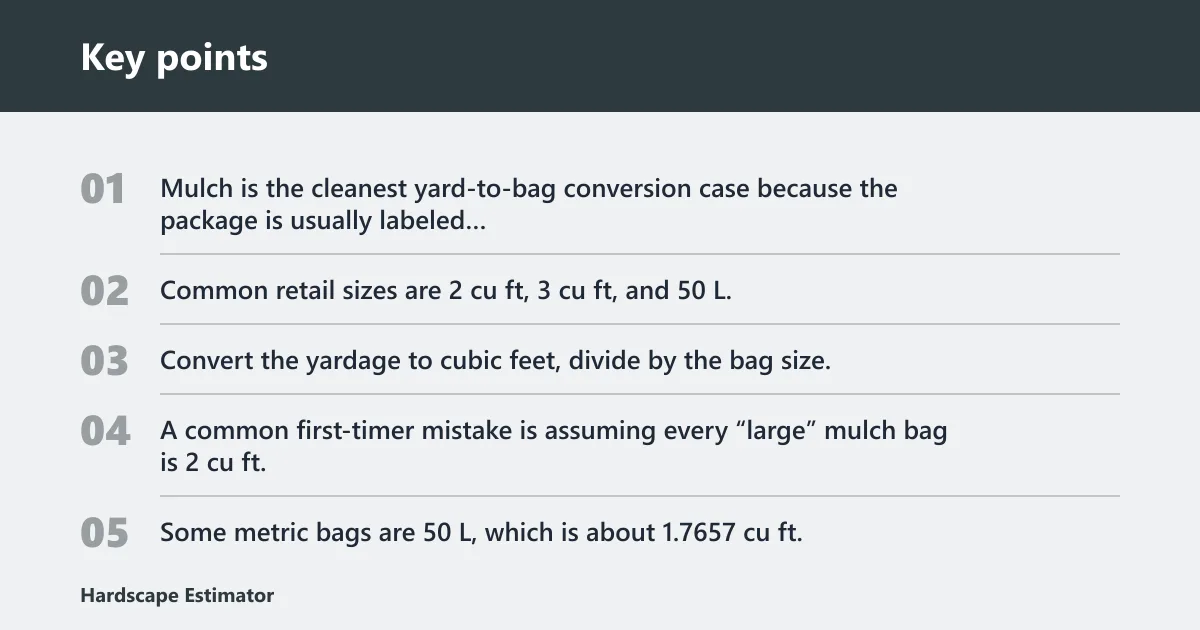
Mulch is the cleanest yard-to-bag conversion case because the package is usually labeled by volume. Common retail sizes are 2 cu ft, 3 cu ft, and 50 L. Convert the yardage to cubic feet, divide by the bag size, add the allowance for the bed condition, and round up once.
A common first-timer mistake is assuming every “large” mulch bag is 2 cu ft. Some are 3 cu ft. Some metric bags are 50 L, which is about 1.7657 cu ft. Read the label before converting.
Soil, sand, and stone
For bagged soil, sand, and gravel, the bag count still comes from volume. Moisture does not change the printed bag volume on a sealed bag, but it does affect field behavior. Wet soil and sand can settle more after placement, and wet aggregate can change weight significantly if the estimate is later converted into tons.
Material density varies by material type and by moisture content. Density matters when converting volume into weight, pounds, or tons. It is not needed to turn cubic yards into bag counts unless the product is sold by weight and also provides a yield volume.
Concrete and cement-based mixes
Use the manufacturer’s mixed-volume yield printed on the bag. Do not convert yards into concrete bag counts from nominal bag weight alone. A bag’s shipping weight does not tell how many cubic feet of mixed material it produces unless the label states that yield directly.
Nonstandard and mixed bag sizes
Some projects combine sizes because of stock shortages, delivery caps, or partial-pallet deals. In that case, convert each bag size into cubic feet contributed, total those volumes, then round the final uncovered balance once.
Picture a supplier with ten 2-cu-ft mulch bags left and unlimited 3-cu-ft bags. If the job needs 37.8 cu ft after allowance, the first ten bags provide 20 cu ft, leaving 17.8 cu ft. Then 17.8 ÷ 3 = 5.933, so buy 6 of the 3-cu-ft bags. Do not round each small step more than needed.
Bag count matrix
This matrix shows common cubic-yard totals against the bag sizes most shoppers actually see: 0.5 cu ft, 1 cu ft, 2 cu ft, 3 cu ft, and 50 L. Read across the required yardage row, then round up only at the final buying step where a count is fractional.
Conversion matrix
| Cubic yards | Cubic feet | 0.5 cu ft bags | 1 cu ft bags | 2 cu ft bags | 3 cu ft bags | 50 L bags |
|---|---|---|---|---|---|---|
| 0.25 | 6.75 | 13.5 | 6.75 | 3.375 | 2.25 | 3.823 |
| 0.5 | 13.5 | 27 | 13.5 | 6.75 | 4.5 | 7.646 |
| 0.75 | 20.25 | 40.5 | 20.25 | 10.125 | 6.75 | 11.468 |
| 1.0 | 27 | 54 | 27 | 13.5 | 9 | 15.291 |
| 1.5 | 40.5 | 81 | 40.5 | 20.25 | 13.5 | 22.937 |
| 2.0 | 54 | 108 | 54 | 27 | 18 | 30.583 |
How to read the matrix
The table shows pure volume equivalents before overage and final rounding. For example, 1 yard equals 13.5 bags at 2 cu ft, but the purchase quantity is 14 because whole bags only are sold. One yard equals 15.291 50 L bags by volume, so the purchase quantity is 16.
Rounding, pallets, and supplier increments
Round up to whole bags because bags are purchased in whole units, but round only once at the final purchase quantity. Early rounding can overstate mixed orders and partial-yard jobs. Also confirm whether the seller allows single-bag quantities, partial pallets, or only full-pallet and minimum-order increments.
Whole bags only
Fractional results are estimating outputs, not order quantities. A result of 13.5 means the project needs the volume of 13.5 bags, but the store can only sell 14 whole bags.
Do not round each subtotal too early
This matters most with multiple areas or mixed bag sizes. Add the true volume requirements first, apply the allowance, then convert to bags and round once. Rounding each area separately often builds in extra bags that were never needed.
Partial pallets and minimum orders
Some yard materials are available by the single bag at retail stores. Others are sold by the pallet through supplier counters, or require a minimum quantity for delivery. A pallet rule can override the clean math, so confirm:
- single-bag versus pallet-only availability
- partial-pallet fees or restrictions
- delivery minimums
- whether the listed bag size is in cu ft or liters
Why weight conversions are separate
Volume and weight answer different questions. Cubic yards and bag counts deal with volume. Pounds and tons deal with weight. Material density is needed only when converting between those systems, and density changes with material type and moisture content, so there is no single yard-to-weight number for all materials.
Volume first, weight second
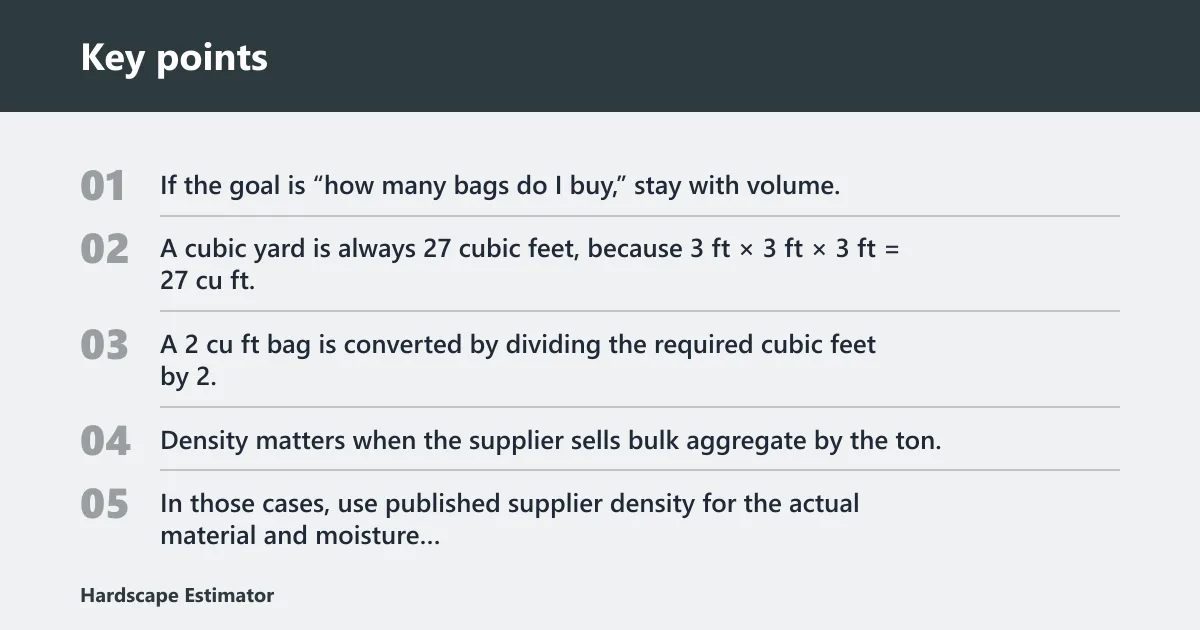
If the goal is “how many bags do I buy,” stay with volume. A cubic yard is always 27 cubic feet, because 3 ft × 3 ft × 3 ft = 27 cu ft. A 2 cu ft bag is converted by dividing the required cubic feet by 2. No density input is needed for that step.
Where density matters
Density matters when the supplier sells bulk aggregate by the ton, when a truck payload limit matters, or when the project spec calls for weight instead of volume. In those cases, use published supplier density for the actual material and moisture condition, not a generic number.
Moisture and yield risk
Moisture changes weight more than it changes the printed volume on a sealed bag. The practical risk for bag buyers is not that the factory-filled bag volume changed, but that damp soil or sand may place differently, settle differently, and lead to a slightly higher field demand than a dry, idealized estimate suggested.
Frequently asked questions
How many 2 cubic foot bags make a yard?
One cubic yard is 27 cubic feet, so 27 ÷ 2 = 13.5 bags by volume. Because bags are bought as whole units, the purchase quantity rounds up to 14 bags before any waste or settling allowance is added.
How many 3 cubic foot bags make a yard?
One cubic yard in 3-cubic-foot bags is 27 ÷ 3 = 9 bags. This one divides evenly, so the calculated result and the store purchase quantity are the same: 9 bags before any extra allowance for waste, grading loss, or compaction.
Should I round up when buying bags?
Yes. Bag counts are whole-number purchases, so any fraction must round up. The important detail is timing: add all required volume first, include the waste allowance, then round once at the final purchase quantity rather than rounding each intermediate step.
Does moisture change bagged material yield?
Moisture does not change the printed volume on a sealed bag, but it does affect density and can affect field behavior. Wet soil, sand, and similar materials may settle or place differently, which is why some jobs need more overage than a dry, ideal estimate suggests.
When should I buy bags instead of bulk?
Buy bags when the job is small, the site is hard to access, clean staging matters, or only part of a yard is needed. Buy bulk when the final volume, including overage, is large enough that handling many bags becomes less practical than delivery and loose placement.
How much extra bagged material should I buy for waste and settling?
A 10% planning allowance is a common default and fits many loose-fill or lightly leveled jobs. Move to 10% to 15% for leveled beds and 15% to 25% for compacted installs, uneven subgrade, or materials likely to settle after watering or traffic.