Can Grass Grow on Fill Dirt, or Do You Need Topsoil?
Grass can grow on fill dirt if the top about 2 to 4 in. are loosened, leveled, and seeded or sodded with enough organic material for rooting. Raw compacted fill dirt alone is a poor grass bed. Skip that finish layer and you risk thin turf, poor drainage, shallow roots, and wasted seed or sod. This guide shows when fill dirt is enough, when topsoil is better, and how to decide on a thin finishing layer.
Can grass grow on fill dirt?
Yes, grass can sometimes grow on fill dirt, but the result is usually weak unless the surface layer is workable for roots. Fill dirt is used to raise, fill, or reshape an area, while topsoil is the upper growing layer that supports grass and other plants. The key difference is not height alone; it is whether the top layer can support rooting, moisture, and nutrients.
What fill dirt does well
Fill dirt is the right material when the job is bulk and shape. It compacts into a stable, load-bearing base, so it works under lawns where the grade needs to be rebuilt or a low area needs depth. It is commonly sold by the cubic yard and is often made of lower-organic subsoil, which is why it is poor for plant growth at the surface.
Why topsoil is the better surface for roots
Topsoil is the organic-rich upper soil layer used for finish grade and landscaping. That matters because grass roots need a surface they can move through. If the top layer is dense, clay-heavy, or sealed off by compaction, seed can sprout poorly and sod may struggle to knit in.
Think of the lawn in two jobs: support below and growth above. Fill dirt can do the support job. Topsoil does the growth job. For lawn areas, use fill dirt to build up the low area, then finish with screened topsoil.
When fill dirt is enough
Fill dirt alone can be enough only when the existing soil already supports turf and the new material is not the main rooting zone. Shallow lawn dips are usually better suited to screened topsoil. Deep regrading is different: there, fill dirt is the base and topsoil is the finish layer.
Picture a 3 in. dip across a side yard that already has decent soil elsewhere. A screened topsoil patch can often correct the surface without rebuilding the whole profile. Now picture a low spot that drops 10 in. near a driveway edge. That usually needs fill dirt first, then a topsoil cap on top.
Do you need topsoil for grass seed or sod?
Usually, yes. Grass seed and sod both perform better with a workable rooting layer at the surface, and topsoil is the better finish material for that job. Seed needs contact with moist, fine material to germinate well. Sod needs close soil contact so the roots can bridge into the ground instead of drying in air pockets.
Grass seed and the need for a rooting layer
Seed can germinate on fill dirt if the surface has been loosened and improved, but seed alone on compacted fill dirt often wastes money. The seed may sprout in pockets, then dry out or stall because the roots hit a dense layer too quickly. A thin cap of screened topsoil gives the seed a more uniform place to root.
A common first-timer mistake is broadcasting seed onto rough fill and calling it done. The first rain can move the seed, and the next dry spell can leave it stranded on crusted soil. If the surface will be seeded, the top layer needs to be fine enough to rake smooth and hold moisture without sealing shut.
Sod and the need for close soil contact
Sod needs a smooth, even base with close contact under the roots. Loose pockets, stones, and uneven fill can leave air gaps that dry out the sod before it takes hold. A topsoil cap helps the sod sheet sit flat and root more evenly, especially over new grade.
That does not mean sod requires a deep soil layer everywhere. It means the upper few inches have to be suitable for contact and rooting. The finish layer is what matters most at installation.
Clay-heavy fill dirt at the surface
Clay-heavy fill dirt can be especially risky as the top layer because it seals up, sheds water slowly, and roots poorly. Even when grass grows at first, the turf can stay thin and stressed. That thin cover is easier to damage during heat, freeze-thaw cycles, or heavy rain.
- Check the existing surface. If the old soil already grows turf well, a shallow repair may only need a screened topsoil cap. If the area is a deep low spot or the fill is compacted and clay-heavy, plan on fill dirt below and topsoil above.
- Match the planting method. Seed needs a finer, moisture-holding surface than rough fill dirt can usually provide. Sod needs a smooth, tight contact layer so roots can knit in quickly.
- Leave room for settling. Build the grade with fill dirt in lifts, then finish with topsoil after compaction. That reduces the chance that the lawn sinks after the first season.
How much topsoil should go over fill dirt?
Most turf and planting areas only need a 4 to 6 inch topsoil cap. After yard grading projects, 4-6 inches of topsoil is typically recommended for lawn areas. That cap gives grass roots a better finish layer without using topsoil as structural fill. Thinner caps can work for shallow repairs, while thicker caps are useful when the subgrade is poor.
Typical cap depths
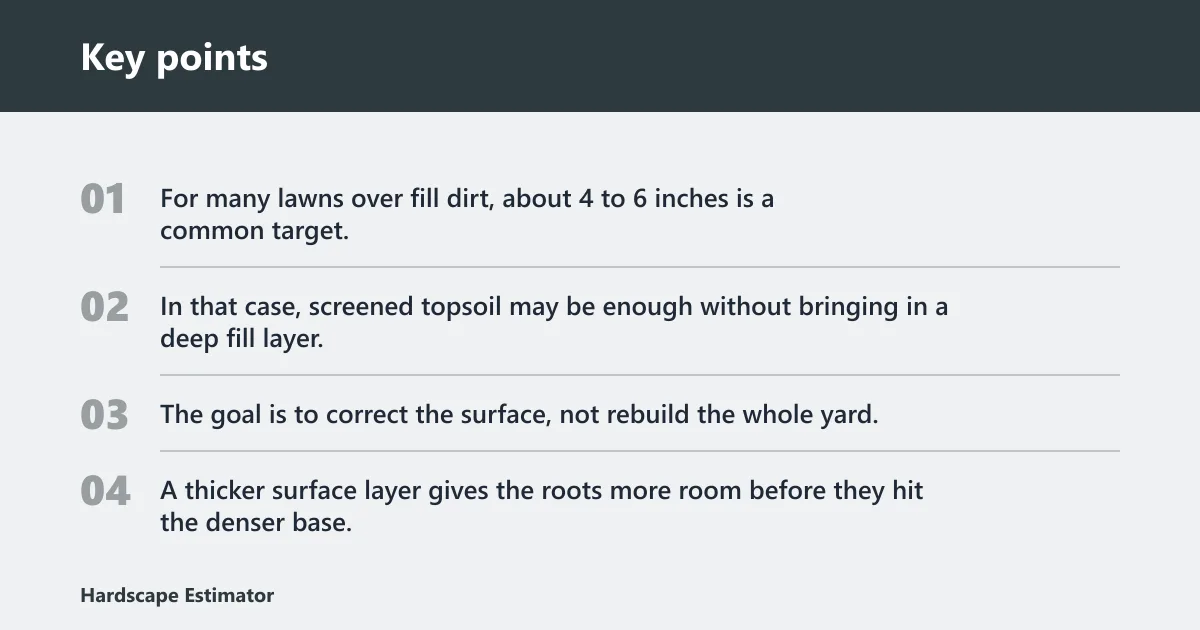
For many lawns over fill dirt, about 4 to 6 inches is a common target. That depth is enough to cover a stable base and provide a rootable surface. It also gives room for light settling without exposing the fill underneath.
| Situation | Recommended layer order | Topsoil cap depth | Compaction note | Likely risk if skipped |
|---|---|---|---|---|
| Existing soil okay | Prep existing soil, then seed or sod | 0 to 2 in. only if needed | Loosen the surface; do not overfill | Unnecessary fill can create settling or poor drainage |
| Shallow dip | Screened topsoil only, then seed or sod | 2 to 4 in. | Rake smooth and lightly firm | Using heavy fill can leave a hard patch and uneven grade |
| Deep low spot | Fill dirt below, then topsoil finish | 4 to 6 in. | Compact fill in lifts before topsoil | Without topsoil, grass roots stay weak and turf thins out |
| Seed-only repair | Lightly loosen soil, add screened topsoil, then seed | 2 to 4 in. | Keep the surface fine and even | Seed can dry out or wash away on rough fill |
| Sod over new grade | Fill dirt below, then screened topsoil, then sod | 4 to 6 in. | Firm the top so sod has close contact | Loose pockets can dry roots and slow establishment |
| Clay-heavy fill | Replace or cap with better material, then topsoil | 6 in. or more if the subgrade is poor | Break up compacted clay before final grading | Poor drainage, shallow roots, and winter heave damage |
When a thinner cap can work
A thinner cap can work when the existing soil is already close to lawn-ready and the issue is only a shallow dip or a small repair. In that case, screened topsoil may be enough without bringing in a deep fill layer. The goal is to correct the surface, not rebuild the whole yard.
When a thicker cap is worth it
A thicker cap makes sense when the fill below is coarse, compacted, or inconsistent, or when the yard needs a cleaner finish for sod. A thicker surface layer gives the roots more room before they hit the denser base. It also helps smooth out small height changes after rain and freeze-thaw cycles.
Fill dirt
Use fill dirt when the job is grade and volume. Use topsoil when the job is growth. For many lawn repairs, the right answer is both: fill dirt below, topsoil above. The choice depends on how much height must be added, how good the existing soil is, and whether the surface will be seeded or sodded.
Simple decision rule
If the area only needs minor correction and the existing soil still supports turf, topsoil alone may be enough. If the area needs real build-up, start with fill dirt and finish with screened topsoil. If the surface is going to carry sod or seed, do not stop at fill dirt unless the top layer is already loose, fine, and rootable.
- Measure the low area. Decide whether the repair is shallow or deep. Shallow dips usually point to topsoil only, while deeper fills need a compacted base first.
- Check the drainage path. Grade the surface so water moves away from the house and does not pool near the foundation. Good material choice still fails if the slope is wrong.
- Pick the finish layer. Use screened topsoil where grass will root. Save fill dirt for below-grade work and structural build-up.
- Compact the base in lifts. Place fill dirt in layers of about 6 to 8 inches and compact each lift before adding more. That reduces later settling and keeps the finish grade from dropping.
- Finish with lawn soil. Spread 4 to 6 inches of topsoil over the prepared base for most turf areas. Then seed or sod into the final layer, not into raw fill.
What goes wrong if you plant into compacted fill dirt?
Planting directly into compacted fill dirt usually leads to weak rooting, thin turf, and later settling. The problem often starts with poor contact between seed or sod and the soil below. Then the roots stay shallow, the lawn dries faster, and rain or winter weather can open cracks, low spots, or dead patches.
Compaction, poor rooting, and thin turf
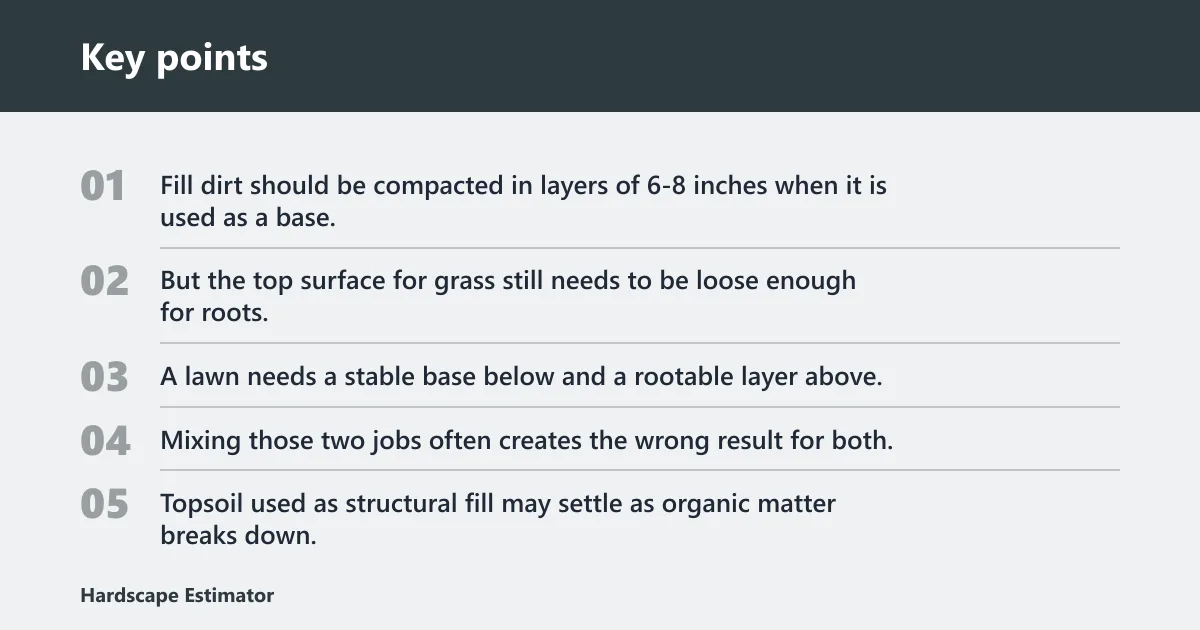
Fill dirt should be compacted in layers of 6-8 inches when it is used as a base. That makes it stable. But the top surface for grass still needs to be loose enough for roots. If the whole profile is tight and dense, the lawn can look acceptable at first and fail later because the roots never built depth.
Topsoil cannot meet compaction standards like ASTM D698 or D1557, and that is part of why it belongs at the surface, not as structural fill. A lawn needs a stable base below and a rootable layer above. Mixing those two jobs often creates the wrong result for both.
Settling after rain and winter damage
Topsoil used as structural fill may settle as organic matter breaks down. That can leave low spots, trip edges, or thin lawn cover. Fill dirt is better below grade because it compacts into a stable base. Once the base settles and the surface is finished with topsoil, the lawn is less likely to sink later.
Suppose a homeowner fills a 12 in. depression with loose topsoil and seeds it right away. The area may look fine for a short time, then settle after repeated rain. By the next season, the grass sits in a bowl that holds water and turns patchy. That is the failure sequence: compaction problems, poor rooting, thin turf, then weather damage.
Drainage problems near the house
Drainage matters as much as the dirt choice. If grade slopes toward the house, even good topsoil cannot fix the water problem. The surface should move water away from structures and avoid pooling near the foundation. Fill dirt can help build that slope, but the final lawn layer still has to support grass.
Frequently asked questions
How much topsoil should go over fill dirt for a lawn?
A common target is 4 to 6 inches of topsoil over the fill for lawn areas. That amount gives grass a usable growing layer without treating topsoil as structural fill. Thin repairs may use less, while poor subgrades may justify a thicker cap.
Can I plant grass directly into fill dirt?
You can, but it is usually a poor choice unless the top layer has been loosened and improved. Direct seeding or sodding on compacted fill often leads to weak roots and thin turf. A screened topsoil cap gives grass a much better surface to establish.
What happens if I seed grass on compacted fill dirt?
Seed often germinates unevenly, then stalls because the roots hit a dense layer too soon. The surface can crust over, dry out, or wash away after rain. Even when some grass comes up, the turf is usually shallow-rooted and more likely to fail later.
Should I use fill dirt first and topsoil on top?
Yes, for most deep lawn repairs or regrading jobs. Fill dirt should build the base and shape the yard, then topsoil should finish the surface where grass will grow. That stack gives you depth below and a workable rooting layer above, which is the right split for most lawns.