Which Could Cause Topsoil to Be Lost From Your Yard?
Rain runoff, wind over bare soil, compaction that keeps water moving across the surface, settlement, and buried leaks can all strip topsoil from a yard. If the loss comes back after rain, inspect drainage first. Ignoring the cause can turn a thin bare area into a rut, washout, or foundation drainage issue that costs much more than new fill. This guide gives the field signs, quick checks, and the fix for each cause.
Common causes of topsoil loss and erosion in a yard
Topsoil loss usually means one of two things: soil is being carried away, or the ground is shifting and making it look that way. The most common causes are erosion, runoff, compaction, poor drainage, settlement, buried pipe leaks, animal digging, and thatch that holds moisture at the surface.
The practical rule is simple. If the loss repeats after rain, treat it as a cause problem first, not a filling problem. Topsoil can level low areas in a yard, but it is not a one-pass fix for every spot.
Erosion and runoff
Erosion removes soil by moving it with water or wind. Runoff concentrates that water, so damage often starts where bare ground meets a slope, a downspout discharge, a driveway edge, or a low spot that catches flow. On sloped or exposed areas, the surface can change faster than a homeowner expects.
Sheet erosion can strip a thin layer evenly. Rills leave small channels. Washout is more severe and usually leaves clear flow paths. Those are different patterns, and they point to different fix sizes.
Compaction and poor drainage
Compaction squeezes the soil, so water tends to soak in more slowly. That can leave water sitting on the surface or moving sideways across it, which raises the chance of soil movement. Vehicles, repeated foot traffic, and repeated repair work are common causes.
Poor drainage can keep the ground wet long enough to soften the surface and move loose topsoil. It can also make a yard look uneven even when the soil has not gone anywhere. If the same area stays soft after rain, drainage deserves attention before any topdress.
Settlement and buried pipe leaks
Settlement can happen when disturbed soil, fill, or a repaired area sinks after excavation. It can return after a surface fix if the fill below is still settling. That is why a spot that keeps dropping is not the same problem as a shallow dip in the turf.
A broken buried pipe can do more than wet the area. It can create repeated washout, sinkage, or a soft spot that returns after rain or irrigation. When a low area keeps reappearing in the same place, buried utilities need to stay on the list.
Animal digging and thatch
Animal digging can leave loose soil, tunnels, and small collapses that feel like topsoil loss. The surface may look churned rather than washed. Burrowing pests can also create unstable edges that give way under a footstep or mower.
Thatch is not soil loss, but it can make a lawn look uneven and trap moisture at the surface. That can hide the true shape of the yard and keep the soil soft longer after rain.
How to tell if erosion is the cause
Erosion is likely when you can point to a path the soil followed. Look for bare streaks, exposed roots, small channels, or soil piled at the bottom of a slope. If the same area looks worse after each storm, runoff or wind is probably doing the moving.
The key is to separate surface removal from settling. If the ground is actually sinking, the fix is different. If soil is being carried downhill or blown away, refilling without source control only delays the next loss.
After-rain signs
After rain, check where water enters, speeds up, and exits the yard. Soil loss often shows up where a roof edge, a slope, or a hard surface funnels water into one line. You may see muddy water at the downhill edge, small rills, or soil washed into a drain or against a foundation.
- Walk the yard after rain. Look at the first 15 to 30 minutes after water stops falling if possible, then check again once standing water drains. That shows where flow concentrates, not just where water sits.
- Trace the flow path. Follow the wet line uphill to find the source. A thin stream that starts at a sidewalk edge or downspout can remove more soil than a broad sheet of rain.
- Mark the damage edges. Use flags, chalk, or stakes to mark where bare soil begins and ends. That makes it easier to decide whether the problem is one patch or a broader drainage pattern.
Dry-weather signs
Dry weather reveals the shape of the damage. Erosion often leaves exposed roots, a crusted surface, or a visible drop between bare ground and turf. Wind loss is more likely where the soil is loose, dry, and exposed with little plant cover.
Say your backyard has a 12 ft strip beside a fence and the soil disappears after every storm. If the same strip also has a shallow channel and a pile of fine dirt at the bottom, runoff is a stronger suspect than simple settling.
Slope, bare soil, and flow paths
Bare ground matters because it removes the cover that slows water and wind. A slope makes the problem easier to see, but even nearly flat yards can lose topsoil if water is forced into one path. The question is not only whether the yard slopes; it is whether water is being concentrated.
Can wind blow topsoil away from a yard? Yes. It is most likely on dry, bare, sandy, or newly disturbed soil with little turf cover. Wind loss is usually slower than storm runoff, but it can keep thinning the same exposed spot until the surface crust breaks and the soil starts moving faster.
Can poor drainage wash topsoil away?
Yes. Poor drainage can wash topsoil away when water cannot soak in and instead moves across the surface or stands long enough to soften the soil. The soil may not look like it was carried far, but repeated wetting and surface flow can still remove it from the same spot.
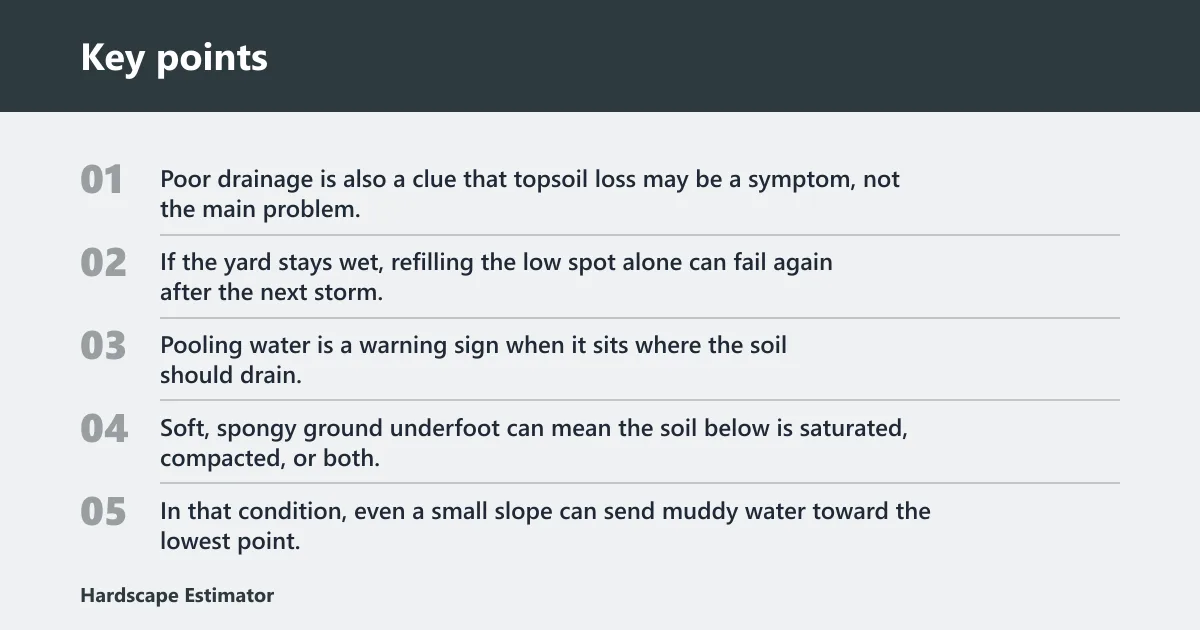
Poor drainage is also a clue that topsoil loss may be a symptom, not the main problem. If the yard stays wet, refilling the low spot alone can fail again after the next storm.
Pooling and soft ground
Pooling water is a warning sign when it sits where the soil should drain. Soft, spongy ground underfoot can mean the soil below is saturated, compacted, or both. In that condition, even a small slope can send muddy water toward the lowest point.
Compaction from vehicles or foot traffic can make this worse by reducing infiltration. Once the surface seals over, runoff increases and topsoil has less chance to stay put.
Where water exits the yard
Look at the exits, not only the low spot. Water often leaves through the same edge every time: a driveway opening, a curb cut, a drain inlet, a sidewalk seam, or the base of a slope. That exit point is where soil loss often becomes visible first.
If topsoil keeps washing into a drain or toward a foundation, the fix is to slow and redirect the water, not just add fill at the bottom. A thin patch can fail fast if the flow path stays open.
When grading is the real fix
When the ground sends water the wrong way, grading is the real fix. Surface topsoil cannot correct a yard that slopes toward the house, holds water in a basin, or channels runoff into one line. In those cases, soil depth is not the main issue.
A common first-timer mistake is to add soil to the low area before checking the edges and the outlets. That can bury a symptom while the drainage problem keeps working below the surface.
Does heavy rain or wind remove topsoil?
Yes. Heavy rain can remove topsoil by splash, sheet erosion, rills, and washout, while wind can remove loose soil from bare ground. The larger the exposed area and the more focused the flow, the faster the loss can happen.
Heavy rain is especially damaging when the yard already has bare spots, a slope, compacted soil, or a route that channels water. Wind is most effective when the surface is dry, loose, and uncovered.
Sheet erosion, rills, and washout
Sheet erosion is the removal of a thin layer across a broad surface. Rills are small channels cut by moving water. Washout is a larger failure where the flow has enough force to move a visible amount of soil, gravel, or mulch. (Wikipedia)
Those patterns matter because they tell you how much source control is needed. A sheet-erosion patch may respond to better cover and minor regrading. A washout usually needs the runoff path corrected first.
Wind loss on exposed soil
Wind does not need a storm to move soil. Dry, loose, exposed topsoil can drift from open areas, especially where turf is thin or newly disturbed. The loss may show up as a fine dusting against hard edges, not a deep hole.
That is why bare soil keeps getting worse. Once the surface is open, it dries faster, loosens more easily, and loses the plant cover that helps hold it in place.
What a sinking spot can mean
A sinking spot often means the yard is moving, not just losing surface soil. Settlement after excavation or fill, compaction from traffic, or a buried utility problem can all make the same area drop again after a repair. If the depression returns, topsoil alone is rarely the answer.
This is the point where repeated filling becomes a warning sign. The surface may look like a small dip, but the cause may be below it.
Settlement after fill or excavation
Settlement is common where soil was recently disturbed, filled, or repaired. It can continue after the first patch is placed because the material below is still settling. That is why a spot may sink again even after a careful topdress.
For deeper ruts, lifting the sod is recommended instead of burying the lawn. Shallow irregularities may be repaired with screened topsoil or a topsoil-based blend, but deeper depressions need a different approach.
Compaction from traffic
Repeated traffic can compact the soil and create uneven ground. Vehicles, wheelbarrows, repeated mowing patterns, or frequent foot traffic can all press the soil down and change how water moves across the surface.
Compaction is also a reason a low spot may hold water even when the surface looks firm. The soil can be hard and still drain poorly.
Buried utilities and voids
A leaking or broken buried pipe can cause a yard to sink or stay uneven. Irrigation, water, or sewer line failure can also create soft, wet, or hollow-feeling ground. If a sinkhole-like spot appears near a utility run, the surface should not be treated as a simple cosmetic dip.
Suppose a 6 ft by 4 ft patch near a hose bib suddenly softens after irrigation runs. If the edges slump and the same area keeps sinking, that pattern points away from a shallow topdress and toward a buried problem that needs diagnosis first.
Topsoil loss diagnostic table
This table helps separate the cause from the symptom. Use it after rain if possible. The field signs matter more than the visual size of the low spot.
| Cause | What you will see after rain | What you will see in dry weather | Quick homeowner check | When to call a pro |
|---|---|---|---|---|
| Erosion | Soil moved downhill, muddy streaks, rills, bare patches | Exposed roots, thin turf, scoured surface, soil piled downslope | Follow the flow path from high to low ground | When the slope keeps shedding soil or the washout is expanding |
| Runoff | Water runs in one line, pools at the bottom, carries soil into drains | Visible channels, hard crust, repeated bare strip | Check where roof water, pavement, or slope water enters the yard | When water reaches a foundation, drain, or neighboring property |
| Compaction | Water sits on the surface or moves sideways instead of soaking in | Hard soil, thin turf, uneven growth, footprint or tire marks | Push a screwdriver or probe into the soil to compare resistance | When a large area stays sealed and regrading or aeration is needed |
| Settlement | Low spot reappears after repair or after rain | Sunken patch, edge separation, soft fill over a hollow | Check whether the spot is near a recent repair, trench, or fill area | When the same area keeps dropping or a void is suspected |
| Poor drainage | Standing water, muddy surface, soil softening over time | Persistent dampness, mossy or weak turf, uneven wet patches | See how long water remains after rain ends | When grading, drains, or soil structure need correction |
| Broken buried pipe | Sudden sinkage, localized washout, very wet spot, repeating collapse | Damp ground without rain, unexplained soft area, lush strip over the leak | Shut off irrigation and note whether the area still gets wet | When a utility leak or sewer issue is possible |
| Animal digging | Fresh loose soil, holes, tunneling, disturbed turf | Uneven ground, open burrows, unstable edges, thin patches | Look for entry holes and mounded spoil around the spot | When burrows are active, widespread, or near structures |
| Thatch | Surface looks bumpy and holds moisture | Cushiony feel, trapped water, uneven turf height | Measure the spongy layer at the turf base | When thatch is thick enough to block water movement or mask the grade |
Should you add topsoil or fix the cause first?
Fix the cause first when the spot keeps returning, stays wet, or shows signs of runoff, settlement, or a buried leak. Add topsoil only after you know the ground is stable and the water path is under control. Topdressing is useful for minor irregularities, not for recurring sinkage.
The depth matters too. Topdressing is suggested for less than about 1 inch of variation. Roughly 1 to 3 inches may require staged filling or spot repair. More than roughly 3 inches points to deeper reconstruction or regrading.
When shallow topdressing is enough
Shallow irregularities may be repaired with screened topsoil or a topsoil-based blend. Use that only when the area is stable, drains properly, and does not keep sinking. The goal is to level a minor dip, not to hide a moving problem.
F1 through F13 together point to the same decision rule: topsoil can help, but depth, native soil, turf condition, and the source of the low spot all matter. Poor initial preparation can also lead to uneven yards, so a new repair should not be assumed to be correct just because it is fresh.
When to stop and regrade
Stop and regrade when the surface keeps collecting water, the slope sends flow toward the wrong place, or the low spot is larger than a simple patch. A yard with major slope should not be treated as a simple topsoil patch.
- Measure the depth. Use a straight board and tape measure across the low area. Compare the dip to the surrounding grade so you know whether it falls under less than about 1 inch, roughly 1 to 3 inches, or more than roughly 3 inches.
- Check the water path. Inspect after rain and note where water enters, pools, and leaves. If the flow route crosses the spot every time, fixing the path matters more than filling the hollow.
- Match the repair to the cause. Use shallow topdressing for minor irregularities only. If settlement, drainage, or a buried leak is present, correct that problem before any surface fill.
When to call a pro
Call a pro when the same area keeps sinking, when a buried pipe may be involved, or when water is reaching a foundation, drain, or neighboring lot. That is also the right call if the soil keeps disappearing uphill, downhill, or at the edge of hardscape and the cause is not obvious.
What should you check before filling a low spot with topsoil? Look for rainwater flow, soft ground, exposed roots, burrows, recurring sinkage, and any sign of a leak or grading problem. If the cause is still active, the fill will likely fail again.
Frequently asked questions
What could cause topsoil to be lost from your yard?
Topsoil can be lost from a yard by erosion, runoff, wind, compaction, poor drainage, settlement, buried pipe leaks, animal digging, and thatch-related moisture problems. The cause depends on where the soil disappears, when it happens, and whether the spot keeps returning after rain.
Does poor drainage wash topsoil away?
Yes. Poor drainage can leave water sitting on the surface or moving across it, and that can carry topsoil away. If the same area stays wet, soft, or muddy after rain, drainage is probably part of the problem and may need grading or drainage correction.
Can heavy rain cause topsoil loss?
Yes. Heavy rain can trigger sheet erosion, rills, and washout, especially on slopes, bare ground, and compacted soil. The risk is higher when water is funneled into one path or when the yard has little plant cover to slow the runoff.
Can wind blow topsoil away from a yard?
Yes. Wind can move dry, loose topsoil from bare or newly disturbed areas. It is most noticeable where turf is thin, the soil is sandy or dusty, and there is little cover to hold the surface in place.
Will a leaking pipe make soil disappear from my yard?
Yes. A leaking or broken buried pipe can create recurring wet spots, sinkage, or washout. If the same area keeps dropping or stays wet without rain, the surface repair should wait until the leak is ruled out or fixed.
When is topsoil loss really a grading or drainage problem?
It is usually a grading or drainage problem when water keeps flowing toward the same low spot, pooling does not clear, or the yard sends runoff toward a drain or foundation. In that case, the surface loss is a symptom, and the slope or drainage route needs correction first.