How Many Extra Pavers Should You Keep for Future Repairs?
Keep about 5% to 15% of the pavers as a repair reserve, with a common minimum of about 10 to 20 pieces for small projects. Ten percent is a solid middle ground, but simple layouts often need less. Too few spares make a cracked unit harder to replace cleanly, and a partial replacement can cost more than the stock you saved.
How many spare pavers should you keep?
For many patios and walks, about 5% is enough if the layout is simple, the paver line is still in stock, and only a few future replacements are likely. Use about 10% when you want a safer reserve for breakage, cut loss, and routine repairs. Move to about 15% when the color, finish, or pattern is harder to match.
When 10% is enough
Ten percent fits a standard installation with a current product line, a common color, and a pattern that does not create many visible patch boundaries. It also leaves room for broken pieces during the job, a few precise angle cuts, and later repairs without forcing a color search.
When to hold more than 10%
Keep more than 10% when the pavers have a special finish, the batch is limited, or the pattern makes patches easy to spot. Herringbone, basket weave, and running bond can all be repaired, but the less common the layout and color, the more spare pieces matter. Long straight runs should be limited to about nine feet, and four corners should not meet at the same point.
A common first-timer mistake is treating spare pavers as project waste only. The better rule is to think of them as a repair reserve, because future breakage, cut-loss allowance, and batch or color match risk all rise after the patio is already in use.
Repair reserve table
This table converts common order sizes into spare-paver counts at 5%, 10%, and 15%. Use the column that fits your risk level, then round up to the next whole paver. If you are ordering by square feet, convert the total paver count first and then apply the reserve.
| Total pavers ordered | 5% reserve | 10% reserve | 15% reserve | Which reserve level fits best? |
|---|---|---|---|---|
| 100 | 5 | 10 | 15 | 5% for simple, current-stock jobs; 10% for average repair risk; 15% for limited colors or hard patterns |
| 200 | 10 | 20 | 30 | 5% for easy replacement matching; 10% if some cuts or breakage are likely; 15% if the product may age out |
| 500 | 25 | 50 | 75 | 5% for large, standard runs with ongoing supply; 10% for most residential projects; 15% for long-term maintenance stock |
| 1,000 | 50 | 100 | 150 | 5% if the same batch is secure; 10% for a balanced reserve; 15% when the site will need phased repairs over time |
| 2,000 | 100 | 200 | 300 | 5% for high-volume commercial stock that will stay standardized; 10% to cover routine maintenance; 15% for exposed or discontinuation-prone projects |
Which reserve level fits each risk case?
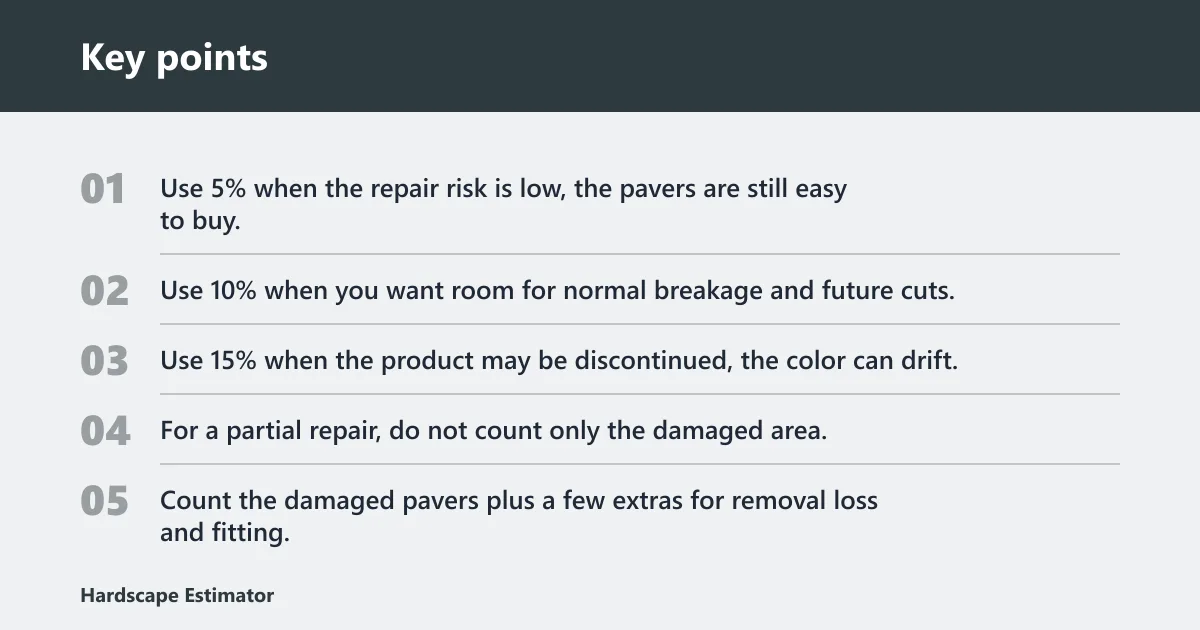
Use 5% when the repair risk is low, the pavers are still easy to buy, and the pattern is forgiving. Use 10% when you want room for normal breakage and future cuts. Use 15% when the product may be discontinued, the color can drift, or the finish must match closely in a visible area.
How to read the table for partial repairs
For a partial repair, do not count only the damaged area. Count the damaged pavers plus a few extras for removal loss and fitting. If the patch crosses a border, curve, or odd angle, the cut-loss allowance rises fast. That is why a small repair can still justify a reserve of 10 or more pieces.
Say your patio needs 240 pavers total. A 5% reserve is 12 pavers, 10% is 24, and 15% is 36. If the project is a plain rectangle with a current product line, 12 may be enough. If the finish is special and the supplier warns of limited stock, 24 or 36 is safer.
Should you keep pavers from the same pallet?
Yes, when you can. Keeping spare pavers from the same pallet or batch gives the best chance of matching color, texture, and edge profile later. Replacement matching gets harder as the surface wears, the dye lot shifts, and the original stock ages in sun, rain, and freeze-thaw cycles.
Batch and color match risk
Even interlocking pavers with built-in spacers can look different from one batch to another. Small tone shifts may be hard to see in a new stack, then obvious once the replacement sits beside weathered units. Save pieces from the same pallet whenever possible, especially for lighter colors and smooth-face finishes.
Why old stock can look different
Older pieces can fade, collect surface wear, and change slightly after frost exposure. That does not mean they fail structurally. It does mean a fresh replacement may stand out in the field, especially near the edge of a patio where the eye catches contrast. Discontinued pavers create the same problem, only faster.
What to save when you buy extra
Save a mix of full units and any clean cut pieces that could be reused in future patches. Keep enough full pieces for visible spots and a few cuts for border work. If the project includes a matching edge or accent row, keep spares from that section too, because those units are often the hardest to replace cleanly.
What makes a repair match harder?
Pattern choice, age, and movement all affect how a repair blends in. Herringbone, basket weave, and running bond are common interlocking layouts, but each one puts different visual stress on a patch. As the patio settles and the surface weathers, replacement work becomes more visible if the saved stock is thin.
Pattern sensitivity in herringbone, basket weave, and running bond
Herringbone is often the most forgiving in high-use areas because the interlocking layout handles movement well. Basket weave can also work well, but its repeated blocks make a patch easier to spot if the color match is off. Running bond is simple, yet long straight lines can draw attention to any replacement section.
Wear, fading, and frost exposure
Older pavers may not match new stock even when the product name is the same. Sun exposure, dirt, and freeze-thaw cycling can alter the face enough that a fresh piece looks cleaner or brighter. That is why spare stock should be kept in a way that limits fade, staining, and edge damage.
Replacement fit in interlocking pavers
Interlocking pavers rely on consistent spacing, not loose fit. Their built-in spacers help keep joints even, but a replacement still has to sit within the same base and sand system. If the base has moved, the repair may reveal the spot even when the color match is close.
How should you store spare pavers?
Store spare pavers so they stay dry, labeled, and physically intact. Keep them out of sun, soil, and repeated moisture swings. A good storage setup protects both appearance and fit, so the pieces are still usable when a repair comes up months or years later.
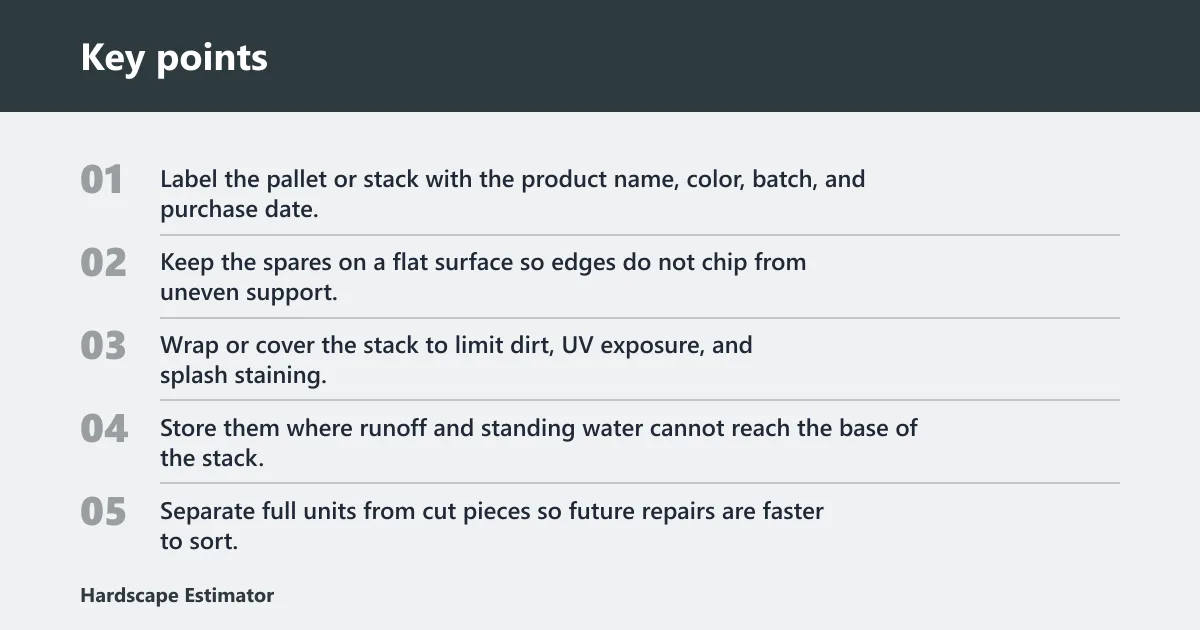
- Label the pallet or stack with the product name, color, batch, and purchase date.
- Keep the spares on a flat surface so edges do not chip from uneven support.
- Wrap or cover the stack to limit dirt, UV exposure, and splash staining.
- Store them where runoff and standing water cannot reach the base of the stack.
- Separate full units from cut pieces so future repairs are faster to sort.
- Check the stack once in a while for moisture, pests, or broken corners.
Keep them dry and stable
A dry, stable location matters more than a perfect indoor room. Pavers can tolerate storage, but they should not sit in mud, under a leaking eave, or where rain and drying cycle through the stack. Those swings can stain faces and weaken the chance of a clean match later.
Protect the corners and faces
Edge chips are a common reason spare units get rejected later. Stack them flat, do not lean them against a wall, and avoid sliding one piece across another. If the pavers have a textured face, keep grit off the surface so the saved units do not abrade while stored.
Picture a 250 sq ft walkway with a simple running bond layout. If the owner keeps 25 spare pavers in a labeled bundle and stores them dry, a future patch can often be done with fewer visible changes than if the repair starts with mixed leftovers from different corners of the yard.
What if the pavers are discontinued?
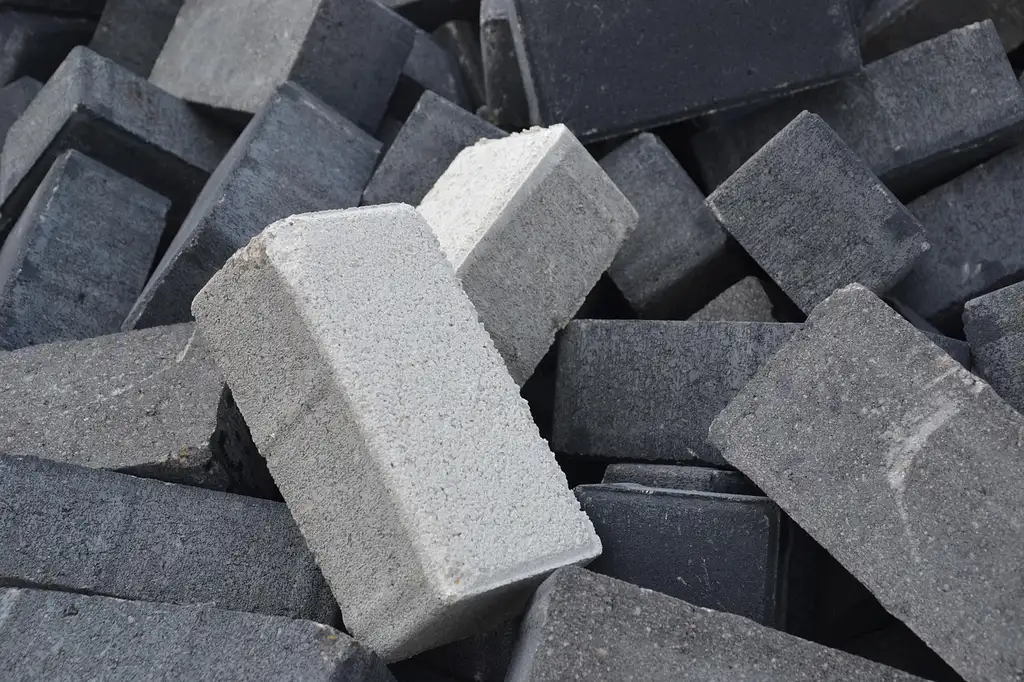
If the pavers are discontinued, the value of saved stock goes up. Plan for limited future supply by keeping more of the original batch, especially pieces that will sit in the center of the field or along a visible edge. Use the best-matching units where the eye is most likely to notice them.
Plan for limited future stock
Once a line is discontinued, matching becomes a moving target. Color drift, wear, and batch differences can all show up at once. In that case, a 15% reserve is often safer than 5% or 10%, because the reserve is no longer only for breakage; it is also for match quality.
Use saved pieces where visibility matters most
Keep the cleanest and most consistent pieces for the most visible repairs, such as the middle of a patio or the front edge near a door. Less visible zones can sometimes accept a near match better than the main field. That strategy helps stretch limited stock without making the repair look patched from across the yard.
When to call a supplier or installer
If the product is discontinued and the repair area is large, contact a supplier or installer before removing the damaged section. A replacement plan may need a mix of saved pieces, alternate stock, or a redesigned patch area. That is especially true when the existing base has movement or when a new section must blend with older weathered pavers.
Frequently asked questions
How many extra pavers should I keep for repairs?
Keep 5% to 15% extra, depending on how hard the pavers will be to match later. For many standard projects, 10% is a good middle level. Small jobs may only need 10 to 20 pieces, while discontinued colors or complex patterns justify a larger reserve.
Should I store pavers from the same pallet for future replacements?
Yes. Same-pallet stock gives the best chance of matching color, texture, and surface wear. Batch differences, fade, and frost-weathering can make a later purchase look different even when the product name is the same. Label the saved stack so you know where it came from.
How many replacement pavers do I need for a patio?
Start with the total paver count for the patio, then add a reserve based on risk. For a 200-paver patio, 5% is 10 spares, 10% is 20, and 15% is 30. If you expect future cuts or a hard-to-match color, move upward.
Is 10% extra paver waste enough for repairs later?
Often yes, but not always. Ten percent is a reasonable middle ground for breakage, cut loss, and routine repairs. It may be too much for a simple, current-stock layout and too little when the pattern is sensitive, the color is limited, or the line may be discontinued.
What paver patterns are most likely to need spare pieces kept?
Herringbone, basket weave, and running bond all benefit from spare stock, but the need is strongest when the layout is visible and the pattern repeats over a large field. Herringbone is generally forgiving in use, yet color mismatch still stands out if the repair pieces are scarce.
How should I store leftover pavers so they stay usable?
Keep them labeled, flat, dry, and protected from sun and dirt. Stack them so the corners do not chip, and separate clean full units from cut pieces. The goal is simple: preserve the batch, the finish, and the edges so the spares can still blend later.
Can I use the same batch of pavers years later for repairs?
Yes, if the stored pieces are still in good shape. The batch match will usually be closer than a new purchase, but the repair can still show if the old field has faded or worn. Store the batch carefully and expect some color drift over time.
What if my pavers are discontinued when I need a replacement?
Use saved pieces first, especially in visible areas. If the reserve is short, contact a supplier or installer before patching so the repair plan can account for limited stock, color drift, and the existing pattern. A small visible mismatch is easier to avoid than to hide after the fact.
Repair planning basics
Extra pavers matter most when the original base and bedding layers were built correctly. Patios and walkways typically use a 4 to 6 inch base depth, while driveways and parking areas typically use a 6 to 10 inch base depth. Weak soil or heavy rainfall can require another two to four inches of base material.
The base should not vary more than about one-eighth of an inch in height. The bedding sand layer should be around one inch thick and screeded before the pavers are set. Use crushed gravel instead of dirt for the base, because dirt can shrink by as much as 30 percent over time. A plate compactor should compact the base with horizontal and vertical passes.
Those support layers do not change the spare-paver rule, but they change how often repairs are needed. A stable base means fewer lifted edges, fewer broken units, and less chance that the saved pieces will be needed early.