How Much Does a Cubic Yard of Gravel Weigh in a Pickup?
A cubic yard of dry gravel usually weighs about 2,800 to 3,000 lb, so it often exceeds a half-ton pickup’s payload even if it fits in the bed. Overloading can strain tires, suspension, and brakes, and it can put the truck over its legal payload rating. This guide shows bed fit, the door-sticker check, and when to haul half a yard instead of one.
Cubic yard gravel weight
One cubic yard of gravel does not have one fixed weight. A practical range is 2,400 to 3,000 lb per cubic yard, which is about 1.2 to 1.5 short tons. The exact number depends on stone type, moisture, and how tightly it is packed.
Typical pounds per cubic yard
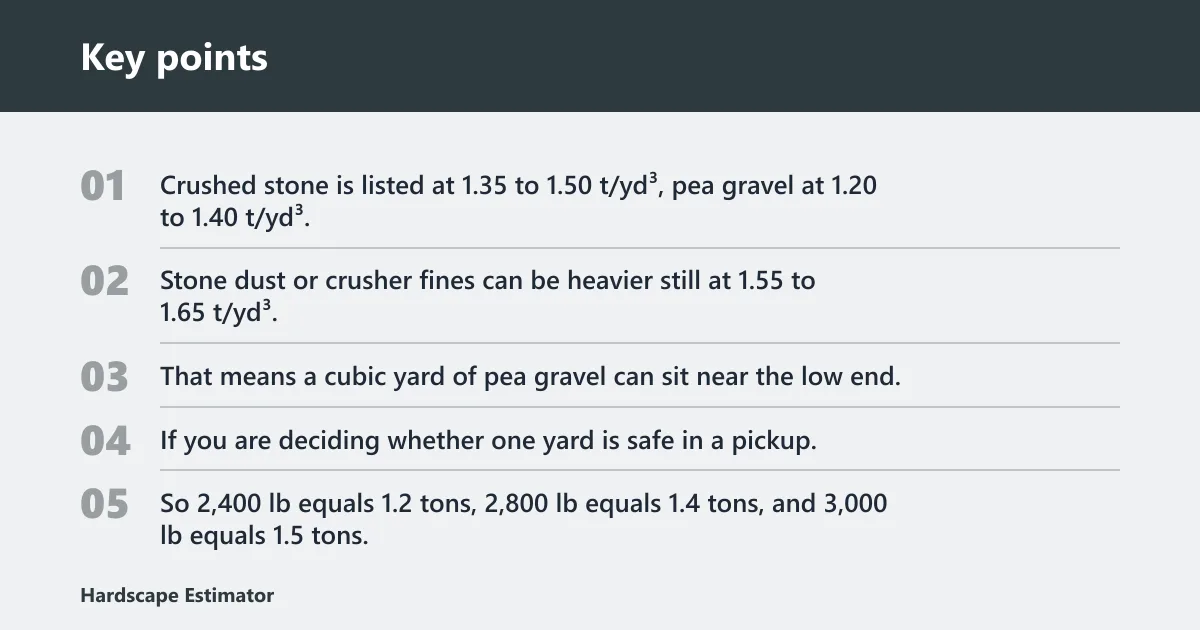
Different products land in different ranges. Crushed stone is listed at 1.35 to 1.50 t/yd³, pea gravel at 1.20 to 1.40 t/yd³, river rock at 1.25 to 1.45 t/yd³, and dense grade or road base at 1.45 to 1.60 t/yd³. Stone dust or crusher fines can be heavier still at 1.55 to 1.65 t/yd³.
That means a cubic yard of pea gravel can sit near the low end, while road base and crusher fines can push above 3,000 lb per yard. If you are deciding whether one yard is safe in a pickup, the product name matters as much as the volume.
Short ton conversion
A short ton is 2,000 lb. So 2,400 lb equals 1.2 tons, 2,800 lb equals 1.4 tons, and 3,000 lb equals 1.5 tons. For a quick estimate, one cubic yard of gravel is usually around 1.2 to 1.5 short tons. (Wikipedia)
What changes the weight
Wet gravel weighs more. Packed gravel weighs more in the same space. A wet, tightly packed load can weigh more than a loose, dry load of the same product. Supplier density is the better number when available, because quarry names and product blends vary.
YardCalc notes that there is no universal gravel density. It also gives the calculation used on this page: pounds = cubic yards × 27 × density in pounds per cubic foot. That is why a volume estimate is exact from measurements, while weight depends on the material itself.
Will one yard fit?
One cubic yard can fit by volume in many full-size pickup beds, but fit by volume is not the same as safe hauling. Short beds, standard beds, and long beds can all swallow roughly a yard of loose material, yet payload often becomes the limiting factor before bed space does.
Short bed vs long bed
Bed dimensions decide whether a cubic yard can sit in the truck, not whether the truck can carry it safely. A typical full-size short bed may hold close to one cubic yard by volume, while a standard bed or long bed may hold more. That extra space does not increase payload capacity.
Tailgate-down hauling does not raise legal or safe capacity. It may change how far the pile sticks out, but it does not change the door-sticker payload rating, the axle limits, or the strength of the suspension and tires.
Why tailgate-down is not a capacity fix
Some loads look manageable only because part of the pile hangs out of the bed. That does nothing for the truck’s legal payload. It can also shift more weight behind the rear axle, which hurts stability and braking. The truck still carries the same mass.
Picture a half-ton pickup with a short bed and a 1,500 lb payload sticker. A full cubic yard of road base at roughly 2,900 to 3,200 lb is too heavy, even if the bed can physically hold it. Splitting the order is the safer move.
Pickup payload check
Use the door-sticker payload rating, not the marketing label on the tailgate or brochure. GVWR is the truck’s maximum gross vehicle weight rating; payload is what you can add on top of the empty truck, including passengers, fuel, tools, and the gravel itself. The sticker wins every time.
GVWR vs payload
GVWR is the maximum allowed weight for the whole truck. Payload is the difference between that maximum and the truck’s ready-to-work curb weight. The same model line can have different payload ratings because cab size, engine choice, bed length, and 4WD change curb weight.
A crew cab, heavier engine package, and 4WD can reduce payload compared with a regular cab, lighter engine, and 2WD version of the same pickup. That is why two trucks that look alike may have very different sticker numbers on the driver-side door jamb.
How to read the sticker
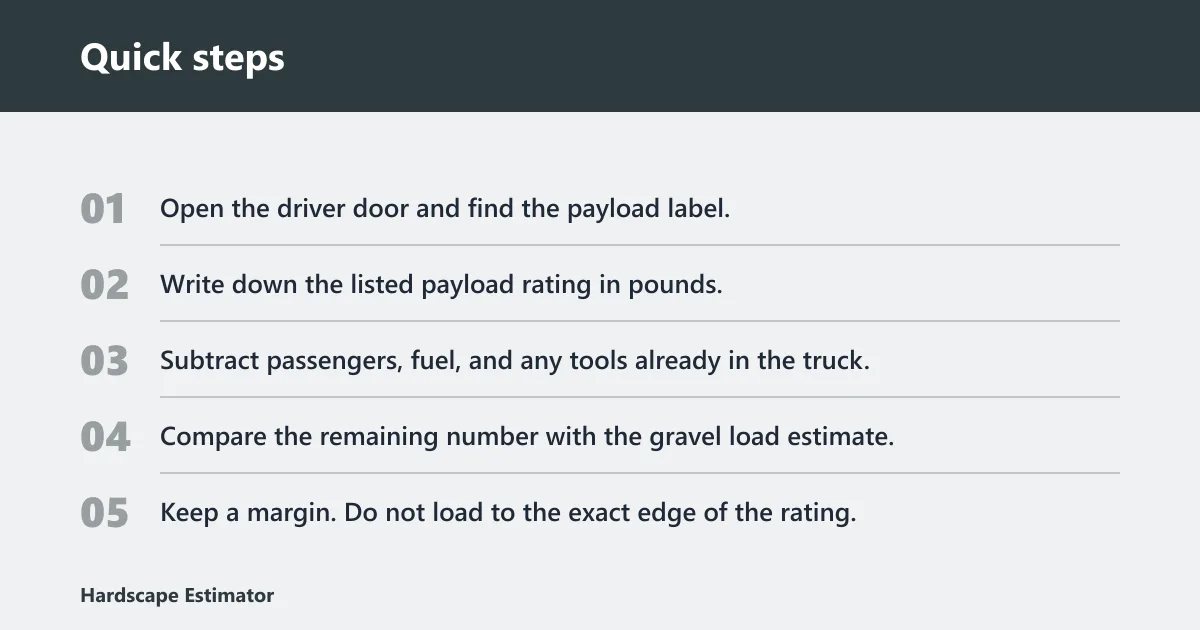
- Open the driver door and find the payload label.
- Write down the listed payload rating in pounds.
- Subtract passengers, fuel, and any tools already in the truck.
- Compare the remaining number with the gravel load estimate.
- Keep a margin. Do not load to the exact edge of the rating.
Use the smaller number after the subtraction. If the sticker says 1,650 lb and the cab already carries 250 lb of people and gear, the remaining safe capacity is not 1,650 lb. It is about 1,400 lb before the gravel goes in, and less if the truck is already carrying other items.
Pickup gravel load table
This table uses the common density ranges above and a simple safety test: a load should fit by bed volume and stay under the available payload rating with a margin. The “recommended max fraction” below is a conservative haul fraction for a pickup whose remaining payload is about 1,500 lb after passengers and fuel.
| Pickup bed size | Cubic yards | Estimated pounds | Fits by volume? | Fits by payload? | Recommended max fraction of a yard |
|---|---|---|---|---|---|
| Short bed | 1.0 | 2,400–3,000 | Usually yes | Usually no for half-ton trucks | 0.4–0.6 yd |
| Standard bed | 1.0 | 2,400–3,000 | Usually yes | Depends on payload sticker | 0.5–0.7 yd |
| Long bed | 1.0 | 2,400–3,000 | Usually yes | Depends on payload sticker | 0.6–0.8 yd |
| Short bed | 0.5 | 1,200–1,500 | Yes | Often yes on many half-ton trucks | 0.5 yd |
| Any full-size bed | 1.0, road base | 2,900–3,200 | Usually yes | Usually no for half-ton trucks | 0.4–0.5 yd |
This is a load check, not a promise. The table assumes the truck still has to carry people, fuel, and tie-down gear. If your payload sticker leaves less than about 1,500 lb available, one full yard of most gravel products is too much.
Suppose your truck has a 1,700 lb payload sticker and two adults plus fuel already use about 300 lb of that rating. That leaves about 1,400 lb available. That could work for about half a yard of crushed stone, but not for a full yard of dense grade or crusher fines.
Does wet gravel weigh more?
Yes. Wet gravel weighs more than dry gravel, and compaction can push the weight higher again. Water fills the gaps between stones and adds mass. That means a yard that seems fine on paper can get heavier after rain or when the pile is packed tightly at the quarry.
When supplier numbers matter most
Supplier-provided density matters most when you are close to the payload limit. A quarry may use a product name that does not match another quarry’s blend. If the supplier lists a density or tonnage figure, use that number instead of assuming all “road base” or all “pea gravel” weighs the same.
Eartheasy gives a useful check for volume planning: a 10 ft by 10 ft area at 2 inches needs about 0.62 cubic yards, or roughly 0.85 tons. That kind of estimate helps you see why small surface jobs often fit in a pickup while a full yard can push weight limits fast.
How much can a half-ton haul?
A half-ton label is not enough to answer this safely. Some half-ton trucks have payload ratings high enough for a light half-yard load, while others are already nearly full after passengers and fuel. The door sticker, not the badge, tells the real answer.
Why half-ton labels are not enough
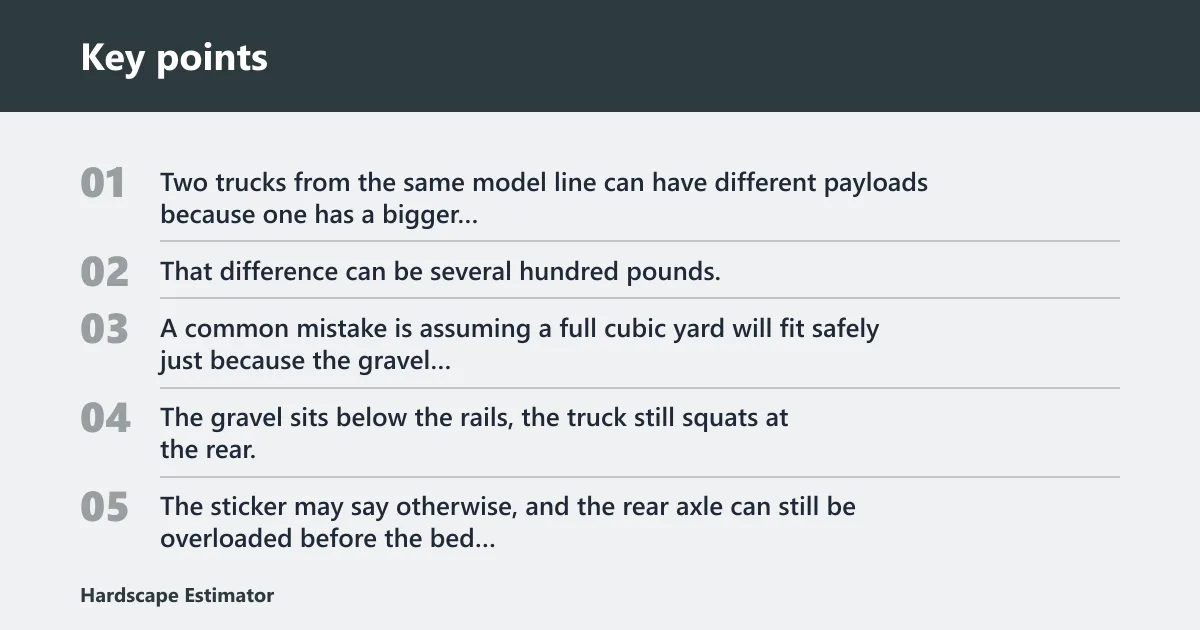
Half-ton pickups vary widely. Two trucks from the same model line can have different payloads because one has a bigger cab, a heavier engine, or 4WD. That difference can be several hundred pounds, which is enough to turn a safe half-yard into an overload.
A common mistake is assuming a full cubic yard will fit safely just because the gravel sits below the top of the pickup bed. The gravel sits below the rails, the truck still squats at the rear, and the driver assumes the setup is fine. The sticker may say otherwise, and the rear axle can still be overloaded before the bed looks full.
Should you haul gravel in one trip or split the load?
Split the load when one yard exceeds the remaining payload after passengers, fuel, and gear are counted. Split it if the truck is a short-bed half-ton, if the product is dense road base or crusher fines, or if the gravel is wet. One extra trip is cheaper than an overload.
Keep the load centered over the axle, spread it evenly side to side, and do not pile material above the bed rails unsafely. Rear axle loading, stability, and braking all worsen as the pile gets heavier and taller. A lower, even load is easier to control.
Frequently asked questions
How much does a cubic yard of gravel weigh in a pickup?
Always check the door sticker first.
Will one cubic yard of gravel fit in my pickup bed?
Often yes by volume in a full-size pickup, especially a standard bed or long bed. But volume is only half the check. A cubic yard can fit in the bed and still be too heavy for the truck’s payload rating, rear axle, or tires.
How many tons is a cubic yard of gravel?
Using 2,000 lb per short ton, one cubic yard of gravel is usually about 1.2 to 1.5 short tons. The exact number depends on the product. Pea gravel is lighter than dense grade or crusher fines, and wet material weighs more than dry material.
How much gravel can a half-ton pickup carry safely?
There is no single safe answer for every half-ton pickup. Use the door-sticker payload rating, then subtract passengers, fuel, and gear. Many half-ton trucks can carry only part of a yard safely, and some cannot safely carry a full yard of dense gravel at all.
How do I compare gravel weight to my truck payload sticker?
Start with the payload number on the driver-side door label. Subtract everything already in the truck, then compare the remaining pounds with the gravel estimate. A cubic yard of gravel is commonly 2,400 to 3,000 lb, so a full yard may exceed the leftover payload quickly.
Does wet gravel weigh more than dry gravel?
Yes. Water adds weight, and tighter packing raises it further. A wet load of the same gravel can weigh enough to move a truck from “close” to “over limit.” If the quarry stockpile is damp or compacted, use the supplier’s density instead of a dry estimate.