Paver Base vs Gravel: What Is the Difference?
Paver base is the structural layer, and it is commonly made from 3/4-inch crushed stone or a manufactured base material. Gravel is often used as a drainage layer, and rounded gravel is generally not a good choice for compaction. Using the wrong one can leave pavers settling, rocking, or draining poorly, which means callbacks, rework, and edge failure. This guide compares how each material compacts, what to order for a patio or walkway, and where each one fails.
| Decision factor | Paver base | gravel | Winner |
|---|---|---|---|
| Load bearing | High | Low | Paver base |
| Compaction | High, especially with angular particles and fines | Low | Paver base |
| Drainage | Good | Excellent | gravel |
| Shape stability under pavers | Locks together well | Can shift more easily | Paver base |
| Best use case | Patios, walkways, driveways | Drainage-focused layers and light-duty areas | Paver base |
Paver base vs gravel: the core trade-off
The short answer is structural support versus drainage. Paver base carries load and stays put after compaction. Gravel lets water move through, but rounded stone does not lock together as tightly under pavers.
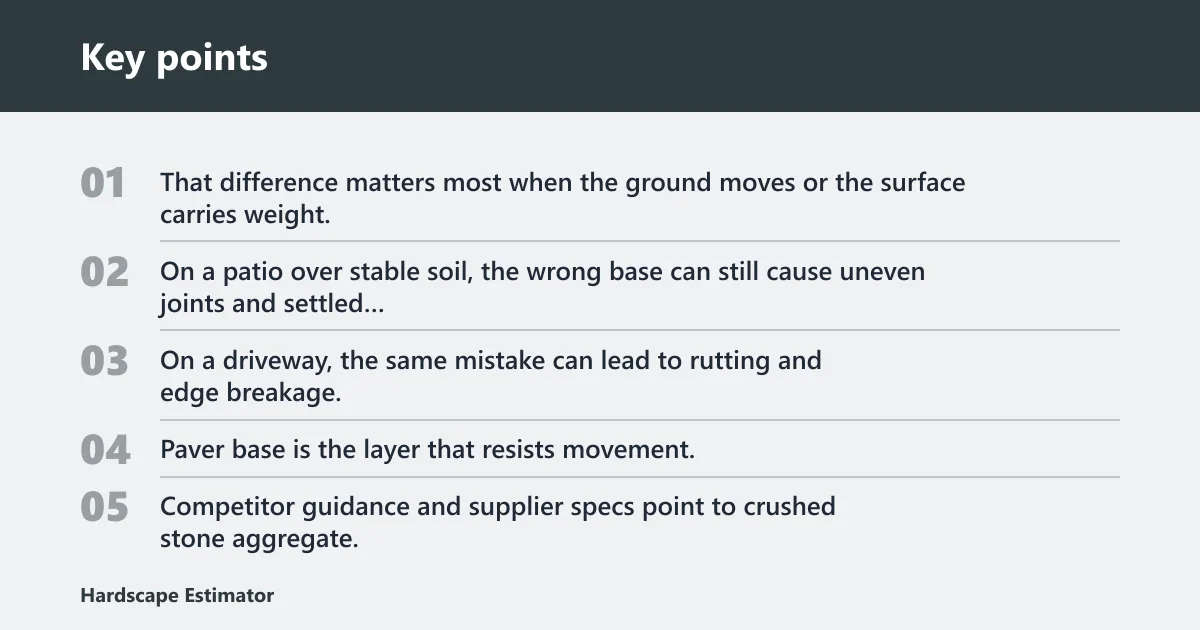
That difference matters most when the ground moves or the surface carries weight. On a patio over stable soil, the wrong base can still cause uneven joints and settled corners. On a driveway, the same mistake can lead to rutting and edge breakage.
Structural support versus drainage
Paver base is the layer that resists movement. Competitor guidance and supplier specs point to crushed stone aggregate, usually graded from 3/4 inch down to fine particles, because the angular shape and fines help the layer compact into a firm mat.
Gravel moves water well, and that is its main advantage. But if the stones are rounded and clean, they do not interlock as well, so the surface can shift under repeated foot traffic or vehicle loads.
What the wrong choice usually does to a patio
A common first-timer mistake is treating any rock under pavers as the same thing. Say your 12×16 patio sits on rounded gravel over clay soil; the joints may look fine at first, then a corner starts to dip after a wet season because the layer never locked up.
Another common failure is using stone that is too large. Most professionals recommend 3/4-inch crushed stone for paver bases, and stones larger than 1 inch often fail to compact evenly. Stones below 1/2 inch may settle too much under weight.
What counts as paver base?
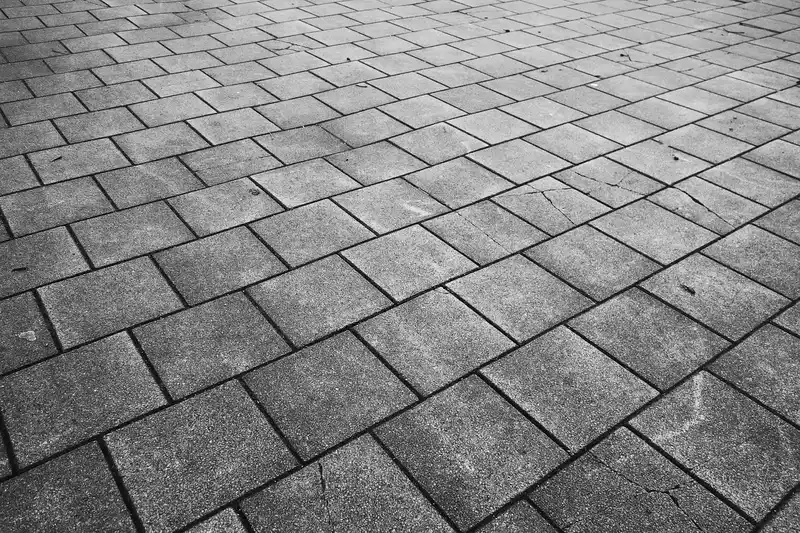
Paver base is the structural layer under the bedding sand and pavers. It is usually crushed stone or aggregate designed to compact, carry load, and drain water away from the finished surface.
In practice, that means the supplier product matters more than the word “gravel.” Some products are crushed and graded for compaction; others are rounded and sold mainly for drainage or decorative use.
Crushed stone and base rock
Crushed stone is the standard paver base material because angular particles lock together. A comparison chart from supplier material pages describes base rock as having high load bearing and high compaction, while gravel has low load bearing and low compaction.
That is why “base rock,” “crushed stone,” and “paver base” are not interchangeable with rounded gravel. The same truckload label can mean very different performance under a paver system.
Why 3/4-inch crushed stone is common
Most professionals recommend 3/4-inch crushed stone for paver bases. One source also calls it 3/4 minus, which means the pile includes smaller particles and fines that help the layer compact.
That size range suits patios and driveways because it balances stone size, drainage, and compaction. Larger stones leave more voids. Smaller material can settle too much if it is too fine and not graded correctly.
Where 3/4 minus fits
3/4 minus is useful when the installer wants a base that tightens up under a plate compactor. The fines fill the gaps between larger particles, so the layer becomes denser than clean, rounded gravel.
That does not make it a sand replacement. It is still the base layer, while sand above it is only the bedding layer that sets the pavers to the final elevation.
Crushed stone vs rounded gravel
The key difference is particle shape. Angular crushed stone resists movement and packs tightly. Rounded gravel drains well but shifts more easily when loaded or compacted in place.
Interlock and load bearing
Angular particles create more contact points. That is why crushed stone is described as the better base rock choice: it forms a denser, more stable layer under pavers, especially when compacted in lifts.
Rounded gravel has less mechanical lock. It can work in drainage areas, but it is a weak choice as the main structural layer for patios, walkways, or driveways.
Drainage and water movement
Gravel’s advantage is permeability. Water moves through it quickly, which helps in spots where drainage matters more than stiffness, such as a free-draining sublayer or a wet edge detail.
That said, drainage alone does not make a good base. On frost-prone soil, water movement helps, but the system still needs a compacted base that resists seasonal heave and settlement.
Compaction by layer
Layer-by-layer compaction is where crushed stone pulls ahead. The fines in a minus product help each lift tighten under the compactor, while rounded gravel tends to roll and shift instead of locking solidly.
That is why the same depth can perform very differently depending on material shape. A compacted 3/4 minus base is not the same as a loose bed of rounded stone.
What goes above the base layer?
Above the base goes the sand bedding layer, not more base stone. The sand sets the pavers to final height and helps with fine adjustment, but it does not replace the structural function of the base.
Sand bedding layer basics
Competitor installation guides commonly place the bedding sand at about 1/2 to 1 inch thick. Its job is to provide a smooth setting bed for the pavers, not to carry the load.
When the bedding layer gets treated like the base, the system loses stiffness. That often shows up as wobble, uneven edges, or joints that open after traffic and rain.
Why sand is not the base
Sand is too fine to act as the main support layer. It can settle and migrate, especially if it is asked to do the work that belongs to compacted crushed stone.
Use sand to bed the pavers after the base is already built and compacted. Do not use it as a substitute for structural aggregate.
Common layer order under pavers
- Prepare and grade the subgrade.
- Add the compacted paver base in lifts.
- Screed the bedding sand.
- Set the pavers.
- Lock the joints according to the system used.
Paver base decision matrix
The right pick depends on project type, soil, and load. For most hardscape work, crushed stone is the default structural choice. Gravel is better reserved for drainage-focused areas or light-duty uses where compaction is not the main goal.
| Project type | Soil condition | Load | Best pick | Why |
|---|---|---|---|---|
| Patio | Well-drained, stable | Foot traffic | Paver base | Needs a compacted structural layer under bedding sand |
| Walkway | Clay or mixed fill | Foot traffic | Paver base | Clay moves with moisture and needs more stability |
| Driveway | Stable but wet-prone | Vehicle load | Paver base | Loads and turning forces demand high compaction |
| Drainage strip beside a patio | Wet area | Light | gravel | Permeability matters more than structural stiffness |
When crushed stone is the right call
Choose crushed stone when the pavers must stay level under repeated use. That covers most patios, nearly all driveways, and many walkways where the base has to resist settlement and edge movement.
If the soil is clay, frost-prone, or prone to moisture swings, the choice gets even clearer. A compacted angular base is the safer default because it holds shape better after wetting and drying cycles.
When gravel may work as a drainage layer
Choose gravel when the main goal is water movement, not structural support. It can make sense in a drainage trench, behind retaining features, or in a layer that is not carrying the paver system itself.
It is still a poor choice as the main base under loaded pavers. Gravel may drain well, but a paver surface needs stiffness first.
How much paver base do you need?
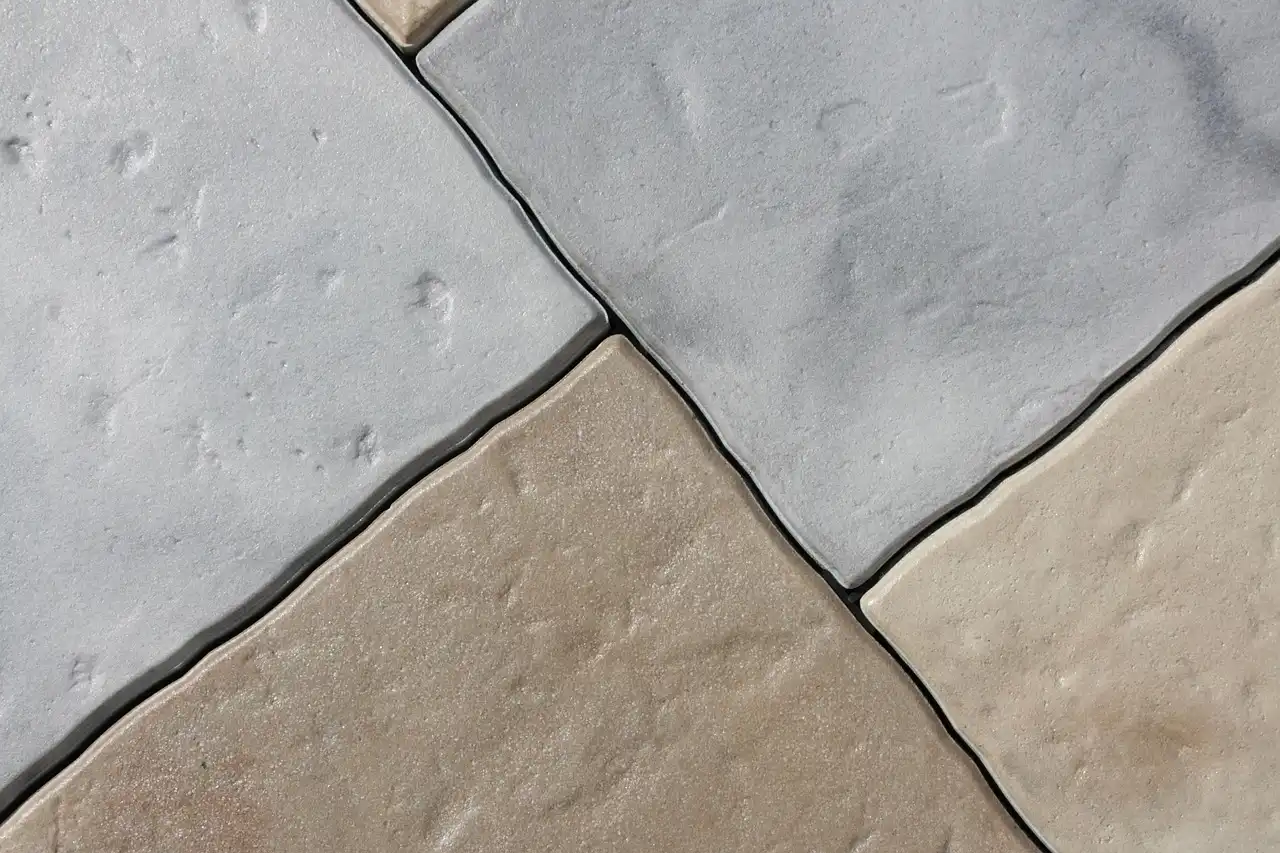
Use the finished patio size and the base depth to estimate volume, then convert that volume into cubic yards and tons. For the common 10×10 patio example, a 4-inch base uses 100 sq ft × 4/12 ft = 33.3 cu ft, or about 1.23 cu yd before compaction allowance.
| Patio size | Base depth | Cubic feet | Cubic yards | Approx. tons of crushed stone | Approx. tons of rounded gravel |
|---|---|---|---|---|---|
| 10×10 ft | 4 in | 33.3 | 1.23 | 1.8 to 2.0 | 1.6 to 1.8 |
| 10×20 ft | 4 in | 66.7 | 2.47 | 3.6 to 4.0 | 3.2 to 3.6 |
| 12×12 ft | 4 in | 48.0 | 1.78 | 2.6 to 2.9 | 2.3 to 2.6 |
Cubic yards from patio size
Multiply area in square feet by depth in feet, then divide by 27. A 10×20 patio at 4 inches deep is 200 × 0.333 = 66.7 cubic feet, which converts to 2.47 cubic yards.
That math matters because base stone is often sold by the ton, while some suppliers quote by the yard. Getting the wrong unit can leave the job short.
Tons from cubic yards
The tonnage depends on material density, so ordering by ton requires a supplier check. For estimating, crushed stone and rounded gravel do not weigh the same per cubic yard, so the ton count changes even when the volume is identical.
That is why the table lists ranges. The exact number should be confirmed with the yard or supplier before ordering.
Crushed stone versus rounded gravel ordering differences
Crushed stone often compacts more tightly than rounded gravel, so a delivered yard may finish differently after compaction. That does not mean you should order less base; it means the installed thickness should be checked after each lift.
If the base is a 3/4 minus product, expect the fines to reduce voids. Clean rounded gravel may look full in the truck but still leave more open space in the bed.
Choose Paver base if… / Choose gravel if…
Choose Paver base if the surface needs to carry foot traffic, vehicle loads, or repeated use on clay or frost-prone soil. Choose gravel if the goal is drainage first and the layer is not the main structural support under pavers.
Choose Paver base if…
Use it for patios, walkways, and driveways where compaction matters. Use it when the base must stay stiff after wet weather, seasonal movement, or turning loads.
It is the safer choice when a supplier lists 3/4-inch crushed stone or 3/4 minus as the base material. That is the material class most often used for paver systems.
Choose gravel if…
Use it where water movement matters more than structural lock and the surface load is light. It fits drainage details, not the main paver foundation layer.
Do not use pea gravel as a paver base. Its rounded shape shifts too easily, so it does not give the compacted support that pavers need.
Frequently asked questions
What is the difference between paver base and gravel?
Paver base is the structural layer under pavers, usually crushed stone or aggregate that compacts well. Gravel is often rounded natural aggregate and is valued more for drainage than for load bearing. Under pavers, that difference shows up as stability versus movement.
What is a paver base?
A paver base is the compacted foundation layer under the bedding sand and pavers. Most professionals use 3/4-inch crushed stone, and one common source also calls it 3/4 minus. The point is to create a firm, drainable layer that supports the surface.
What type of gravel should you use for a paver base?
If the goal is a true paver base, use angular crushed stone rather than rounded gravel. Most professionals recommend 3/4-inch crushed stone for paver bases. That size compacts more evenly than larger stone and holds shape better than rounded material.
Can you use gravel instead of paver base?
Not as the main structural layer under pavers. Rounded gravel drains well, but it does not compact into a stable base the way angular crushed stone does. It may suit a drainage layer, but not as a substitute for the foundation.
Paver base panels vs gravel base: which should you use?
Paver panels can help with drainage and speed of installation, but they do not replace the need to match the base to the load and soil. For a patio or driveway, a compacted crushed stone base is usually the safer structural choice. Panels may fit light-duty drainage details better.
Can you use pea gravel for paver base?
No. Pea gravel is rounded and tends to shift too easily, so it is generally not suitable for the interlock and compaction needed under pavers. It may look tidy, but it is not a substitute for crushed stone base material.