Why Bagged Stone and Soil Weights Vary by Moisture
Bag count for a given volume does not change. Bagged soil or stone can weigh much more or less as moisture changes, often by several pounds per bag. Ignore that and you can under-plan truck payload, pay too much for freight, or miss storage and lifting limits. This guide shows how moisture changes pounds per bag, what that means for hauling, and how to estimate material by volume instead of wet weight.
Why bagged material weighs more when wet
Wet material weighs more than dry material because water adds mass while the bag volume stays fixed. A 1 cu ft bag still holds 1 cu ft whether it is dry, damp, or saturated. The bag count for a project does not change, but the pounds carried by each bag can shift a lot with moisture.
Why suppliers publish approximate weights
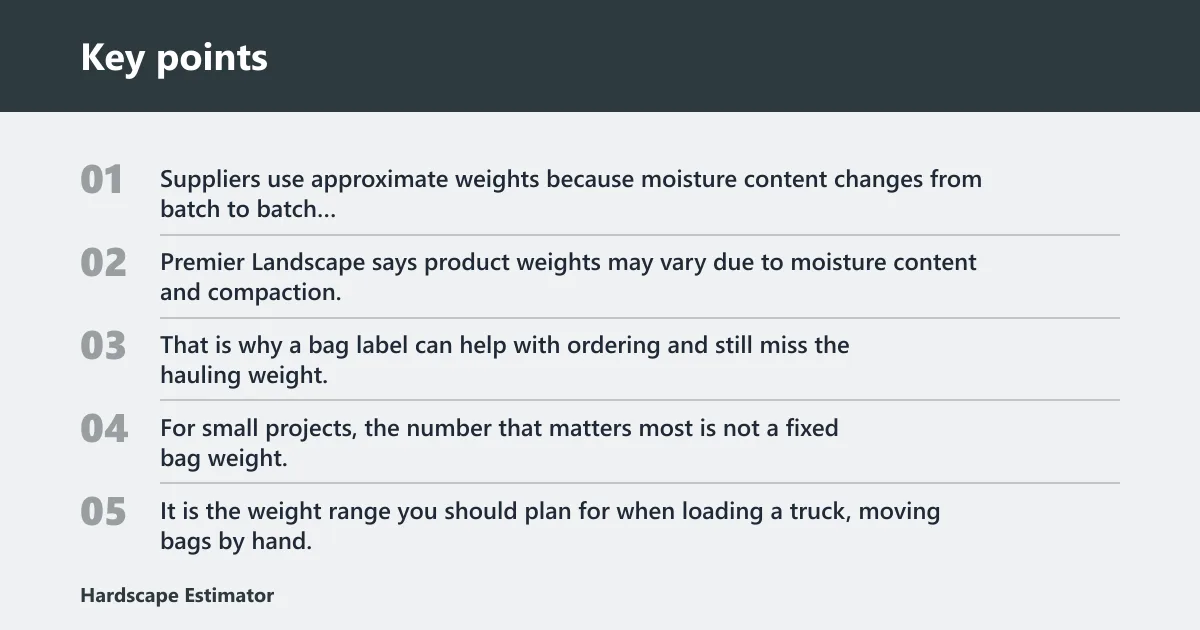
Suppliers use approximate weights because moisture content changes from batch to batch and even from one day to the next. Premier Landscape says product weights may vary due to moisture content and compaction, and also due to material size and natural product variation. That is why a bag label can help with ordering and still miss the hauling weight.
For small projects, the number that matters most is not a fixed bag weight. It is the weight range you should plan for when loading a truck, moving bags by hand, or storing bags after delivery.
How soil moisture is measured
Labs report soil results on a dry weight basis because wet weight varies with moisture. The dry mass of the soil particles stays constant, while water changes the total. Soil moisture content can be expressed several ways, and the choice affects whether a number describes the sample itself or the water carried in it.
Dry weight basis and wet weight basis
On a dry weight basis, water is compared to the oven-dry soil mass. On a wet, or as received, basis, the water is compared to the total wet sample mass. A sample can read very differently depending on which basis is used, which is why moisture notes matter on supplier sheets and lab reports.
Gravimetric water content
Gravimetric water content is the mass of water divided by the dry mass of soil. Written as a formula:
Gravimetric water content = (wet mass − dry mass) ÷ dry mass
If a dry soil sample weighs 10 lb and the wet sample weighs 12 lb, the gravimetric water content is 2 ÷ 10 = 0.20, or 20%.
Volumetric water content and relative water content
Volumetric water content compares the volume of water to the total sample volume. Relative water content compares current water content to the water content at full saturation, so it is useful when tracking how close a soil is to its maximum water-holding state. These terms are not the same, and they are not interchangeable.
Soil bulk density is the bridge between moisture and pounds per cubic foot or cubic yard. Bulk density is dry soil mass per unit volume, so it lets you move from a moisture ratio to a hauling weight. The same volume can weigh more or less as water fills pore space or drains away.
Why topsoil changes weight the most
Topsoil changes weight the most because it contains organic matter, pore space, and fine particles that hold water differently from stone. Dry topsoil can be light enough for one loading plan, then rise quickly after rain. Ottr lists dry screened topsoil at about 2,000 pounds per cubic yard and moist topsoil at about 2,200 to 2,400 pounds per cubic yard.
Dry, moist, and saturated topsoil
Weighopedia says dry loose dirt generally weighs between 2,000 and 2,200 pounds per cubic yard. It also says wet topsoil can rise to 3,000 pounds per yard or more. The same source says saturated soils can push topsoil and fill dirt weight 20 to 30 percent above summer baseline. That is a large swing for a material that still occupies the same cubic space.
Organic matter lowers density, so two 1 cu ft bags labeled topsoil can feel different even before rain enters the picture. A darker, peat-heavy blend may weigh less than a mineral-heavy blend at the same volume. Once water is added, the gap can widen because the water fills pore space and clings to fine particles.
Why rain can push weight up fast
Rain adds water to pore space, coats the particles, and raises the total wet weight. For topsoil, that can happen fast because the material can absorb and hold water rather than simply shedding it. The same bag can feel normal one day and heavy the next, even though the label volume has not changed.
Say your delivery sits on wet ground overnight. The bags may still contain the same volume of material, but the shells, seams, and exposed top layer can carry extra water. That is a hauling and lifting issue, not a bag-count issue.
Why stone and sand still vary by moisture
Crushed gravel or stone is heavier than soil, but it still changes weight with moisture. The same source lists crushed gravel or stone at about 2,800 to 3,200 pounds per cubic yard. The change is usually driven by surface water and trapped moisture between particles, not absorption the way soil behaves.
Stone behaves differently from soil
Stone does not soak up water the same way soil does. Instead, water sits on the surface, fills voids between particles, or remains trapped in the load after rain or washing. That means the weight jump often comes from carried water, not from the stone itself becoming heavier in the same way a wet soil mass does.
Holm-Products says aggregates are denser, with 1 cubic meter weighing 1,500 to 2,000 kg. That matches the general pattern: stone is dense, but its wet weight can still move with moisture and compactness. Finer material and tighter packing usually increase payload per volume.
Sand can shift too
Sand holds water between grains, so its weight changes with drainage and surface moisture. It does not usually swing as dramatically as a peat-heavy topsoil blend, but it can still surprise someone who expects a dry-yard number to match a damp delivery. Material size and natural variation matter here as well.
Compactness matters because tighter packing reduces air space and can increase the mass in a given bucket, tote, or bag. That is why the same nominal volume can weigh differently after settling, vibration, or rain exposure.
Moisture adjustment table
This table gives a practical way to think about added pounds per 1 cu ft bag. The bag count stays the same. Only the carried weight changes. Use the dry row for indoor storage or freshly bagged stock, and use the damp or wet rows when bags have sat outside or been rained on.
| Condition | 1 cu ft bagged topsoil | 1 cu ft bagged gravel | 1 cu ft bagged sand | Use this when |
|---|---|---|---|---|
| Dry | About 74 to 81 lb, based on 2,000 to 2,200 lb per yd³ | About 104 to 119 lb, based on 2,800 to 3,200 lb per yd³ | Use supplier bag weight or dry fill estimate; expect a lower carry weight than damp stock | Materials stored under cover or just delivered and dry |
| Slightly damp | Add about 5 to 10 lb per bag | Add about 3 to 8 lb per bag | Add about 4 to 8 lb per bag | Light surface moisture, cool storage, or short outdoor exposure |
| Rain-exposed | Add about 10 to 20 lb per bag | Add about 8 to 15 lb per bag | Add about 8 to 15 lb per bag | Bags sat outside in rain or on wet ground |
| Saturated | Use a buffer of 20 to 30 percent above dry baseline | Use a buffer for trapped water and surface runoff; check each bag by hand | Use a buffer for water held in the pile or bag seams | Water has soaked in, pooled, or the bag has been exposed for long enough to hold significant water |
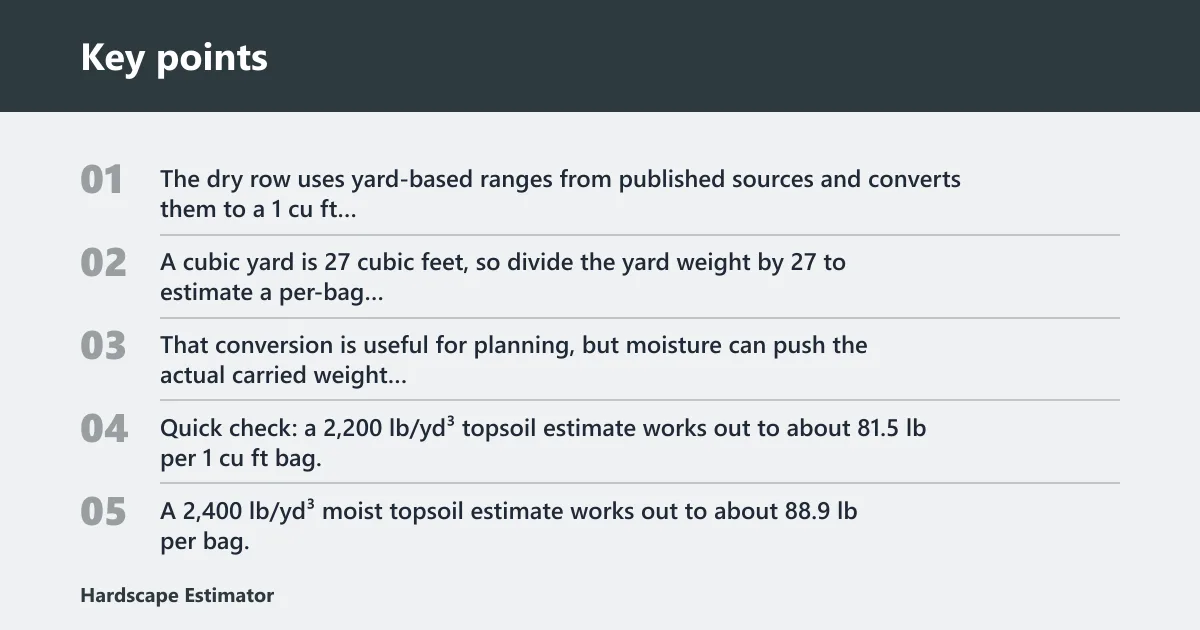
The dry row uses yard-based ranges from published sources and converts them to a 1 cu ft bag. A cubic yard is 27 cubic feet, so divide the yard weight by 27 to estimate a per-bag weight for a 1 cu ft bag. That conversion is useful for planning, but moisture can push the actual carried weight above or below the dry estimate.
Quick check: a 2,200 lb/yd³ topsoil estimate works out to about 81.5 lb per 1 cu ft bag. A 2,400 lb/yd³ moist topsoil estimate works out to about 88.9 lb per bag. The bag still holds 1 cu ft either way.
Does moisture change yards to bags math?
Moisture does not change the yard-to-bag count, because that conversion is a volume conversion. One cubic yard is 27 cubic feet. If a project needs 9 cubic feet of fill, it still needs 9 one-cubic-foot bags whether the bags are dry or wet. Moisture changes weight, hauling load, and handling, not the number of bags needed for the volume.
How to estimate bag weight when the bags are damp
Start with the supplier’s approximate dry or nominal weight, then add a moisture buffer if the bags feel damp, were stored outside, or were delivered after rain. If the bags are only slightly damp, a small buffer is usually enough. If they were soaked or sat in standing water, plan for a much larger change and check the truck’s payload limit before loading.
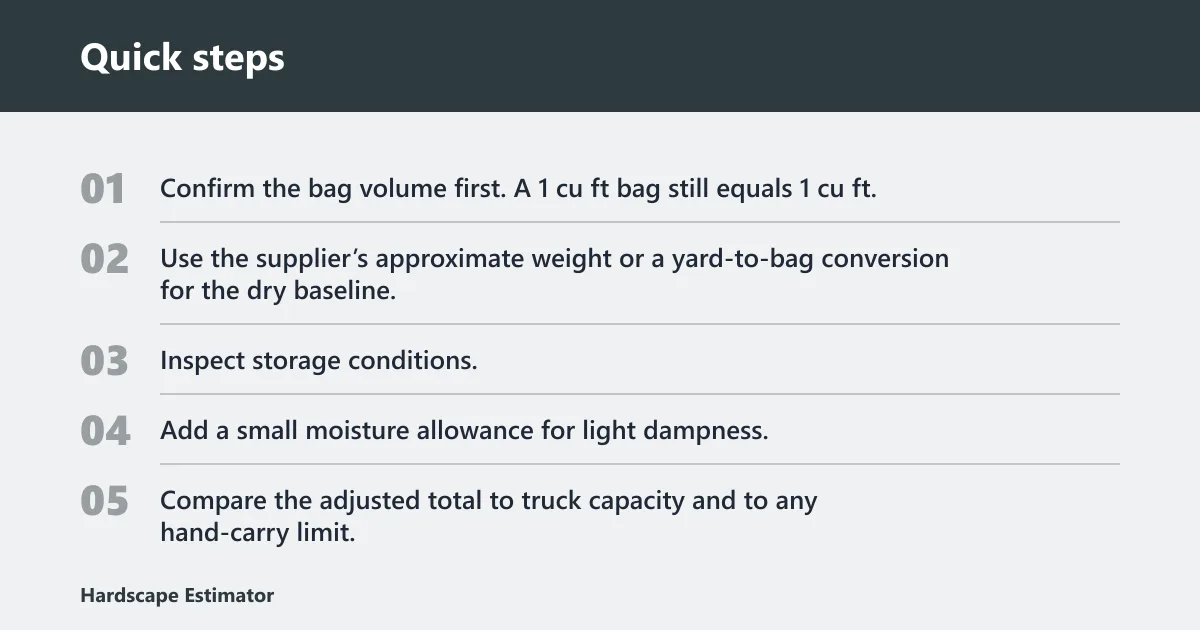
- Confirm the bag volume first. A 1 cu ft bag still equals 1 cu ft.
- Use the supplier’s approximate weight or a yard-to-bag conversion for the dry baseline.
- Inspect storage conditions. Dry cover, damp ground, or direct rain exposure changes the likely buffer.
- Add a small moisture allowance for light dampness, or a larger allowance for rain exposure.
- Compare the adjusted total to truck capacity and to any hand-carry limit.
A common first-timer mistake is to multiply the bag count by the dry weight and stop there. That works only when the material is dry enough that the moisture difference is minor. If the bags are outside after a storm, the total load can move enough to matter on a small pickup or when carrying bags up steps.
Another common mistake is to treat a bag label as a fixed pound value. Bulk bags and 1 cu ft bags hold a volume, not a fixed density. Suppliers therefore give approximate weights, and the final number shifts with water content, compactness, and material type.
When to add a truck buffer
Add a buffer whenever the load is close to the truck’s rated payload, when bags were stored outside, or when the load includes wet topsoil. The safest choice is to plan the trip with moisture in mind instead of hoping the wet weight will land near the dry estimate. That matters most with topsoil and other fine materials that can carry more water.
When hand-carry loads need a safety check
Hand-carry becomes less reliable when the bags are heavy enough that lifting posture changes or the carrier must stop often. Moisture makes that more likely. If a bag feels much heavier than expected, move fewer bags at a time and check the total before assuming the wet weight is still manageable. For stone and sand, the issue is often repeated lifts rather than a single huge spike.
Frequently asked questions
Why do bagged soil and stone weigh more after rain?
Rain adds water to the bag, the seams, or the material itself. Soil can absorb and hold more water, while stone mainly carries surface water and trapped moisture. The bag volume stays the same, but the wet weight rises, sometimes enough to matter for hauling and lifting.
How much can moisture change the weight of bagged topsoil?
Moisture can change topsoil weight a lot. The same source says wet topsoil can rise to 3,000 pounds per yard or more, so a 1 cu ft bag can gain several pounds quickly.
Why does the same bag feel different from one day to the next?
The bag may contain the same volume, but the water inside and on the outside can change overnight. Soil can hold water in pore space, while stone and sand can hold water between particles or on the surface. That changes the carrying weight even when the bag count for the project stays fixed.
Does wet soil change bag count or just weight?
It changes weight, not bag count, when the required volume is unchanged. A project that needs 10 cubic feet still needs 10 one-cubic-foot bags. Moisture only changes how heavy those bags are, which affects truck loading, lifting, and any estimate that depends on pounds instead of volume.
How do I estimate bag weight when the bags are damp?
Use the dry or nominal supplier weight as the baseline, then add a moisture buffer based on the storage condition. Slightly damp bags usually need only a small adjustment. Bags exposed to rain or standing water need a larger one. If the load is near a truck limit, use the wetter estimate, not the dry one.
How should I account for moisture when converting yards to bags?
Convert yards to bags by volume first, then treat moisture as a separate weight check. One cubic yard is 27 cubic feet, so the bag count is set by volume. After that, estimate the pounds per bag using a dry baseline and add a buffer if the material is damp, rain-exposed, or saturated.