Soft Edging vs Hard Edging in Landscape: What’s the Difference?
Soft edging is a flexible border made from soil, mulch, grass, or narrow trench cuts. Hard edging is a fixed barrier made from steel, aluminum, plastic, stone, or concrete. Hard edging lasts longer on paths, slopes, and wheel edges. If you pick the wrong edge, beds creep, mulch spills, mowers strike the border, and you pay for resets or replacement. This guide compares load resistance, failure risk, and upkeep so you can choose the right edge for beds, paths, and lawn borders.
| Decision factor | Soft edging | hard edging | Winner |
|---|---|---|---|
| Upfront cost | Lower material cost; often only trenching or reshaping is needed | Higher cost from material, stakes, base prep, and cutting | Soft edging |
| Grass and root restraint | Weak unless the trench is maintained often | Stronger barrier against runners, rhizomes, and stolons | hard edging |
| Mowing and trimming | Good access if the border stays open, but shape can blur | Cleaner wheel line and less string-trimmer work when installed well | hard edging |
| Slopes and wet soil | More likely to slump, wash out, or collapse | Holds shape better when anchored and buried to the right depth | hard edging |
| Lifespan target | Short to medium, with frequent touch-up | Medium to long, depending on material and install depth | hard edging |
Anatomy of the border: depth, soil, and maintenance
Soft edging is a shaped border. Hard edging is a restraint border. The soft version depends on a cut line, a trench, or a maintained slope in soil or mulch. The hard version uses a fixed material to separate the bed from turf, gravel, or paving and to hold that line in place.
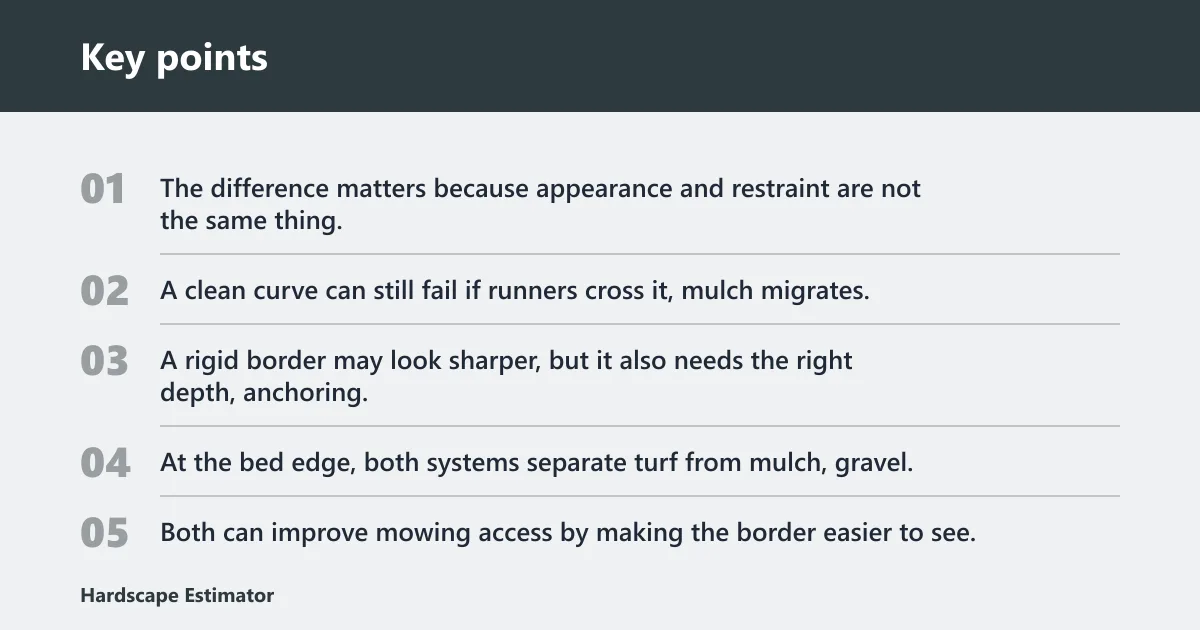
The difference matters because appearance and restraint are not the same thing. A clean curve can still fail if runners cross it, mulch migrates, or the edge sloughs off after rain. A rigid border may look sharper, but it also needs the right depth, anchoring, and material profile to work as true edge restraint.
| What is being compared | Soft edging | Hard edging | Practical takeaway |
|---|---|---|---|
| Typical install depth | Shallow trench or cut line, usually surface-level | Often set below grade; metal borders are commonly buried several inches | Hard edging needs a defined set depth to stay stable |
| Best soil fit | Stable, well-drained soils with low runoff | Clay, mixed soils, and areas that need stronger restraint | Soil movement is the deciding factor more than appearance |
| Maintenance burden | Frequent recutting and cleanup | Periodic inspection of stakes, joints, and heave | Soft edging costs less to start; hard edging usually costs less to maintain |
| Resistance to turf spread | Low unless the edge is kept sharp | High when the barrier is continuous and anchored | hard edging usually keeps grass out better |
What each edge does at the border line
At the bed edge, both systems separate turf from mulch, gravel, or soil and mark a finished line. Both can improve mowing access by making the border easier to see. The difference is that hard edging also resists movement; soft edging depends on the soil holding its shape and on regular clean-up.
Where the two systems differ in failure risk
Soft edging tends to fail by blur and collapse. Wet soil slumps into the trench, grass creeps over the edge, and mulch spills into the lawn after a few mowings. Hard edging tends to fail by heave, loosening, or visible gaps if the base is shallow, the stakes are too sparse, or frost pushes the edge up.
What is soft edging?
Soft edging is a flexible border created by shaping the existing ground rather than adding a rigid barrier. It is usually made with a shallow trench, a beveled bed edge, or a mower-cut line between lawn and bed. It works when the site stays fairly calm and the owner accepts regular touch-up.
How trench edges are formed
A trench edge is a shallow cut or mow strip that leaves a visible separation between turf and bed. The cut can be made with a spade, edging tool, or bed knife, then maintained so the lawn edge stays open. On a flat, dry border, that line can stay neat for a while.
But the edge itself is not a barrier. If the soil softens, the shoulder collapses. If the turf sends runners, the border moves inward. A trench edge is a shape, not a wall.
Why soft edges depend on maintenance
Soft edging depends on mowing discipline, periodic recutting, and quick cleanup after rain or irrigation. That is why it is common where the owner wants a simple border and can trim it often. On a border with active grass spread, the maintenance burden rises fast.
Say your 20 ft front bed borders a lawn of creeping grass on damp clay. The edge may look neat at first, but the trench can close after a few wet weeks, and the grass line starts to slide into the bed unless it is cut back again.
Where soft edging works best
Soft edging fits flat beds, low-traffic borders, and informal designs where a softer line is acceptable. It also works when the turf pressure is light and the owner wants the lowest install time. It is a weaker choice for steep grades, wheel-heavy paths, or aggressive runners.
What is hard edging?
Hard edging is a rigid border material that creates a fixed edge restraint. Common materials include steel, aluminum, plastic, concrete, brick, and pavers. Installed well, it keeps a cleaner line, improves wheel control at the mower edge, and slows turf and mulch movement.
Common hard edging materials
Steel and aluminum give a slim profile and can bend to curves. Plastic is easier to handle and often cheaper, but it can flex more. Concrete, brick, and pavers give a heavier border and a more formal look, though they need more base prep and space.
Material profile matters. Height above grade affects how much mulch or gravel stays back. Burial depth affects stability. For metal edging, thickness or gauge changes stiffness, and tighter bend radius makes curves easier without kinking. In practical terms, a steel border often holds a sharper line than a thin plastic strip, especially where mowers pass close to the edge.
What edge restraint means in practice
Edge restraint means the border physically resists side pressure from roots, turf, mulch, or gravel. That is different from a decorative border that only looks finished. A restraint edge should stay aligned even after repeated mowing and seasonal soil movement.
Suppose a paver path runs beside a bed with bermudagrass. A shallow decorative border may shift and open gaps, but a properly anchored restraint holds the pavers and keeps the turf from pushing into the joint line as quickly.
Install depth, height, and rigidity
Most hard edging needs enough burial depth to lock it in place and enough exposed height to block drift from mulch or gravel. If the material is too thin or too shallow, it can curl, rack, or pop loose. Rigidity also affects how well the edge survives wheel contact and seasonal movement. For many landscapes, a practical target is about 2 to 3 inches of exposed edge above grade and a deeper set beneath the surface where the soil can grip it.
How do soil, slope, and water change the result?
Soil and water change edging performance more than most product pages admit. Clay holds shape when dry but can heave and smear when wet. Sandy soil drains fast but can shed support. Slopes add runoff force, which makes soft borders wash out sooner and makes hard edges need stronger anchoring. The University of Florida IFAS notes that landscape edging performance depends heavily on site conditions, especially drainage and soil stability.
Clay soil vs sandy soil
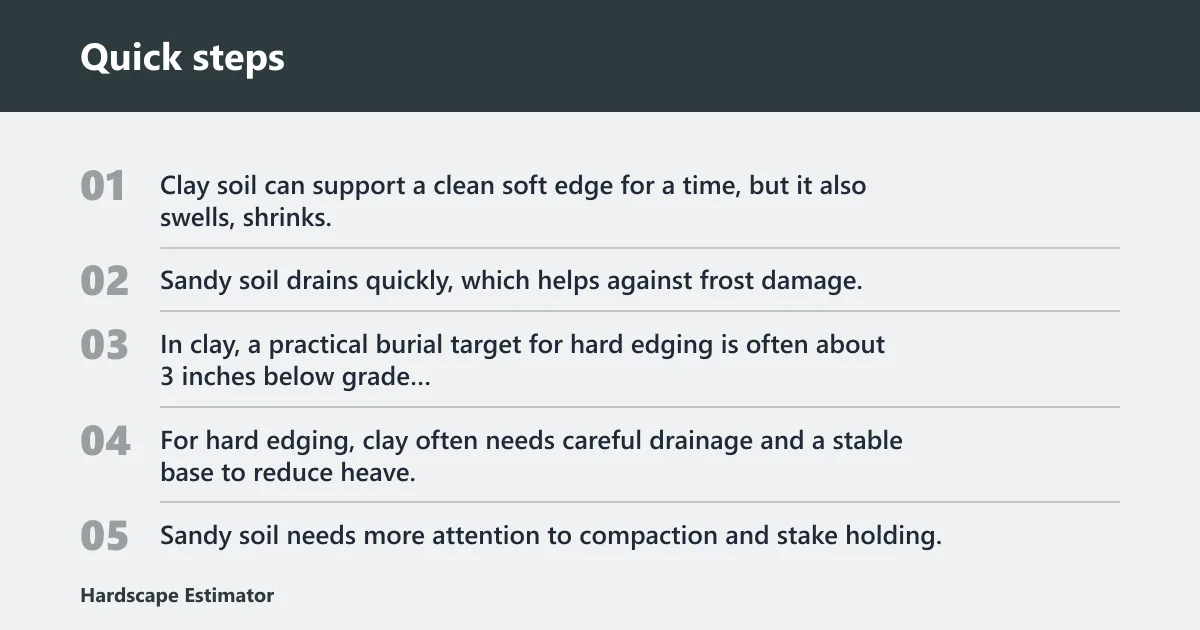
Clay soil can support a clean soft edge for a time, but it also swells, shrinks, and stays wet longer after rain. That raises collapse risk. Sandy soil drains quickly, which helps against frost damage, but the edge can lose support and slump if the border is cut too steep. In clay, a practical burial target for hard edging is often about 3 inches below grade where the material needs soil grip and resistance to movement.
For hard edging, clay often needs careful drainage and a stable base to reduce heave. Sandy soil needs more attention to compaction and stake holding. The edge only works as well as the soil around it.
Flat beds vs sloped beds
Flat beds are forgiving. Soft edging can work there if turf pressure is light and the line is maintained. Sloped beds are harsher. Water runs downhill, mulch migrates faster, and the edge gets more lateral stress, so hard edging usually lasts longer and needs fewer resets. On slopes, anchor spacing and set depth matter more than the material’s appearance.
Drainage, settling, and frost heave
Water movement at the bed edge can erode a soft border and wash fines away from hard edging. In freeze-thaw climates, trapped water can expand and lift materials. That is why anchoring depth, drainage, and soil contact matter as much as the edge material itself.
Hard edging does not ignore frost heave. It only handles it better when the base is set correctly. Soft edging has little protection against freeze-thaw movement because the border is the soil. USDA and university extension guidance consistently ties frost damage and heave to drainage, soil moisture, and installation depth.
Landscape edge decision matrix
This matrix scores each site condition from 1 to 5, where 5 is the better fit for that edging type. The recommendation follows the higher total for that scenario, with the site condition driving the choice.
| Site condition | Soft edging score | hard edging score | Recommended choice |
|---|---|---|---|
| Flat bed with light turf pressure | 4 | 3 | Soft edging |
| Sloped bed with heavy runoff | 1 | 5 | hard edging |
| Clay soil with aggressive grass runners | 1 | 5 | hard edging |
| Low-maintenance border with a long lifespan target | 1 | 5 | hard edging |
| Curved bed beside a mower strip or driveway edge | 2 | 5 | hard edging |
| Sandy soil with occasional irrigation overspray | 3 | 4 | hard edging |
| Formal gravel border that needs clean containment | 1 | 5 | hard edging |
A flat bed with modest turf pressure is the one place where soft edging can stay useful without demanding constant resets. Once slope, clay, or aggressive runners enter the picture, hard edging pulls ahead because the border has to resist motion, not just look neat. For gravel-heavy borders, a rigid edge is usually the more reliable choice because the stone wants to migrate under foot traffic and rainfall; see gravel edging that keeps stone in place.
Choose soft edging if… / Choose hard edging if…
Choose soft edging if the border is flat, the lawn pressure is light, and you want the lowest upfront cost with the least material. Choose hard edging if you need stronger grass restraint, cleaner mower access, fewer touch-ups, or a longer service life on a path, curve, or slope.
Choose soft edging if…
- the bed is flat and drains well
- the turf is not an aggressive runner type
- you can recut or clean the edge on a schedule
- the priority is a simple border, not strong restraint
Choose hard edging if…
- the bed slopes or takes runoff
- grass spread is a real problem
- you want less string-trimmer work and clearer wheel clearance
- you want a longer-lasting edge with fewer rebuilds
Cost is not only about the price of the material. A shallow trench edge is cheaper to install, but it may need more labor over time. A rigid border costs more at the start, yet its replacement interval is usually longer if the depth and anchoring are right.
Picture a side yard with a 30 ft gravel border and a mower path beside it. If the gravel keeps spilling into the grass every month, the higher install cost of hard edging can pay back in reduced cleanup and fewer edge repairs.
A mixed system can also make sense. Use soft edging in calm, flat beds where the line is mostly visual, and use hidden restraint or hard edging where mulch, gravel, or turf pressure is higher. That gives a softer look in low-stress zones and stronger support where the edge has to work harder.
How do you install and maintain each edge?
Soft edging is easiest to install because it usually needs only shaping and cutting. Hard edging takes more planning, deeper setting, and more care with base and alignment. The trade is simple: faster setup for soft edging, stronger restraint and lower reset frequency for hard edging.
Basic setup for a soft edge
- Mark the bed line with a hose or paint.
- Cut a shallow trench or mower strip along the line.
- Shape the bed side so soil or mulch does not spill easily.
- Trim back grass runners before they cross the border.
- Recut the edge when the line starts to blur.
Basic setup for a hard edge
- Mark the line and check curves, slope, and drainage.
- Excavate enough depth for the chosen material and base.
- Set the edging at the proper height above grade.
- Anchor or lock the material so it cannot rack or lift.
- Backfill and compact so the edge stays stable.
Maintenance intervals and replacement timing
Soft edging usually needs recurring touch-up during the growing season, especially where runners spread fast. Hard edging still needs inspection, but the work is more about checking stakes, joints, and heave than re-forming the border line. Replace or reset hard edging when it loosens, shifts, or bends beyond recovery.
Frequently asked questions
What is the difference between soft edging and hard edging in landscaping?
Soft edging uses the shape of the soil, mulch, or turf edge itself to define the border. Hard edging uses a fixed material such as steel, aluminum, plastic, brick, pavers, or concrete. Soft edging is simpler and cheaper to start; hard edging gives stronger restraint and a cleaner long-term line.
When should I use soft edging instead of hard edging?
Use soft edging on flat, well-drained beds where the turf pressure is light and you can maintain the line often. It works well when the goal is a simple, natural-looking border and the site does not need strong restraint against runners, runoff, or wheel traffic.
Is hard edging better for stopping grass from spreading?
Yes, hard edging is usually better at slowing grass spread because it creates a physical barrier. It is not perfect, though. Aggressive rhizomes and stolons can still find gaps, especially if the edge is shallow, loose, or left with openings at joints and ends.
Does soft edging cost less than hard edging?
Usually yes, because soft edging often needs only trenching or shaping instead of purchased material and deeper install work. The full cost picture also includes maintenance. If the soft edge needs frequent recutting or rebuilding, the gap can narrow over time.
Which edging lasts longer, soft or hard edging?
Hard edging usually lasts longer because it is built to resist movement and hold a fixed line. The exact lifespan depends on the material, burial depth, and soil conditions. Soft edging can last in calm sites, but it generally needs more frequent repair and re-shaping.
How do I choose edging for mulch, gravel, or pavers?
Choose based on how much movement the border must resist. Mulch on a flat bed can work with soft edging, but gravel and pavers usually need hard edging or restraint to keep the edge from spreading. Slopes, runoff, and mowing traffic push the decision toward a rigid border.
Sources
- University of Florida IFAS Extension: landscape edging and border maintenance guidance
- USDA Natural Resources Conservation Service: soil texture, drainage, and runoff references
- University extension resources on frost heave, soil movement, and landscape installation depth