What Is the Best Landscape Edging for Gravel?
For most gravel paths and beds, aluminum edging is the best all-around choice; use steel for driveways or high-traffic edges, and choose stone or concrete only when the border is meant to stay rigid as part of the design. Weak edging lets gravel migrate, weeds move in, and repair costs pile up. This guide compares edging materials by gravel type, traffic, climate, and lifetime cost, with failure modes and buying rules. If you need a broader project plan, see our gravel driveway guide, pea gravel maintenance, and edging installation tutorial.
Good gravel systems usually work best as a package: edging, base preparation, and sometimes stabilization fabric or geogrid. A woven landscape fabric can help separate soil from aggregate, but it is not a substitute for strong edge restraint. For weak subgrades or driveways that rut, geogrid can reinforce the base under the gravel while woven fabric blocks contamination and helps reduce sinking. If the site already has a weed barrier, make sure the edging system can be anchored without tearing it or trapping water against the border.
Gravel edging material choices
For a typical gravel path or bed, aluminum is the best balance of corrosion resistance, clean lines, and installability. The best choice changes by project type: plastic for low-cost DIY curves, steel for driveways, concrete for permanent borders, and natural stone for decorative edges where appearance matters more than cost. If the gravel sits on a weak base, add geogrid or woven fabric stabilization before choosing the edge, because edging alone cannot fix a soft subgrade.
If the gravel is pea gravel, containment matters more. Pea gravel moves with wind, rain, and foot traffic, so a shallow, flexible edge is often not enough unless the run is short and lightly used. Heavier crushed stone holds a line better, so the edging can be less aggressive. In weed-prone beds, a weed barrier for gravel may be compatible, but it should be breathable and paired with an edge that can hold the fabric down at the perimeter.
Quick picks for gravel edging
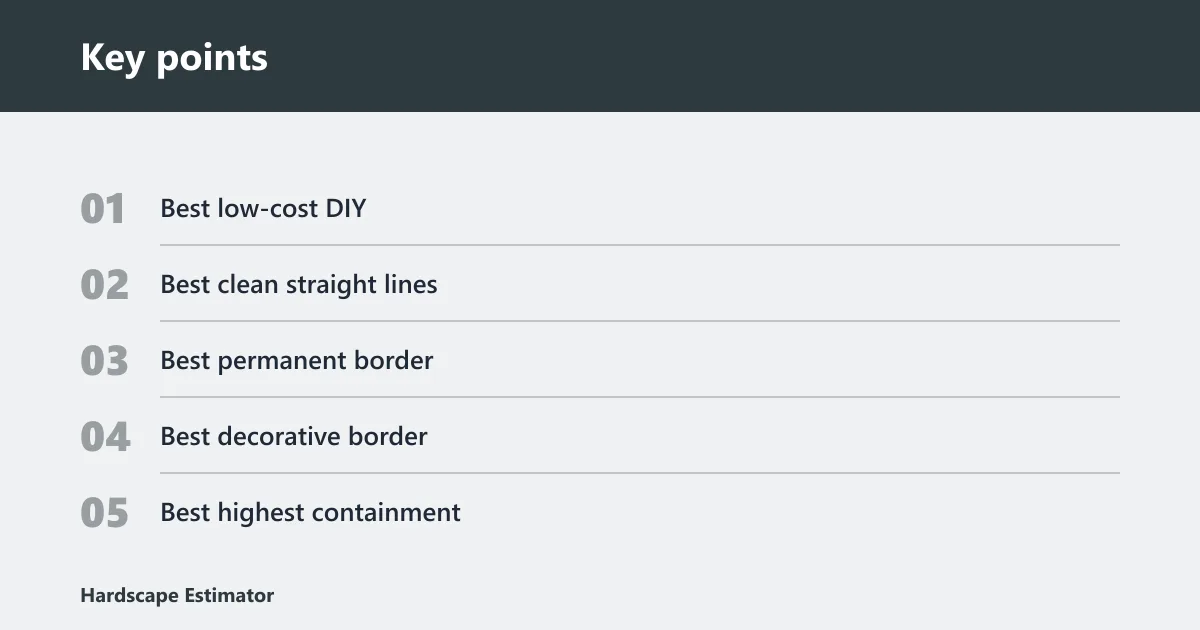
- Best low-cost DIY: plastic edging for short beds, light paths, and curves.
- Best clean straight lines: aluminum edging for crisp borders and lower corrosion risk.
- Best permanent border: steel edging for driveways, edges with impact, and longer service life.
- Best decorative border: natural stone where the border is part of the finished design.
- Best highest containment: concrete curbing for harsh climates, slopes, and heavy traffic.
Gravel edging decision table
| Material | Containment strength | Curveability | Frost resistance | Driveway suitability | Likely replacement cycle |
|---|---|---|---|---|---|
| Plastic | Low to moderate | High | Low to moderate | Poor to limited | Short |
| Aluminum | Moderate | Moderate | High | Moderate | Mid-range |
| Steel | High | Moderate | High | High | Long |
| Concrete | Very high | Low | Very high | Very high | Long |
| Natural stone | High | Low | High | Limited | Mid-range |
Lifetime-cost formula: Lifetime cost per foot = (material cost per foot + install cost per foot) ÷ expected service years + replacement cost allowance per foot. If a border is likely to need resetting, rust treatment, or full replacement, that cost belongs in the total.
For example, a product that costs less upfront can still cost more over time if it fails early. Armor Curbing lists plastic edging at 1 to 3 years in northern Wisconsin, while it lists concrete curbing at $10 to $20 per linear foot installed and steel edging at $10 to $28 per linear foot installed. Those installed costs matter because labor often outweighs the material price. Common retail products also show the spread: EasyFlex no-dig edging is often around $20 to $35 per 15-foot kit, basic aluminum edging frequently runs about $3 to $7 per linear foot, and higher-end COR-Ten steel edging can cost substantially more depending on thickness and height.
What should I use for landscape edging on a gravel path?
Use aluminum for a straight or gently curved path, and plastic only when the budget is tight and traffic is light. For a path, the edge must hold gravel without creating a stumble point, so height and profile matter as much as material. Bob Vila notes path edging height should hold gravel without creating a tripping hazard. If the path is built over soft soil, a woven fabric separator under the gravel can help keep the base clean, but the border still needs enough rigidity to keep the edge from spreading.
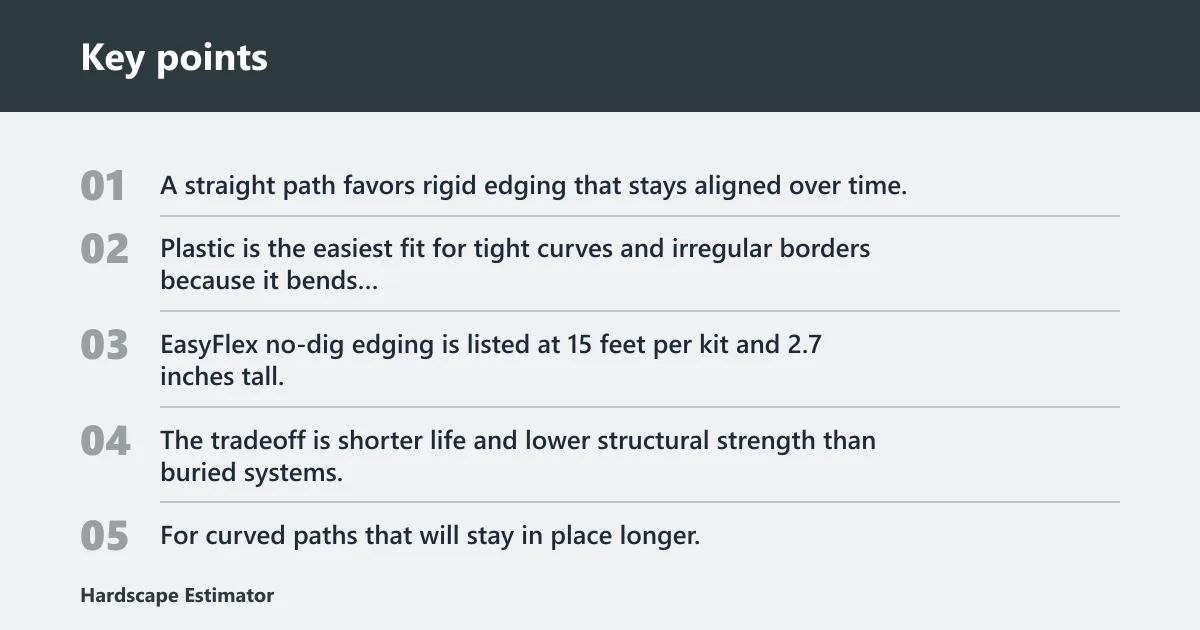
A curved path favors flexible edging. A straight path favors rigid edging that stays aligned over time.
Best choice for curved paths
Plastic is the easiest fit for tight curves and irregular borders because it bends readily and often comes as a no-dig system. EasyFlex no-dig edging is listed at 15 feet per kit and 2.7 inches tall, which is useful for light containment along a footpath. The tradeoff is shorter life and lower structural strength than buried systems. For curved paths that will stay in place longer, aluminum can still work if the curve is gentle and the anchors are spaced tightly.
Best choice for straight paths
Aluminum is usually the better fit for straight, clean runs. It resists corrosion and gives a sharper line than plastic, but it can bend under impact, so it is better suited to walking paths than repeated wheel hits. Steel is the stronger upgrade when the path also sees carts, blowers, or frequent edge strikes. If the path is built over unstable soil, geogrid under the gravel can improve load distribution while the edging keeps the face of the path tidy.
Edge height for foot traffic
For shallow containment, about 2 to 3 inches is a common rule of thumb. That height keeps the border low enough to reduce trip risk while still helping with gravel retention. Bob Vila’s trench guidance of about 4 to 6 inches wide and 3 to 4 inches deep gives a practical installation zone for many paths.
For example, a garden path using pea gravel and curving around planting beds can be used as a guide. A 2.7-inch no-dig plastic edge can help, but it will need more attention if the path gets regular foot traffic or if rain pushes gravel outward at the turns. The same path in crushed stone would usually need less frequent resetting.
What is the best gravel driveway edging?
Steel is the best gravel driveway edging for most homes because it combines strong fixation with high containment and better long-term performance than plastic. For colder climates and heavy vehicle use, concrete curbing is the stronger border, especially where freeze-thaw movement and wheel impact are constant. Where the base is weak or the driveway ruts, geogrid under the aggregate can reduce deformation before the edge starts to fail.
Driveways fail edging faster than paths do. Tires push gravel outward, plows catch edges, and thaw cycles move the base. A light no-dig system is usually not enough by itself.
Why driveways need stronger fixation
Driveway edging has to resist lateral force, not just keep stones neat. Hammer-in edging or buried systems usually hold better than no-dig styles because the anchoring is stronger. That matters when the gravel is loose pea gravel or when the driveway slopes toward a street or garage apron. If the driveway also has a weed barrier, the edge must pin it without creating a gap that lets fines wash through.
When steel or concrete makes sense
Steel makes sense where you want a permanent border that can take repeated use but still keep a relatively narrow edge. Concrete makes sense when the edge is part of a permanent hardscape and the goal is maximum containment. Concrete curbing also performs well in freeze-thaw conditions, which is why it is often chosen for harsher climates.
What fails first under vehicle traffic
Plastic usually deforms first. Aluminum can bend under impact. Steel can rust or corrode in some climates, especially if the finish is damaged or the site stays wet. Concrete can crack, and stone can reset over time if the base shifts or if vehicles push against the line repeatedly.
Choose edging by gravel type, traffic, slope, and border shape. That is the order that matters most. A decorative bed with low foot traffic does not need the same solution as a sloped pea gravel driveway, even if both look similar from the street.
Gravel type: pea gravel versus crushed stone
Pea gravel is the harder case. Its rounded stones roll more easily, so it tends to move with wind, rain, and foot traffic. Crushed stone locks together better, so it usually needs less aggressive containment. If the project uses pea gravel, a taller edge and tighter fixation become more important. On larger projects, a stabilization layer of geogrid below the base or a woven fabric separator beneath the stone can improve performance without changing the visible design.
Grass Seed Professionals notes that pea gravel binders can set within 12 to 24 hours, and one mulch glue covers up to 277 square feet at 1 inch depth. That can help in light-use areas, but binder is not a substitute for a stable border on a driveway or slope.
Traffic level and slope
Light-use beds can get by with lower edging and softer materials. Heavy traffic and slopes push the choice toward steel or concrete, because the edge has to resist repeated movement. Higher edging helps contain gravel better, but it also raises the trip risk, so the design has to match the site.
Curves versus straight runs
Flexible edging is better for curves. Rigid edging is better for long straight borders. That is why plastic is common around planting beds and winding paths, while aluminum and steel are better for formal edges. Stone and concrete can work on straight runs, but they are far less forgiving if the layout changes later.
No-dig versus hammer-in systems
No-dig edging is faster and less invasive, which makes it a strong DIY option for light containment. It is usually lower in structural strength than buried systems, though. Hammer-in edging, often metal, takes more effort but gives a tighter lock into the base and tends to last longer in permanent installations. If you are pairing edging with weed control, a woven landscape fabric can usually work under the gravel, but thick nonwoven barriers may bunch up at the edge and make installation harder.
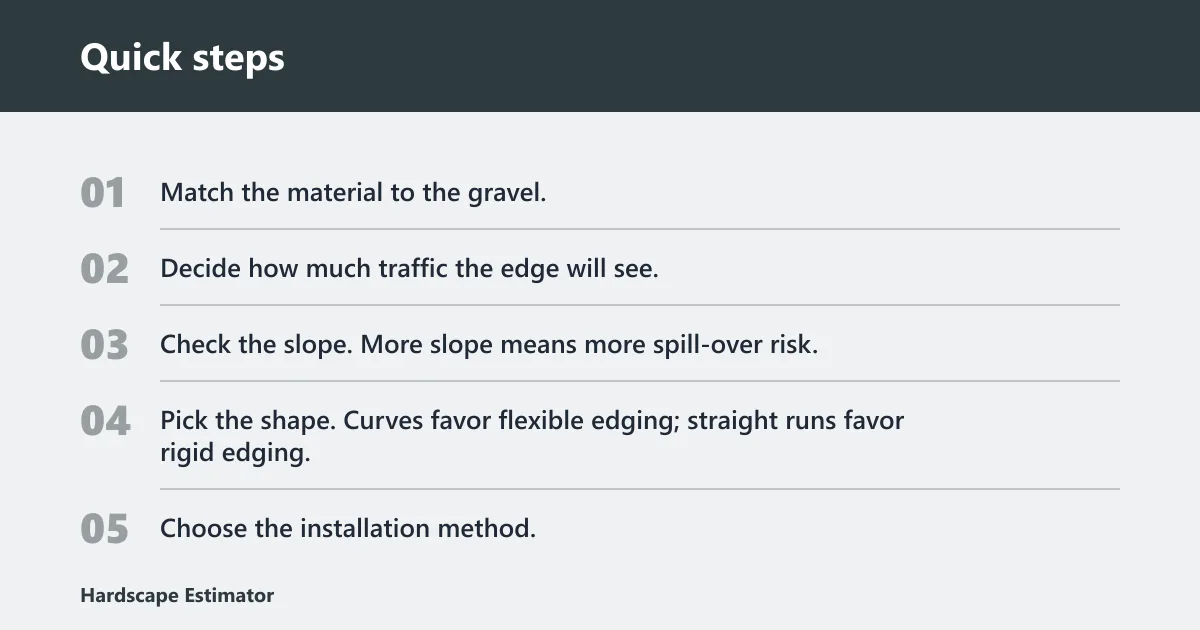
- Match the material to the gravel. Use pea gravel only with tighter containment than crushed stone.
- Decide how much traffic the edge will see. Walking, mowing, carts, and cars do not ask the same thing of a border.
- Check the slope. More slope means more spill-over risk.
- Pick the shape. Curves favor flexible edging; straight runs favor rigid edging.
- Choose the installation method. No-dig is quicker; hammer-in or buried systems are stronger.
Suppose a 40-foot driveway edge uses pea gravel on a mild slope. Plastic may look acceptable on day one, but repeated tire push and winter movement can shorten its useful life fast. Steel or concrete costs more to install, yet the lifetime cost can be lower if the edge does not need early replacement. In this kind of project, a geogrid base layer and woven fabric separator are often a better investment than spending the budget on a decorative edge that cannot hold the load.
How tall should gravel edging be?
Use about 2 to 3 inches for shallow containment, and 6 inches or more for heavy traffic or slopes. Height affects both retention and tripping risk, so taller is not automatically better. The right height depends on how much gravel movement the site creates and how visible the edge is to foot traffic.
2 to 3 inches for shallow containment
This height is often enough for decorative beds, short paths, and low-traffic borders. The edge stays subtle, and the tripping risk stays lower. It works best when the gravel is larger and the border is not constantly disturbed.
6 inches or more for heavy traffic or slopes
For driveways, downhill runs, and high-movement edges, more depth helps keep the gravel in place. A featured corrugated metal edging is 40 feet long and 6 inches tall, and Edge Right COR-Ten steel edging is described as 6-inch depth. Those deeper profiles fit containment work where shallow edging would spill too easily.
Height, tripping risk, and spill-over
More height helps with retention, but it can create a hard edge that catches feet or tires. That is why a gravel patio or walk often needs a lower profile than a driveway or slope. The goal is not to stop every loose stone. It is to reduce migration enough that maintenance stays manageable.
Frequently asked questions
What is the best landscape edging for gravel?
Aluminum is the best all-around choice for most paths and beds because it balances corrosion resistance, appearance, and installability. For driveways or high-traffic edges, steel is usually better. For permanent architectural borders, concrete or stone can be the right fit if the higher cost and repair burden are acceptable.
What do I use to keep pea gravel from spreading?
Use a tighter edge than you would for crushed stone. Pea gravel moves with wind, rain, and foot traffic, so taller edging, stronger fixation, and sometimes a binder are useful together. On light-use areas, plastic or aluminum can work; on driveways or slopes, steel or concrete is safer. A woven fabric separator can also help keep fines from migrating upward, but it should be installed so water can still drain freely.
Do I need edging for gravel?
Not always, but it helps in most finished projects. Edging is most useful on patios, paths, driveways, and sloped borders, where gravel migration is common. On flat, informal beds with large stone, edging can be optional, though it still improves the line and reduces cleanup.
Should gravel edging be plastic, metal, or concrete?
Plastic is the low-cost, flexible option for light-duty work. Metal splits into aluminum for clean lines and steel for stronger, longer-lasting borders. Concrete is the most permanent and the highest containment choice, but it costs more and is harder to repair if it cracks.
How much does gravel edging cost per foot?
Installed cost depends on material and labor. The same source lists concrete curbing at $10 to $20 per linear foot installed and steel edging at $10 to $28 per linear foot installed. Plastic is cheaper upfront, but a short replacement cycle can raise lifetime cost if the edge fails early. For many DIY products, the material-only price is much lower: plastic strips are often under $2 per linear foot, aluminum edging is commonly a few dollars per linear foot, and premium steel edging can climb well above that before installation.
What edging works best for curves and irregular gravel borders?
Plastic works best for tight curves because it bends easily and comes in no-dig formats. Aluminum can handle gentle curves and gives a cleaner line. For irregular borders that will stay fixed for years, stone or concrete can work, but they are less forgiving if the layout changes later.