How Much Extra Bagged Material to Buy for Waste and Settling
Buy 5% to 10% extra for clean, easy materials like sand, gravel, compost, and mulch, and 10% to 15% extra for concrete mix or any job with cutting, spillage, or compaction; add settling allowance only when the material will compress after placement. Underbuying stops a project midstream, while overbuying leaves paid-for bags unused. This guide separates waste from settling and gives material-by-material buy-more rules with simple math.
This guide is part of our Yards to bags: convert cubic yards into bag counts series.
How much extra should you buy?
Start with 10% extra for most bagged projects, then adjust for the material and the site. Use 5% when the fill is measured, contained, and easy to place. Use 15% when the area is uneven, open, or likely to lose material during placement. Add settling on top of waste only when the material will compress after install.
Bag waste matrix
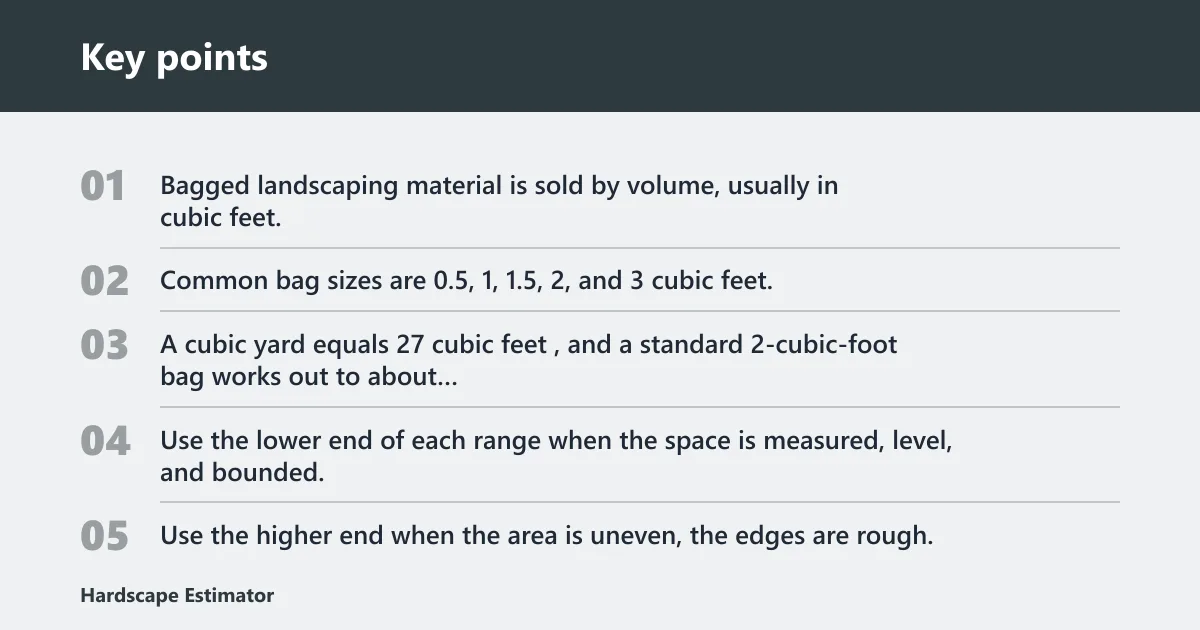
Bagged landscaping material is sold by volume, usually in cubic feet, so the label size matters as much as the product type. Common bag sizes are 0.5, 1, 1.5, 2, and 3 cubic feet. A cubic yard equals 27 cubic feet, and a standard 2-cubic-foot bag works out to about 13 to 14 bags per cubic yard.
| Material | Extra percentage | When to use it | Why |
|---|---|---|---|
| Mulch | 10% to 15% | Open beds, light slope, hand spreading | Mulch settles 10% to 20% in the first month, so the buy-more allowance needs room for both placement waste and settling. |
| Topsoil | 10% to 15% | Raised beds, grading touchups, loose fill | Soil amendments and topsoil compact more than mulch, especially after watering and tamping. |
| Gravel and sand | 5% to 10% | Defined beds, base layers, tight edges | These materials usually need less settling margin, but minor spill and leveling loss still happen. |
| Compost | 10% | Garden beds and soil blends | Compost can compress and mix into existing soil, so a standard buffer helps cover loss during spreading. |
| Concrete mix | 10% to 15% | Any job with forms, joints, or short pours | Mix loss, cleanup, and moisture variation make a higher buffer safer than a bare minimum count. |
Use the lower end of each range when the space is measured, level, and bounded. Use the higher end when the area is uneven, the edges are rough, or the material will be disturbed after placement. For most jobs, 10% is a sound planning buffer, but it is not a rule for every material or every site.
Say your mulch bed needs 12 bags at the exact label coverage. A 10% buffer adds 1.2 bags, which rounds up to 14 total bags after whole-bag rounding. That extra 2 bags covers both small spill loss and the settling that happens after the mulch beds in.
Do you need 10% extra?
Yes, 10% extra is enough for many small to medium bagged projects, especially when the area is defined and the material is easy to place. It is a planning default, not a universal rule. Use less for tight, exact fills. Use more when the surface is irregular, the bag size is unusual, or the material will settle.
When 5% is enough
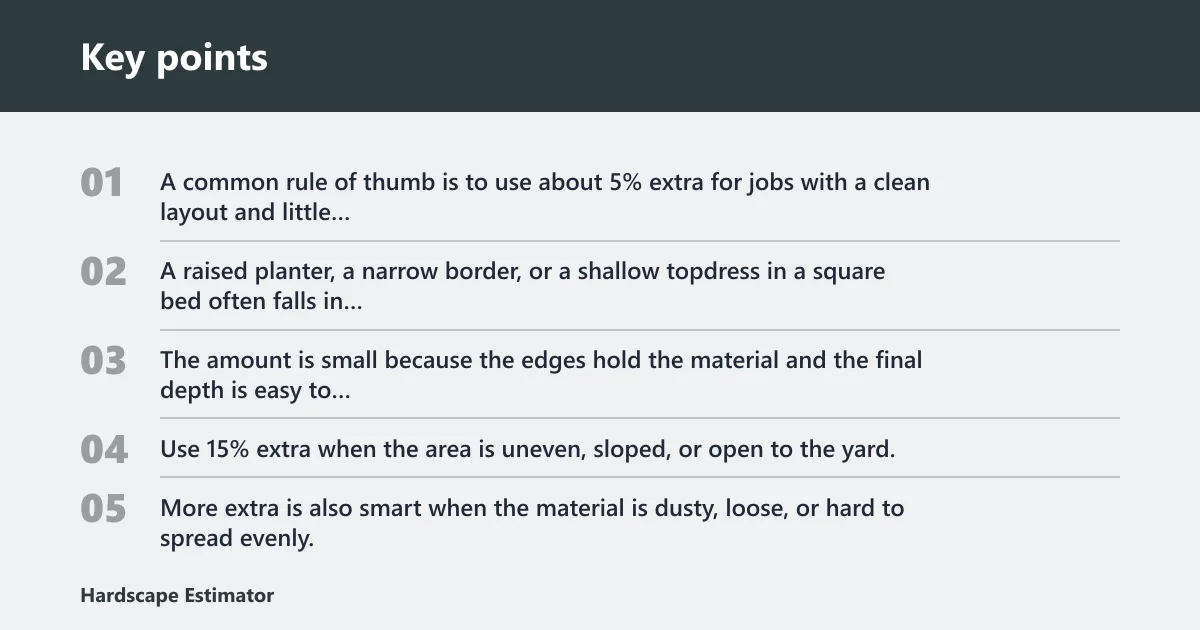
A common rule of thumb is to use about 5% extra for jobs with a clean layout and little handling loss. A raised planter, a narrow border, or a shallow topdress in a square bed often falls in this range. The amount is small because the edges hold the material and the final depth is easy to control.
When 15% is safer
Use 15% extra when the area is uneven, sloped, or open to the yard. More extra is also smart when the material is dusty, loose, or hard to spread evenly. The higher end covers the loss from wheelbarrows, scoops, level-off waste, and the gaps that appear after settling.
When to add no extra
Add no extra only when the space is measured to an exact finished fill and the material is not expected to settle. That can happen in some planter fills or tight sand beds with a defined edge. Even then, round up to the next whole bag because stores do not sell partial bags.
Should you round up to the next full bag or buy a little extra? Round up after you add the allowance. That is the safer step. Buying a partial margin in theory does not help if the store only sells whole bags. The final number should always be an integer, and the allowance should be applied before rounding.
Settling vs waste
Waste and settling are different. Waste is what gets lost during handling, spreading, trimming, or cleanup. Settling is the drop in height or volume after placement. A bag count should account for both, but not as one blended number unless the project is simple and the material has little compression.
Why mulch needs more margin
Mulch often needs a larger allowance because it is light, loose, and subject to settling. The common estimate is 10% to 20% settling in the first month. A 2-cubic-foot bag of mulch covers about 8 square feet at 3 inches deep, so a thin layer can disappear faster than readers expect once it beds in.
Why soil and compost settle more
Topsoil and compost often need more extra than gravel because they can compress, mix, and compact after watering or foot traffic. Soil bags are often 1 or 1.5 cubic feet, so the count climbs quickly when the finished depth must stay exact. If the bed is being filled for planting, plan the higher end of the range.
Why gravel usually needs less
Gravel usually needs less extra because it does not settle as much as mulch or soil, and it is less likely to shrink after placement. Still, some loss happens when the surface is sloped or the layer is spread thin. For most gravel jobs, a buffer of about 5% to 10% is usually enough.
Picture a gravel path that measures 80 square feet at 2 inches deep. The depth is controlled and the edge is contained, so 5% extra is often enough. A mulch bed with the same footprint needs more attention because the surface can drop after the first rain and the first few weeks of settling.
How to convert bags
Read the cubic feet on the label first, because that is the number that controls coverage and bag count. Then convert the project volume to the same unit. If you need bulk comparison, convert to cubic yards: 1 cubic yard equals 27 cubic feet. A standard 2-cubic-foot bag is about 13 to 14 bags per cubic yard.
Read cubic feet on the label
Most bagged material is sold in 1.5 to 3 cubic foot quantities, and mulch bags are often 2 cubic feet. Soil bags are often 1 or 1.5 cubic feet. Those differences matter. A 2-cubic-foot bag does not cover the same area as a 1-cubic-foot bag at the same depth, so the label must guide the final count.
Convert cubic feet to cubic yards
Use cubic yards when comparing a bag purchase with bulk delivery. Divide cubic feet by 27. For example, 54 cubic feet equals 2 cubic yards. If the material comes in 2-cubic-foot bags, that same amount is 27 bags before any waste or settling allowance. This makes the price comparison easier to check.
Round up to whole bags
After adding the allowance, round up to the next whole bag. If the math gives 12.4 bags, buy 13. If the math gives 13.1 bags and the project is exposed or uneven, buy 14. The store will not split a bag, and a short count usually costs more time than one extra bag costs in storage.
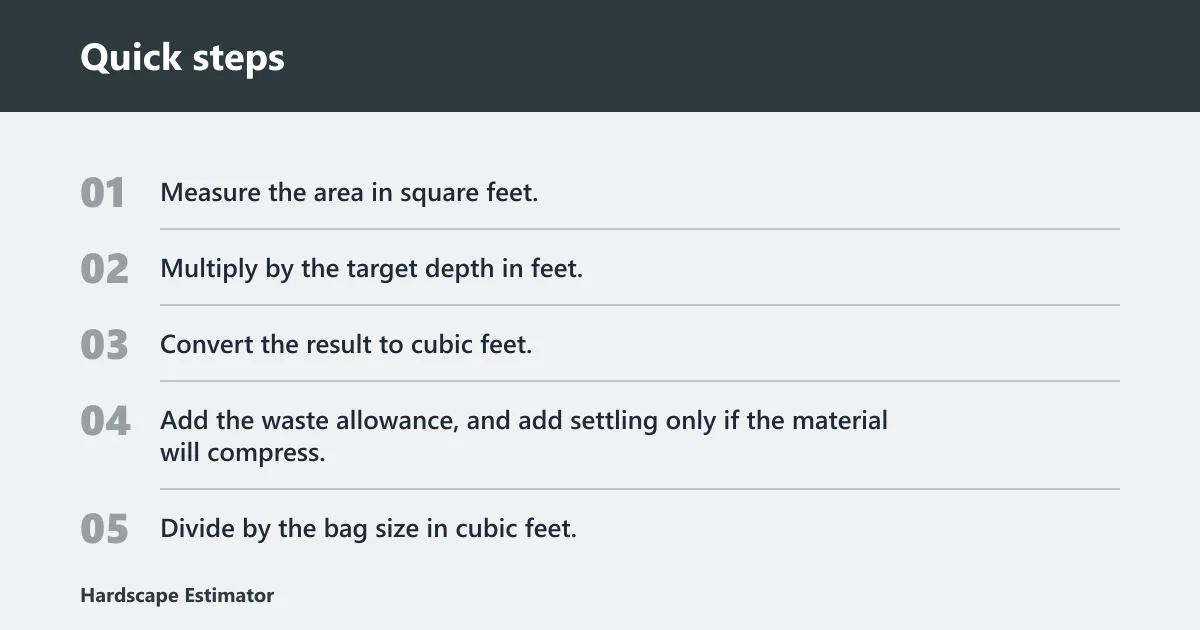
- Measure the area in square feet.
- Multiply by the target depth in feet.
- Convert the result to cubic feet.
- Add the waste allowance, and add settling only if the material will compress.
- Divide by the bag size in cubic feet.
- Round up to the next whole bag.
Suppose a planter needs 18 cubic feet of topsoil and the bags are 1.5 cubic feet each. The base count is 12 bags. Add 10% for waste and settling, which brings the count to 13.2 bags. Round up to 14 bags, because the store sells whole units only.
When should you round up?
Round up any time the final count is not a whole number, and round up one more step when the area is uneven or open. The more irregular the site, the more likely the material will shift, spill, or settle after placement. Small projects can still need an extra bag even when the calculated allowance looks modest.
Uneven ground
Uneven ground needs more extra because low spots swallow material and high spots shed it. A 10% buffer may be enough for a small patch, but 15% is safer on rough grades. The uneven surface changes the real depth from point to point, so the nominal estimate can run short fast.
Raised beds and planters
Raised beds and planters often need less extra than open yard areas because the sides hold the fill. In some exact planter fills, the best allowance can be 0% to 5% if the dimensions are fixed and the material is not expected to compress much. Check the label coverage carefully before buying.
Open yard applications
Open yard applications need more extra because the edges are not contained. Wind, rake loss, and uneven spreading all reduce the usable amount. This is where a 10% to 15% buffer is most practical, especially for mulch and topsoil. The larger the open area, the more the buffer matters.
A common first-timer mistake is buying the exact labeled count for a sloped mulch bed. The delivery arrives, the bags cover the flat sections, and the low edge still looks thin. The fix is simple: use the full measured count, add settling allowance, then round up before buying.
Bagged material vs bulk
Bagged material makes sense for small projects, tight access, and jobs where cleanup matters more than unit price. Bulk delivery is usually the better buy once the project grows, because the per-yard cost is often lower. Bags still win when the order is small, storage is limited, or the site needs only a few cubic feet.
When bags make sense
Bags are practical for patch repairs, short borders, planters, and small hardscape beds. They are easy to carry, easy to store, and easy to return if unopened. They also let a buyer match exact coverage when the label lists a useful size, such as 2 cubic feet for mulch or 1.5 cubic feet for soil.
When bulk delivery is the better buy
Bulk becomes more practical when the project volume climbs or the bag count turns unwieldy. Once a job moves into many cubic yards, the number of bags can be hard to handle and store. That is when the cost gap between bags and bulk starts to matter more than convenience.
Bagged product has a downside: leftovers. Unused bags need dry storage, and returns are not always worth the trip. That is why the allowance should be enough to avoid a shortfall, but not so large that several bags sit around after the job is finished.
Frequently asked questions
How much extra bagged material should I buy for waste and settling?
Use 5% to 10% extra for clean, controlled jobs and 10% to 15% for materials that settle or sites that are uneven. Keep waste and settling separate in the math. For mulch and soil, lean higher; for gravel and sand, the lower end is usually enough.
Is 10% extra enough for mulch and soil bags?
Often, yes. Ten percent is a standard planning buffer for many jobs, but mulch can settle 10% to 20% in the first month, and soil can compress after watering. If the bed is open, sloped, or loosely filled, 10% may be the minimum, not the comfort zone.
Should I round up to the next full bag or buy a little extra?
Round up after you add the allowance. Whole-bag rounding is required because stores do not sell partial bags. If the math lands just under a whole number, the next bag protects against small spill loss and leaves less risk of running short mid-project.
Does settling matter more for mulch, topsoil, or gravel?
Settling matters most for mulch and topsoil. Mulch commonly drops after placement, and topsoil can compact with watering and foot traffic. Gravel usually needs less settling allowance because it holds volume better, though a thin layer on an uneven base still benefits from a small buffer.
When does waste allowance change from 5% to 15%?
Move from 5% toward 15% when the area is uneven, open, sloped, or difficult to fill cleanly. The same shift applies when the bag size is awkward, the material is dusty or loose, or the job requires more trimming, hauling, or cleanup than a tight, defined bed.
How do I estimate bag count if the bag size is not standard?
Use the cubic feet printed on the label, not the product name. Divide your needed volume by that bag size, then add the waste or settling allowance before rounding up. A 1.5-cubic-foot bag and a 3-cubic-foot bag will produce very different counts for the same project.