What Is the Right Paver Base Depth for a Patio?
For a typical paver patio, plan on 4 to 6 in. of compacted base over well-drained soil, and 6 to 8 in. in freeze-prone or weaker ground. Too little base causes settling, wobble, and joint failure that is expensive to fix. This guide shows compacted depth, excavation depth, and how to convert that depth into an order quantity for base material.
This guide is part of our Paver base depth: How deep should a paver base be? series.
Patio base depth at a glance
For most patios, the right answer is 4 to 6 in. of compacted base, with 1 in. of bedding sand above it. That is the common patio range for stable soil, and it is the starting point for order estimates. If the soil is weak, wet, or subject to freeze-thaw, move toward the deeper end.
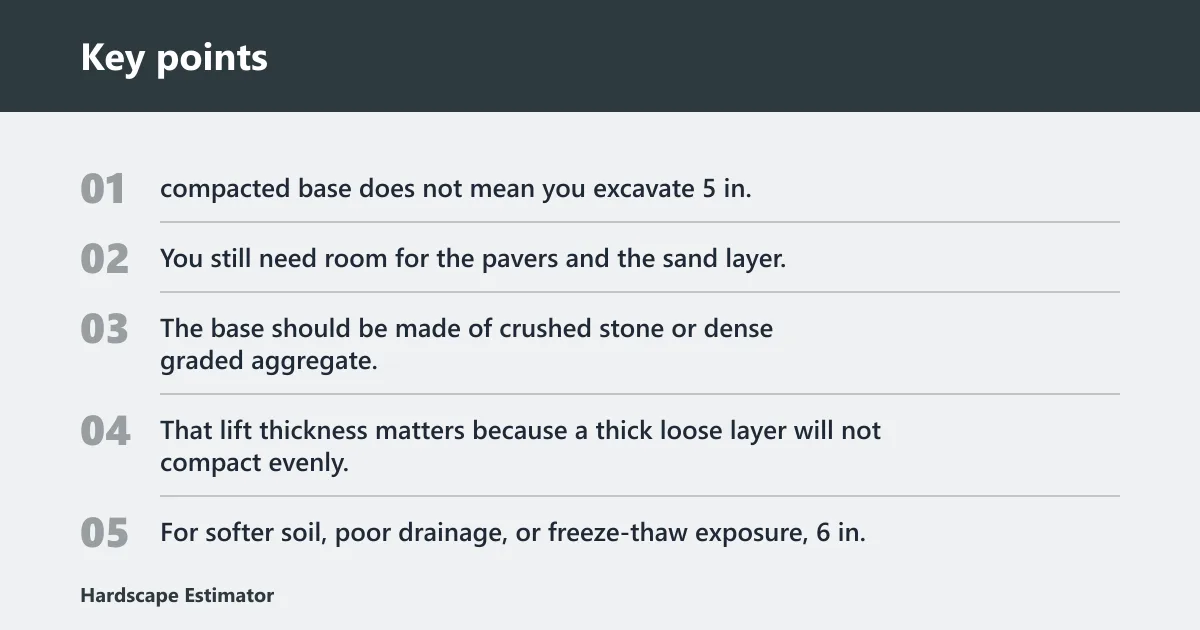
The base is not the same as the dig depth. A 5 in. compacted base does not mean you excavate 5 in. total. You still need room for the pavers and the sand layer, plus a little allowance for grading and finish height.
Typical compacted depth for patios
Walkways and patios typically use 4 to 6 in. of compacted base. The base should be made of crushed stone or dense graded aggregate, compacted with a plate compactor, and installed in thin 2 to 3 in. lifts. That lift thickness matters because a thick loose layer will not compact evenly.
For a normal patio on decent soil, 4 in. can work. For softer soil, poor drainage, or freeze-thaw exposure, 6 in. or more is the safer starting point.
When to move from 4 in. to 6 in
Move deeper when the subgrade is soft, holds water, or has a history of movement. Poor soil or freeze-thaw climates often need 6 in. or more. A patio that sees concentrated use near steps, doors, or corners also benefits from the deeper end of the range.
📊 Plastic base panels can replace gravel in some patios and reduce digging by 40 to 50 percent. Source: Familyhandyman.
How deep should you dig for a paver patio?
Dig deeper than the base alone. For a standard patio with 2 3/8-in. pavers, 1 in. of sand, and 5 in. of base, the excavation is about 8 to 9 in. deep. That depth changes with the paver thickness, the chosen base depth, and any final slope away from the house.
Finish height, pavers, sand, and base
Excavation depth should account for the finished patio elevation. If the patio must end flush with a doorway or step, the dig depth starts from that finished line and works downward through pavers, bedding sand, and compacted base. That is why the hole is deeper than the base thickness by itself.
Picture a patio that needs 2 3/8-in. pavers, 1 in. of bedding sand, and 6 in. of compacted base. The total is just over 9 in. before any slope adjustment. If the top needs to fall away from the house, the far edge may sit slightly lower than the house side.
Why excavation depth is deeper than base depth
The base carries the load, but the pavers and sand still take up space. The bedding sand is commonly 1 in. thick and screeded smooth, and the pavers sit on top of that layer. If the excavation stops at the base depth, the finished surface will end up too high.
A common first-timer mistake is digging to the compacted base number and forgetting the sand and paver thickness. The result is a patio that sits proud of the planned finish line or blocks drainage near the house.
What base material works best under pavers?
Crushed angular aggregate is commonly used as a standard base under patio pavers. It locks together better than rounded gravel, which shifts more easily under load. Common regional names include road base, crusher run, and base rock. Those products compact into a stable layer instead of rolling apart.
Crushed angular aggregate vs rounded gravel
Angular pieces bite into each other. Rounded gravel does not. That difference matters under pavers, where the goal is a tight, stable platform that resists movement after compaction. A patio base should be 4 to 6 in. of compacted 3/4-in. minus crushed stone, not a loose pile of smooth rock.
Can I use pea gravel under pavers? No, not as the structural base. Pea gravel is rounded and mobile, so it does not compact into the same stable layer as angular base stone. It can belong in some drainage details, but not as the main patio base.
Why compaction matters
Compaction controls settlement. The base should be installed in 2 to 3 in. lifts and compacted with a plate compactor after each lift. That process reduces future movement and helps the patio keep its level, especially at edges and near traffic paths.
Skipping compaction, or trying to compact one thick loose layer, leaves voids. Those voids show up later as dips, wobble, and pavers that no longer sit flat.
Patio base depth table
This table separates compacted thickness from loose-order volume. The loose volume is what you order, while the compacted thickness is what the patio needs after the plate compactor has done its work. Ton figures use about 1.4 tons per cubic yard of crushed stone.
| Patio size | Area | Compacted base | Loose base volume | Approx. tons of 3/4-minus | Climate / soil decision |
|---|---|---|---|---|---|
| 10 x 10 | 100 sq ft | 4 in. | 1.23 cu yd | 1.7 tons | Mild climate, well-drained soil |
| 10 x 10 | 100 sq ft | 6 in. | 1.85 cu yd | 2.6 tons | Freeze-thaw climate or softer soil |
| 12 x 16 | 192 sq ft | 4 in. | 2.37 cu yd | 3.3 tons | Mild climate, firm subgrade |
| 12 x 16 | 192 sq ft | 5 in. | 2.96 cu yd | 4.1 tons | Most patios on average soil |
| 12 x 16 | 192 sq ft | 6 in. | 3.56 cu yd | 5.0 tons | Freeze-thaw or soft clay subgrade |
| 16 x 20 | 320 sq ft | 4 in. | 3.95 cu yd | 5.5 tons | Mild climate, stable base soil |
| 16 x 20 | 320 sq ft | 6 in. | 5.93 cu yd | 8.3 tons | Freeze-thaw or soft clay subgrade |
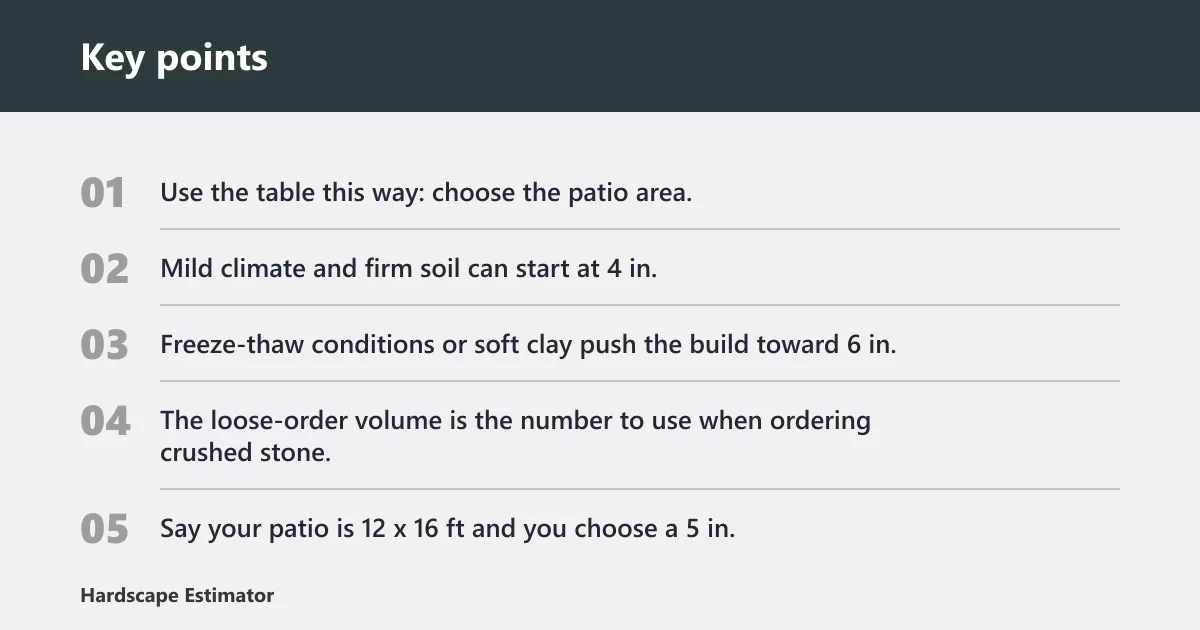
Use the table this way: choose the patio area, then pick the compacted depth based on soil and climate. Mild climate and firm soil can start at 4 in. Freeze-thaw conditions or soft clay push the build toward 6 in. or more. The loose-order volume is the number to use when ordering crushed stone.
Say your patio is 12 x 16 ft and you choose a 5 in. compacted base. You need about 2.96 cu yd of loose base, which is roughly 4.1 tons. That is separate from bedding sand and separate from the pavers themselves.
How thick should the bedding sand be?
The bedding sand layer is typically 1 in. thick. It sits above the base and below the pavers, and it is screeded level before the pavers go down. The sand is not there to add strength. It creates a uniform setting bed for the finished surface.
Screeding and finish tolerance
Use coarse concrete sand, not fine play sand. Screed it smooth to a consistent thickness, then set the pavers on top without walking in and out of the sand more than needed. A good sand bed is thin and even, not deep and soft.
If the sand layer grows too thick, the patio becomes harder to keep level. Thick sand can move under load, which increases lippage and creates a less stable finish.
How do slope, drainage, and edge restraint affect depth?
The patio should slope away from the house so water leaves the surface instead of pooling against the structure. One common recommendation is about 1/4 in. per foot, while another source gives about 1 in. for every 4 ft. Both point to the same practical idea: the finished patio needs a clear fall away from the building.
Pitch away from the house
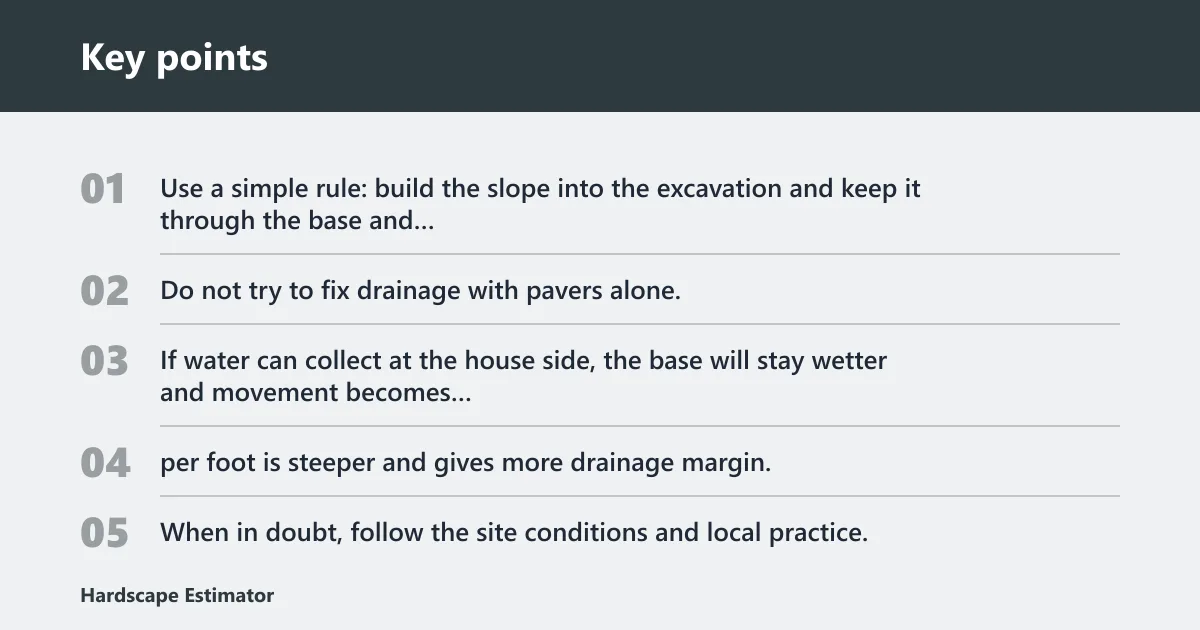
Use a simple rule: build the slope into the excavation and keep it through the base and sand layers. Do not try to fix drainage with pavers alone. If water can collect at the house side, the base will stay wetter and movement becomes more likely.
A slope of 1/8 in. per foot is a light pitch. A slope of 1/4 in. per foot is steeper and gives more drainage margin. When in doubt, follow the site conditions and local practice, but keep the direction away from the house.
Edge restraint at open borders
Edge restraint keeps pavers from spreading outward on open edges. It is needed wherever the patio does not butt against a rigid border. The restraint is usually paired with spikes or fasteners so the edge can hold the field of pavers in place.
Without edge restraint, the perimeter can creep outward over time. That movement opens joints, creates a ragged border, and makes the patio harder to maintain.
When drainage changes the build
If the subgrade stays wet, the build often needs more base depth, better drainage, or both. A shallow base on wet clay is asking for movement. In those cases, the depth decision is about support and water control, not just material cost.
Can you use paver base panels instead of gravel for patios?
Paver base panels can replace gravel in some patios, and they can reduce digging by 40 to 50 percent. A plastic paver patio base may need about 4.5 in. deep including bedding sand. They are not a universal substitute, though, and they are not the right answer for every site.
Where panels can reduce digging
Panels make sense where excavation depth is limited and the patio is small, light-duty, and not exposed to vehicle loads. They can help when a project needs less digging and the goal is to simplify installation on a stable site.
Where aggregate base is still the better choice
For patios on soft clay, in freeze-thaw climates, or where long-term stability matters most, crushed aggregate is still the safer default. Panels do not replace the need for a sound subgrade. They also are not suitable for vehicle areas, where the load is much higher.
Think of panels as an option for some patio and walkway projects, not as a blanket replacement for road base or crusher run.
Frequently asked questions
How deep should a paver base be for a patio?
For most patios, 4 to 6 in. of compacted base is the standard target. Use 4 in. on firm, well-drained soil and move to 6 in. or more for poor soil or freeze-thaw conditions. The base should be compacted in 2 to 3 in. lifts with a plate compactor.
How much base material do I need for a patio?
Convert the patio area into cubic yards using the compacted depth, then order the loose volume. A 12 x 16 ft patio with a 5 in. compacted base needs about 2.96 cu yd of loose stone, or about 4.1 tons. That is before sand and pavers.
What is the minimum paver base thickness for a patio?
Four inches of compacted base is the lower end for a patio on firm, well-drained soil. That minimum is not a good fit for soft clay, wet subgrade, or freeze-thaw exposure. In those conditions, 6 in. or more is the better call.
How thick should the bedding sand be under pavers?
The bedding sand layer is commonly 1 in. thick and screeded smooth. It sits above the compacted base and below the pavers. Keep it uniform. It is a setting bed, not a structural layer.
What base material is best for patio pavers?
Crushed angular aggregate is the best standard choice. Look for 3/4-in. minus crushed stone, often sold as road base, crusher run, or base rock. It compacts and locks together better than rounded gravel, which is too mobile for a patio base.
Can I use pea gravel under pavers?
No, not as the main patio base. Pea gravel is rounded and does not lock together the way angular crushed stone does. That makes it a poor structural layer under pavers, where stability and compaction matter most.
Do paver base panels replace gravel for patios?
They can replace gravel in some light-duty patios and can reduce digging, but they are not a fit for every project. Panels are not suitable for vehicle areas and are a weaker match for soft or frost-prone sites. Aggregate base remains the safer choice in those cases.
What slope should a paver patio have?
Build the patio to slope away from the house. A common recommendation is about 1/4 in. per foot, and another common rule is about 1 in. for every 4 ft. Use a consistent fall so water does not sit against the structure or pool on the surface.
Can you lay pavers directly on dirt?
No. Direct-on-dirt installs invite settlement, puddling, lippage, and weed growth. The subgrade must be stable and compacted before base placement, then the base, bedding sand, and pavers go in as a layered system. Dirt alone cannot hold the finished surface in place.
How deep should a paver base
For a patio, the usual answer is 4 to 6 in. of compacted base. Use the deeper end if the soil is weak, wet, or freeze-prone. Then add 1 in. of bedding sand and include the paver thickness in your excavation depth.
How deep should base be for pavers
For patio pavers, 4 to 6 in. compacted is the common range, with 2 to 3 in. lifts during installation. That is the structural layer beneath the sand. If the site has soft clay or freeze-thaw exposure, plan on the deeper end or more.