How Many Bags of Mulch Do I Need for 200 Square Feet?
For a 200-square-foot bed, about 17 bags at 2 inches, 25 bags at 3 inches, or 34 bags at 4 inches are needed if each bag is 2 cu ft; a common rule of thumb is to buy one extra bag for cleanup and settling. Buying short leaves bare soil and can trigger another store trip. This guide gives the exact math, common bag sizes, and a safer purchase count with a small buffer.
This guide is part of our Bagged mulch: how much to buy, cost, and best uses series.
What you’ll need
- Tape measure or a plan with the bed dimensions
- Your target mulch depth in inches
- A calculator, or the chart below
- The bag size on the label: 1 cu ft, 1.5 cu ft, 2 cu ft, or 3 cu ft
- A plan for edging, slope, and any gaps around plants
How many bags do you need?
Start with the bed area, then apply the depth. For 200 square feet, the exact bag count changes with spread depth and bag size. Always round up to whole bags, because mulch bags are sold in fixed counts, not fractions.
Fast answer for 200 square feet
At 200 square feet, a 2-inch layer needs 17 bags of 2 cu ft mulch, a 3-inch layer needs 25 bags, and a 4-inch layer needs 34 bags. If the bed is uneven or sloped, add a buffer instead of buying only the minimum.
How coverage changes by depth
Depth changes the order size fast. One cubic yard equals 27 cubic feet, and one cubic yard covers 162 sq ft at 2 inches, 108 sq ft at 3 inches, and 81 sq ft at 4 inches. A standard 2 cu ft bag covers 12 square feet at 2 inches on level ground.
Mulch buy chart
This chart gives the exact 200-square-foot buy by common bag size, then separates the minimum buy from a safer buy with a 10% buffer. In the table below, the last two columns list the 2-inch, 3-inch, and 4-inch counts in order. The buffer helps where the bed is irregular, has edging gaps, or includes a slope that can thin the finished layer.
| Bag size | 2-inch depth | 3-inch depth | 4-inch depth | Minimum buy | Buy with buffer |
|---|---|---|---|---|---|
| 1 cu ft | 34 bags | 50 bags | 67 bags | 34, 50, 67 | 38, 55, 74 |
| 1.5 cu ft | 23 bags | 34 bags | 45 bags | 23, 34, 45 | 26, 38, 49 |
| 2 cu ft | 17 bags | 25 bags | 34 bags | 17, 25, 34 | 19, 28, 38 |
| 3 cu ft | 12 bags | 17 bags | 23 bags | 12, 17, 23 | 13, 19, 26 |
Why the buffer matters
The minimum buy is the exact rounded-up count for a level bed. The buy-with-buffer count adds about 10% and gives you room for settling, uneven edges, and spots where mulch is spread thinner than planned. Competitors commonly recommend 10% or 10% to 15% extra for irregular ground.
How do you calculate mulch for 200 square feet?
Use area times depth. Convert inches to feet first, then divide the cubic-foot total by bag size. For a 200-square-foot bed at 3 inches deep, the volume is 50 cubic feet. That is 34 bags of 1.5 cu ft mulch, 25 bags of 2 cu ft mulch, or 17 bags of 3 cu ft mulch, all rounded up.
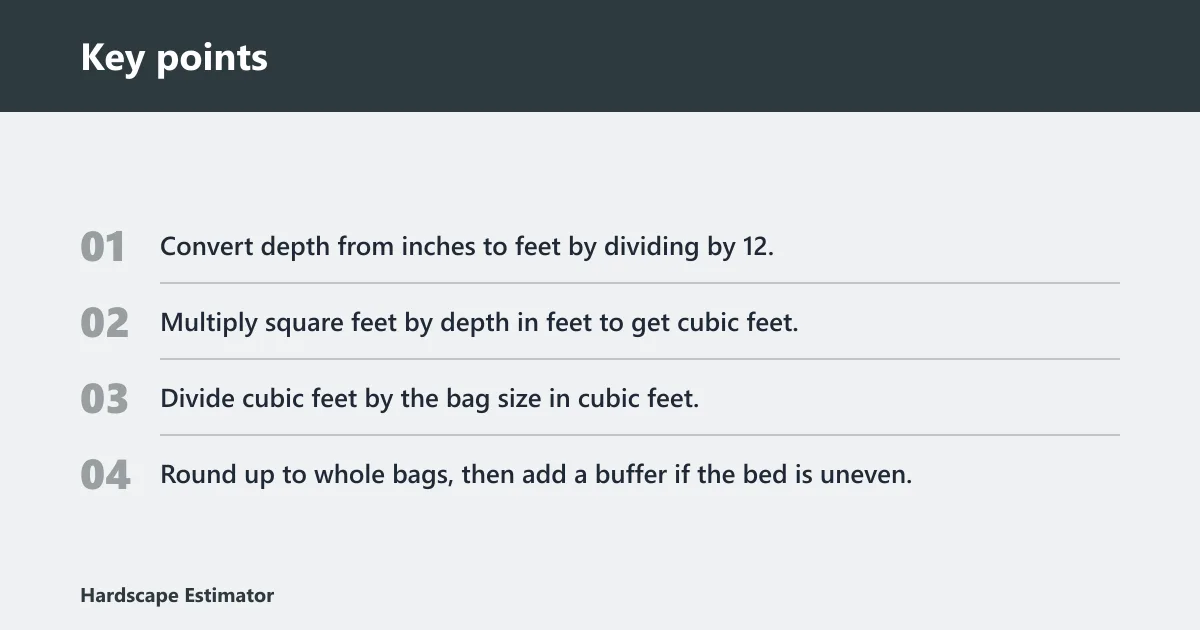
- Convert depth from inches to feet by dividing by 12.
- Multiply square feet by depth in feet to get cubic feet.
- Divide cubic feet by the bag size in cubic feet.
- Round up to whole bags, then add a buffer if the bed is uneven.
Worked example at 2 inches
For 200 square feet at 2 inches, the volume is 200 × 2 ÷ 12 = 33.33 cubic feet. That equals 16.67 bags of 2 cu ft mulch, so the minimum buy is 17 bags. With a 10% buffer, the order rises to 18.33 bags, so the safer buy is 19 bags.
Worked example at 4 inches
For 200 square feet at 4 inches, the volume is 200 × 4 ÷ 12 = 66.67 cubic feet. That equals 33.33 bags of 2 cu ft mulch, so the minimum buy is 34 bags. With a 10% buffer, the safer buy is 37.33 bags, so the order becomes 38 bags.
Should you buy bagged or bulk mulch?
Bagged mulch fits small jobs, tight access, or cases where you want to move the material in smaller loads. Bulk mulch is sold by the cubic yard and often costs less once the order gets larger. For 200 square feet, the better choice depends on delivery, minimums, and your local price per yard.
When bagged mulch fits a 200-square-foot bed
Bagged mulch is practical if you need a precise quantity and want to avoid leftover material. Most hardware stores stock 1 cu ft, 1.5 cu ft, 2 cu ft, and 3 cu ft bags, and a 2 cu ft bag also weighs about 20 lbs dry to 40+ lbs wet, so handling matters.
When bulk mulch may cost less
Bulk mulch can lower the material price when the yardage is high enough to offset delivery. Delivery and minimum order rules can change the final total. One cubic yard equals 27 cubic feet, so the math stays simple once you know the delivery charge.
Quick comparison for 200 square feet
At 3 inches deep, 200 square feet needs 50 cubic feet of mulch, which is 1.85 cubic yards. That is a small bulk order, so bagged mulch may be easier if the store does not charge much per bag, while bulk may win if the supplier has a low delivery fee and no large minimum.
Common mistakes
Most bad mulch orders come from unit mix-ups or from treating a level-bed estimate like a final delivery count. A bed that looks square on paper can still need more mulch if the edges curve, the ground slopes, or the border is loose.
- Mixing square feet with cubic feet. Square feet measure area; cubic feet measure volume.
- Forgetting to round up. A partial bag is not a purchase option.
- Buying to the exact math on uneven ground. Add a buffer if the bed is sloped or irregular.
- Spreading too thin. Thin mulch breaks coverage faster and shows more soil.
- Spreading too deep. Excess depth can crowd stems and plant crowns.
What happens if you spread mulch too thin or too deep?
Too thin leaves bare spots faster and reduces weed suppression. Too deep can trap moisture against stems and make the bed look heavy. For most flower beds, 2 to 4 inches is the common range, with 3 inches often used as a practical middle ground.
Picture a 200-square-foot bed with a curved edge and a low spot near one corner. The math may still say 17 bags of 2 cu ft mulch at 2 inches, but a 19-bag order gives room for the low area without forcing a second trip.
How much mulch should I buy if my bed is uneven or sloped?
If the bed is uneven or sloped, buy above the minimum. A 10% buffer is a practical starting point, and 10% to 15% is reasonable when the ground varies a lot or the border is irregular. That turns a 17-bag minimum into 19 bags of 2 cu ft mulch at 2 inches, or 25 bags into 28 bags at 3 inches.
Should I round up when buying bagged mulch?
Yes. Round up to whole bags every time. Bagged mulch is sold in fixed units, so the final order must cover the full calculated volume. If the math lands between counts, choose the next whole bag and add one more if the bed shape is irregular.
Suppose your bed is 200 square feet, but one side has a soft curve that makes the true area a bit larger than the sketch. The safe move is to keep the depth at 3 inches and order 28 bags of 2 cu ft mulch instead of 25, because the extra three bags cover the shape error.
Frequently asked questions
How many bags of mulch do I need for 200 square feet?
For a level 200-square-foot bed, the minimum is 17 bags at 2 inches, 25 bags at 3 inches, or 34 bags at 4 inches if you buy 2 cu ft bags. For a safer order, add about 10% and round up: 19, 28, or 38 bags.
How many 2 cubic foot bags cover 200 square feet at 2 inches?
It takes 17 bags to cover 200 square feet at 2 inches with 2 cu ft bags. That count comes from 33.33 cubic feet total volume, divided by 2 cubic feet per bag, then rounded up. For a buffer, order 19 bags instead.
How many 2 cubic foot bags cover 200 square feet at 3 inches?
It takes 25 bags to cover 200 square feet at 3 inches with 2 cu ft bags. The math is 200 × 3 ÷ 12 = 50 cubic feet, then 50 ÷ 2 = 25 bags. A safer buy is 28 bags if the bed is uneven.
How much area does one bag of mulch cover?
Coverage depends on bag size and depth. A 2 cu ft bag covers 12 sq ft at 2 inches, 8 sq ft at 3 inches, and 6 sq ft at 4 inches. Smaller and larger bags cover less or more area in direct proportion to their volume.
How much mulch do I need for 50 square feet?
For 50 square feet at 3 inches deep, you need 12.5 cubic feet of mulch. That is 7 bags of 2 cu ft mulch, 9 bags of 1.5 cu ft mulch, or 5 bags of 3 cu ft mulch, all rounded up. Add one more bag if the bed is uneven.