Why Is Landscape Fabric Not Letting Water Through?
Fabric usually stops water because it is clogged with soil, silt, mulch fines, or roots, or because the soil below drains too slowly; if water beads on top after a hose test, diagnose drainage before replacing the fabric. Ignore the cause, and you can end up with puddles, soggy beds, and dead plants, while repeated swaps waste money. This guide shows how to tell clogging from grading or soil problems, and when fabric type is the real issue.
Does fabric allow water to pass through?
Yes, fabric is meant to be somewhat porous, so water and air can move through it. The problem is that flow depends on fabric type, thickness, and what has collected on top of it. A clean sheet of fabric behaves very differently from one loaded with silt, mulch fines, or roots.
Permeable is not the same as fast-draining
Fabric is sold in two forms: woven and spun fabric. Both are intended to let water through, but the flow rate is not equal. A tighter product drains more slowly, and a clogged product can act like a barrier even though it was never meant to be waterproof. (Illinois)
That difference matters in beds, gravel paths, and around patios. Some rain may move through the cloth, while some water can flow over the top if the surface is compacted or if the openings are partly blocked. A deep soaking rain can also leave some soil dry beneath fabric, which is a sign that water is not moving down evenly.
What normal drainage looks like
When fabric is working, water should soak in and disappear at a steady pace after rainfall or watering. A brief sheen of standing water on the surface is not unusual during heavy rain, but it should not remain there for long. If a hose test leaves puddles for hours, that usually suggests drainage is being limited below the fabric.
Why is water pooling on top?
Water pools on top when the fabric cannot pass it down as quickly as it arrives, or when the soil below has nowhere to send it. The most common causes are clogged pores, clay-heavy soil, compacted subgrade, poor grading, or a fabric choice that is too dense for the job.
Clogged pores from debris
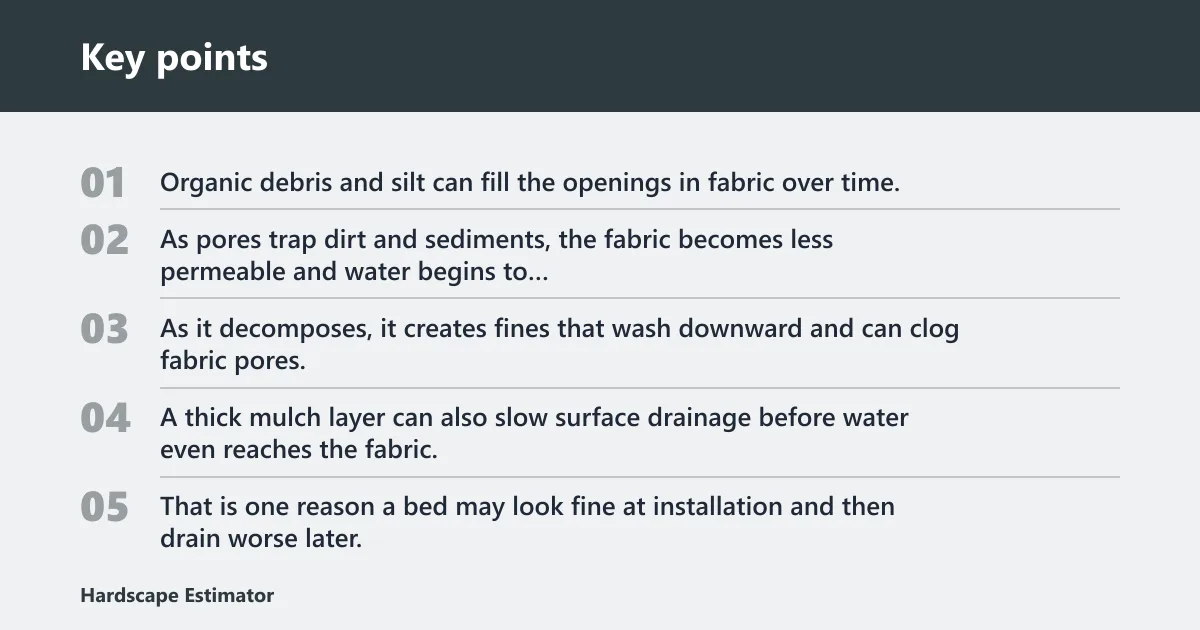
Organic debris and silt can fill the openings in fabric over time. That is a slow failure, not an instant one. As pores trap dirt and sediments, the fabric becomes less permeable and water begins to sit on top instead of soaking in.
Mulch can add to the problem. As it decomposes, it creates fines that wash downward and can clog fabric pores. A thick mulch layer can also slow surface drainage before water even reaches the fabric. That is one reason a bed may look fine at installation and then drain worse later.
Clay soil below the fabric
Clay-heavy soil often drains slowly and can contribute to ponding above the fabric. It drains slowly on its own, so fabric above it may get blamed unfairly. If the soil below stays saturated, water cannot move away fast enough, and the surface begins to pond even when the fabric is still partially open.
Suppose a 12 ft by 8 ft planting bed gets a deep watering and the surface stays glossy for an hour. If the fabric is clean but the native soil is sticky and slow-draining, replacing the cloth will not solve the puddling. The limiting layer is below it.
Compacted subgrade
Compacted subgrade behaves like a sealed base. It is common under gravel paths, patios, and older beds that were driven on or packed down during construction. When the base is tight, water has trouble moving through the soil profile, so the fabric becomes a holding point instead of a passage.
A common first-timer mistake is replacing fabric under a gravel walkway when the real issue is the compacted base beneath the gravel. The new fabric may look better, but the water still has nowhere to go.
Fabric drainage table
Use the symptom first. Then check the likely cause with a simple hose test or a small dig test. The goal is to fix the layer that is actually failing, not just the one that looks dirty.
| Symptom | Likely cause | Quick test | Fix |
|---|---|---|---|
| Water sits on top after rain | Clogged fabric | Lift a corner and check for mud, silt, or roots packed into the pores | Clean what is salvageable, then replace if the pores are loaded |
| Surface drains slowly everywhere | Clay soil | Dig about 6 to 8 in. below the fabric and feel whether the soil stays sticky and wet | Improve soil drainage or install a proper drainage layer |
| Puddles return after traffic or settling | Compacted subgrade | Probe the base under the fabric; if it feels hard and dense, infiltration is limited | Loosen or rebuild the base before reinstalling fabric |
| Top of bed stays wet and slimy | Too-thick mulch | Measure mulch depth; if fines have built up, water may be trapped above the cloth | Reduce mulch depth and remove decomposed material |
| Water runs off instead of soaking in | Tight woven fabric | Check the label or product type; woven fabric usually drains more slowly than non-woven | Switch to a more open product where filtration is the goal |
| No water passes through at all | Plastic sheeting | Look for an impervious sheet with no breathable structure | Remove it and replace with a permeable drainage material |
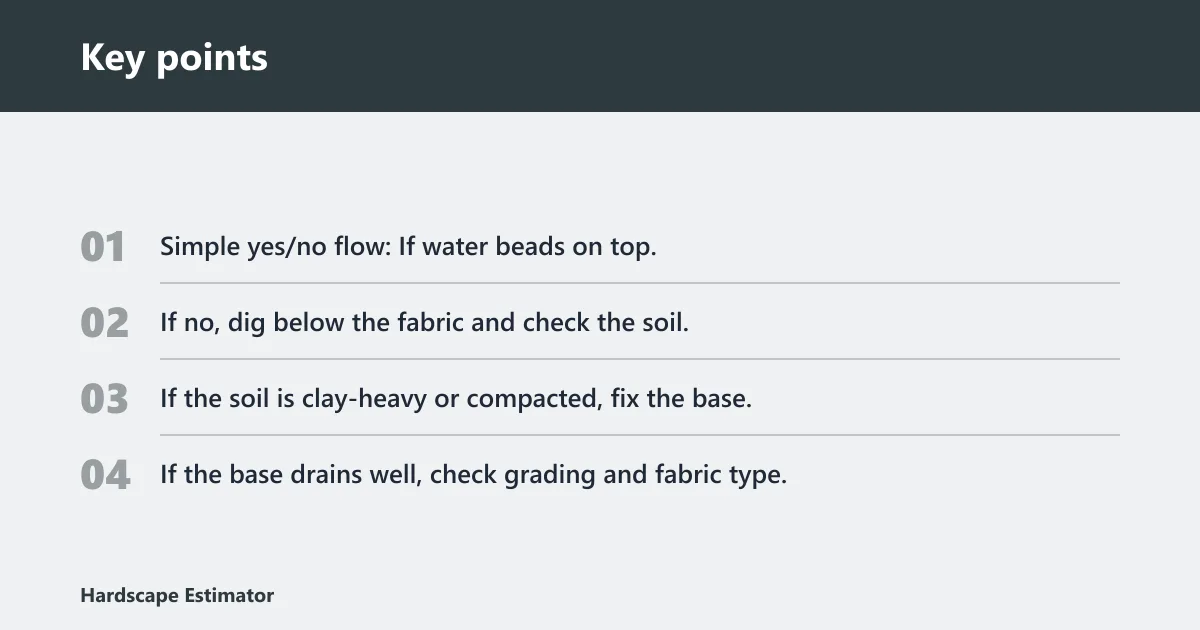
Simple yes/no flow: If water beads on top, ask whether the fabric is dirty or packed with fines. If yes, clear or replace it. If no, dig below the fabric and check the soil. If the soil is clay-heavy or compacted, fix the base. If the base drains well, check grading and fabric type.
Which fabric type drains best?
Non-woven geotextile is usually the better choice when drainage matters more than weed control. Woven fabric has a tighter weave and is better for stabilization than drainage. Non-woven geotextile is made by needle punched or bonding fibers together, and it is highly water permeable.
Woven fabric
Woven fabric is useful where you want separation and some stabilization under gravel, drives, or block paving. It still allows water through, but the tighter weave can slow passage. Growtivation warns that woven fabric on drives can reduce drainage, and standard weight woven fabric under block paving can cause pooling.
Non-woven geotextile
Non-woven geotextile fits drainage jobs better because it is more open and filters water while letting it move through. That makes it a better match for French drains, gravel trenches, and filtration layers. For drainage work, the goal is not weed suppression alone. The goal is free movement of water without losing the gravel or soil layer.
Choose by use case
Use woven fabric when the main goal is separation under a path or drive and the base is already well drained. Use non-woven geotextile when the job depends on flow, filtration, and keeping gravel clean around pipe and stone. Do not treat the two products as interchangeable.
How soil and grading change drainage
Proper grading has to move water away before fabric can help. If the surface slopes the wrong way, water will sit no matter how breathable the fabric is. Soil type matters too. Clay-heavy soil can slow infiltration enough to make a good fabric look bad.
Grading comes first
When a bed, path, or patio edge slopes toward a foundation or a low spot, water will collect there. Fabric cannot correct a reverse slope. Before replacing anything, check whether the surface falls away from the structure and whether the low point is trapping runoff.
Compaction under gravel and beds
Compaction often shows up after construction, edging work, or repeated foot traffic. Under gravel paths and planting beds, a tight base can behave like a bowl. Even a porous fabric will not drain well if the water cannot pass into the subgrade below it.
Picture a 4 ft wide gravel path that stays muddy after a storm. If the fabric is still intact but the base was packed hard during installation, the right fix is not another roll of the same cloth. The base needs to be opened up, regraded, or rebuilt so water has a path out.
How to fix the drainage problem
Start with the layer that is easiest to inspect. Surface debris, mulch depth, and grading are faster to check than full replacement. Only after those are ruled out should the fabric itself be blamed. That order saves labor and avoids replacing the wrong material.
- Remove loose leaves, soil, and decomposed mulch from the surface.
- Check mulch depth and reduce it if fines have built up.
- Run a hose test and note whether water beads, drains slowly, or disappears normally.
- Dig a small inspection hole to check the fabric and the soil below it.
- Correct grading if water slopes toward the bed, path, or structure.
- Replace the fabric only if the pores are loaded or the product type is wrong for the job.
If you are dealing with a French drain setup, the fix is different from a weed-control bed. French drains typically use a drainage geotextile around the pipe and gravel so water can move through while fines stay out. That is a higher-flow use case than a decorative bed.
Redo cost matters
Drainage failure is not just inconvenient. It can mean repeated replacement, extra labor, plant loss, and a second round of gravel or mulch removal. If the wrong fabric is used under a patio or drain, the redo often costs more than choosing the correct material the first time.
When to replace fabric or switch materials
Replace the fabric when cleaning cannot restore flow, when roots have filled the openings, or when the product is too dense for the application. Switch materials when the site needs filtration or drainage performance that weed-barrier cloth cannot provide. Plastic sheeting is not the answer.
Signs the fabric is beyond cleaning
If dirt and sediments have packed the pores so tightly that water still beads after clearing the surface, the fabric is past the point of simple repair. Fabric helps suppress weeds only for a couple of years, and drainage performance can drop as the openings clog. At that stage, replacement is usually the practical choice.
When to use non-woven geotextile instead
Use non-woven geotextile when the project is a drain, a gravel trench, or any installation where water movement matters more than weed suppression. It is more porous than woven fabric and is the better fit for filtration. If the current cloth is woven and the site keeps pooling, the material choice may be the real problem.
When plastic sheeting is the wrong choice
Plastic sheeting blocks water completely and does not let water pass through. It should not be confused with permeable fabric. If the goal is drainage, plastic is the wrong substitute. It may stop weeds, but it also stops the water that plants and soil need to move through the bed.
Frequently asked questions
Why is my fabric not letting water through?
The usual causes are clogging, slow-draining soil below the fabric, compacted subgrade, poor grading, or a fabric that is too tight for the application. If water beads on top after a hose test, check the soil and base before replacing the fabric.
Why does fabric hold water?
It usually does not hold water by itself. Water stays on top when the pores are clogged or when the soil below cannot absorb it fast enough. Clay-heavy soil and compacted bases are common reasons the fabric looks like the problem when it is really the site conditions.
What type of fabric drains best?
Non-woven geotextile usually drains best because it is more porous and better suited to filtration and French drains. Woven fabric is tighter and usually drains more slowly. Use woven products for separation and stabilization, not where high flow is the main goal.
Should I use plastic instead of fabric?
No, not if drainage matters. Plastic sheeting blocks water completely and is not a substitute for breathable fabric. It may control weeds, but it also traps moisture and can worsen water problems in beds, paths, and drain-adjacent areas.
Can clogged fabric cause drainage problems?
Yes. Clogged fabric can make water sit on top instead of soaking in. As pores trap dirt and sediments, the fabric becomes less permeable. That is why a bed may drain well at first and then fail after a season or two of mulch breakdown and surface buildup.