How to Measure a Round Bed in Square Feet
Measure the widest point across the bed, divide by 2 for the radius, then use area = 3.14 × r²; a 10 ft round bed is roughly 78.5 sq ft. A bad measure can leave you short on mulch or stuck paying for extra material. This guide shows the fastest field method, the area formula, and how to turn square feet into mulch, fertilizer, and plant counts.
This guide is part of our Yards to square feet: conversion and calculator series.
Measuring and calculating area for a round bed
Use the widest straight-line measure you can get, then convert it to radius and square the radius. For a true circle, area = 3.14 × radius², and radius is the distance from the center to the edge. If diameter is easier to read, divide it by 2 first.
What you’ll need
- Tape measure marked in feet and inches
- Paper or phone notes for the numbers
- Calculator
- Stakes or a string line if shrubs or edging block the center
Measure the bed with the right tape reading
- Find the widest span. Stretch the tape across the bed through the center if possible. If a shrub or planter blocks the center, measure edge to edge at the widest visible point and note that it is a diameter estimate.
- Convert inches to feet. Divide inches by 12 before calculating. A 7 ft 6 in radius is 7.5 ft, not 7 ft 6 in in the formula.
- Apply the circle formula. Square the radius, then multiply by 3.14. That gives square feet for a round bed.
- Round for ordering. For mulch or planting material, round up to the next practical number. If the bed is 78.5 sq ft and bags cover 2 sq ft each, order 40 bags, not 39.
Say your bed measures 10 ft across. The radius is 5 ft, so the area is 3.14 × 5² = 78.5 sq ft. If you are buying mulch in 2-cubic-foot bags, that square footage still helps you pick a depth target before you convert to volume.
Do I use the diameter or the radius for a circle bed?
Use the radius in the area formula, not the diameter. Diameter is the distance across the whole circle through the center, and radius is half of that. If you start with diameter, divide by 2 first. Using diameter where radius is needed makes the area about four times too big.
Quick circle formula check
- Diameter known: divide by 2 to get radius
- Radius known: plug it in directly
- Circumference known: convert to radius first
- Half-circle shape: calculate full circle, then cut it in half
| Setup | Measurement to take | Formula | Result method | Rounding note |
|---|---|---|---|---|
| Diameter known | Measure across the widest point | Area = 3.14 × (diameter ÷ 2)² | Divide diameter by 2, then square that radius | Round up after the final area |
| Radius known | Measure from center to edge | Area = 3.14 × radius² | Square the radius, then multiply by 3.14 | Keep one decimal place for ordering |
| Circumference known | Measure around the outside edge | radius = circumference ÷ 6.28; then Area = 3.14 × radius² | Convert circumference to radius before calculating area | Round radius to the nearest tenth only if needed for purchase math |
| Half-circle edge case | Measure the flat edge across the center line | Half area = 0.5 × (3.14 × radius²) | Find full circle area, then multiply by 0.5 | Round up if the bed edge is clipped or irregular |
Worked example
A 15 ft wide pool has a 7.5 ft radius and covers 176.7 square feet. The math is 3.14 × 7.5 × 7.5 = 176.7. That same process works for a round bed. If the tape says 12 ft across, the area is 3.14 × 6² = 113.1 sq ft.
How do I measure a half-circle bed in square feet?
Measure the flat edge as the diameter of the full circle, divide by 2 for radius, and calculate half of the full-circle area. A semicircle uses half of the circle-area formula. This is the right approach for beds against a wall, fence, driveway, or curved patio edge.
Half-circle workflow
- Measure the flat side. Treat that straight edge as the diameter. If it reads about 8 ft, the radius is about 4 ft.
- Find the full circle area. Multiply 3.14 by the radius squared. For a 4 ft radius, that is 3.14 × 16 = 50.24 sq ft.
- Cut the area in half. Multiply by 0.5. The semicircle area is about 25.12 sq ft.
- Round for ordering. For mulch, round up to the next bag or yard because edge shape and depth vary in the field.
How do I measure a circular bed if I only know the circumference?
Convert the circumference to radius first, then use the circle area formula. A 31.4 ft circumference converts to a 5 ft radius. From there, area is about 3.14 × 5², or roughly 78.5 sq ft. Do not skip the conversion, or the area will come out wrong.
Circumference-to-area shortcut
- Measure around the edge. Wrap the tape or a string along the outside perimeter. Record the full circumference in feet.
- Divide by 6.28. That gives the radius. For 31.4 ft, the radius is 5 ft.
- Square the radius. Then multiply by 3.14 to get square feet.
- Round up usefully. If the result is 78.5 sq ft, plan for 79 sq ft of coverage before converting to mulch or plant counts.
How do I estimate an oval or irregular bed?
An oval bed uses pi times major radius times minor radius. For a mostly round bed with clipped corners, or a kidney-shaped bed, the fastest acceptable estimate is to break it into simpler shapes or use equally spaced width lines. Choose the method that matches the bed shape and the time you have.
Oval bed or ellipse
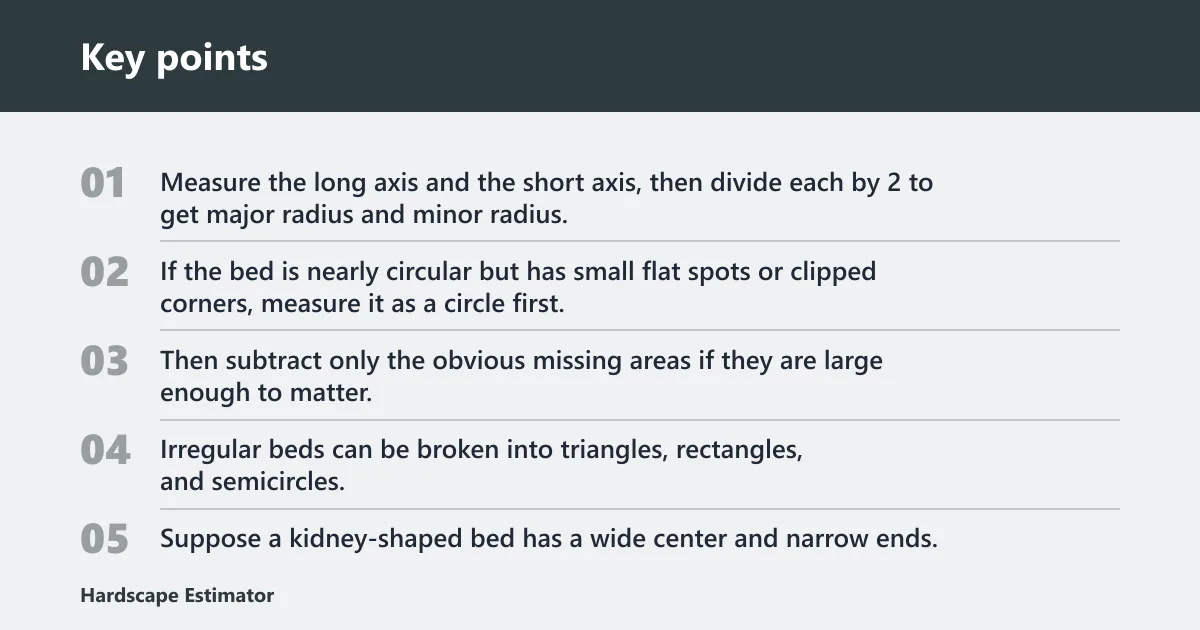
Measure the long axis and the short axis, then divide each by 2 to get major radius and minor radius. Area = 3.14 × major radius × minor radius. This works well when the bed is smooth and symmetrical.
Mostly round bed with clipped corners
If the bed is nearly circular but has small flat spots or clipped corners, measure it as a circle first. Then subtract only the obvious missing areas if they are large enough to matter. For most mulch orders, a round-bed estimate with a little rounding up is faster and safer than chasing exact shape fragments.
Broken-up shape estimate
Irregular beds can be broken into triangles, rectangles, and semicircles. That is the cleanest way to handle a bed that wraps around a walkway or tree ring. Another option is equal spacing: measure perpendicular width lines at equal intervals, such as every 3 feet, then multiply the sum of those width lines by the segment width.
Suppose a kidney-shaped bed has a wide center and narrow ends. If the shape is hard to split cleanly, take width lines every 3 ft across the bed. Add the widths, then multiply by 3 ft. It is an estimate, but it is usually good enough for mulch and planting quantities.
How much mulch do you need?
Square footage is the starting point, but mulch is ordered by volume and bag coverage. After you know the bed area, choose a depth, then convert area to cubic feet or cubic yards. A bed area of 78.5 sq ft at 2 in depth needs less material than the same bed at 3 in depth.
Turn area into ordering math
- Pick a mulch depth. Common depths are 2 in to 3 in for beds.
- Convert depth to feet. Divide inches by 12. Two inches is about 0.167 ft.
- Multiply area by depth. 78.5 sq ft × 0.167 ft = about 13.1 cubic ft.
- Convert to bags or yards. Check the bag label for coverage, then round up. For bulk mulch, divide cubic feet by 27 to get cubic yards.
A common first-timer mistake is ordering exactly the calculated amount and coming up short at the edges. Add a little extra for a bed with border stones, root flares, or uneven depth. A 10 percent cushion is a practical adjustment when the shape is hard to measure cleanly.
Common mistakes
The biggest errors come from mixing up radius and diameter, skipping inch-to-feet conversion, and rounding too early. Those mistakes change the order more than the final decimal does. If a bed is partly blocked by shrubs or edging, measure the clearest equivalent span and note the assumption.
- Using diameter in the radius formula
- Leaving inches in the calculation
- Forgetting that a semicircle is half a circle
- Using a circle formula for an oval bed
- Trying to force an irregular bed into one exact shape
- Rounding down before ordering material
If a bed has one clipped corner or a small notch, do not rebuild the whole shape from scratch. Estimate the main circle or oval first, then adjust only the missing section. That is usually fast enough for buying mulch, fertilizer, or a plant count.
Round bed field checklist and calculator
Use this checklist on site, then run the matching formula. It keeps the measurement workflow short and reduces the chance of using the wrong circle value.
| Field check | What to record | Formula to use | Order-rounding note |
|---|---|---|---|
| Diameter known | Widest straight-line distance across the bed | Area = 3.14 × (diameter ÷ 2)² | Round up to the next usable area or bag count |
| Radius known | Center-to-edge distance | Area = 3.14 × radius² | Keep one decimal place if buying by coverage |
| Circumference known | Outside perimeter length | radius = circumference ÷ 6.28; then Area = 3.14 × radius² | Round radius only after the conversion if needed |
| Half-circle | Flat edge across the diameter line | 0.5 × (3.14 × radius²) | Round up because edge shape is often imperfect |
- Measure the easiest span. Use diameter if you can reach across the bed. If the center is blocked, use circumference or an estimated center-to-edge radius.
- Convert to radius. Divide diameter by 2, or divide circumference by 6.28.
- Calculate area. Use 3.14 × radius² for a full circle, or multiply by 0.5 for a semicircle.
- Adjust for purchase. Round up to the next bag, yard, or plant count so the order covers real-world edges.
Frequently asked questions
How do I measure a round garden bed in square feet?
Measure the diameter, divide by 2 for radius, then use area = 3.14 × radius². If the bed is blocked, circumference works too: divide by 6.28 to get radius first. The result is square feet, which you can use for mulch or plant counts.
How do I estimate an oval or kidney-shaped bed in square feet?
For an oval, measure the long and short spans, divide each by 2, then use 3.14 × major radius × minor radius. For a kidney shape, break it into rectangles, triangles, and semicircles, or use equal width lines every 3 ft for a fast estimate.
How much mulch do I need once I know the square footage?
Pick a depth, convert inches to feet, and multiply by square footage to get cubic feet. Then divide by 27 for cubic yards or check bag coverage on the label. Round up so the bed gets full coverage at the edges and around plants.