Is Polymeric Sand Permeable and Does It Drain Water?
Polymeric sand is generally not treated as a truly permeable paving material; some water can pass through open joints, but the system still depends on the base, slope, and joint layout for drainage. If you assume the joints will drain like a permeable paver system, you can trap water, stain the surface, or pay for a rebuild. This guide compares joint drainage with system drainage, shows where polymeric sand fits, and explains how joint width and base design change the answer.
Quick answer: does polymeric sand drain water?
Yes, but only to a limited extent. Water can move through some polymeric sand joints, especially when the joints are narrow, the fill is clean, and the joints are not overpacked or sealed on top. That is not the same as a permeable paving system, which is built so water can move through the surface and into a drainage layer below.
The binder changes the path. It helps lock the grains together after watering, so the joint resists erosion and washout. That makes the joint more stable, but it also means the fill is not open in the same way as loose sand or a permeable joint medium.
What water can pass through
Water may pass through gaps in the joint fill and into the base below. How much gets through depends on the joint width, how tightly the sand was compacted, whether fine dust was left on the surface, and whether the product formed a crust that limits flow at the top.
What the binder changes
Polymeric sand is a joint filler used between paver joints after installation. It contains a binder that activates with water, then hardens enough to resist movement. That bond is the point of the product, and it is also why it is not a free-draining joint medium in the same category as permeable jointing sand.
Why this is not a permeable system
A permeable system is built for drainage from top to bottom. Standard polymeric sand is built first to hold joints together. If the base, slope, and drainage outlet are wrong, water can still sit in the assembly even if the joints appear to pass some moisture.
Polymeric sand vs permeable jointing sand
Standard polymeric sand belongs in regular paver joints where the goal is joint lockup, cleaner edges, and less washout. Permeable jointing sand is a separate product category intended for drainage through permeable pavement systems. The label and the base design need to match the job.
Standard paver joints
For conventional patios, walkways, and driveways, polymeric sand fills the joints after installation and hardens with water activation. Product labels specify a maximum joint width, and market examples range from about 1/8 in to 6 in depending on the product line.
Permeable pavement joints
Permeable pavers need a jointing product intended for permeability, not standard filler. Those systems also need open-graded aggregate and a base that moves water downward. A standard polymeric sand can reduce void space in the joint and change how the system drains.
Where each product belongs
Use standard polymeric sand when the goal is joint stability and washout resistance. Use permeable jointing sand when the design goal is infiltration through the pavement section. The products are not interchangeable, even when both are sold for paver joints.
Will polymeric sand drain water here?
It depends on the paver type, the joint width, and the drainage goal. On a standard patio with narrow joints and a drained base, some water may move through the joints. On a permeable system, steep runout, or a saturated area, the same material can restrict flow and create trouble.
How joint width changes drainage and washout
Wider joints can admit more water at the surface, but they also raise the risk of voids, erosion, and movement if the product is not rated for that width. The label matters because joint-width ratings tell you where the binder and grain size can still hold up under traffic and rain.
Label limits and fit
Product ratings are the first filter. Gator Maxx G2 is marketed for joints up to 4 inches, Rhino Power Bond Plus is rated to 2 inches, and Alliance Gator Dust Bond is for joints up to 6 inches. Those are not drainage promises; they are fit limits for the joint size and expected movement.
Wide joints and erosion risk
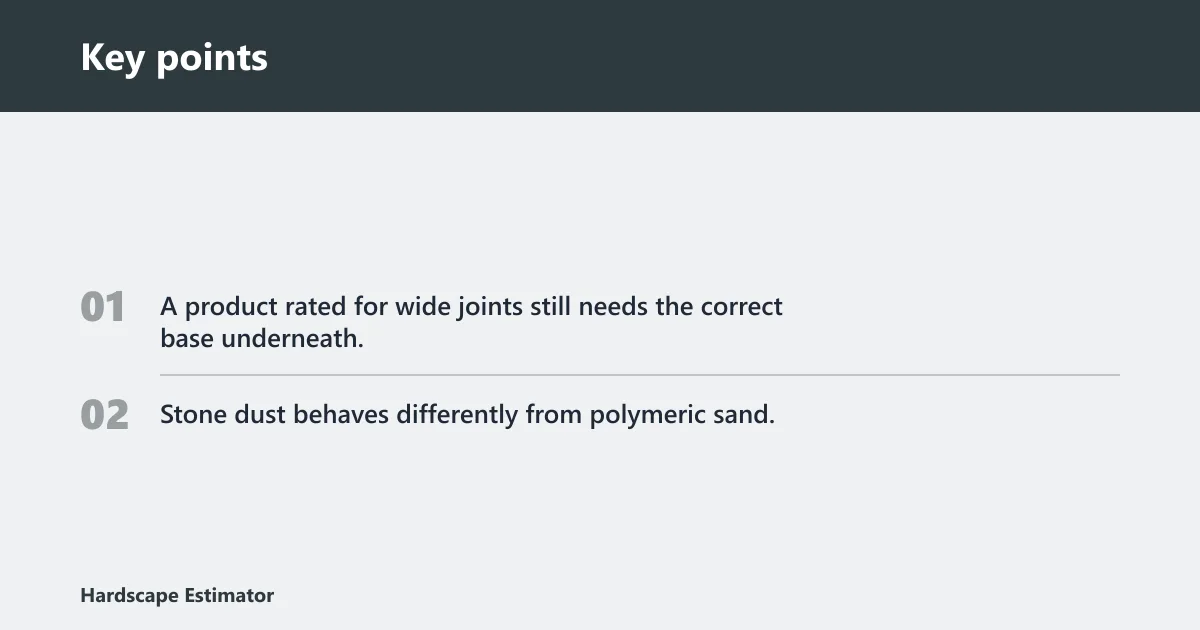
As joints get wider, water can move more freely at first, but the fill also has more room to settle, crack, and wash out. That matters most where runoff is strong or where the base is not built to carry water away. A product rated for wide joints still needs the correct base underneath.
When stone dust is a different category
Stone dust behaves differently from polymeric sand. It does not harden the same way, and it is not intended to give the same joint lock or haze resistance. For some installations, especially temporary or nonlocked fills, stone dust may belong in a different design category altogether.
| Will polymeric sand drain water here? | Joint width | Expected water behavior | Recommended product type | Red-flag failure modes |
|---|---|---|---|---|
| Standard pavers | About 1/8 in to the label limit | Some water can pass through joints, but drainage still depends on base slope and outlets | Standard polymeric sand | Haze on the surface, trapped water in a flat base, joint loss from poor cleanup |
| Permeable pavers | System-specific, often wider joints | Water should move through the section, not just through the top joint fill | Permeable jointing sand | Restricted infiltration, clogged openings, failure to match the open-graded base |
| Wide joints | Up to the product rating, such as 2 in, 4 in, or 6 in | More surface entry, but more chance of settling and washout if the product is undersized | Wide-joint polymeric sand only if the label allows it | Cracking, joint voids, erosion after storms |
| Steep slopes | Any width, but runoff pressure is higher | Water moves fast across the surface and can pull fines out of the joint | High washout resistance formula, if allowed by the project | Joint erosion, material sloughing, exposed edges |
| Pool decks | Usually narrow to moderate | Frequent wetting makes surface cleanup and cure control more important than drain-through | Polymeric sand with good haze control and the right joint rating | White film, soft joints, residue near coping and drains |
How water activation and cure time work
Polymeric sand needs water to activate the binder. Some products need one watering, while older formulas may call for multi-pass soaking. Cure timing matters because the product has to start locking before the next rain, but too much water can push binder to the surface and create haze.
One-watering formulas
Some newer products are designed for a single watering pass. Gator Maxx G2 says it needs one watering, and Gator Super Sand G2 uses the “30-30” watering method. These claims point to simpler activation, but the joint still needs the right fill depth and cleanup.
Older multi-pass watering claims
Older formulas may ask for repeated watering to drive activation deeper through the joint. That can be useful in taller or wider joints, but it also raises the risk of overwatering if the installer keeps adding water after the binder has already begun to migrate.
Rain-safe timing and what it really means
Rain-safe claims are short cure claims, not drainage claims. Gator Maxx G2 and Gator Super Sand G2 are marketed as rain safe in about 15 minutes, while some earlier versions have referenced roughly one hour. That means the surface may resist a light shower sooner, not that the pavement will drain like a permeable system.
-
Compact the joints.
Fill the joints to the label depth, then compact the sand so there are no loose pockets. Dense joints resist washout better and leave fewer voids that can collect water and settle later.
-
Remove surface residue.
Brush all dry material off the paver face before watering. Leftover grains can bond to the surface and create haze or a white film, especially on textured stone and lighter colors.
-
Water exactly as directed.
Use the number of passes and flow rate the label calls for. Too little water leaves weak joints; too much water can move binder onto the surface and reduce the joint’s clean drainage path.
-
Protect the cure window.
Keep foot traffic and runoff off the surface until the product has set. Rain-safe wording helps with scheduling, but a fast storm can still disturb the joint if the material has not started locking.
Say a patio of about 300 sq ft uses narrow joints and the label allows roughly a 1/8 in to 1/2 in fill. If the installer leaves dust on the top and then overwaters, the top film can harden while the joint below stays weak. That is a cleanup problem first, and a drainage problem second.
Why haze and residue happen
Haze happens when binder or fines remain on the paver surface after activation. It is a common failure mode because the surface film can look like dried dust at first, then turn into a white residue that is hard to remove. It also gives a false impression that the joints are sealed shut.
Surface cleanup
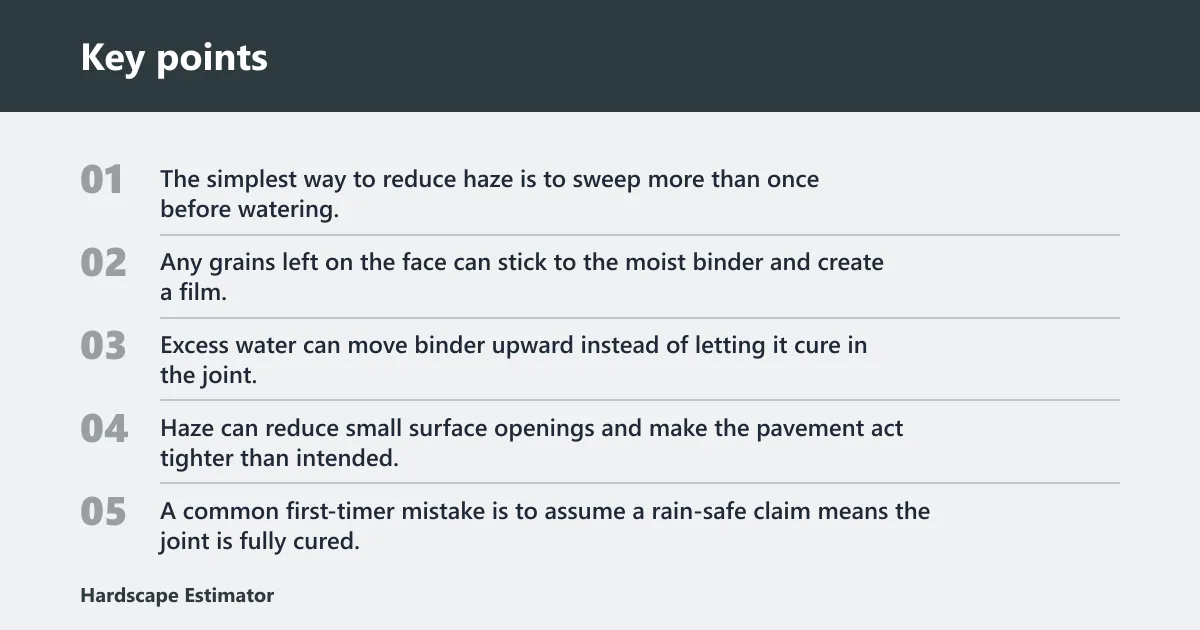
The simplest way to reduce haze is to sweep more than once before watering. Any grains left on the face can stick to the moist binder and create a film. That matters most on textured pavers, where residue hides in low spots and along chamfered edges.
Overwatering and binder migration
Excess water can move binder upward instead of letting it cure in the joint. That weakens the fill and makes the top layer look sealed even when the lower section is not stable. It can also make readers think the product blocks water more than it really does.
How haze affects drainage expectations
Haze can reduce small surface openings and make the pavement act tighter than intended. That does not prove the system is permeable or nonpermeable by itself, but it does show why water activation and cleanup affect both appearance and water movement.
A common first-timer mistake is to assume a rain-safe claim means the joint is fully cured. It does not. Rain-safe timing is only one part of the installation, and it does not override joint width limits, compaction quality, or the drainage design under the pavers.
When polymeric sand is the wrong choice
Polymeric sand is the wrong choice when the project needs a permeable joint medium, when runoff is intense enough to attack the joint face, or when the base design depends on open flow. In those cases, the label, the base, and the water path all need to be matched before a product goes into the joints.
Permeable pavers
Permeable paver systems need a product intended for permeability, not standard polymeric sand. The goal is to move water through the section, and a binder-heavy joint fill can work against that goal by reducing the open space the system depends on.
Steep slopes
On steeper slopes, water speed matters as much as water volume. Fast runoff can strip fine material from the joint before it locks, so washout resistance becomes more important than simple filling. That is where products like Rhino Power Bond Plus, which claims to lock joints against erosion and washout, are aimed.
Pool decks and saturation-prone areas
Pool decks see frequent wetting, splashing, and cleaning. A product with haze control and a joint rating that matches the stone size is the better fit there, because surface residue and joint stability are usually bigger issues than long-term infiltration.
Freeze-thaw exposure
Some products claim flexibility with temperature swings, and that can matter where freeze-thaw movement pushes joints apart. That is still not a drainage feature. If the base traps water, the system can move and heave no matter how flexible the joint binder is.
Frequently asked questions
Is polymeric sand permeable, or does it block water like regular sand?
It is not a true permeable joint medium. Some water can move through the joint, but the binder reduces open voids and changes the flow path. That means it can pass some water while still acting as a joint-locking material rather than a drainage layer.
Does polymeric sand drain water through paver joints?
Sometimes, but only partly. Drainage depends on the joint width, how the product was compacted, how much residue was left on top, and whether the base below can move water away. It should not be treated as the same thing as a permeable paving system.
What is the difference between polymeric sand and permeable jointing sand?
Polymeric sand is made to lock standard paver joints and resist washout. Permeable jointing sand is made for systems that need water to move through the pavement section. The right choice depends on whether the project needs joint stability or infiltration.
Can you use polymeric sand on a permeable paver system?
Usually no, unless the product label and the system design specifically allow it. Permeable pavers depend on open flow through the joints and into the base, and standard polymeric sand can reduce that flow. Check the system requirements before filling the joints.
Which polymeric sands are rated for wider joints?
Market examples in the store include Gator Maxx G2 for joints up to 4 inches, Rhino Power Bond Plus to 2 inches, and Alliance Gator Dust Bond for joints up to 6 inches. Those ratings are product-specific, so the label must match the actual joint width.
How much watering does polymeric sand need to activate properly?
It depends on the formula. Some products need one watering, while older formulas may call for multi-pass soaking. The same source says it needs one watering, and Gator Super Sand G2 uses the “30-30” watering method, which shows how differently products can be activated.
How soon can rain hit polymeric sand after installation?
Some products are marketed as rain safe in 15 minutes, while older versions have referenced about one hour. That claim means the surface can tolerate rain sooner, not that the joint is fully cured or that the system will drain like a permeable pavement.
Will polymeric sand haze or clog the surface if installed wrong?
Yes. Leftover material on the face, overwatering, and poor cleanup can leave a white film or residue. That haze can make the surface look sealed and can reduce the small openings that let water enter the joint, so installation matters as much as product choice.
What joint widths are allowed for polymeric sand versus stone dust products?
Polymeric sand is label-rated, and market products range from about 1/8 in to 6 in depending on the line. Stone dust is a different fill category with different lockup and drainage behavior, so the allowed width depends on the project design rather than a universal paver rule.