Can a Pickup Truck Carry a Pallet of Sod Safely?
Yes. A pickup can carry a pallet of sod only when the truck’s payload rating stays above the pallet weight with room to spare; many full-size pallets weigh about 2,000 to 3,000 lb. Too much weight can bend the suspension, overload tires, and make braking and steering unsafe. This guide shows how to check payload, estimate pallet weight, see if the pallet fits the bed, and split the load when it is borderline.
Can a pickup truck carry sod safely?
The safe answer starts with payload, not tow rating. Most half-ton pickup payload ratings are 1,500 to 2,300 pounds, while a standard sod pallet weighs 2,000 to 3,000 pounds, so many half-ton trucks fall short before passengers, fuel, tools, and tie-down gear are counted.
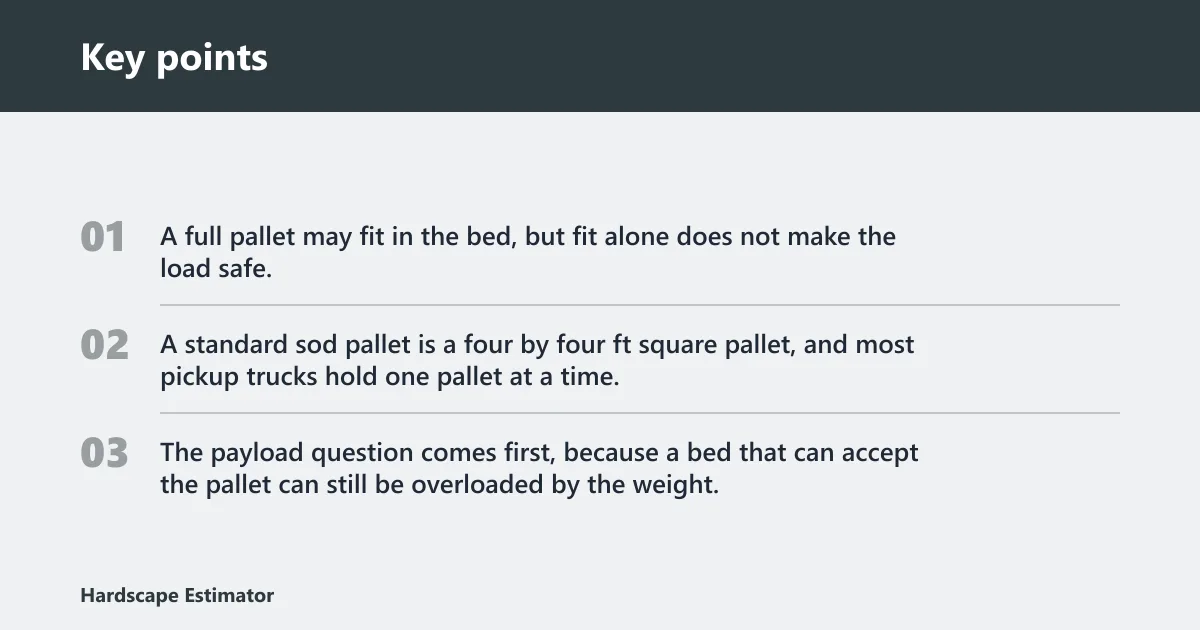
That is why one truck can work and another cannot. A payload sticker on the door jamb is the number that matters for the truck itself, while tow rating mainly applies to pulling a trailer. A full pallet may fit in the bed, but fit alone does not make the load safe.
Pickup vs. sod pallet decision table
| Truck class | Payload sticker range | Typical sod pallet weight | Safe haul verdict | Fallback option |
|---|---|---|---|---|
| Light half-ton pickup | 1,500 to 2,300 lb | 2,000 to 3,000 lb | Usually unsafe for a full pallet | Loose pieces, partial pallet, or delivery |
| Heavier half-ton with higher sticker | Near the top of the class range | 2,000 to 3,000 lb | Borderline unless the pallet is on the light end and the truck is otherwise empty | Partial pallet or medium utility trailer |
| 3/4-ton pickup | Often above half-ton range | 2,000 to 3,000 lb | More likely to handle a full pallet safely if axle and tire limits also work | Trailer if the order grows or the pallet is wet |
| Any pickup with passengers or gear aboard | Reduced by all added weight | 2,000 to 3,000 lb | Can become unsafe even if the empty truck looked adequate | Split the load or arrange delivery |
A standard sod pallet is a four by four ft square pallet, and most pickup trucks hold one pallet at a time. That is a physical fit question. The payload question comes first, because a bed that can accept the pallet can still be overloaded by the weight.
How much does a pallet of sod weigh for a pickup truck?

A standard sod pallet weighs 2,000 to 3,000 pounds, which is why it can exceed many pickup payload ratings before the truck even leaves the yard. A full pallet is heavy enough that wet turf, wet pallet boards, or rain can push a borderline load into an unsafe one.
Typical pallet size and footprint
The common footprint is four by four ft. That footprint matters because it is close to the width of a full-size pickup bed, but the weight is what drives the safety decision. The pallet itself, plus the turf, adds concentrated mass near the rear axle area.
Full pallet versus loose pieces
For smaller self-pickup jobs, the page recommends 50 to 80 loose pieces instead of a full pallet. Loose pieces can be a safer choice when the truck’s stickered payload is short of the full pallet weight, or when the truck also needs to carry people, tools, or other materials.
Say your truck’s payload sticker says 1,800 lb. A full pallet near 2,500 lb is already too heavy before anyone climbs in the cab or before rain adds extra moisture. In that case, loose pieces or delivery are the safer route.
Why wet sod weighs more
Wet sod adds weight many people miss. Moisture in the turf, damp pallet lumber, and a recent rain can add enough weight to change the decision. A pallet that looked manageable in dry weather can become borderline after a storm.
Picture a pallet that seems fine on a dry afternoon. If the same pallet sits through rain, the truck may no longer have enough margin for the rear axle, tires, and suspension travel. The safe answer changes with the weather.
Will a full pallet fit in the bed?
Most pickup trucks have a bed long enough to accept a standard sod pallet, since the average pickup bed is 6 feet or longer and the pallet footprint is about 4 feet by 4 feet. That said, fit in the bed is not the same as safe payload, and the tailgate position changes how the load sits.
Bed length and 4-foot pallet footprint
A 4-foot square pallet will usually fit in a pickup bed with room to spare on length. The more useful question is how the weight sits over the axle area and whether the truck can carry that weight without excessive rear sag. Bed fit alone does not tell you that.
Tailgate closed versus open
With the tailgate closed, the pallet sits fully in the bed and is easier to secure. With the tailgate open, the load may overhang and shift the center of mass rearward, which increases rear-axle bias and can make the truck squat more. A tailgate-open setup is not a free pass for extra weight.
Why fit is not the same as safe payload
A pallet can fit physically and still overload the truck. The rear axle, springs, and tires carry the working load, and those limits can be reached long before the bed fills up. The safe decision depends on stickered payload, not just on whether the pallet slides in.
What payload rating do you need?
The payload sticker should be higher than the pallet weight by a real margin. Payload matters more than tow rating because sod rides in the truck, not behind it. A half-ton may be enough for loose pieces or a light partial load, but a full pallet often pushes past the safe limit.
Half-ton versus 3/4-ton context
Most half-ton pickup payload ratings are 1,500 to 2,300 pounds, which makes many of them a poor match for a full sod pallet. A 3/4-ton truck gives more room, but the sticker still rules the decision. A heavier class is not automatic approval.
Some published model payloads show how wide the spread can be. A Chevrolet Silverado Max payload is listed as 2,443 pounds, the Ford F-150 is listed with a max payload of 3,325 pounds, and the Toyota Tundra is listed at 1,940 pounds max payload. Those figures show why the door sticker matters more than the badge on the tailgate.
Rear axle and tire limits
Payload is not only a bed number. The rear axle takes most of the weight, and too much load can compress the springs, reduce suspension travel, and bottom the truck out over bumps or dips. Tire load rating matters too, because tires can be overloaded before the bed looks full.
A truck can have enough gross payload on paper and still be a poor choice if the load sits too far back or if the tires are not rated for the rear axle load. Keep the weight forward enough to stay in the bed, but not so far rearward that the tailgate carries the burden.
How do you haul sod safely?
Haul sod with the load centered over the axle area, tires set to the manufacturer’s recommended pressure for the load, and the pallet or stacked pieces secured so they cannot slide or tip. A safe haul depends on balance, restraint, and staying within the truck’s stickered payload.
-
Read the payload sticker. Find the manufacturer-listed payload on the door jamb and treat that as the hard limit for the truck, before cargo, passengers, and gear. If the sticker is lower than the pallet estimate, stop there and choose a smaller load.
-
Put the load forward. Set the pallet or loose stacks just ahead of the rear axle area, not all the way at the tailgate. That placement helps reduce rear-biased loading and lowers the chance of spring compression or bottoming out.
-
Check tire load rating. Confirm that the rear tires can handle the added weight and that inflation matches the load the truck will carry. Underinflated tires run hotter and have less margin when the bed is near capacity.
-
Secure the sod tightly. Use rated tie-downs over the pallet or around stacked pieces so the load cannot shift in braking, turning, or on rough pavement. A loose pallet can move rearward and increase axle load in a sudden stop.
A common first-timer mistake is loading the pallet so far back that the rear suspension squats hard before the truck even leaves the lot. The bed may still look level enough from the side, but the axle, tires, and brakes are already carrying more than they should.
When should you use a trailer or delivery?
A trailer is the better call when the truck’s payload sticker is too close to the pallet weight, when the order includes two or more pallets, or when the pallet is wet and heavy. Delivery makes even more sense as the order grows, because commercial trucks are often built to offload with a forklift.
When a utility trailer is the better call
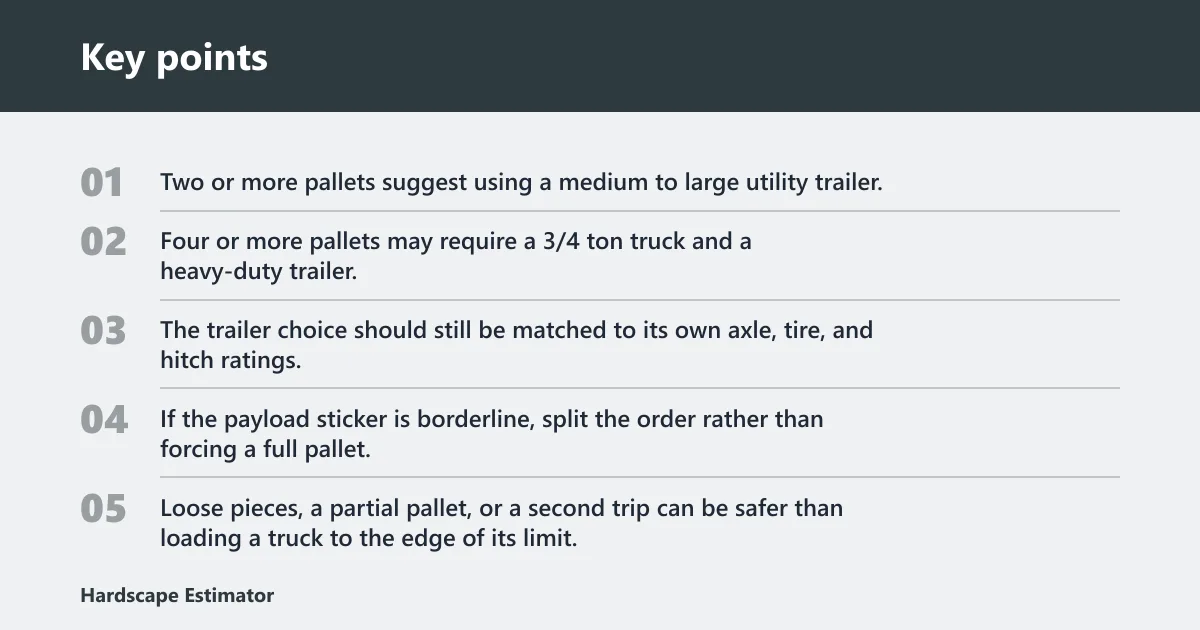
Two or more pallets suggest using a medium to large utility trailer. Four or more pallets may require a 3/4 ton truck and a heavy-duty trailer. The trailer choice should still be matched to its own axle, tire, and hitch ratings.
Use a small trailer only when the combined weight of the sod and trailer stays inside the trailer’s rating and the tow vehicle’s ratings. A heavy-duty trailer is the better choice for larger orders, but the load still needs to be secured and balanced over the axles.
When a forklift offload makes sense
Six or more pallets are usually delivered with commercial and semi-trucks, and those deliveries may use a forklift to offload turfgrass. That is often the cleanest option when the order is too large for a pickup or when the site does not have room for repeated trips.
When to split the order
If the payload sticker is borderline, split the order rather than forcing a full pallet. Loose pieces, a partial pallet, or a second trip can be safer than loading a truck to the edge of its limit. The same is true after rain, when the sod weighs more than expected.
Suppose a pickup has 2,100 lb of payload and the sod yard quotes a pallet near 2,800 lb because the turf is wet. That is a clear no-go for a single run. A split pickup or delivery is the safer path.
Frequently asked questions
Can a pickup truck carry a pallet of sod safely?
Yes, but only if the truck’s payload rating is higher than the pallet weight by a safe margin. Many full pallets weigh 2,000 to 3,000 pounds, which exceeds the payload of many half-ton trucks. If the sticker is close, choose loose pieces, a partial pallet, a trailer, or delivery.
Will a full pallet fit in a pickup bed?
Usually, yes. A standard sod pallet is a four by four ft square pallet, and the average pickup bed is 6 feet or longer. Physical fit does not guarantee safe hauling, though, because the truck still has rear axle, tire, and suspension limits.
How many pallets of sod can a pickup truck carry?
Most pickup trucks hold one pallet at a time. Even then, the truck may not be able to carry a full pallet safely if the payload sticker is too low. Two or more pallets generally point toward a utility trailer, while larger orders are better handled by delivery.
Can a half-ton pickup handle a pallet of sod?
Sometimes, but not always. That means many half-ton trucks cannot carry a full pallet safely, especially if the sod is wet or the truck has passengers aboard.
What payload rating do I need for sod hauling?
You need a payload rating that exceeds the sod weight with room to spare. For a full pallet, that usually means more than the 2,000 to 3,000 pound pallet range, plus allowance for the driver, fuel, and gear. If the sticker is borderline, use a partial load or delivery.
How do I secure sod in the truck bed?
Place the sod over the axle area, keep the weight low and centered, and use rated tie-downs so the load cannot shift. Check tire pressure and tire load rating before leaving. A loose pallet or sloppy stack can move under braking and change rear-axle load fast.
What can happen if I overload my truck with sod?
Overloading can compress the suspension, bottom out the rear of the truck, overload the tires, and make steering and braking less predictable. A wet pallet can make the problem worse. If the load is over the stickered payload, the safer choice is to reduce the load or use delivery.