How to Load a Pickup Truck for Stone or Soil Safely
Load stone or soil so the truck’s total cargo stays under the payload placard, and target no more than 80% of that rating for a safer margin. Overloading a pickup can overload tires, sag the rear axle, and make braking and steering worse fast. This guide shows how to estimate wet and dry material weight, place the load over the axles, secure the bed, and make a simple go/no-go check before you drive.
Pickup payload and axle limits

The door sticker is the starting point. It lists the truck’s payload rating, and that number must cover passengers, tools, fuel reserve, and the material in the bed. It is not the same as GVWR, which is the truck’s maximum allowable total weight with everything aboard.
For pickup hauling, the useful number is remaining payload after people and cargo are subtracted. A truck can also run out of rear-axle or tire capacity before it hits the door-sticker payload number, so both limits matter.
Read the door-sticker payload rating
Start with the yellow payload placard on the driver’s door jamb. Subtract the weight of every passenger, hand tools, straps, buckets, and any other cargo that will ride with the material. Leave a reserve for fuel and small items that often get added later.
Example: if the door sticker lists 1,500 lb of payload, and the cab already carries 400 lb of people and gear, the remaining payload is 1,100 lb before any stone or soil goes in the bed.
Check GVWR, rear-axle limits, and tire load ratings
GVWR is the total truck limit. Rear-axle load and tire load ratings are separate limits, and either one can be the first to fail. A load placed behind the axle can push a larger share onto the rear axle than the payload number alone suggests.
For a practical check, compare the material weight plus passengers against the payload placard, then verify the rear axle will not be overloaded by the way the bed is filled. If axle ratings are not obvious from the sticker package, follow the owner’s manual or the manufacturer’s listing for your model.
Estimate front and rear axle load before you leave
Use a simple balance check. A centered load spreads more evenly; a load pushed rearward puts more weight on the rear axle and can lighten the front end. The front axle should not get so light that steering response changes noticeably.
A practical estimate works like this: if a 1,000 lb load sits mostly behind the axle, assume most of that weight is added to the rear axle. If the same load is centered over or slightly ahead of the axle, the front axle keeps more of its share. The exact split varies by wheelbase and bed placement, so the door sticker and axle ratings still control.
Where the load should sit
Keep the heaviest material centered left to right, low in the bed, and as close to the axle line as the material and tailgate allow. That lowers rollover risk, limits rear squat, and reduces the chance of load shift under braking.
Center heavy material left to right
Put the main pile in the middle of the bed, not against one side. Side loading can create a lean that is easy to miss when the bed is still low. Stone and wet soil both move weight around as the truck turns or stops.
Keep the load low and forward of the tailgate
The tailgate is not the best shelf for dense material. Keep the main mass forward of the tailgate so the load does not hang off the back of the truck and press hard on the gate or latch. Bed length matters here: a short bed reaches its limit sooner, and wheel-well width can force a narrower center pile.
Tailgate load support varies by model and condition. Follow the vehicle manual, never work under a vehicle held only by a jack, never exceed the vehicle’s rated roof/hitch/tow limit, keep items out of airbag zones and the driver’s view, and check local laws.
Use bed length and wheel-well width to avoid overhang
A short-bed pickup may fit the volume of a load before it fits the weight of that load. Bagged stone, loose stone, and topsoil all occupy bed space differently, and wheel wells reduce the usable flat floor. Measure the flat section of the bed, not just the outside bed size.
Suppose a load reaches the top of the wheel wells but still leaves a low mound in the center. That can be fine if the total weight is within payload and the material is contained. If the pile must sit above the rails or hang over the tailgate to fit, reduce the load or choose delivery.
How do you load stone safely?
Load stone in smaller lifts and keep it contained. Loose stone is dense, shift-prone, and easy to overload in a short-bed truck. Bagged stone is easier to count and stack, but it still adds weight fast and can exceed payload before the bed looks full.
Load loose stone in smaller lifts
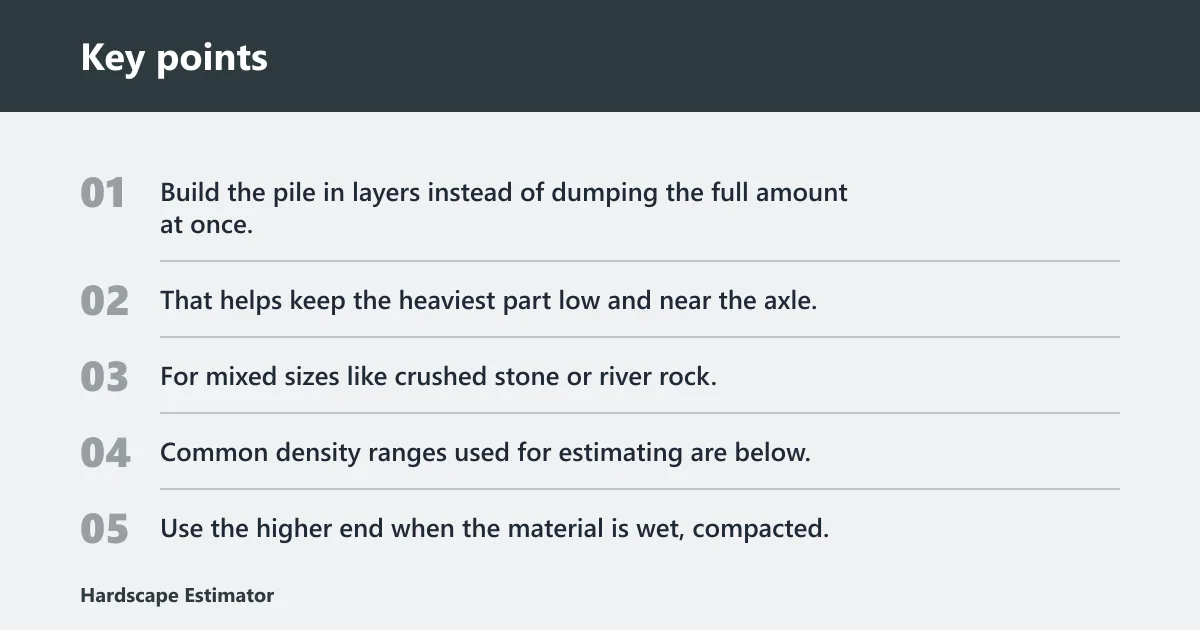
Build the pile in layers instead of dumping the full amount at once. That helps keep the heaviest part low and near the axle. For mixed sizes like crushed stone or river rock, smaller lifts also make it easier to stop before the bed is overfilled.
Common density ranges used for estimating are below. Use the higher end when the material is wet, compacted, or a mix of fines and larger pieces.
| Material | Typical weight per cubic yard | Notes for pickup loading |
|---|---|---|
| Dry topsoil | 1,000–1,200 lb/yd³ | Often lighter when loose, heavier when compacted |
| Wet topsoil | 1,300–1,700 lb/yd³ | Moisture can add a large amount of weight quickly |
| Loose gravel | 2,700–3,000 lb/yd³ | High density; payload runs out fast |
| Crushed stone | 2,700–3,200 lb/yd³ | Use the high end for wet or tightly packed stone |
Example: 0.5 yd³ of crushed stone at 2,900 lb/yd³ weighs about 1,450 lb. That already exceeds a 1,100 lb remaining payload figure, before straps, tools, or passengers are counted.
Block or contain stone so it cannot roll
Use blocking, side boards, or a tarp liner to keep loose stone from shifting. Stone can move toward the tailgate or one corner during braking, which changes axle load and can damage the bed. A bed liner or tarp liner also helps with cleanup.
A common first-timer mistake is filling the bed with loose stone to the rail height and assuming the trip is fine because the pile looks neat. The better test is weight first, then containment, then placement.
Can I haul pavers or stone in a pickup truck bed?
Yes, if the weight and size fit the truck’s limits. Pavers are dense, flat, and easy to stack, but they can exceed payload before the bed looks crowded. Use the pallet weight or bag count, then compare that number to the remaining payload and rear-axle capacity.
Keep pavers centered and low, and do not let a stack rest partly on the tailgate unless the manual and the load layout allow it. If the stack is taller than the side rails or needs fork handling to reach the bed safely, delivery or a trailer is the better choice.
How do you load topsoil in a pickup truck safely?
Topsoil should be treated as a variable-weight load, not a fixed one. Dry soil can be manageable, but wet soil can gain a lot of weight and slump during transit. A truck that is fine for dry topsoil may be overloaded by the same volume after rain.
Estimate wet weight before you load
Estimate by cubic yard, then use the wet range if the soil is damp or recently dug. For example, 1.0 yd³ of wet topsoil at about 1,500 lb/yd³ weighs about 1,500 lb. That can exceed the payload of many half-ton trucks once passengers are included.
Moisture is the common overload trap. Soil can look like the same pile size as dry topsoil, yet weigh several hundred pounds more per yard because water fills the voids between particles.
Tarp or line the bed to reduce spill
Use a tarp, liner, or bed liner so loose soil does not spill through the gate gap or corner seams. Secure the tarp so wind does not lift it into the driver’s view. Keep the cover clear of lights, mirrors, and airbag zones.
For small loads, a liner helps cleanup and keeps fines from packing into the bed floor. For larger loads, the tarp also gives some containment if the load settles on the drive.
Watch for slump and water-related weight gain
Soil can slump toward the tailgate as the truck moves. That shift is a load-balance problem, not just a cleanup problem. If the truck bed starts to look packed at the rear after a short drive around the yard, the load is too loose or too wet for the pickup.
Stone and soil loading checklist
This checklist is for the load decision itself. It keeps payload math, bed placement, and securement in one place before the truck leaves the yard.
| Section | Checklist item | What to check |
|---|---|---|
| 1. Payload calculation | Door sticker | Read payload rating from the driver-door placard |
| 1. Payload calculation | Subtract people and gear | Remove passenger weight, tools, and fuel reserve from remaining capacity |
| 1. Payload calculation | Compare to material weight | Use cubic yards, bag count, or pallet weight to estimate load |
| 2. Bed-loading sequence | Stone | Load in small lifts, keep low, block loose edges, avoid tailgate overhang |
| 2. Bed-loading sequence | Soil | Estimate wet weight, line the bed, tarp the load, watch for slump |
| 2. Bed-loading sequence | Mixed loads | Keep heavy material centered and stop if the bed starts to bias rearward |
| 3. Red flags | Axle squat | Rear suspension drops hard, but do not use squat alone as the safety test |
| 3. Red flags | Tire loading | Sidewall bulge, hot tires, or a tire near its rated limit |
| 3. Red flags | Control changes | Steering feels light, braking lengthens, or the truck leans on corners |
| 4. Stop rules | Switch to trailer or delivery | Stop when payload, axle, tire, or containment limits are reached |
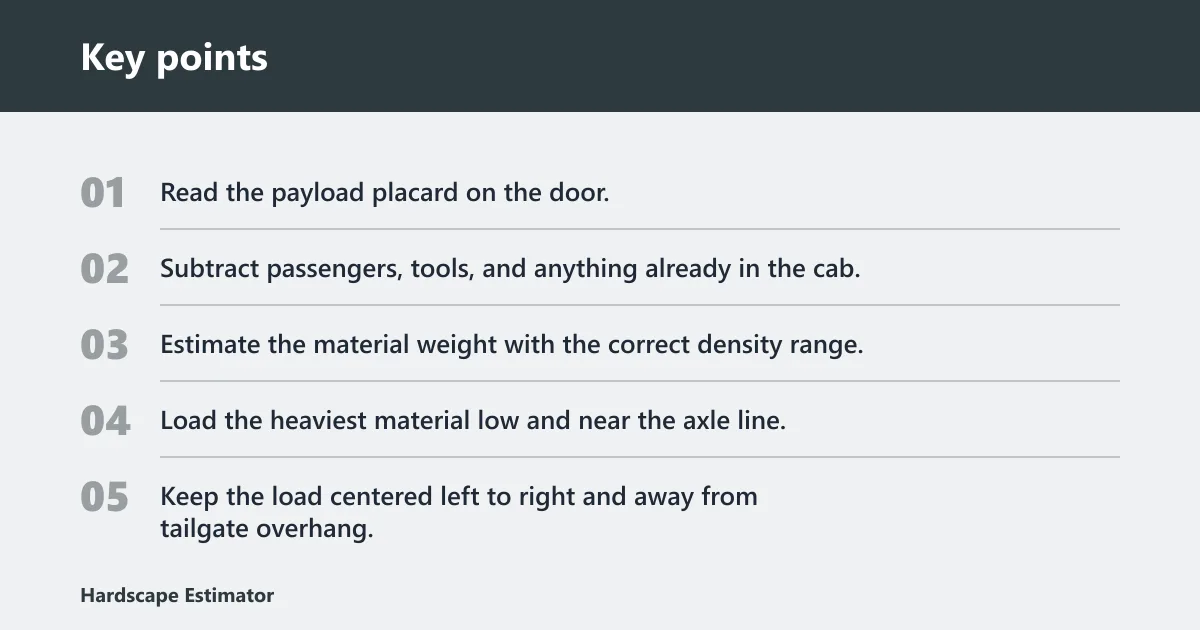
- Read the payload placard on the door.
- Subtract passengers, tools, and anything already in the cab.
- Estimate the material weight with the correct density range.
- Load the heaviest material low and near the axle line.
- Keep the load centered left to right and away from tailgate overhang.
- Secure loose stone or soil with tarp, liner, straps, or blocking.
- Confirm the rear axle and tires are still within rating.
- Stop and switch to a trailer or delivery if any limit is exceeded.
Here is the go/no-go rule: if the estimated load plus passengers is over the remaining payload, do not load it. If the load fits payload but threatens axle, tire, or containment limits, reduce the load or stop. A truck that looks “close enough” can still be over limit before the rear end visibly sags.
What should you check before driving?
Before leaving, check the rear suspension, tire sidewalls, steering feel, braking response, visibility, and securement. A visual squat is a warning sign, but it is not a load test. The real check is weight math plus bed placement plus securement.
Check rear-suspension squat and tire sidewall bulge
Look for major rear-end drop, tire bulge, and uneven lean. Those signs suggest the truck is carrying too much weight or the load is too far rearward. Still, a truck can be overloaded even if the squat is not dramatic.
Check steering, braking, and visibility changes
If the front end feels light, steering response may change. If braking takes longer or the truck noses forward more than expected, the load may be too far rearward or too heavy. Make sure the load does not block the driver’s view or sit in an airbag zone.
Check route limits and securement before leaving
Confirm road restrictions, bridge or weight limits, and any local rules for uncovered loads. Use straps, chains, or blocking as needed for the material and truck setup. Follow the vehicle manual, never work under a vehicle held only by a jack, never exceed the vehicle’s rated roof/hitch/tow limit, keep items out of airbag zones and the driver’s view, and check local laws.
How do you unload dirt from a pickup truck safely?
Park where the truck can be unloaded without backing into a slope, ditch, or traffic lane. Keep the tailgate protected, unload in small sections, and use a shovel or wheelbarrow instead of throwing material off the bed in a single rush. The safest order is to remove the top and rear material first, then work forward.
For stone, open the load at the rear and let it flow under control into a wheelbarrow or onto a tarp, not onto the tailgate edge. For soil, break up compacted lumps first so the weight does not surge out all at once. If the material must be offloaded by hand, keep feet clear of the tailgate and avoid twisting under a full shovel.
If the site is tight, set the truck so the shovel path is short and level. That reduces lifting distance and helps keep the load from spilling beyond the target area. If the material cannot be unloaded without risking tailgate damage, hand strain, or a long carry, a trailer or dump delivery is safer.
Frequently asked questions
How much can a pickup truck carry before it becomes unsafe?
A pickup becomes unsafe when the total of passengers, cargo, and material exceeds the payload placard, or when the rear axle or tires are overloaded. A common safer working target is no more than about 80% of payload. For exact limits, use the door sticker and the owner’s manual for your model.
Do I need to secure stone or dirt with straps or a tarp?
Yes, loose stone and soil should be contained so they do not shift, spill, or block the driver’s view. A tarp, liner, straps, chains, or blocking may be needed depending on the load shape and size. Securement matters even on short trips because braking can move the load rearward.
Where should the heaviest material sit in the truck bed?
The heaviest material should sit low and centered, with the main mass near the axle line rather than at the tailgate. That placement helps control rear-axle loading and keeps steering more stable. Left-to-right balance matters too, especially with loose stone or wet soil that can slide.
What kind of pickup truck is best for hauling soil or stone?
A truck with the highest payload rating, a bed long enough for the load, and enough rear-axle capacity is the better choice. Bed length and wheelbase matter as much as the badge on the tailgate. Check the door sticker and the owner’s manual instead of assuming a half-ton, three-quarter-ton, or one-ton truck will fit every load.
How do I get loads for pickup trucks?
For pickup hauling, the practical answer is to size the load to the truck, not to the bed shape. Ask for the material’s weight per cubic yard, bag count, or pallet weight before you accept the job. If the numbers are missing, treat the load as uncertain and do not guess.
When is a trailer safer than using a pickup truck?
A trailer is safer when the load would exceed payload, rear-axle capacity, tire ratings, or the bed’s practical containment limit. It is also the better choice when the material is wet, dense, or too tall to keep below the rails. If the math is close, stop and switch.