Polymeric Sand vs Regular Sand for Pavers: Which Is Better?
Polymeric sand is often a better fit for paved patios and driveways when joints are about 1/8 to 1/4 in. and the goal is to reduce washout and weed growth; regular sand is often a better fit for wider joints, permeable builds, or lower-maintenance budgets. Pick the wrong filler and you get joint loss, staining, hard-to-fix haze, or constant topping up. This guide compares joint width, drainage, traffic, and upkeep so you can match the filler to the job.
| Decision factor | Polymeric sand | regular sand | Winner |
|---|---|---|---|
| Joint lockup | Hardens after water activation and ties the top of the joint together. | Stays loose and moves with vibration, brushing, and runoff. | Polymeric sand |
| Joint width fit | Best in narrow, uniform joints; wide joints can be hard to fill evenly. | More forgiving in wider joints, though very wide joints may still need a specialty filler. | regular sand |
| Washout and erosion resistance | Better on patios, driveways, and slopes when installed and cured correctly. | More likely to wash out on runoff paths and at edges. | Polymeric sand |
| Weed and ant resistance | Harder for seeds and insects to move through when joints stay intact. | More open and easier for weed seeds, ants, and debris to occupy. | Polymeric sand |
| Repairability | Harder to remove during future repairs or settlement fixes. | Easy to rake out, top off, or replace after movement. | regular sand |
| Lifecycle cost | Higher bag price, but fewer re-sands and less cleanup over time. | Lower upfront cost, but more frequent top-offs and maintenance. | Depends on project |
How each filler works
Polymeric sand is a joint filler blended with polymers that hardens after water activation. Regular sand is an unbound joint filler that stays loose. Both belong in the paver joints, not in the base or bedding layer.
Polymeric sand
Most manufacturers package it as a joint sand with a polymer binder that activates with careful watering. It is made for paver joints, then cured so the top of the joint resists washout, weeds, and ant activity better than loose sand. Manufacturer instructions matter here because joint-width range, cure time, and weather limits vary by product.
Best for: narrow, uniform joints; patios, walkways, and driveways that need more lockup; projects where weeds and washout are a concern. Avoid if: the joint layout is uneven, the surface may get rain during cure, or the system needs open drainage.
-
Clean the joints fully.
Sweep and blow out dust, leaves, and crusted residue so the binder contacts the sand grains instead of debris. Residue left in the joint weakens lockup and can leave a hazy film on the paver face. -
Fill the joints dry.
Sweep the material into the joints until they are packed to the manufacturer’s stated depth, then remove all sand from the surface. Surface residue is the main cause of haze after activation. -
Activate with light water.
Mist the surface in controlled passes, then let the water soak in. Overwatering can float binder out of the joint; under-watering can leave the top loose and weak. Weather limits on the bag matter because rain or wind can ruin the set. -
Protect the cure.
Keep foot traffic, cleaning, and rainfall off the surface for the cure period listed on the bag, often about 24 hours or more. Rain during cure can disturb the joint face and shorten the lockup.
Regular sand
Regular sand stays loose after installation. That makes it simple to place, easy to refresh, and easy to remove if the pavers need to be lifted or reset later. It does not harden, so it depends more on proper compaction, edge restraint, and occasional top-offs.
Best for: wider joints, permeable builds, and projects where the pavers may be moved later. Avoid if: the area gets strong runoff, steep slope, or heavy tire traffic and the owner wants to minimize upkeep.
Because it remains unbound, it is more prone to washout on slopes, at drip lines, and where traffic or sweeping moves the top layer. It is also the easier choice when a permeable joint system needs open flow through the joints.
Quick side-by-side comparison
Polymeric sand gives better joint stability and lower upkeep when the project calls for a tighter, more locked surface. Regular sand wins when the joints need to stay open, the pavers may be moved later, or the owner wants the cheapest first cost.
For example, a 300 sq ft patio with 1/8 in. joints and a compacted base with a standard bedding layer is often a reasonable candidate for polymeric sand. Polymeric sand is usually the better fit because the joints are narrow and the surface is meant to stay fixed. If the same patio is built as a permeable system, regular sand or a permeable-rated jointing material is the safer technical choice.
Which joints can each filler handle?
Polymeric sand is usually the better fit for narrow, uniform joints. Regular sand is more forgiving in wider joints and in projects where the joints may need to be opened, reworked, or drained. Very wide joints often call for a specialty product rather than either standard option.
Narrow joints and standard pavers
For joints around 1/8 to 1/4 in., polymeric sand is usually a cleaner match because it packs tightly and can help lock the paver edges together. Standard concrete pavers with consistent joint lines benefit most from that added cohesion.
Best for: standard concrete pavers, tight and consistent joints, and projects where the face should stay stable. Avoid if: the joints vary a lot in width or the installation needs open flow through the joints.
Wide joints and special cases
Wide joints are harder to stabilize with any sand because the filler has more room to settle and erode. Regular sand is easier to place in these openings, but if the joint is much wider than typical paver spacing, a specialty jointing material may be a better technical choice than either standard sand.
A common first-timer mistake is assuming extra polymeric sand will solve a wide joint. It usually does not. Too much void depth makes curing less reliable, and the top can break apart if water or settlement keeps moving the joint.
Best for: projects that need a product made for larger openings and better bridging. Avoid if: the plan is to overfill standard polymeric sand into a gap that is outside the manufacturer’s range.
Permeable paver systems
Permeable builds need water to pass through the joints, so a hardening filler can work against the drainage plan unless the product is specifically rated for that use. Regular sand is often the better fit when open flow is the main goal and the system is designed around infiltration.
-
Match the system spec.
Check whether the paver assembly calls for open-joint drainage, filtered infiltration, or a locked surface. The joint filler has to support the base design, not fight it. -
Choose the right grain size.
Use a product that matches the joint width and the manufacturer’s installation instructions. Grain size affects how tightly the joint packs and how much void space remains after compaction. -
Do not mix functions.
Keep joint filler out of the bedding layer and base. The bedding layer supports leveling; the joint filler fills the top joints and should not be used to correct grade errors.
How do traffic and weather change the choice?
Traffic and weather push the decision in opposite directions. More traffic favors polymeric sand because it helps resist joint movement. More drainage, runoff, freeze-thaw cycling, or slope exposure can also favor polymeric sand, but only if the installation is dry enough and the joints are cleaned well before activation.
Patios and walkways
For patios and walkways, polymeric sand is usually the stronger default when the owner wants lower maintenance and better joint stability. Regular sand can still work when the area is shaded, lightly used, or expected to be changed later.
If the walkway has leaf litter, sprinklers, or edges that catch runoff, the loose filler will usually need more top-offs. That maintenance burden is the main tradeoff, not the bag price.
Driveways and higher load areas
Driveways generally favor polymeric sand because tires, turning, and vibration put more stress on the joints. A tighter locked joint helps keep the top course from shedding sand at the edges and wheel paths.
Regular sand can still be used, but it is more likely to lose material from repeated tire movement and snow clearing. That means more frequent re-sanding and more visible joint loss over time.
Slopes, runoff, and freeze-thaw exposure
Sloped surfaces and runoff paths are where polymeric sand usually earns its keep. Loose sand can migrate downhill, especially where water sheets across the pavers after storms. Freeze-thaw cycling can widen any soft joint and speed that loss.
Polymeric sand is not immune to failure. If the base settles, the pavers move, or rain hits the surface during cure, the joint can crack or wash out at the top. The product reduces erosion risk; it does not erase installation errors.
Does polymeric sand stop weeds and ants better?
Yes, but not perfectly. Polymeric sand usually resists weeds and ant intrusion better than regular sand because the cured joint is harder to dig through and less welcoming to windblown seed. It is a resistance benefit, not a guarantee.
Weed growth and ant intrusion
Weeds often start where dust, soil, or decomposed debris fills the top of the joint. A hardening filler leaves less loose material for seeds to root in, so the joint stays cleaner longer. Ants also have a harder time moving loose grains when the top of the joint is bonded.
That said, weeds can still appear from airborne seeds, soil in the joints, or edges that were never fully filled. If the base or edge restraint is poor, the joints will still be vulnerable.
Repairability after settlement
Regular sand wins when a project may settle or need future repairs. It is easier to rake out, clean, and replace after pavers are lifted or reset. Polymeric sand can bridge small movement, but once it hardens, repairs take more time and care.
Suppose a driveway section settles 1/4 in. after a utility cut. Regular sand lets the repair crew lift the units and re-joint them quickly. Polymeric sand can still be repaired, but the hardened material must be removed first or the new fill will not seat correctly.
Re-sanding frequency
Regular sand usually needs more frequent top-offs, especially after the first season, because wind, sweeping, rain, and foot traffic move the loose material. Polymeric sand lowers that re-sanding cycle when it is installed correctly and protected during cure.
The lifecycle difference matters. A cheaper bag that needs repeated replenishment can cost more in labor and cleanup than a pricier bag that stays put longer.
What does each option cost over time?
Regular sand has the lower upfront price. Polymeric sand costs more per bag, but the installed cost can narrow once you count cleanup time, repeat topping, and less frequent maintenance visits. The right answer depends on the project size and how much upkeep the owner accepts.
Bag price and coverage
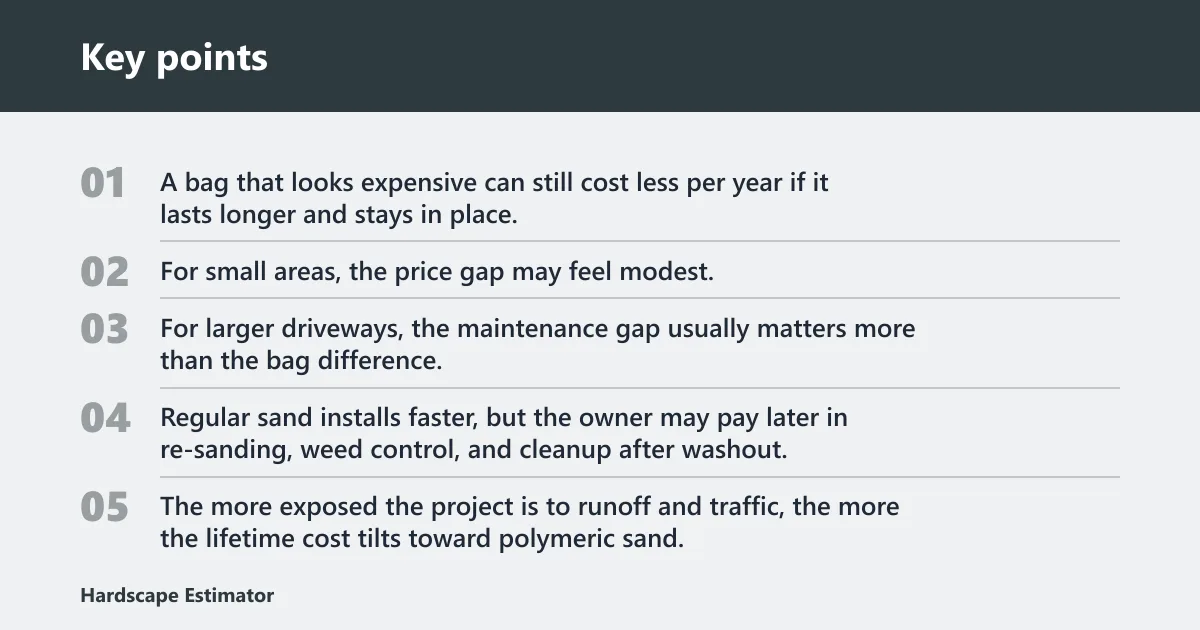
Bag coverage varies by joint width, paver size, and how full the joints are, so the installed price is more useful than the sticker price alone. A bag that looks expensive can still cost less per year if it lasts longer and stays in place.
For small areas, the price gap may feel modest. For larger driveways, the maintenance gap usually matters more than the bag difference.
Installed cost versus upkeep
Polymeric sand often costs more to install because it needs careful surface cleaning, controlled watering, and cure protection. Regular sand installs faster, but the owner may pay later in re-sanding, weed control, and cleanup after washout.
The more exposed the project is to runoff and traffic, the more the lifetime cost tilts toward polymeric sand. In low-traffic areas with easy access, regular sand can still be the cheaper long-term choice.
Cleanup time and replacement cycles
Polymeric sand can create haze if residue is left on the paver face or if the surface is overwatered. That cleanup takes time. Regular sand avoids curing haze, but it can require more sweeping and more frequent joint top-offs after storms or seasonal movement.
Paver sand decision matrix
This scorecard uses a simple 1 to 5 scale, where 5 is better for the factor listed. The project pick follows the strongest fit across joint width, slope, traffic, weed control, repairability, and lifecycle cost.
| Project type | Joint width | Slope/runoff | Traffic load | Weed control | Repairability | Lifecycle cost | Recommended choice |
|---|---|---|---|---|---|---|---|
| Patio | Polymeric sand 5 / regular sand 3 | Polymeric sand 4 / regular sand 2 | Polymeric sand 4 / regular sand 3 | Polymeric sand 5 / regular sand 2 | Polymeric sand 2 / regular sand 5 | Polymeric sand 4 / regular sand 3 | Polymeric sand |
| Walkway | Polymeric sand 5 / regular sand 3 | Polymeric sand 4 / regular sand 2 | Polymeric sand 3 / regular sand 3 | Polymeric sand 5 / regular sand 2 | Polymeric sand 2 / regular sand 5 | Polymeric sand 4 / regular sand 3 | Polymeric sand |
| Driveway | Polymeric sand 5 / regular sand 3 | Polymeric sand 4 / regular sand 2 | Polymeric sand 5 / regular sand 2 | Polymeric sand 5 / regular sand 2 | Polymeric sand 2 / regular sand 5 | Polymeric sand 4 / regular sand 2 | Polymeric sand |
| Pool deck | Polymeric sand 4 / regular sand 4 | Polymeric sand 3 / regular sand 3 | Polymeric sand 3 / regular sand 3 | Polymeric sand 4 / regular sand 2 | Polymeric sand 2 / regular sand 5 | Polymeric sand 3 / regular sand 4 | Polymeric sand |
| Permeable paver system | Polymeric sand 2 / regular sand 5 | Polymeric sand 2 / regular sand 5 | Polymeric sand 3 / regular sand 3 | Polymeric sand 3 / regular sand 3 | Polymeric sand 2 / regular sand 5 | Polymeric sand 3 / regular sand 4 | regular sand |
Polymeric sand vs regular sand scorecard
Polymeric sand wins the locked-surface categories because it performs better where washout, weeds, and traffic matter most. Regular sand wins repairability and permeable-system fit because it stays open, can be removed easily, and does not fight drainage.
The matrix also shows why the cheapest bag is not always the cheapest job. A project that needs repeated re-sanding, edge cleanup, or washout repair can cost more over time than a project that uses the more expensive filler once.
Recommended choice by project type
For patios, walkways, driveways, and most pool decks, polymeric sand is the better choice when the joints are standard width and the installation can be kept dry through cure. For permeable paver systems, regular sand is generally the better fit when the design depends on open flow through the joints.
Choose Polymeric sand if… / Choose regular sand if…
Choose Polymeric sand if the joints are about 1/8 to 1/4 in., the surface sees moderate to heavy foot or vehicle traffic, runoff is a concern, and the goal is to cut down on weeds, ants, and joint loss. It is also the better fit when the owner accepts a careful install in exchange for lower upkeep.
Choose regular sand if the joints are wider, the paver system needs open drainage, the installation may be changed later, or the budget prioritizes low upfront cost over maintenance. It is also the better technical choice when easy removal and re-leveling matter more than a locked joint.
Frequently asked questions
Is polymeric sand better than regular sand for pavers?
Polymeric sand is better for most standard patios, walkways, and driveways because it hardens after water activation and resists washout, weeds, and ant activity better than loose sand. Regular sand is the better choice when joints are wider, the system is permeable, or future removal matters more than lockup.
When should I use regular sand instead of polymeric sand?
Use regular sand when the pavers are part of a permeable system, when joints are wider than a standard narrow joint, or when you want the easiest possible future repair. It is also sensible for temporary installs and other areas where reworking the surface later is likely.
Does polymeric sand last longer than regular sand in paver joints?
Usually yes. Polymeric sand tends to last longer because it binds the top of the joint and resists washout, while regular sand stays loose and needs more frequent top-offs. The gap is biggest on slopes, in drainage paths, and in areas with repeated traffic or sweeping.
Can I use polymeric sand in all paver joints?
No. Polymeric sand is not the best fit for every joint width or every paver system. Very wide joints can be hard to fill and cure evenly, and permeable systems often need a filler that keeps water moving through the joint instead of locking it down.
What happens if I use regular sand in a driveway or patio?
You will usually get lower upfront cost, but also more washout, more joint loss, and more frequent re-sanding. On a driveway, tire traffic can move the sand faster. On a patio, wind, rain, and cleaning can slowly pull the joints down and invite weeds.
Can I install polymeric sand over existing regular sand?
Only after the old sand is removed from the top portion of the joint and the joints are cleaned to the depth required by the product. New polymeric sand will not bond well over loose residue. If the old joint is contaminated or uneven, a full cleanup is safer.
Is polymeric sand worth the extra cost?
Often yes for small patios and higher-wear driveways, because the added bag cost can be offset by fewer top-offs, less washout, and less weed cleanup. For low-traffic areas, regular sand may stay cheaper overall if the owner accepts routine maintenance and periodic re-sanding.